
EU AI Act Enters High-Risk Enforcement Phase: What the August 2026 Deadline Mandates
On August 2, 2026, the European Union's AI Act transitions from theoretical guidance to active enforcement for high-risk systems, introducing strict compliance mandates and fines up to 7% of global turnover.
By Factlen Editorial Team
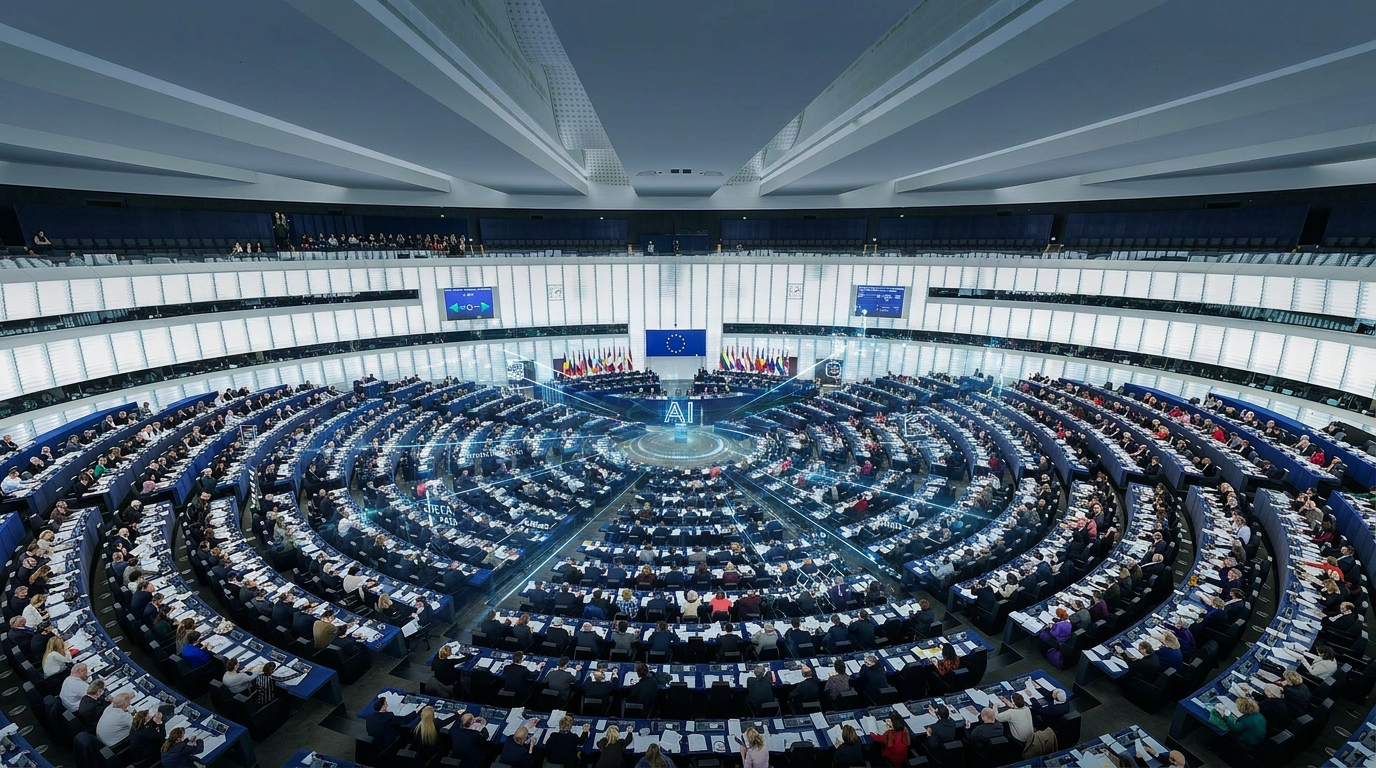
- EU Policymakers
- Argue strict enforcement is necessary to protect fundamental rights and ensure AI safety.
- Enterprise Compliance
- Focus on the immense operational costs, technical hurdles, and legal ambiguities of the mandates.
- Global AI Strategists
- Analyze the geopolitical impact and how the rules will force global architectural standardization.
What's not represented
- · Small and Medium Enterprises (SMEs) who may be priced out of the EU market due to compliance costs.
- · End-users and citizens whose data and rights the Act is designed to protect.
Why this matters
This marks the first time global enterprises face binding, audited legal requirements for how their AI models operate, log data, and resist adversarial attacks, effectively setting a new global baseline for AI architecture.
Key points
- The EU AI Act's core mandates for high-risk AI systems become legally enforceable on August 2, 2026.
- Violations involving prohibited AI practices can incur fines of up to €35 million or 7% of global annual turnover.
- High-risk systems must now feature tamper-evident logging, human oversight mechanisms, and robust cybersecurity at the action layer.
- A recent 'Digital Omnibus' amendment granted a four-month grace period for generative AI watermarking and delayed rules for embedded physical products until 2028.
- The law applies extraterritorially to any company whose AI system outputs are utilized within the European Union.
On August 2, 2026, the global artificial intelligence industry will cross a regulatory point of no return. Two years after the European Union's AI Act officially entered into force, the legislation is transitioning from a theoretical framework into an active enforcement regime. For enterprises deploying AI within the EU, the era of voluntary guidelines and self-attested safety pledges is ending. In its place comes a binding legal structure that mandates strict architectural, security, and transparency standards for any system deemed "high-risk."[1][2]
The stakes for non-compliance are unprecedented in technology regulation, surpassing even the General Data Protection Regulation (GDPR). Organizations found deploying prohibited AI practices face maximum fines of €35 million or 7% of their global annual turnover, whichever is higher. Breaches of the high-risk system requirements carry penalties of up to €15 million or 3% of global turnover. Because the law applies extraterritorially to any provider whose AI outputs are used within the EU, these penalties extend far beyond European borders, capturing American and Asian developers alike.[4][5]
The August 2026 deadline specifically activates the core obligations for high-risk AI systems—those used in critical infrastructure, employment, credit scoring, law enforcement, and essential private services. While prohibited practices (such as social scoring and untargeted facial recognition scraping) were banned in early 2025, the new phase requires companies to prove their systems are safe, resilient, and transparent before and during their deployment.[1][5]

At the technical level, compliance requires fundamental changes to how AI systems are built and monitored. Under Article 15 of the Act, high-risk systems must be resilient against adversarial attacks across their entire "action layer." This means security teams can no longer just secure the model's weights or text outputs; they must secure every API call, agentic action, and external server connection the AI makes. If an AI agent is manipulated via prompt injection into executing an unauthorized financial transaction, the deployer is legally liable for failing to implement adequate cybersecurity resilience.[4]
Traceability is another major pillar of the incoming enforcement. Article 12 mandates that high-risk systems automatically generate tamper-evident logs that enable continuous risk identification. These logs must be retained for a minimum of six months for standard high-risk systems, and up to 24 months for biometric identification and law enforcement applications. For large enterprises processing millions of AI inferences daily, building the infrastructure to securely store and audit these logs represents a massive operational and financial undertaking.[4][8]
Transparency obligations also take full effect this August. Under Article 50, providers of AI systems that interact directly with humans or generate synthetic audio, image, video, or text content must clearly disclose that the content is AI-generated. This includes mandatory watermarking and labeling for deepfakes and synthetic media published on matters of public interest.[2][3]
However, the legislative landscape has seen recent adjustments to prevent market collapse. In May 2026, the EU Council and Parliament reached a provisional agreement on the "Digital Omnibus" package, a set of targeted amendments designed to streamline the AI Act's implementation. Recognizing that the necessary testing infrastructure and harmonized standards were not fully ready, regulators introduced critical grace periods.[2][3]
However, the legislative landscape has seen recent adjustments to prevent market collapse.
Under the Omnibus adjustments, generative AI systems already on the market before August 2, 2026, receive a four-month grace period to comply with the Article 50 watermarking obligations, pushing their deadline to December 2, 2026. Furthermore, the compliance deadlines for high-risk AI systems embedded into regulated physical products—such as medical devices, toys, and agricultural machinery—have been postponed to August 2028, giving traditional manufacturers more time to adapt.[1][3]

Despite these extensions for physical goods, the August 2026 deadline remains absolute for standalone software and general-purpose AI models used in high-risk contexts. The European Commission's AI Office, established to centralize oversight of general-purpose models, will now wield its full investigative and enforcement powers. This includes the authority to request technical documentation, conduct model evaluations, and demand market restriction or withdrawal of non-compliant systems.[1][2]
Enforcement on the ground will be handled by national Market Surveillance Authorities (MSAs) appointed by each EU Member State. These MSAs have the power to audit organizations, investigate whistleblower complaints, and levy the multi-million euro fines. However, legal experts note that the designation and funding of these national authorities have been slower than anticipated, raising questions about how consistently the rules will be enforced across different EU countries in the initial months.[5]
A critical, yet often overlooked, component of the August enforcement is the mandate for "AI literacy." The Act requires organizations to ensure that their staff possess a sufficient understanding of how AI systems operate, where they can fail, and how human oversight must be applied. Compliance is not merely about technical guardrails; it requires demonstrable proof that human operators are trained to intervene when an AI system behaves erratically.[6][8]
The ambiguity of certain provisions continues to cause anxiety among compliance teams. For instance, the Act requires a new conformity assessment whenever a high-risk system undergoes a "significant change." In the context of continuously learning AI models or frequent software updates, defining what constitutes a "significant change" remains legally murky. While the Commission published draft guidelines in May 2026 to clarify classification, many enterprises feel they are flying blind into a strict liability regime.[3][8]

To mitigate this uncertainty, Article 57 of the Act requires every EU Member State to establish at least one AI regulatory sandbox by August 2, 2026. These sandboxes provide controlled environments where companies can test innovative AI systems under regulatory supervision before bringing them to market, theoretically reducing the risk of accidental non-compliance.[5]
The global ripple effects of the August deadline are already visible. Because the EU AI Act applies to any system whose output is used in Europe, major US and Chinese AI developers are being forced to adapt their global architectures to meet European standards. This phenomenon, known as the "Brussels Effect," mirrors the global adoption of GDPR privacy standards a decade ago.[7][8]
As the deadline approaches, the enterprise software market is seeing a surge in "AI governance" tools designed to automate compliance. Companies are scrambling to implement continuous risk management systems (Article 9), data governance protocols (Article 10), and automated technical documentation pipelines (Article 11) to satisfy auditors.[4][6]
Ultimately, the August 2026 enforcement marks the end of the "move fast and break things" era for artificial intelligence in the enterprise. By forcing companies to treat AI with the same rigorous safety and quality controls applied to aviation or pharmaceuticals, the European Union is betting that strict regulation will foster long-term public trust, even if it imposes heavy short-term friction on innovation.[1][8]
How we got here
August 1, 2024
The EU AI Act officially entered into force, beginning the phased implementation period.
February 2, 2025
Provisions banning 'unacceptable risk' AI practices and mandating AI literacy became fully enforceable.
May 2026
The EU provisionally agreed on the 'Digital Omnibus' amendments, adjusting timelines for certain embedded AI products.
August 2, 2026
The core compliance mandates for standalone high-risk AI systems and transparency obligations take full legal effect.
August 2, 2028
The delayed enforcement deadline for high-risk AI systems embedded into regulated physical products, such as medical devices.
Viewpoints in depth
European Regulators
Emphasizes the protection of fundamental rights and the necessity of human-centric AI.
EU policymakers argue that the August 2026 enforcement is essential to prevent AI from becoming a "wild west" of unchecked corporate power. They maintain that the heavy compliance burden is a necessary trade-off to ensure that high-risk systems—such as those deciding loan approvals, hiring outcomes, or biometric identification—do not encode bias or threaten citizen safety. The establishment of the AI Office and national Market Surveillance Authorities is viewed as the bedrock of a trustworthy digital single market.
Enterprise Compliance & Security Teams
Focuses on the operational friction, high costs, and technical ambiguities of the new mandates.
For the teams tasked with implementing the law, the August deadline represents a monumental operational hurdle. Security professionals point out that securing the "action layer" of autonomous AI agents (Article 15) is a novel computer science problem, not just a policy checklist. Furthermore, legal teams express deep concern over the vague definition of a "significant change" to a model, fearing that routine software updates could trigger mandatory re-assessments and halt product deployments.
Global AI Developers
Views the legislation through the lens of international competitiveness and the "Brussels Effect."
International tech companies and open-source advocates are divided on the Act's global impact. Some argue that the strict logging, watermarking, and risk-management requirements will force a global standardization of AI safety, as companies will build one compliant model for the world rather than fragmenting their architecture. Others warn that the sheer cost of compliance—and the threat of 7% global turnover fines—will cause frontier AI labs to geoblock their most advanced systems from the European market entirely, widening a transatlantic technology gap.
What we don't know
- How strictly national Market Surveillance Authorities will enforce the rules in the immediate aftermath of the August deadline.
- The exact legal threshold for what constitutes a 'significant change' to an AI model, which would trigger a mandatory re-assessment.
- Whether the high costs of compliance will cause major international AI developers to delay or restrict their model releases in the European market.
Key terms
- High-Risk AI System
- An AI system whose failure or misuse poses a significant threat to health, safety, or fundamental rights, triggering strict compliance obligations under the EU AI Act.
- Action Layer
- The interfaces and APIs through which an AI model interacts with external software, executes commands, or retrieves data, which must be secured against adversarial attacks.
- Digital Omnibus
- A May 2026 legislative package that introduced targeted amendments to the EU AI Act, streamlining implementation and delaying certain deadlines for embedded physical products.
- Brussels Effect
- The phenomenon where the European Union's regulations effectively become global standards because multinational companies find it easier to comply globally rather than build separate systems for different regions.
Frequently asked
Does the EU AI Act apply to companies based outside of Europe?
Yes. The Act applies extraterritorially to any provider or deployer whose AI system outputs are used within the European Union, regardless of where the company is headquartered.
What happens if an AI system was already on the market before August 2026?
Generative AI systems already on the market receive a four-month grace period (until December 2, 2026) to comply with transparency and watermarking rules. High-risk systems embedded in physical products have until August 2028.
What is a 'high-risk' AI system under the Act?
High-risk systems include AI used in critical infrastructure, educational admissions, employment and hiring, essential private or public services (like credit scoring), law enforcement, and border control.
Are all AI systems subject to these strict rules?
No. The Act uses a tiered risk framework. Systems posing 'minimal risk' (like spam filters or AI in video games) face no mandatory obligations, while those posing 'transparency risk' (like chatbots) only require clear labeling.
Sources
Source coverage
8 outlets
3 viewpoints surfaced








[1]European CommissionEU Policymakers
AI Act | Shaping Europe's digital future
Read on European Commission →[2]Travers SmithEnterprise Compliance
The EU AI Act – the current state of play
Read on Travers Smith →[3]StibbeEnterprise Compliance
AI Act reloaded? What the latest AI Act changes mean in practice
Read on Stibbe →[4]Salt SecurityEnterprise Compliance
EU AI Act Compliance 2026: What High-risk AI Systems Must Do Now
Read on Salt Security →[5]DLA PiperEnterprise Compliance
Enforcement / fines in the European Union - AI Laws of the World
Read on DLA Piper →[6]Compliance & RisksEnterprise Compliance
AI Rules Are Changing: Key Regulatory Updates for 2025 & 2026
Read on Compliance & Risks →[7]Partnership on AIGlobal AI Strategists
Six AI Governance Priorities for 2026
Read on Partnership on AI →[8]Factlen Editorial TeamGlobal AI Strategists
Synthesis by Factlen editorial team
Read on Factlen Editorial Team →

More in ai
See all 5 stories →On-Device AI
How Local AI Replaced the Cloud: Running Frontier Models on Your Laptop
0 sources

Enterprise AI
The Rise of Small Language Models: How Enterprises Are Running AI Locally in 2026
0 sources

Drug Discovery
New AI Model Accelerates Molecular Simulations 10,000-Fold, Slashing Drug Discovery Timelines
0 sources

Every angle. Every day.
Get ai stories with full source coverage and perspective breakdowns delivered to your inbox.