
Eco-Theology Explainer: How Major Faiths Are Turning Green
From solar-powered mosques in Jordan to the Vatican's global sustainability platform, religious institutions are increasingly framing climate action as a moral and spiritual duty.
By Factlen Editorial Team
- Faith-Based Climate Leaders
- Religious institutions and advocacy groups framing environmental stewardship as a core spiritual duty.
- Global Policy & Data Analysts
- Secular observers tracking the institutional and demographic impact of religious climate initiatives.
- Frontline Faith Communities
- Local religious groups in developing nations focusing on immediate climate adaptation and resilience.
- Traditionalist Voices
- Factions prioritizing human economic development and expressing caution about secular environmentalism.
What's not represented
- · Secular environmental NGOs skeptical of religious partnerships
- · Fossil fuel industry representatives operating in highly religious regions
Why this matters
With over 80% of the global population identifying with a religion, faith-based climate initiatives have the potential to mobilize billions of people and unlock massive institutional resources for the green transition.
Key points
- Major world religions are increasingly framing climate action and sustainability as core spiritual duties, a movement known as eco-theology.
- Initiatives like the Islamic Green Mosque movement are retrofitting thousands of places of worship with solar panels and water-saving tech.
- The Vatican's Laudato Si' Action Platform tracks and encourages sustainable habits across global Catholic institutions.
- The World Council of Churches has launched a decade-long initiative to integrate climate justice into Protestant and Orthodox theology.
- By leveraging their moral authority and vast institutional assets, faith groups have the potential to significantly accelerate the global green transition.
The climate crisis is often framed in the language of science, policy, and economics—parts per million, carbon taxes, and renewable energy subsidies. But for billions of people around the world, the most compelling argument for environmental action is not coming from a laboratory or a parliament. It is coming from the pulpit, the minaret, and the altar. Across the globe, major world religions are undergoing a profound theological shift, reframing ecological preservation as a core spiritual duty.[1]
This movement, broadly known as "eco-theology," seeks to bridge the gap between ancient scriptures and modern environmental crises. It is not merely a rebranding of secular environmentalism; rather, it is a fundamental re-reading of sacred texts to emphasize humanity's role as stewards of the earth rather than its absolute masters. As the World Council of Churches launches its "Ecumenical Decade of Climate Justice Action" for 2025 to 2034, faith-based climate initiatives are moving from the fringes of religious life into the institutional mainstream.[1][3]
The stakes for this theological pivot are immense. According to the Pew Research Center, approximately 84% of the global population identifies with a religious group. If even a fraction of these institutions align their moral authority, financial assets, and community infrastructure with climate goals, the impact could rival major international treaties. Religious organizations control trillions of dollars in investments, operate vast networks of schools and hospitals, and own millions of buildings worldwide.[1][2]

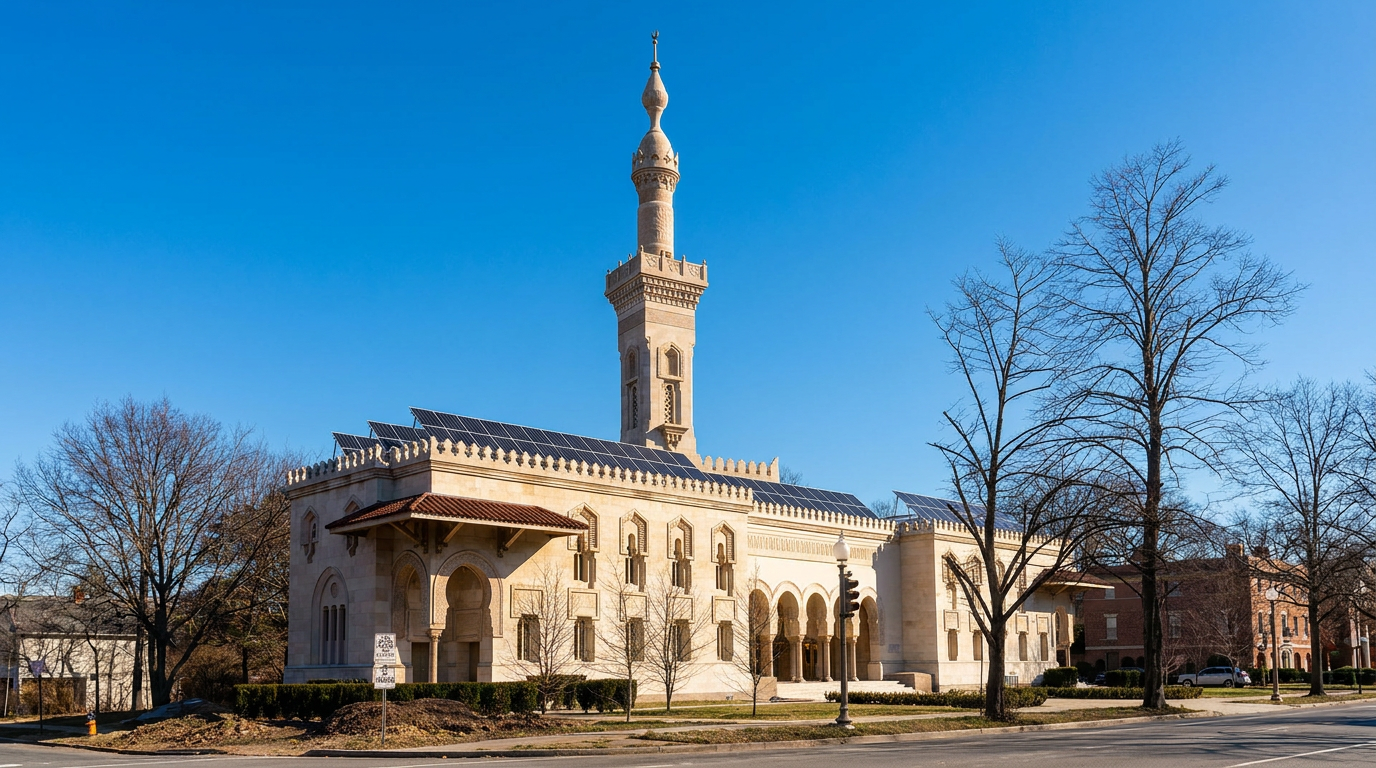
In the Islamic world, this shift is visibly manifesting in the "Green Mosque" movement. From the Middle East to Southeast Asia, mosques are being retrofitted to serve as living examples of sustainability. In Jordan and Morocco, government-backed initiatives have equipped hundreds of state-funded mosques with solar panels, LED lighting, and solar water heaters. One mosque in Morocco reported an 80% reduction in its energy bill following a modest $30,000 investment, turning the place of worship into a public showcase for energy independence.[4]
The theological grounding for these actions is rooted in the Islamic concepts of khalifa (stewardship) and mizan (balance). The Islamic Declaration on Climate Change, drafted by international scholars, explicitly calls on the world's 1.6 billion Muslims to phase out greenhouse gas emissions and transition to 100% renewable energy. Organizations like Ummah for Earth are now pushing these initiatives further, helping communities install water-saving ablution taps and biogas digesters, while framing the transition away from fossil fuels as a moral imperative.[5][6]
Indonesia, home to the world's largest Muslim population, has become a critical testing ground for these ideas. The country's top clerical body launched the "ecoMasjid" initiative, aiming to transform its 800,000 mosques into centers for environmental education and clean water conservation. In 2025, the Universitas Islam Internasional Indonesia hosted a landmark global conference on "Religious Environmentalism in Action," explicitly designed to bridge the gap between faith-based grassroots movements and national climate policymakers.[6][7]

Indonesia, home to the world's largest Muslim population, has become a critical testing ground for these ideas.
Within the Catholic Church, the catalyst for eco-theology was Pope Francis's 2015 encyclical, Laudato Si', which linked the "cry of the earth" with the "cry of the poor." A decade later, this teaching has been operationalized into the Laudato Si' Action Platform, a global framework tracking the sustainability efforts of Catholic families, parishes, schools, and religious orders. The platform's recent updates reveal a maturing ecological conscience, with communities moving beyond one-off gestures to embed sustainable practices—like composting, plant-forward diets, and solar installations—into their daily discipleship.[8]
The Catholic approach emphasizes "integral ecology," the idea that environmental degradation cannot be separated from social and economic injustice. This framework has led to an increase in public advocacy from Catholic leaders, who are increasingly using their platforms to push for systemic changes, such as the Fossil Fuel Non-Proliferation Treaty and divestment from carbon-intensive industries. The Vatican's platform now even offers a certificate program to incentivize institutions to measure their carbon footprints and share successful models globally.[1][8]

Protestant and Orthodox denominations are similarly mobilizing. The World Council of Churches' Ecumenical Decade challenges congregations to integrate biodiversity and climate justice into their worship and theology. The initiative provides practical tools for divestment, eco-theology curricula, and liturgical resources, aiming to transform local churches into "sanctuaries of sustainability and centers of resilience" in the face of extreme weather events.[3]
Despite this momentum, the greening of religion faces significant internal and external hurdles. Theologically, eco-theologians often encounter pushback from literalist interpretations of scripture that emphasize human dominion over nature, or from prosperity-driven teachings that prioritize economic growth over ecological limits. In some politically polarized regions, environmentalism is still viewed with suspicion, seen as a secular or partisan agenda rather than a genuine spiritual calling.[1]
Practically, the transition requires capital that many local congregations lack. While a wealthy parish in Europe or North America might easily afford a solar array or a geothermal heating system, faith communities in the Global South—often those most vulnerable to climate impacts—struggle to fund basic infrastructure. Bridging this financial gap is a growing focus for interfaith coalitions, which are exploring crowdfunding and cooperative financing models to support green retrofits in developing nations.[1][3][6]

There is also the challenge of translating high-level declarations into pew-level behavior. While international symposiums and papal encyclicals generate headlines, the true test of eco-theology is whether it changes how ordinary believers consume, vote, and live. This is why the focus has increasingly shifted toward "ecological metanoia"—a profound spiritual conversion that makes caring for creation an ordinary, expected part of religious life rather than a niche activist pursuit.[1][2][3]
Looking ahead, the intersection of faith and climate action is poised to become one of the most dynamic areas of the environmental movement. By speaking the language of morality, duty, and reverence, religious institutions can reach demographics that secular environmental campaigns often alienate. As the impacts of climate change become more severe, the world's ancient faiths are proving that their oldest teachings might hold the key to a sustainable future.[1]
How we got here
2015
Pope Francis publishes the encyclical Laudato Si', and Islamic scholars release the Islamic Declaration on Climate Change.
2017
Morocco launches a national initiative to retrofit state-funded mosques with solar energy and LED lighting.
2021
The Vatican launches the Laudato Si' Action Platform to guide Catholic institutions toward total sustainability.
2025
The World Council of Churches begins its Ecumenical Decade of Climate Justice Action, spanning through 2034.
2025
Indonesia hosts the international 'Religious Environmentalism in Action' conference to bridge faith movements and policy.
Viewpoints in depth
Eco-Theologians & Clergy
Reclaiming stewardship as a core tenet of faith.
This camp argues that for centuries, religious texts were misinterpreted to justify the exploitation of nature. By returning to the original languages and contexts of scripture, they assert that concepts like 'dominion' actually mean responsible stewardship. They view the transition to renewable energy and sustainable living not as a political choice, but as an act of worship and obedience to the Creator.
Secular Climate Advocates
Unlocking massive institutional resources.
Environmental NGOs and secular policymakers increasingly view religious organizations as indispensable allies. They point out that faiths control vast real estate portfolios, educational networks, and financial assets. For this camp, the theological awakening is a practical breakthrough that can mobilize demographics and capital that traditional environmental campaigns have historically failed to reach.
Traditionalist & Literalist Voices
Prioritizing human development and spiritual salvation.
A persistent counter-narrative within various faiths warns against elevating environmental concerns above human welfare or core theological doctrines. This viewpoint often argues that the earth's resources were provided for human flourishing and poverty alleviation. They express concern that 'Green Religion' flirts with pantheism or distracts from the primary mission of spiritual salvation and evangelism.
What we don't know
- How effectively high-level theological declarations will translate into measurable carbon reductions at the local congregation level.
- Whether interfaith coalitions can secure enough funding to support green infrastructure retrofits for places of worship in developing nations.
- How traditionalist factions within various faiths will respond to the increasing integration of environmentalism into core religious doctrine.
Key terms
- Eco-Theology
- A form of constructive theology that focuses on the interrelationships of religion and nature, framing environmental preservation as a spiritual duty.
- Khalifa
- An Islamic concept translating to 'steward' or 'vicegerent,' used in eco-theology to describe humanity's responsibility to protect God's creation.
- Integral Ecology
- A concept popularized by Pope Francis asserting that environmental degradation and social injustice are deeply interconnected and must be addressed together.
- Ecological Metanoia
- A profound spiritual and cultural conversion that transforms a person's or community's daily habits toward environmental sustainability.
Frequently asked
What is a Green Mosque?
A Green Mosque is a place of Islamic worship retrofitted with sustainable technologies like solar panels, LED lighting, and water-saving ablution systems, serving as an environmental model for the community.
How is the Catholic Church addressing climate change?
The Vatican launched the Laudato Si' Action Platform, a global initiative that guides Catholic institutions in adopting sustainable practices, reducing carbon footprints, and advocating for climate justice.
Do all religious groups support environmentalism?
While major institutional bodies are increasingly embracing eco-theology, there is still pushback from some traditionalist factions who prioritize human economic development or view environmentalism as a secular agenda.
Sources
Source coverage
8 outlets
4 viewpoints surfaced








[1]Factlen Editorial TeamGlobal Policy & Data Analysts
Synthesis by Factlen editorial team
Read on Factlen Editorial Team →[2]Pew Research CenterGlobal Policy & Data Analysts
The Global Religious Landscape
Read on Pew Research Center →[3]World Council of ChurchesFaith-Based Climate Leaders
Ecumenical Decade of Climate Justice Action (2025-2034)
Read on World Council of Churches →[4]World Economic ForumGlobal Policy & Data Analysts
Will Morocco's 'green mosques' spark an energy revolution?
Read on World Economic Forum →[5]Carbon BriefGlobal Policy & Data Analysts
Islamic scholars endorse declaration on climate change
Read on Carbon Brief →[6]Ummah for EarthFaith-Based Climate Leaders
Green Mosques Initiative
Read on Ummah for Earth →[7]Universitas Islam Internasional IndonesiaFrontline Faith Communities
Religious Environmentalism in Action: A Global Conference to Tackle Climate Crisis
Read on Universitas Islam Internasional Indonesia →[8]Laudato Si' Action PlatformFaith-Based Climate Leaders
Looking Toward 2026: What We Can Expect
Read on Laudato Si' Action Platform →

Every angle. Every day.
Get culture stories with full source coverage and perspective breakdowns delivered to your inbox.