
Does Ranked-Choice Voting Actually Reduce Political Polarization? The Evidence, Explained
As more municipalities and states adopt ranked-choice voting, advocates claim it penalizes extremism, while skeptics argue it complicates elections. A review of a decade of electoral data reveals a nuanced reality: it changes campaign behavior, but its impact on long-term polarization depends heavily on local political ecosystems.
By Factlen Editorial Team
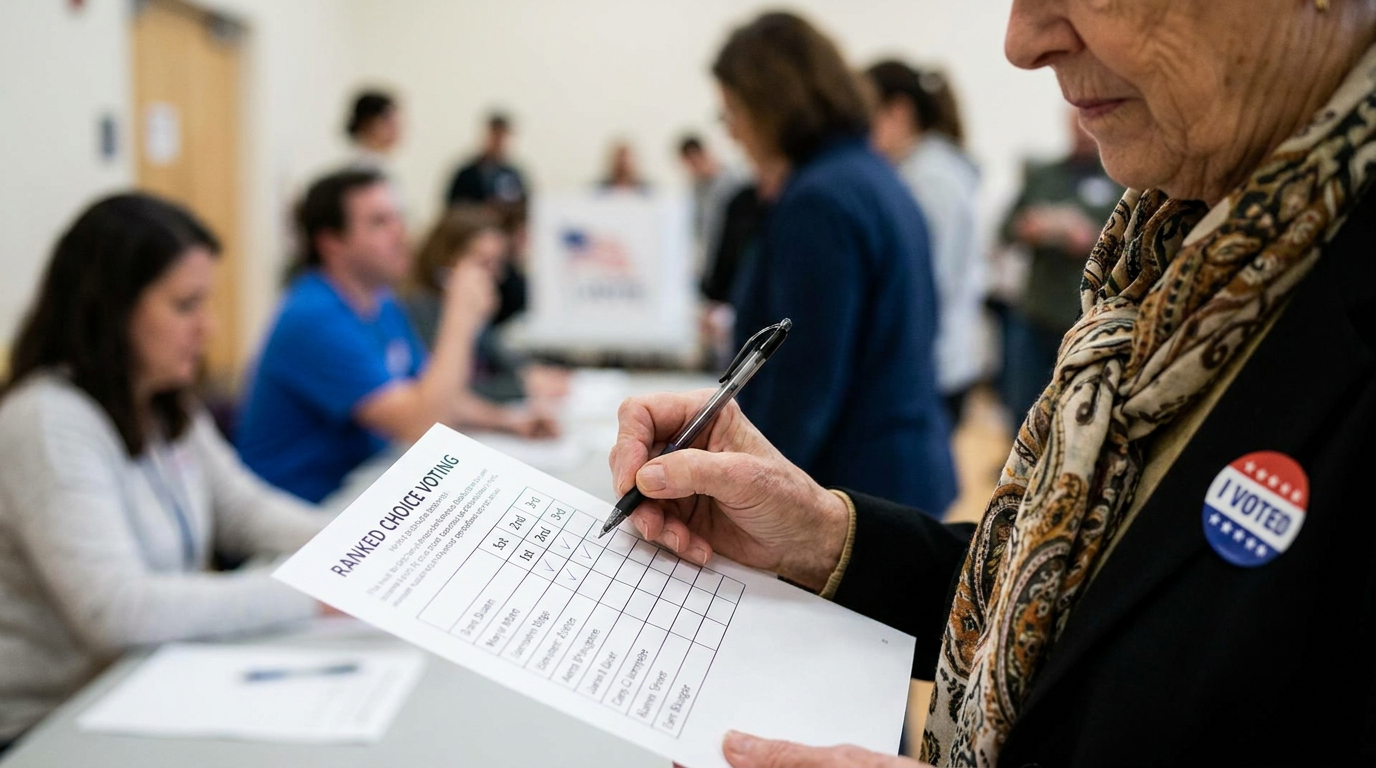
- Political Scientists & Data Analysts
- Focus on empirical outcomes, noting that while the system solves the spoiler effect, its impact on deep-seated polarization is limited by national trends.
- Electoral Reform Advocates
- Argue that ranked ballots are essential for breaking the two-party duopoly and ensuring winners have true majority support.
- Election Traditionalists
- Caution that changing the voting system introduces unnecessary complexity and risks disenfranchising voters who misunderstand the ballot.
What's not represented
- · Local election administrators tasked with upgrading tabulation software
- · Third-party candidates who benefit from the removal of the spoiler effect
Why this matters
The mechanics of how we vote directly dictate who gets elected and how they govern. Understanding the actual data behind voting reform empowers citizens to make informed decisions about the democratic infrastructure in their own communities.
The mechanics of democracy are undergoing a quiet but profound upgrade. Across the United States and in various democracies worldwide, the traditional "choose one" plurality ballot is increasingly being replaced by Ranked-Choice Voting. In this system, voters rank candidates in order of preference—first, second, third, and so on. If no candidate wins an outright majority of first-choice votes, the lowest vote-getter is eliminated, and their supporters' votes are instantly transferred to their next highest preference. This process repeats until a single candidate crosses the fifty-percent threshold.[1][6]
The promise of this system is sweeping. Electoral reform advocates claim it will cure political polarization, eliminate negative campaigning, and ensure that every elected official has genuine majority support. Meanwhile, traditionalists and skeptics argue that the system is overly complex, confuses voters, and ultimately depresses turnout. As the system scales from local mayoral races to statewide federal elections, political scientists and data analysts finally have enough real-world data to test these claims.[3][4]
This evidence pack examines the empirical impact of Ranked-Choice Voting, separating structural guarantees from political wishful thinking. By analyzing a decade of election data, we can evaluate how the system actually alters voter behavior, campaign strategy, and the ultimate ideological makeup of elected bodies.[6]

The most robust and undisputed claim regarding Ranked-Choice Voting is its ability to eliminate the "spoiler effect." In traditional plurality elections, a third-party or independent candidate can siphon votes from a mainstream candidate with a similar platform, inadvertently helping their mutual ideological opposite win the election. This dynamic has historically forced voters into a defensive posture, requiring them to vote for the "lesser of two evils" rather than their genuine favorite.[1][3]
The data confirms that Ranked-Choice Voting effectively neutralizes this spoiler dynamic. Because the system allows voters to rank their preferences, they can safely vote for a third-party candidate first, knowing their vote will seamlessly transfer to their second choice if their favorite is eliminated. Data from the MIT Election Data and Science Lab shows that in races with three or more competitive candidates, the system reliably consolidates support behind the most broadly acceptable candidate without penalizing voters for supporting underdogs.[1]
This structural shift fundamentally empowers voters to express their true preferences without the fear of wasting their vote. It also lowers the barrier to entry for independent candidates, who no longer face accusations of ruining the election for major-party contenders. By removing the spoiler effect, the system ensures that the winning candidate actually commands the consent of the majority of the electorate, a baseline requirement for democratic legitimacy that plurality voting frequently fails to meet.[3][6]
This structural shift fundamentally empowers voters to express their true preferences without the fear of wasting their vote.
A more complex claim is that Ranked-Choice Voting forces candidates to be more civil and moderate. The underlying theory suggests that because candidates need second- and third-choice votes from their opponents' supporters to win a tight race, they will actively avoid negative attacks that might alienate those voters. Instead of appealing solely to a narrow, radical base, candidates are theoretically incentivized to build broad coalitions.[2][4]
The empirical evidence on campaign civility is promising, though highly context-dependent. A comprehensive analysis by the National Bureau of Economic Research found that candidates in Ranked-Choice elections do, in fact, engage in less direct negative advertising compared to those in traditional plurality systems. Campaigns frequently feature cross-endorsements, where candidates explicitly ask voters to rank them first and a specific rival second, fostering a more collaborative electoral environment.[2]

However, researchers at the Bipartisan Policy Center note that this moderating effect is most pronounced in local, non-partisan municipal races. In highly polarized federal elections, the nationalization of political rhetoric often overrides the local incentives of the ranked ballot. While the system penalizes extreme candidates who actively alienate the majority, it does not magically create moderate politicians out of thin air; it simply ensures that the winner is the candidate least objectionable to the median voter.[4][6]
Perhaps the most persistent criticism of Ranked-Choice Voting is that it is too complex, leading to voter confusion, spoiled ballots, and depressed turnout, particularly among marginalized or lower-information communities. Skeptics argue that asking voters to research and rank multiple candidates is an undue burden that effectively disenfranchises those who do not have the time to deeply study the entire field.[4]
Extensive polling and ballot analysis largely contradict the narrative of widespread voter depression. Surveys conducted by the Pew Research Center indicate that voters adapt to the new ballots quite easily. In jurisdictions that have adopted the system, over eighty percent of voters consistently report that the ballot was easy to understand and complete. Furthermore, studies show that the system does not significantly lower overall turnout; in some municipal elections, it has even been associated with slight increases in voter participation, likely due to more competitive and diverse candidate fields.[1][5]
Nevertheless, a real phenomenon known as "ballot exhaustion" does occur and warrants transparent discussion. If a voter chooses to rank only one or two candidates, and those specific candidates are eliminated in early rounds, their ballot becomes "exhausted" and does not factor into the final round of counting. This means the final winner is chosen by a majority of the remaining valid ballots, not necessarily a majority of all ballots originally cast.[3][4]

On average, about nine percent of ballots in multi-round Ranked-Choice elections become exhausted before the final tally. While this means some voters do not weigh in on the final two candidates, electoral data experts point out that this drop-off is functionally similar to—and often lower than—the severe drop in voter turnout typically seen in traditional delayed runoff elections, where voters are asked to return to the polls weeks later.[3][6]
Ultimately, the evidence suggests that Ranked-Choice Voting is not a utopian panacea for all democratic ailments, but it is a highly effective structural upgrade. It definitively solves the spoiler effect, ensures majority support for the winner, and offers modest but measurable improvements in campaign civility. As more jurisdictions experiment with the system, the growing dataset continues to confirm that empowering voters with more choices yields a more representative government.[6]
How we got here
2004
San Francisco becomes the first major US city to implement Ranked-Choice Voting for municipal elections.
2018
Maine becomes the first state to use Ranked-Choice Voting for federal congressional elections.
2020
Alaska voters approve a ballot measure to adopt open primaries and Ranked-Choice Voting for general elections.
2022
Alaska successfully utilizes the system in a highly watched special congressional election, drawing national attention to the mechanics.
Viewpoints in depth
Electoral Reform Advocates
Advocates view the system as a necessary evolution to break the two-party duopoly and ensure majority rule.
Organizations like FairVote argue that the traditional plurality system is fundamentally broken because it forces voters to vote strategically rather than honestly. By eliminating the spoiler effect, they argue that Ranked-Choice Voting opens the door for a wider diversity of candidates, including independents and third parties, to compete without being accused of ruining the election. They point to data showing that winners in ranked systems consistently enter office with a broader mandate and higher approval ratings from the overall electorate.
Election Traditionalists
Skeptics argue the system is a solution in search of a problem that risks alienating voters through complexity.
Critics, including some traditional political strategists and think tanks like the Bipartisan Policy Center, caution that changing the fundamental mechanics of voting can have unintended consequences. They highlight the issue of ballot exhaustion, noting that if voters do not rank the entire field, the final winner may still not represent a true majority of all ballots cast. Furthermore, they argue that the complexity of the ballot can lead to higher error rates, potentially disenfranchising voters who are less familiar with the new rules or who face language barriers.
Political Scientists & Data Analysts
Researchers focus on the empirical data, finding that the system works exactly as designed mechanically, even if it doesn't cure all political polarization.
Academic institutions like the MIT Election Data and Science Lab take a measured view based on a decade of electoral data. They confirm that the system successfully eliminates the spoiler effect and generally leads to more civil local campaigns. However, they caution against viewing it as a panacea for national polarization. The data suggests that while the system prevents the most extreme candidates from winning in divided fields, it cannot override the deep partisan divides that characterize modern federal elections. Ultimately, they view it as a mechanical upgrade that accurately captures voter intent, rather than a psychological cure for a divided nation.
What we don't know
- Whether the moderating effects seen in local municipal elections will eventually scale up to highly polarized federal races.
- How long-term voter turnout will be affected once the novelty of the new voting system wears off in newly adopted jurisdictions.
Key terms
- Spoiler Effect
- A phenomenon in traditional elections where a third-party candidate draws votes away from a similar major candidate, causing their mutual ideological opponent to win.
- Ballot Exhaustion
- When a ballot can no longer be counted in the final rounds of a ranked-choice election because all the candidates the voter chose to rank have been eliminated.
- Instant Runoff
- Another term for Ranked-Choice Voting, highlighting how the system simulates a runoff election instantly without requiring voters to return to the polls on a different day.
- Plurality Voting
- The traditional 'choose one' voting system where the candidate with the most votes wins, even if they receive less than 50% of the total vote.
Frequently asked
Does ranking a second choice hurt my first choice?
No. Your second choice is only considered if your first choice is completely eliminated from the race. It is impossible for your backup choices to count against your favorite candidate.
Do I have to rank every candidate on the ballot?
No. You can rank as many or as few candidates as you wish. If you only want to vote for one person, you can simply mark them as your first choice and leave the rest blank.
What happens if my favorite candidate is eliminated?
If your first choice is eliminated, your single vote instantly transfers to whoever you marked as your second choice, ensuring your voice still matters in the final outcome.
Is Ranked-Choice Voting used in federal elections?
Yes, as of 2026, several states including Maine and Alaska use the system for federal congressional and senatorial elections, alongside dozens of major municipalities.
Sources
Source coverage
6 outlets
3 viewpoints surfaced






[1]MIT Election Data and Science LabPolitical Scientists & Data Analysts
Ranked-Choice Voting: Electoral Mechanics and Voter Behavior
Read on MIT Election Data and Science Lab →[2]National Bureau of Economic ResearchPolitical Scientists & Data Analysts
The Impact of Ranked Choice Voting on Campaign Civility and Polarization
Read on National Bureau of Economic Research →[3]FairVoteElectoral Reform Advocates
Data on Ranked Choice Voting: Turnout, Representation, and Outcomes
Read on FairVote →[4]Bipartisan Policy CenterElection Traditionalists
Assessing the Trade-offs of Ranked Choice Voting in Federal Elections
Read on Bipartisan Policy Center →[5]Pew Research CenterPolitical Scientists & Data Analysts
Voter Attitudes Toward Alternative Voting Systems and Ballot Complexity
Read on Pew Research Center →[6]Factlen Editorial TeamPolitical Scientists & Data Analysts
Synthesis by Factlen editorial team
Read on Factlen Editorial Team →

More in news politics
See all 9 stories →US-Iran Deal
U.S. and Iran Sign Agreement to End War; Vance Lashes Out at Israeli Critics
7 sources
U.S.-Iran Deal
U.S. and Iran Sign 14-Point Agreement to End War, Sparking Fierce Backlash from Israel
6 sources

U.S.-Iran Relations
Vance Rebukes Israeli Critics of U.S.-Iran Peace Agreement, Warning Against Alienating 'Only Powerful Ally'
8 sources

Cognitive Defense
The Science of 'Prebunking': How Psychological Inoculation is Defeating Misinformation
6 sources

Every angle. Every day.
Get news politics stories with full source coverage and perspective breakdowns delivered to your inbox.