
Do Consumer Sleep Trackers Actually Improve Sleep? An Evidence-Based Review
Wearable sleep trackers are highly effective at detecting total sleep time, but their limited accuracy in identifying sleep stages can trigger anxiety that paradoxically worsens rest.
By Factlen Editorial Team
- Clinical Sleep Specialists
- Prioritize diagnostic accuracy and warn against the psychological risks of over-relying on imperfect consumer algorithms.
- Wearable Tech Advocates
- Emphasize the behavioral benefits of tracking and the value of long-term physiological trends over nightly precision.
- Consumer Watchdogs
- Focus on the user experience, highlighting both the empowering aspects of health data and the growing phenomenon of tracker-induced anxiety.
What's not represented
- · Device Manufacturers' Algorithm Engineers
- · Individuals with Diagnosed Clinical Insomnia
Why this matters
Millions of people rely on wearable trackers to optimize their rest, but misunderstanding the limits of this technology can actively worsen sleep quality. Knowing which metrics to trust—and which to ignore—is essential for using these devices to reduce fatigue rather than fuel anxiety.
Key points
- Consumer sleep trackers are highly accurate (85–95%) at detecting when you are asleep versus awake.
- Devices struggle to accurately classify specific sleep stages like REM and deep sleep, as they cannot measure brain waves.
- An obsession with achieving perfect sleep scores has led to a rise in "orthosomnia," a condition where tracker-induced anxiety worsens sleep.
- Roughly 23% of users aged 18 to 35 report feeling stressed by the data provided by their sleep tracking applications.
- Experts recommend using tracker data to monitor long-term trends over weeks or months, rather than fixating on single-night scores.
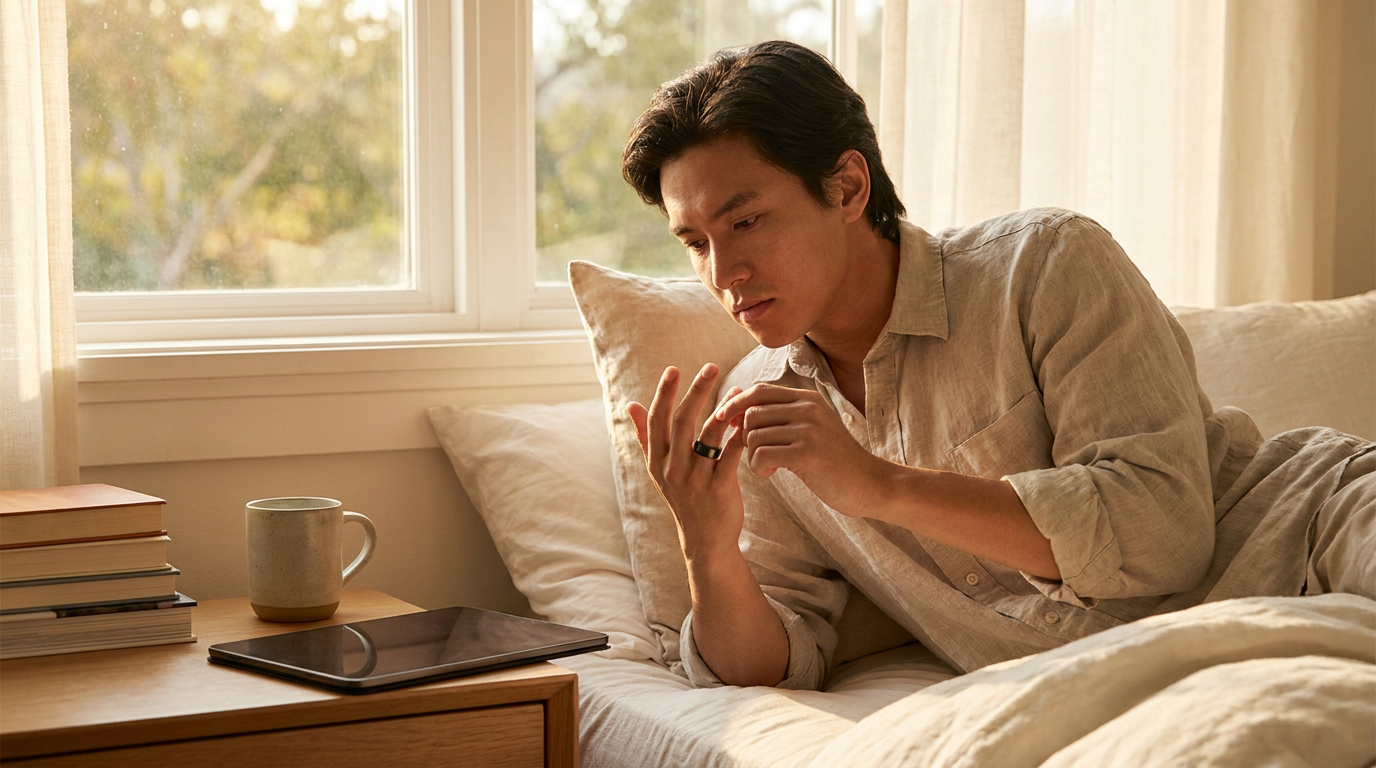
Millions of people now begin their mornings not by stretching, meditating, or brewing coffee, but by reaching for their smartphones to find out how well they slept. Wearable sleep trackers—ranging from smart rings like Oura to wrist-worn devices like the Apple Watch and Whoop strap—have fundamentally transformed rest from a subjective feeling into a highly quantifiable metric. The appeal of this technology is obvious and deeply rooted in modern wellness culture: by meticulously measuring our nights, we hope to optimize our days. Users are presented with daily "sleep scores" that aggregate various physiological signals, offering a seemingly objective verdict on their physical recovery. For many, this data is empowering, providing the motivation needed to prioritize earlier bedtimes and reduce late-night screen time.[7]
But as wearable technology has matured and integrated itself into the daily lives of millions, clinical sleep specialists and behavioral researchers are increasingly asking whether these devices actually deliver on their lofty promises. The resulting scientific evidence paints a complex, highly nuanced picture that challenges the marketing claims of tech companies. While consumer trackers are undeniably effective at promoting general sleep hygiene and making users more mindful of their habits, their technical limitations can sometimes trigger a paradoxical effect. For a growing subset of users, the daily grading of their sleep causes a specific type of performance anxiety that actively degrades the very rest they are desperately trying to improve.[3][7]
To truly understand the utility and limitations of consumer sleep trackers, it is necessary to evaluate their specific marketing claims against rigorous clinical data. The first and most foundational claim is that these devices accurately measure total sleep duration—knowing exactly when you fall asleep and when you wake up. On this specific front, the clinical evidence is generally strong. Studies comparing consumer wearables to polysomnography (PSG)—the in-lab clinical gold standard that measures brain waves, oxygen levels, and respiration—consistently show that modern trackers can identify sleep versus wakefulness with 85 to 95 percent accuracy. For the average user looking to ensure they are getting eight hours of rest, this level of precision is more than sufficient.[4]
However, even in this relatively reliable area of sleep/wake detection, the devices exhibit systematic biases that users should be aware of. A comprehensive 2025 standardized evaluation of eight popular consumer trackers found that most wrist-worn devices tend to consistently overestimate total sleep time. Because they rely heavily on accelerometers to detect movement, they frequently misinterpret a user lying perfectly still while awake as actual sleep. This leads to a significant underestimation of "wake after sleep onset," or the amount of time a person spends tossing and turning in the middle of the night. When sleep becomes fragmented or restricted, the error magnitude of these consumer devices increases drastically, painting a rosier picture of the night than reality dictates.[4]

The second, and far more heavily marketed, claim is that consumer trackers can accurately map a user's sleep architecture—specifically, the nightly cycles of light sleep, deep sleep, and Rapid Eye Movement (REM) sleep. Here, the clinical evidence is significantly weaker, and the technological limitations become glaringly apparent. Clinical polysomnography determines sleep stages by directly measuring brain activity via electroencephalogram (EEG). Consumer wearables, lacking any access to brain waves, must guess sleep stages using secondary proxy metrics like heart rate variability, skin temperature, and wrist movement. They are essentially trying to solve a complex neurological puzzle by looking only at cardiovascular and kinetic clues.[2][4]
Here, the clinical evidence is significantly weaker, and the technological limitations become glaringly apparent.
As a result of this reliance on proxy metrics, the accuracy of sleep stage classification drops considerably compared to simple sleep/wake detection. Recent validation studies indicate that most consumer devices achieve only a "moderate" agreement with clinical PSG for four-stage classification, typically scoring between 0.4 and 0.6 on the Cohen's kappa statistical metric. While proprietary algorithms are constantly improving, researchers note that wrist-worn devices inherently miss crucial physiological signals required for accurate staging. For instance, a 2025 study from Northwestern University demonstrated that breathing patterns are a far more reliable indicator of REM sleep than wrist movement. This discovery has prompted the development of novel neck-worn sensors for clinical use, highlighting the fundamental limitations of tracking sleep from the wrist or finger.[4][5]
The third major claim surrounding these devices is behavioral: that tracking your sleep inevitably leads to better sleep quality. The evidence here is decidedly mixed and heavily dependent on the individual psychology of the user. On the positive side of the ledger, clinical trials have demonstrated that wearing a tracker can indeed improve perceived nighttime sleep quality in healthy individuals. The devices act as a persistent digital conscience, making users more mindful of their daily routines. By visualizing the negative impacts of late-night alcohol consumption, heavy meals, or excessive caffeine, trackers successfully prompt millions of people to adopt healthier, more consistent bedtime habits that genuinely improve their overall well-being.[6][7]
Yet, this hyper-focus on quantified data has birthed a troubling new clinical phenomenon known as "orthosomnia." Coined by researchers in the Journal of Clinical Sleep Medicine, orthosomnia describes an unhealthy, obsessive preoccupation with achieving perfect sleep metrics. Instead of listening to their own bodies and assessing how rested they actually feel, users become entirely fixated on the device's nightly "sleep score." They allow a proprietary algorithm to dictate their morning mood and energy levels. If the device says they slept poorly, they feel exhausted, even if they woke up feeling refreshed just moments before checking their screen.[2][3]
The scale of this psychological side effect is surprisingly large and growing rapidly as wearables become ubiquitous. A 2024 cross-sectional study published in the journal Brain Sciences found that orthosomnia affects between 3 and 14 percent of wearable users, depending on how strictly the condition is defined. The demographic divide in this data is particularly stark: roughly 23 percent of users aged 18 to 35 report that sleep apps actively induce stress and anxiety about their rest, compared to just 2.4 percent of users over the age of 66. For a significant portion of the younger population, the tool designed to optimize their health is actively degrading their mental well-being.[1]

For individuals who are already prone to anxiety, perfectionism, or health-related worry, the sleep tracker frequently becomes a powerful catalyst for insomnia. The psychological loop is vicious: a user wakes up, sees a low deep-sleep score, and feels immediate anxiety about their upcoming day. The following night, they go to bed early and lie awake, actively trying to force themselves into deep sleep. This creates a state of hypervigilance and physiological arousal that biologically prevents the very rest they are desperately chasing. Sleep specialists report that some patients become so entrenched in this cycle that they refuse to accept reassurance from doctors, trusting the flawed data of their commercial tracker over professional clinical evaluations.[2][6]
So, how should consumers navigate the increasingly quantified landscape of sleep health without falling into the trap of orthosomnia? Sleep scientists and behavioral experts recommend treating wearable data as a directional compass rather than a precise clinical diagnosis. Because these devices are highly consistent in their own internal measurements—even if they lack absolute clinical accuracy compared to polysomnography—they are incredibly useful for tracking personal baselines and long-term trends over weeks or months. Users are advised to stop grading individual nights and instead look at rolling seven-day or thirty-day averages to understand how lifestyle changes, such as a new exercise routine or a different diet, impact their overall recovery trajectory.[3][7]

If a user notices that their resting heart rate is consistently elevated or their total sleep time has plummeted over a two-week period, it serves as a valuable early warning sign of overtraining, chronic stress, or impending illness. However, fixating on a single night's sleep score is entirely counterproductive. For those who find that their morning mood is dictated by a digital readout, or who lie awake worrying about their deep sleep percentages, the most evidence-based intervention might be the simplest one. Taking a one-to-two-week break from the device can break the cycle of anxiety, allowing the individual to reconnect with their body's natural signals and remember how to sleep without an audience.[3][7]
How we got here
1950s
Polysomnography (PSG) is developed, establishing the clinical gold standard for measuring brain waves and sleep stages.
2015
Consumer wearables begin integrating optical heart rate sensors, shifting sleep tracking from simple movement detection to cardiovascular monitoring.
2017
Researchers coin the term 'orthosomnia' to describe the growing phenomenon of patients experiencing insomnia driven by an obsession with their sleep tracker data.
2024
Clinical studies reveal that up to 23% of young adult wearable users experience tracker-induced sleep anxiety, prompting calls for healthier data habits.
Viewpoints in depth
Clinical Sleep Specialists
Medical professionals who prioritize diagnostic accuracy and warn against the psychological risks of over-relying on imperfect consumer algorithms.
Clinical sleep specialists emphasize that while consumer trackers are useful for identifying basic behavioral patterns, they cannot replace polysomnography for diagnosing actual sleep disorders. They warn that proprietary algorithms, which guess sleep stages from wrist movement and heart rate, often mislead patients. This inaccurate data can complicate cognitive behavioral therapy for insomnia, as patients become fixated on achieving a specific 'deep sleep' number rather than focusing on how rested they actually feel during the day.
Wearable Tech Advocates
Researchers and industry voices who emphasize the behavioral benefits of tracking and the value of long-term physiological trends.
Advocates argue that despite imperfect stage classification, consumer trackers successfully democratize health data and promote preventative wellness. By highlighting long-term trends in resting heart rate, heart rate variability, and total sleep duration, these devices prompt millions of users to adopt healthier bedtime routines, reduce alcohol consumption, and prioritize recovery. From this perspective, the behavioral improvements driven by the devices far outweigh the technical limitations of their sleep-stage algorithms.
The Quantified Consumer
Everyday users caught between the empowering benefits of health data and the anxiety of constant biological optimization.
Many consumers experience a love-hate relationship with their sleep trackers. They value the insights into their habits and appreciate the motivation to maintain a consistent sleep schedule. However, they also struggle with the emotional weight of being 'graded' on a biological function every morning. For these users, the challenge lies in learning to use the data as a helpful background tool without letting a low sleep score dictate their mood or trigger performance anxiety at bedtime.
What we don't know
- Whether next-generation sensors, such as those measuring respiration or micro-movements, will eventually allow wrist-worn devices to match the accuracy of clinical polysomnography.
- The long-term psychological impact of lifelong biometric tracking on younger generations who have never slept without a wearable device.
- Exactly how proprietary algorithms from major tech companies weigh different physiological signals, as these formulas remain closely guarded corporate secrets.
Key terms
- Polysomnography (PSG)
- The clinical gold standard for sleep testing, which directly measures brain waves, blood oxygen, heart rate, and breathing.
- Orthosomnia
- An unhealthy obsession with achieving "perfect" sleep metrics, often driven by data from consumer sleep trackers.
- Cohen's kappa
- A statistical measure used to evaluate the agreement between two raters—in this case, a sleep tracker versus a clinical sleep study.
- Wake After Sleep Onset (WASO)
- The total amount of time a person spends awake after initially falling asleep and before fully waking up for the day.
Frequently asked
Do sleep trackers measure brain waves?
No. Consumer sleep trackers rely on proxy metrics like movement, heart rate, and skin temperature to estimate sleep stages, which is why they are less accurate than clinical sleep studies.
Can a sleep tracker actually cause insomnia?
Indirectly, yes. The anxiety and hypervigilance caused by obsessing over sleep scores can create an arousal state that prevents restful sleep, a condition known as orthosomnia.
Which sleep tracker is the most accurate?
Independent studies show that most top-tier wearables perform similarly well at detecting total sleep time, but all of them struggle to accurately classify specific sleep stages like REM or deep sleep.
Should I stop using my sleep tracker?
If checking your sleep score causes morning anxiety or dictates your mood, experts recommend taking a one-to-two-week break from tracking to reset your relationship with sleep.
Sources
Source coverage
7 outlets
3 viewpoints surfaced







[1]Brain SciencesClinical Sleep Specialists
Prevalence of Orthosomnia in a Sample of the General Population
Read on Brain Sciences →[2]Journal of Clinical Sleep MedicineClinical Sleep Specialists
Orthosomnia: Are Some Patients Taking the Quantified Self Too Far?
Read on Journal of Clinical Sleep Medicine →[3]Sleep FoundationConsumer Watchdogs
Sleep Trackers and Orthosomnia
Read on Sleep Foundation →[4]ScietyWearable Tech Advocates
Beyond the Hype? A Standardised Real-World Evaluation of Consumer Sleep Trackers
Read on Sciety →[5]Northwestern UniversityClinical Sleep Specialists
Wearable Sleep Monitoring Device May Improve Detection of Sleep Disorders
Read on Northwestern University →[6]SleepopolisConsumer Watchdogs
Study Finds Sleep Trackers Could Make You Sleep Worse
Read on Sleepopolis →[7]Factlen Editorial TeamWearable Tech Advocates
Synthesis by Factlen editorial team
Read on Factlen Editorial Team →

More in shopping
See all 5 stories →

Every angle. Every day.
Get shopping stories with full source coverage and perspective breakdowns delivered to your inbox.