
Do At-Home LED Light Therapy Masks Actually Work? What the Clinical Evidence Shows
At-home LED masks promise to treat acne and reduce wrinkles using light therapy. A review of recent clinical trials reveals measurable but modest benefits, provided users commit to months of consistent application.
By Factlen Editorial Team
- Clinical Optimists
- Focus on the measurable improvements in acne reduction and collagen density observed in clinical trials.
- Dermatological Skeptics
- Warn that at-home results are highly modest, require immense consistency, and cannot replace standard medical treatments.
- Wound Care Specialists
- Emphasize the foundational science of photobiomodulation for cellular repair and post-procedure healing.
What's not represented
- · Device Manufacturers
- · Aesthetician Clinics
Why this matters
Consumers are spending hundreds of dollars on at-home LED masks based on viral social media claims. Understanding the actual clinical evidence helps buyers separate genuine cellular science from exaggerated marketing, ensuring they invest their time and money effectively.
Key points
- At-home LED masks utilize photobiomodulation to stimulate cellular energy and repair processes.
- A 2025 meta-analysis found that consistent use reduces mild-to-moderate acne lesions by roughly 45%.
- Red and near-infrared wavelengths are clinically proven to increase collagen density and improve skin texture.
- Dermatologists warn that results are modest and require months of strict, consistent application.
- FDA clearance indicates the devices are safe for public use, not that their marketing claims are guaranteed.
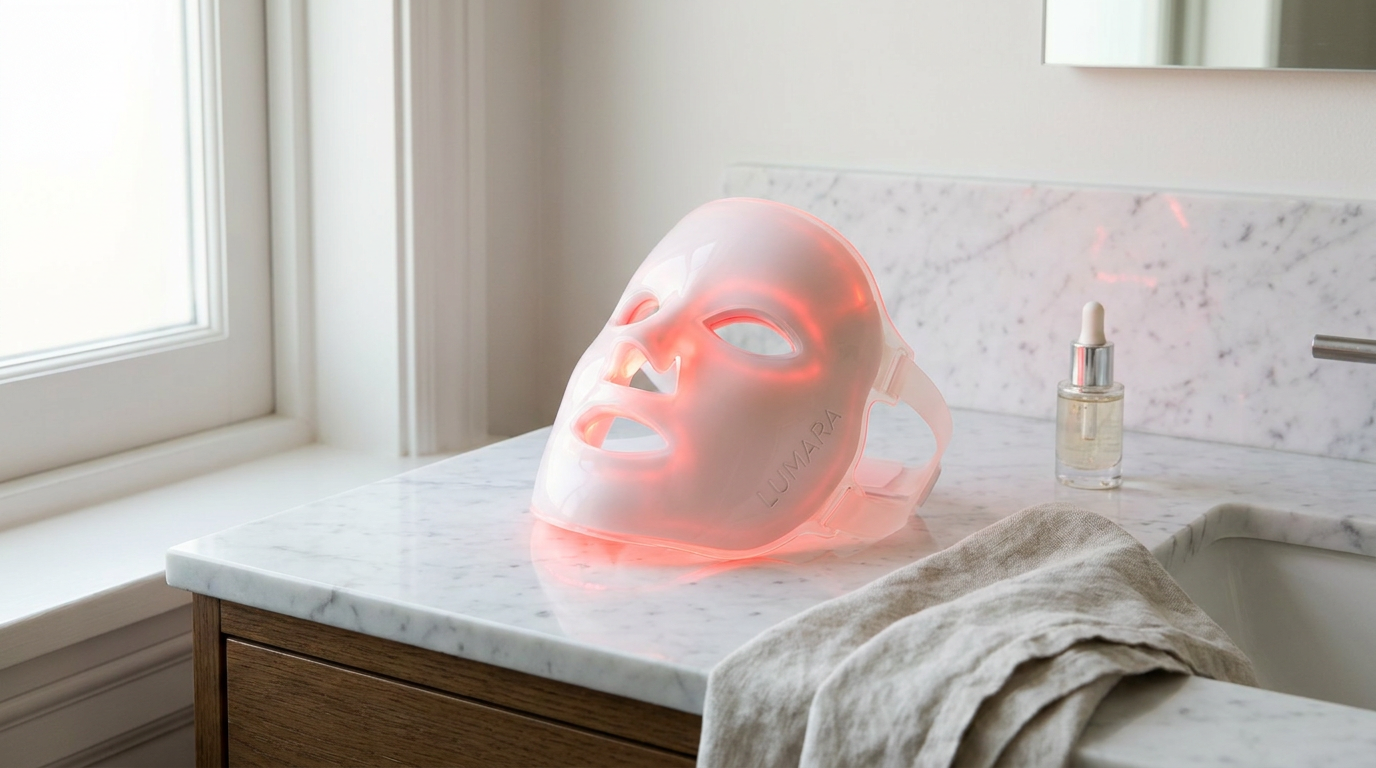
They look like props from a science fiction film, but flexible, glowing silicone face masks have become a staple of modern skincare routines. Emitting bright red, blue, and near-infrared light, these at-home devices promise to smooth wrinkles, clear acne, and rejuvenate the skin without the downtime of chemical peels or lasers.[4]
As the market for these devices explodes—with premium models costing hundreds of dollars—consumers are left to navigate a maze of marketing claims. The central question for buyers is whether these masks are backed by rigorous science or if they are simply an expensive, viral placebo.[3][6]
The underlying technology is entirely real. Known clinically as photobiomodulation, or low-level light therapy, the practice involves exposing the skin to specific wavelengths of light. Unlike ultraviolet (UV) light from the sun, which damages cellular DNA, these specific visible and near-infrared wavelengths are absorbed by the mitochondria—the energy centers of the cells.[2][7]
When the mitochondria absorb this light, they ramp up the production of adenosine triphosphate (ATP), the primary energy carrier in the body. This surge in cellular energy accelerates repair processes, reduces inflammation, and stimulates the production of structural proteins.[6][7]

The foundational evidence for photobiomodulation actually predates the beauty industry by decades. In the 1990s, NASA began experimenting with light-emitting diodes (LEDs) to help astronauts heal wounds and regenerate tissue in the zero-gravity environment of space, where cellular repair naturally slows down.[7]
Today, the strongest clinical evidence for at-home LED therapy centers on the treatment of mild-to-moderate acne. Acne protocols typically utilize a combination of blue light, which penetrates the uppermost layers of the skin to destroy acne-causing bacteria, and red light, which penetrates deeper to calm the associated inflammatory response.[1][5]
A landmark March 2025 meta-analysis published in JAMA Dermatology provided robust validation for this approach. Researchers from Mass General Brigham analyzed data from six randomized controlled trials involving 216 participants who used at-home light therapy devices.[1][5]
A landmark March 2025 meta-analysis published in JAMA Dermatology provided robust validation for this approach.
The results were definitive: individuals using red and blue LED devices experienced a significant reduction in both inflammatory and non-inflammatory acne lesions compared to control groups. On average, consistent use reduced acne lesions by approximately 45% over a four-to-eight-week period, offering a viable non-pharmaceutical alternative for patients who cannot tolerate harsh topical treatments.[5][7]

The evidence supporting LED therapy for anti-aging is also measurable, though dermatologists urge patients to temper their expectations. Red light (typically between 630 and 660 nanometers) and near-infrared light (810 to 850 nanometers) penetrate the dermis to stimulate fibroblasts, the cells responsible for producing collagen and elastin.[4][7]
Clinical trials utilizing ultrasound imaging have confirmed that consistent exposure to these wavelengths can increase intradermal collagen density. Over time, this structural reinforcement translates to a reduction in the depth of fine lines, improved skin elasticity, and a generally smoother texture.[7]
However, the visible transformation is far from instantaneous. Dr. Raman Madan, a dermatologist with Northwell Health, notes that while the biological mechanism is sound, the real-world results of at-home masks are often highly modest compared to the dramatic claims made by manufacturers.[3]
Madan warns that patients often arrive at the clinic with unrealistic expectations fueled by social media filters and aggressive marketing campaigns. He emphasizes that an LED mask will not replicate the dramatic lifting effects of surgery, nor will it replace prescription retinoids or injectable neuromodulators.[3]
The defining variable in achieving any visible result is strict, long-term consistency. Clinical protocols require users to wear the masks for 10 to 15 minutes a day, three to five times a week. Because the cellular turnover process is gradual, users typically must maintain this regimen for three to six months before noticing a definitive improvement in skin texture or firmness.[3][4]

Consumers must also navigate the often-misunderstood FDA-cleared label prominently displayed on most devices. The American Academy of Dermatology clarifies that FDA clearance simply means the device is considered safe and poses a low risk to the public; it is not a government guarantee that the mask will effectively erase wrinkles or cure acne.[2]
Safety profiles for at-home LED masks are generally excellent. Because they do not emit UV rays, they do not carry the skin cancer risks associated with tanning beds. The most commonly reported side effects are temporary, mild dryness or slight irritation.[2][5]
There is, however, a notable caveat for individuals with darker skin tones. Research indicates that melanin-rich skin is more sensitive to visible light, meaning that improper or excessive use of red light devices can occasionally trigger hyperpigmentation. Dermatologists recommend that patients with darker skin consult a professional before beginning an at-home regimen.[2]
Ultimately, the medical consensus views at-home LED masks not as standalone miracles, but as effective complementary tools. When combined with a foundational skincare routine of cleansing, moisturizing, and daily sun protection, photobiomodulation offers a gentle, evidence-backed method to incrementally improve skin health over time.[2][6]
How we got here
1990s
NASA begins experimenting with LED light therapy to help astronauts heal wounds and grow plants in space.
2014
Early controlled trials confirm that specific red light wavelengths can increase collagen density in human skin.
2021
A major review article validates low-level light therapy for skin rejuvenation but notes commercial marketing is outpacing clinical evidence.
March 2025
A JAMA Dermatology meta-analysis confirms at-home LED devices significantly reduce mild-to-moderate acne.
Viewpoints in depth
Clinical Optimists
Focus on the measurable improvements in acne reduction and collagen density observed in clinical trials.
Proponents point to robust data, such as the 2025 JAMA Dermatology meta-analysis, which demonstrates that at-home LED devices can reduce acne lesions by nearly half. They argue that providing consumers with a safe, non-pharmaceutical option for skin management is a massive win for accessible dermatology, especially for patients who experience severe dryness or irritation from traditional topical medications.
Dermatological Skeptics
Warn that at-home results are highly modest, require immense consistency, and cannot replace standard medical treatments.
Many practicing dermatologists caution that the viral popularity of LED masks has vastly outpaced their actual clinical utility. They highlight that the results, while biologically real, are often too subtle for the average consumer to notice without ultrasound imaging. Skeptics worry that patients are spending hundreds of dollars on devices that require months of daily commitment, rather than investing in proven, cheaper interventions like prescription retinoids or daily sunscreen.
Wound Care Specialists
Emphasize the foundational science of photobiomodulation for cellular repair and post-procedure healing.
Medical professionals focused on recovery view light therapy primarily as a healing accelerant rather than a cosmetic beauty tool. Drawing on decades of research originating with NASA, this camp utilizes red and near-infrared light to speed up tissue regeneration after invasive procedures like laser resurfacing or chemical peels, noting that its ability to calm severe inflammation is its most proven and valuable attribute.
What we don't know
- The long-term effects of daily, multi-year exposure to concentrated LED light on facial skin.
- Which specific combination of wavelengths produces the absolute optimal collagen response.
- Whether lower-powered at-home devices can ever truly match the efficacy of high-powered clinical panels.
Key terms
- Photobiomodulation
- The scientific term for light therapy, where specific wavelengths of light are used to stimulate cellular function and healing.
- Near-Infrared Light (NIR)
- Invisible light with longer wavelengths (typically 810–850nm) that penetrates deeper into tissues to promote repair and reduce inflammation.
- ATP (Adenosine Triphosphate)
- The primary energy carrier in cells, the production of which is stimulated by red and near-infrared light.
- Collagen Density
- The concentration of collagen proteins in the skin, which provides firmness and reduces the appearance of wrinkles.
Frequently asked
Can I use an LED mask if I have darker skin?
Yes, but consult a dermatologist first. Darker skin tones can be more sensitive to visible light, which may occasionally trigger hyperpigmentation.
Does 'FDA-cleared' mean the mask is guaranteed to work?
No. FDA clearance simply means the device is considered safe and poses a low risk to the public, not that its efficacy has been proven.
Do LED masks emit UV rays?
No. High-quality LED masks use specific visible and near-infrared wavelengths that do not contain skin-damaging ultraviolet (UV) light.
Can I use my normal skincare products with an LED mask?
Yes, LED therapy is generally used on clean skin or alongside complementary serums, though you should avoid using light-blocking sunscreens or heavy occlusives during the actual light session.
Sources
Source coverage
7 outlets
3 viewpoints surfaced







[1]JAMA DermatologyClinical Optimists
Efficacy of At-Home Light Therapy Devices for Acne
Read on JAMA Dermatology →[2]American Academy of DermatologyDermatological Skeptics
Is red light therapy right for your skin?
Read on American Academy of Dermatology →[3]MedPage TodayDermatological Skeptics
The Truth About Red Light Therapy Masks, According to a Dermatologist
Read on MedPage Today →[4]ForbesClinical Optimists
Best LED Face Masks, According To Dermatologists And Rigorous Testing
Read on Forbes →[5]Mass General BrighamClinical Optimists
At-home light therapy devices are safe and effective for mild-to-moderate acne
Read on Mass General Brigham →[6]Factlen Editorial TeamWound Care Specialists
Synthesis by Factlen editorial team
Read on Factlen Editorial Team →[7]Ottawa Rhinoplasty ClinicWound Care Specialists
Red Light Therapy: What 12 Peer-Reviewed Studies Tell Us
Read on Ottawa Rhinoplasty Clinic →

Every angle. Every day.
Get shopping stories with full source coverage and perspective breakdowns delivered to your inbox.