
Colombia's 2026 World Cup Preview: Why Los Cafeteros Are the Tournament's Ultimate Dark Horse
After missing the 2022 tournament, a revitalized Colombian squad led by Néstor Lorenzo and Bayern Munich winger Luis Díaz arrives in North America as a genuine title threat.
By Factlen Editorial Team
- Neutral Tournament Analysts
- View Colombia as a premier dark horse with an elite defensive spine and playmaking, but warn that wasteful finishing could cost them.
- Colombian National Supporters
- Optimistic about surpassing their 2014 quarter-final peak, trusting in Lorenzo's front-foot philosophy and the massive traveling support.
- Tactical Forecasters
- Preparing for a physically imposing, possession-based side that presses high and dominates midfield transitions.
What's not represented
- · Uzbekistan National Team Supporters
- · Portuguese National Team Analysts
Why this matters
The 2026 World Cup represents a massive redemption arc for Colombia. Their blend of elite talent and passionate traveling support makes them a must-watch team capable of disrupting the established European and South American heavyweights.
Key points
- Colombia returns to the World Cup after missing the 2022 edition, arriving as the 2024 Copa America runners-up.
- Manager Néstor Lorenzo has successfully implemented a proactive 4-2-3-1 system.
- The attack is spearheaded by veteran James Rodríguez and Bayern Munich winger Luis Díaz.
- Wasteful finishing remains the team's biggest vulnerability heading into Group K.
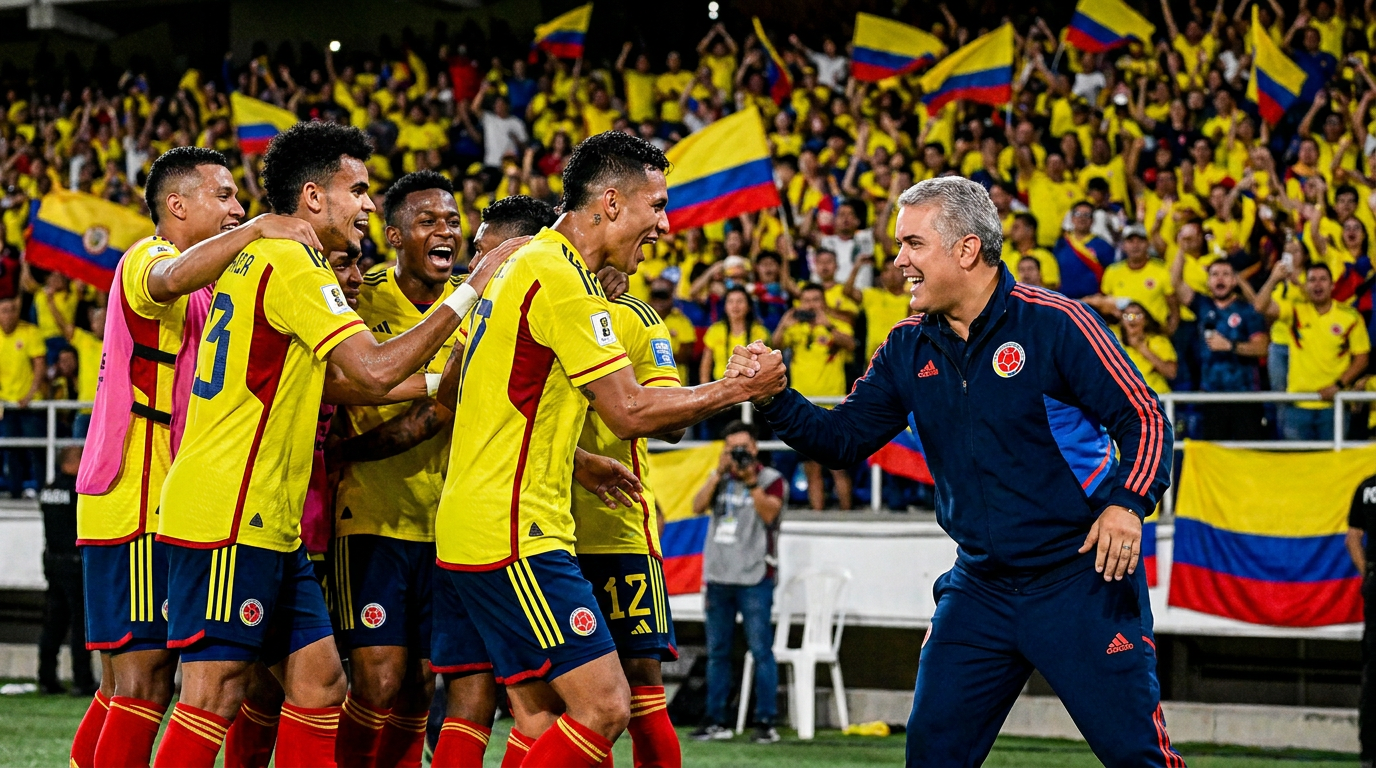
Four years after the heartbreak of missing the tournament in Qatar, Colombia has returned to the FIFA World Cup stage with a vengeance. Rejuvenated and riding the momentum of a spectacular run to the 2024 Copa America final, Los Cafeteros arrive in North America not just to make up the numbers, but to challenge the global elite. Drawn into Group K alongside Portugal, Uzbekistan, and DR Congo, the South American giants are widely considered one of the most dangerous dark horses in the expanded 48-team format.[1][2][3][5][6]
The architect of this resurgence is 60-year-old Argentine manager Néstor Lorenzo. Since taking the reins, Lorenzo has transformed a disjointed squad into a cohesive, front-foot attacking unit. Implementing a possession-based 4-2-3-1 formation, his tenure has been defined by a refusal to hide against top opposition, highlighted by a historic 2-1 victory over Brazil during CONMEBOL qualifying. "The idea is to play well, not just win at any cost," Lorenzo recently noted, emphasizing his commitment to proactive football.[1][2][3]
At the heart of Lorenzo’s system remains a familiar face: 2014 Golden Boot winner James Rodríguez. Now 34 and likely competing in his final World Cup, the veteran playmaker continues to operate as the creative heartbeat of the team in the classic Number 10 role. With 126 international caps and 31 goals to his name, Rodríguez dictates the tempo and provides the crucial final passes that unlock deep-sitting defenses.[1][2][3]

While Rodríguez pulls the strings centrally, the team’s most lethal weapon operates on the flank. Luis Díaz, who recently made a high-profile move to Bayern Munich, brings terrifying pace and a lethal right foot to the left wing. Boasting 22 international goals, Díaz is the focal point of Colombia's transition attacks and the player most capable of turning a tight group-stage match on its head. He is supported by an industrious midfield pivot featuring Jefferson Lerma and Richard Rios, who provide the necessary defensive cover.[1][3][4]
Despite their undeniable quality, Colombia enters the tournament with a glaring vulnerability: wastefulness in front of goal. During their rigorous South American qualifying campaign, the team scored an impressive 28 goals but simultaneously led the continent by missing 31 big chances. Their ability to generate opportunities is unquestioned, but their tendency to leave opponents in the game remains a significant concern for neutral analysts mapping out their knockout-stage prospects.[1]

Despite their undeniable quality, Colombia enters the tournament with a glaring vulnerability: wastefulness in front of goal.
To solve this finishing puzzle, Lorenzo will rely on a mix of striking options. Much of the goalscoring responsibility will fall to 28-year-old Luis Suárez—who arrives in blistering form after hammering in 38 goals across all competitions for Sporting CP last season—alongside Jhon Córdoba and Aston Villa's Jhon Durán. If one of these central forwards can find a clinical edge, Colombia’s attack could become truly unplayable.[2][3][4]
Defensively, Colombia is built on a formidable foundation. Goalkeeper Camilo Vargas is shielded by a physical and organized backline featuring Crystal Palace's Daniel Muñoz, Davinson Sánchez, and Jhon Lucumí. This defensive spine has proven highly resilient, capable of absorbing pressure and launching rapid counter-attacks, making them one of the most frustrating teams to break down in international football.[1][4]

Colombia’s World Cup campaign kicks off in Mexico City against tournament debutants Uzbekistan. While the South Americans are heavy favorites against the Central Asian side, they must navigate a team expected to drop deep and defend in numbers under the guidance of former Italian world champion Fabio Cannavaro. Securing three points in the opener is vital, as it sets the stage for a blockbuster clash against group favorites Portugal in Miami.[2][3]
When Colombia takes the pitch, they will be backed by some of the most passionate traveling support in the world. The famous "yellow fever" is expected to take over stadiums across the United States and Mexico, buoyed by massive local immigrant populations. In fact, ticket demand for Colombia's group stage showdown with Portugal is reportedly the second-highest of the entire tournament, trailing only the final.[2]

With a blend of seasoned veterans, elite European-based talent, and an unwavering tactical identity, Colombia has all the ingredients of a deep-run contender. If they can refine their finishing and top Group K to secure a favorable path through the knockout bracket, Los Cafeteros have a genuine opportunity to surpass their historic 2014 quarter-final appearance and shock the world.[1][2][6]
Looking ahead, the consensus projection for Colombia is highly optimistic. They are heavily favored to advance from Group K, with their robust defense and elite chance creation expected to comfortably see them past Uzbekistan and DR Congo. If they can secure first place in the group by challenging Portugal, a deep run to the quarter-finals—or even the semi-finals—is a highly realistic outcome for South America's premier dark horse.[1][5]
How we got here
2022
Colombia fails to qualify for the FIFA World Cup in Qatar, prompting a national team rebuild.
Mid-2022
Néstor Lorenzo is appointed as head coach to revitalize the squad.
Late 2023
Colombia secures a historic 2-1 victory over Brazil in CONMEBOL qualifying.
July 2024
Los Cafeteros reach the final of the Copa America in the United States, cementing their return to elite status.
June 2026
Colombia arrives in Mexico City to open their World Cup campaign against debutants Uzbekistan.
Viewpoints in depth
The Optimists' View
Focuses on Lorenzo's unbeaten streaks and the sheer talent of Díaz and Rodríguez.
Supporters and optimistic pundits point to Colombia's flawless tactical execution under Néstor Lorenzo. By beating heavyweights like Brazil and reaching the 2024 Copa America final, the team has proven they can handle high-pressure environments. The combination of James Rodríguez's vision and Luis Díaz's pace provides a dual threat that few defenses in the tournament are equipped to handle.
The Tactical Skeptics
Highlights the team's wastefulness in front of goal as a fatal flaw.
Data-driven analysts raise red flags over Colombia's finishing metrics. Leading CONMEBOL qualifying in missed big chances (31) suggests a lack of a ruthless edge. Skeptics argue that in the unforgiving environment of knockout football, failing to convert high-quality chances will inevitably lead to an early exit, regardless of how well the midfield controls possession.
What we don't know
- Whether Colombia's strikers can find the clinical finishing touch they lacked during the South American qualifying campaign.
- How the team will handle the immense pressure and expectations of playing in front of massive, demanding crowds in the US and Mexico.
Key terms
- Los Cafeteros
- The popular nickname for the Colombian national football team, translating to 'The Coffee Growers.'
- CONMEBOL
- The South American football confederation, known for having one of the most grueling World Cup qualifying formats in the world.
- Number 10
- A traditional football role assigned to the team's primary playmaker and creative midfielder, currently occupied by James Rodríguez.
- Dark Horse
- A team that is not considered an outright favorite to win a tournament but possesses the quality to surprise the top contenders.
Frequently asked
Who is in Colombia's group for the 2026 World Cup?
Colombia is in Group K alongside Portugal, Uzbekistan, and DR Congo.
Who is managing the Colombian national team?
The team is managed by 60-year-old Argentine Néstor Lorenzo, who has instilled a highly successful 4-2-3-1 system.
Where do Colombia's star players play their club football?
Key winger Luis Díaz currently plays for Bayern Munich, while striker Luis Suárez recently had a 38-goal season for Sporting CP in Portugal.
Sources
Source coverage
6 outlets
3 viewpoints surfaced





[1]PrizePicksNeutral Tournament Analysts
Colombia World Cup 2026 Preview: Lineup, Best Players, Group, & Picks
Read on PrizePicks →[2]The GuardianColombian National Supporters
Colombia World Cup 2026 team guide
Read on The Guardian →[3]Total Football AnalysisTactical Forecasters
Uzbekistan vs Colombia World Cup 2026 Predictions and Best Bets
Read on Total Football Analysis →[4]Dawn News EnglishNeutral Tournament Analysts
Colombia & Ecuador World Cup 2026 Preview | South America's Dark Horses
Read on Dawn News English →[5]Sports IllustratedNeutral Tournament Analysts
Seven Predictions for the 2026 World Cup Group Stage
Read on Sports Illustrated →[6]GOALNeutral Tournament Analysts
Who are the 2026 World Cup dark horses? GOAL writers have their say
Read on GOAL →

Every angle. Every day.
Get sports stories with full source coverage and perspective breakdowns delivered to your inbox.