
Carolina Hurricanes Defeat Vegas Golden Knights to Win 2026 Stanley Cup
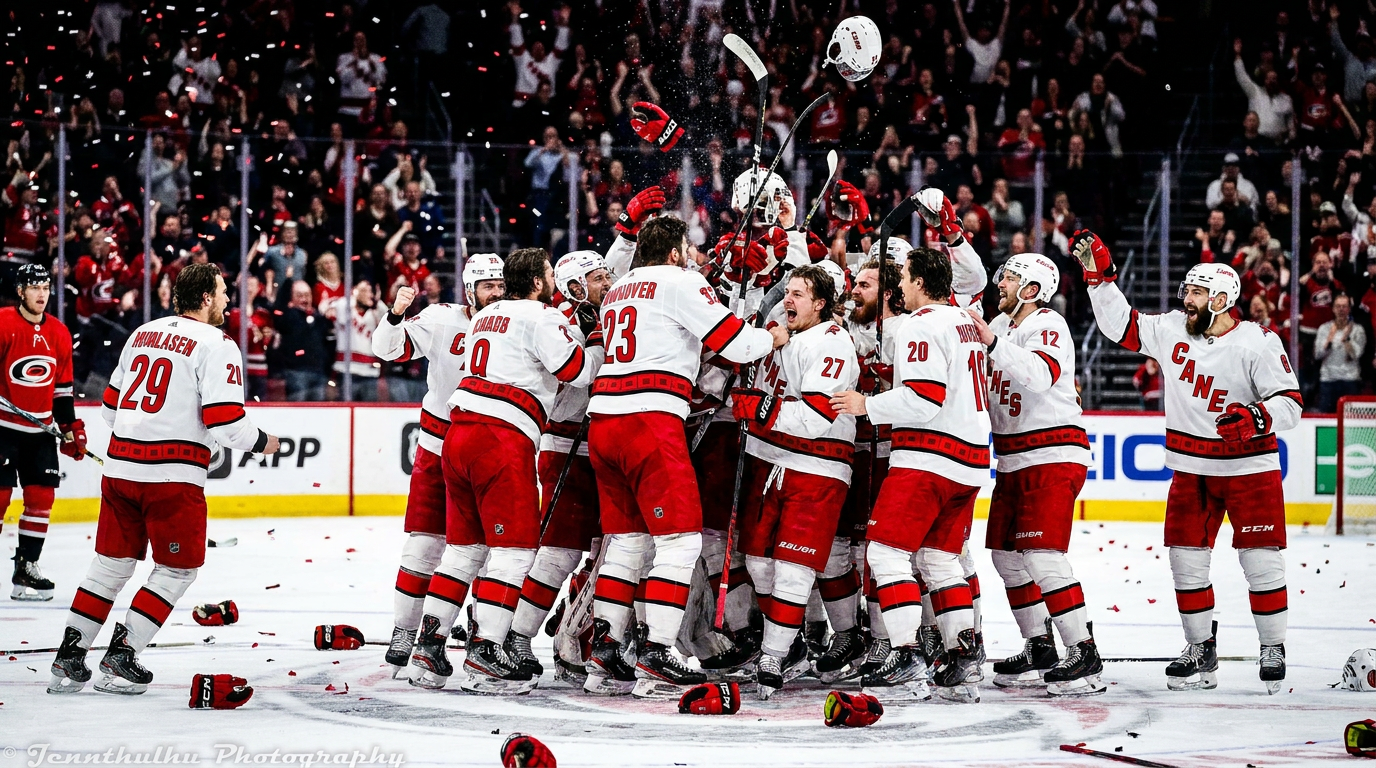
The Carolina Hurricanes secured their second NHL championship in franchise history with a 3-0 Game 6 victory over the Vegas Golden Knights, capping a dominant 16-3 postseason run.
By Factlen Editorial Team
- Carolina Management & Fans
- Celebrates the culmination of a 20-year rebuild, validating the front office's analytical approach and the head coach's leadership.
- Vegas Golden Knights
- Focuses on the exhaustion of a grueling playoff run and the frustration of an offensive collapse in the final games.
- Hockey Analysts
- Highlights the tactical defensive masterclass and the unprecedented historical achievement of the rookie goaltender.
What's not represented
- · Western Conference Scouts
- · Las Vegas Local Businesses
Why this matters
The Carolina Hurricanes' victory proves that a meticulously constructed, analytics-driven roster can overcome traditional top-heavy superstar teams. For hockey fans and franchise builders alike, it serves as a definitive blueprint for how depth, structural discipline, and timely rookie performances can end a two-decade championship drought.
Key points
- The Carolina Hurricanes defeated the Vegas Golden Knights 3-0 in Game 6 to win the 2026 Stanley Cup.
- Rookie goaltender Brandon Bussi recorded a 22-save shutout, becoming the first rookie to do so in a clinching game since 1937.
- Head coach Rod Brind'Amour became the fourth person to win a Cup as both a captain and a coach for the same franchise.
- The Hurricanes' defense held Vegas without a shot on goal for 18 minutes and 37 seconds during the middle of the game.
- Secondary scorers Taylor Hall and Jackson Blake provided the crucial offensive breakthrough for Carolina.
For the first time in two decades, the Stanley Cup is returning to Raleigh. The Carolina Hurricanes secured their second championship in franchise history on Sunday night, defeating the Vegas Golden Knights 3-0 in Game 6 of the Stanley Cup Final at T-Mobile Arena. The victory capped off a dominant 16-3 postseason run that tied the NHL record for playoff efficiency, cementing this iteration of the Hurricanes as one of the most formidable defensive juggernauts of the modern era. As the final buzzer sounded, equipment rained down on the Las Vegas ice, marking the culmination of a meticulous, years-long rebuilding project that finally broke through the Eastern Conference ceiling.[1][2][3]
The emotional epicenter of the celebration was head coach Rod Brind’Amour, who etched his name into a highly exclusive chapter of hockey history. By guiding Carolina to the 2026 title, Brind’Amour became only the fourth individual in the history of the National Hockey League to win a Stanley Cup as a head coach after previously winning it as a captain for the exact same franchise. Twenty years after he hoisted Lord Stanley’s chalice as the on-ice leader of the 2006 squad, Brind’Amour stood behind the bench, orchestrating a tactical masterclass that completely neutralized a potent Vegas offensive attack.[2][5][6]
The clinching game stood in stark contrast to the chaotic, high-scoring affairs that defined the early stages of the series. While the first four games featured blown multi-goal leads and relentless back-and-forth scoring, Game 6 was a suffocating display of structural discipline by the Hurricanes. Carolina established the terms of engagement early and never relented, transforming the neutral zone into an impassable swamp for the Golden Knights. The Hurricanes’ defensive corps, anchored by the flawless positioning of Jaccob Slavin, systematically dismantled the transition game that Vegas had relied upon throughout their improbable playoff run.[2][3]
The sheer scale of Carolina’s defensive dominance was quantified by a staggering drought in the middle of the game. Between the second and third periods, the Vegas Golden Knights went an astonishing 18 minutes and 37 seconds without registering a single shot on goal. Jack Eichel, Mitch Marner, and the rest of the Vegas offensive weapons were repeatedly forced to the perimeter, unable to penetrate the high-danger scoring areas. Every attempted zone entry was met with a wall of white jerseys, forcing dump-ins that were quickly retrieved and cleared by the Carolina defense.[2]

Benefiting from this impenetrable defensive shield was rookie goaltender Brandon Bussi, who authored one of the most improbable underdog stories in recent hockey memory. Making his NHL debut just eight months prior, Bussi was thrust into the spotlight midway through the Final. After the Hurricanes fell behind 4-0 in Game 3, Brind’Amour made the bold decision to insert the 27-year-old rookie into the crease. Bussi not only stabilized the series but completely slammed the door on the Golden Knights, culminating in a flawless 22-save performance in the decisive Game 6.[2][4][5]
Benefiting from this impenetrable defensive shield was rookie goaltender Brandon Bussi, who authored one of the most improbable underdog stories in recent hockey memory.
With his Game 6 masterpiece, Bussi entered rare historical territory. He became the first rookie goaltender to post a shutout in a Stanley Cup-clinching game since Earl Robertson achieved the feat for the Detroit Red Wings in 1937. Bussi’s calm demeanor and precise rebound control radiated confidence throughout the Carolina lineup. Even when Vegas pulled their goaltender for an extra attacker in the dying minutes, creating a frantic 6-on-5 scramble, Bussi remained perfectly square to the shooters, turning aside a final flurry of desperate attempts to preserve the historic shutout.[2]

While the defense and goaltending provided the foundation, Carolina’s offense was driven by an unlikely cast of heroes. Throughout the regular season, the Hurricanes relied heavily on the star power of Sebastian Aho and Andrei Svechnikov. However, both franchise cornerstones were largely neutralized in the postseason, combining for a relatively quiet offensive output. Instead, it was the Hurricanes’ second line that carried the scoring burden, proving that championship rosters are built on relentless depth rather than top-heavy star power.[5]
Veteran forward Taylor Hall set the tone just 3 minutes and 47 seconds into Game 6. Capitalizing on a swift transition play, Hall received a breakout pass, accelerated past the Vegas defense, and beat goaltender Carter Hart on a clean breakaway. The goal was Hall’s seventh of the postseason, instantly deflating the raucous crowd at T-Mobile Arena and providing Carolina with a lead they would never relinquish. Hall’s resurgence throughout the playoffs served as a testament to the Hurricanes’ pro-scouting department, which identified his remaining elite speed as a perfect fit for Brind’Amour’s aggressive forechecking system.[2][4]
The offensive momentum continued in the second period courtesy of rookie sensation Jackson Blake. At the 13:31 mark of the middle frame, Blake positioned himself perfectly in the slot to deflect a shot past Hart, doubling the Carolina advantage to 2-0. Like Hall, it was Blake’s seventh goal of the playoffs. The play was orchestrated by Logan Stankoven, who recorded his fifth assist of the postseason on the sequence. Together, the trio of Hall, Blake, and Stankoven finished the playoffs with a combined 54 points, serving as the undisputed engine of the Hurricanes' championship run.[2][4]

The construction of this deep, resilient roster was the crowning achievement of General Manager Eric Tulsky. Long regarded as one of the brightest analytical minds in the sport, Tulsky blended advanced metrics with traditional scouting to assemble a team without a discernible weakness. Crucial offseason and trade deadline acquisitions, including the signing of winger Nikolaj Ehlers and the trade for defenseman K'Andre Miller, provided the exact ingredients Carolina had been missing in previous playoff failures. Ehlers ultimately sealed the Game 6 victory with an empty-net goal in the final minute.[4][5]
For the Vegas Golden Knights, the defeat marked a bitter end to a remarkably resilient season. Making their third appearance in the Stanley Cup Final in their brief nine-year franchise history, Vegas overcame a wave of regular-season injuries just to qualify for the postseason. Goaltender Carter Hart was valiant in defeat, stopping 19 of 21 shots in Game 6 and keeping his team within striking distance until the final empty-net tally. However, the sheer exhaustion of their grueling playoff path, combined with Carolina’s relentless checking, ultimately proved too much to overcome.[4][5]
As the Stanley Cup was passed from captain Jordan Staal to his jubilant teammates, the scene in Las Vegas mirrored the euphoric watch parties unfolding thousands of miles away in North Carolina. The Hurricanes' 16-3 playoff record stands as a monument to their consistency, sweeping both the Ottawa Senators and Philadelphia Flyers before dismantling the Montreal Canadiens and finally the Golden Knights. The 2026 Carolina Hurricanes will be remembered not just for ending a 20-year drought, but for the suffocating, team-first blueprint they used to conquer the hockey world.[3][6]
How we got here
2005-06 Season
The Carolina Hurricanes win their first Stanley Cup with Rod Brind'Amour serving as team captain.
May 2026
General Manager Eric Tulsky finalizes a deep playoff roster, heavily emphasizing secondary scoring and defensive structure.
June 2026 (Game 3)
Rookie goaltender Brandon Bussi takes over the net for Carolina after the team falls behind 4-0, turning the series around.
June 14, 2026
The Hurricanes shut out the Golden Knights 3-0 in Game 6 to secure their second franchise championship.
Viewpoints in depth
Carolina's Tactical Blueprint
How the Hurricanes used analytics and depth to overwhelm opponents.
For years, the Carolina Hurricanes were criticized for lacking the elite, game-breaking superstars necessary to win a Stanley Cup. However, General Manager Eric Tulsky and head coach Rod Brind'Amour doubled down on a system built around relentless forechecking, elite puck possession, and suffocating team defense. By acquiring depth pieces like Nikolaj Ehlers and K'Andre Miller, they ensured that even when their top line was neutralized, their secondary scorers could dominate the opposition. This structural discipline ultimately proved impenetrable for the Golden Knights.
The Vegas Perspective
The Golden Knights' view on their offensive collapse and Carter Hart's silver lining.
From the perspective of the Vegas Golden Knights, the Final was a story of physical attrition and offensive frustration. Having battled through a grueling Western Conference gauntlet, the team appeared out of gas by Game 6, evidenced by their staggering 18-minute shotless streak. Despite the offensive power outage, Vegas found a silver lining in the performance of goaltender Carter Hart, who consistently kept the games within reach despite facing a barrage of high-danger chances from Carolina's transition game.
The Goaltending Miracle
Analysts' view on Brandon Bussi's unprecedented rise from the AHL to Stanley Cup hero.
Hockey historians and analysts are framing Brandon Bussi's performance as one of the greatest rookie goaltending feats in NHL history. Thrust into the net down 4-0 in Game 3, the 27-year-old rookie not only stabilized the series but completely demoralized the Vegas shooters. By becoming the first rookie since 1937 to post a shutout in a Cup-clinching game, Bussi transformed what was considered Carolina's biggest question mark into their ultimate competitive advantage.
What we don't know
- Whether rookie goaltender Brandon Bussi will be named the full-time starter for the Hurricanes next season.
- How the Vegas Golden Knights will retool their aging roster after a grueling and physically taxing playoff run.
- Which player will be awarded the Conn Smythe Trophy as the most valuable player of the playoffs.
Key terms
- Stanley Cup
- The championship trophy awarded annually to the playoff winner of the National Hockey League (NHL).
- Shutout
- A game in which a goaltender successfully prevents the opposing team from scoring any goals.
- Empty-net goal
- A goal scored when the opposing team has removed their goaltender from the ice in favor of an extra offensive skater.
- Secondary scoring
- Goals and points produced by players outside of a team's primary top offensive line, indicating strong roster depth.
- Forechecking
- A defensive strategy applied in the offensive zone to pressure the opposing team and regain control of the puck.
Frequently asked
Who won the 2026 Stanley Cup?
The Carolina Hurricanes won the 2026 Stanley Cup, defeating the Vegas Golden Knights 4-2 in the series.
Who was the winning goaltender in Game 6?
Rookie goaltender Brandon Bussi earned the win for Carolina, stopping all 22 shots to record a historic shutout.
How long had it been since Carolina's last championship?
It had been 20 years. The Hurricanes' only other Stanley Cup victory came in the 2005-06 season.
Who scored the goals in the clinching game?
Taylor Hall, Jackson Blake, and Nikolaj Ehlers (empty net) scored the three goals for Carolina in their 3-0 Game 6 victory.
Sources
Source coverage
6 outlets
3 viewpoints surfaced






[1]ESPNHockey Analysts
Hurricanes win Game 6, raise Cup for second time
Read on ESPN →[2]CBS SportsVegas Golden Knights
2026 Stanley Cup Final: Hurricanes claim second title with 3-0 win in Game 6
Read on CBS Sports →[3]NHL.comCarolina Management & Fans
Carolina Hurricanes Win 2026 Stanley Cup Final
Read on NHL.com →[4]TSNHockey Analysts
Hurricanes close out Golden Knights in Game 6 to secure second Stanley Cup title in franchise history
Read on TSN →[5]Pro Hockey RumorsHockey Analysts
Carolina Hurricanes Win 2026 Stanley Cup
Read on Pro Hockey Rumors →[6]WRALCarolina Management & Fans
Hurricanes win Stanley Cup
Read on WRAL →

Every angle. Every day.
Get sports stories with full source coverage and perspective breakdowns delivered to your inbox.