
AWS Launches $1 Billion 'Secret Cloud' AI Initiative for Public Sector Following CIA Warnings
Amazon Web Services has unveiled a $1 billion investment to build isolated, highly classified AI infrastructure for government agencies. The move aims to safely bring generative AI to the intelligence community without risking data exposure.
By Mateo Ramos

Share this story
The generative artificial intelligence boom has largely bypassed the world's most data-rich organizations: national intelligence and defense agencies. Because classified information cannot be routed through public commercial APIs, government analysts have been forced to watch from the sidelines as the private sector automates complex workflows.[1]
That bottleneck is now breaking. Amazon Web Services (AWS) has launched a $1 billion "Secret Cloud" initiative, a massive infrastructure build-out designed specifically to host frontier AI models in completely isolated, air-gapped environments for the public sector.[2]
The announcement comes just days after the CIA Director starkly framed the stakes of the technology, referring to advanced artificial intelligence as "digital nuclear weapons" that require unprecedented security protocols and careful handling by state actors.[1]
For intelligence and defense agencies, the challenge has not been a lack of interest in AI, but a lack of secure deployment mechanisms. Commercial AI models typically rely on continuous internet connectivity and shared cloud compute, both of which are absolute non-starters for classified data.
The AWS Secret Cloud initiative solves this by physically separating the AI infrastructure. Rather than renting space on shared commercial servers, government clients will have access to dedicated data centers that are physically disconnected from the public internet.
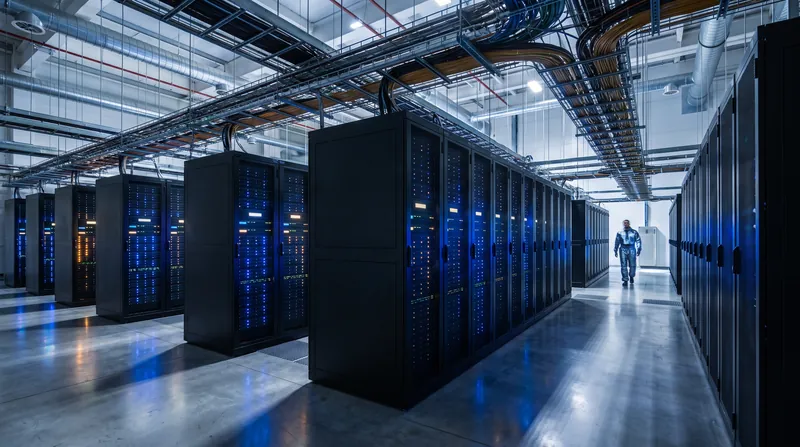
Inside these highly secure facilities, AWS is deploying specialized server racks equipped with the latest AI accelerators. This allows agencies to run massive language models entirely on-premises, ensuring that sensitive prompts and proprietary training data never leave the facility.[3]
The mechanism of "air-gapped AI" requires a fundamental rethinking of how models are updated. Because the servers cannot connect to the outside world to download the latest weights or software patches, updates must be physically carried into the facility on secure drives—a process historically known as "sneaker-netting."
Once inside the secure perimeter, the models can be fine-tuned on highly classified datasets. For example, an intelligence agency could train a model on decades of intercepted communications or satellite imagery, creating a bespoke AI analyst capable of finding patterns human operators might miss.
The $1 billion investment will primarily fund the construction of these specialized facilities and the procurement of high-end compute hardware, which remains in short supply globally due to massive commercial demand.[2]
Defense officials have welcomed the initiative, noting that adversaries are aggressively pursuing AI capabilities. The ability to rapidly deploy and scale AI tools within a secure perimeter is increasingly viewed as a critical national security imperative to maintain strategic parity.[1]
However, the isolated nature of the Secret Cloud introduces unique operational challenges. Frontier AI models are notoriously difficult to maintain, often requiring constant monitoring, troubleshooting, and tweaking by teams of specialized machine learning engineers.[3]
In a classified environment, every engineer touching the system must possess top-secret clearance, drastically shrinking the available talent pool. AWS has indicated that a portion of the $1 billion fund will be dedicated to training cleared personnel to manage these complex systems.
Furthermore, the cost of running dedicated AI infrastructure is astronomical. Unlike commercial cloud computing, where costs are amortized across millions of users, the Secret Cloud requires the government to bear the full cost of the hardware, specialized cooling, and continuous maintenance.[2][3]
Despite these financial and logistical hurdles, the demand for secure AI is surging. Beyond the intelligence community, civilian agencies dealing with sensitive health records, tax data, and critical infrastructure are also exploring isolated AI deployments to modernize their operations.
The AWS initiative represents a broader shift in the AI industry toward "sovereign" and "isolated" compute. As organizations realize the immense value of their proprietary data, the willingness to share that data with commercial AI providers is rapidly diminishing.[2]
By providing a proven blueprint for secure, air-gapped AI, the Secret Cloud could eventually pave the way for highly regulated private industries—such as global banking and healthcare networks—to adopt similar isolated architectures.[3]
Ultimately, the success of the initiative will depend on whether the isolated models can keep pace with the rapid advancements occurring in the commercial sector. If the capability gap between public and classified AI grows too large, the utility of the Secret Cloud may diminish.
For now, however, the AWS investment provides a critical bridge, allowing the public sector to harness the transformative power of generative AI without compromising the nation's most closely guarded secrets.[1]
Key points
- AWS is investing $1 billion to build highly secure, isolated AI infrastructure for the public sector.
- The 'Secret Cloud' allows intelligence agencies to use generative AI without risking classified data exposure.
- The CIA Director recently compared the strategic stakes of advanced AI to 'digital nuclear weapons.'
- The servers are entirely air-gapped, meaning they have no physical connection to the public internet.
Open questions
- Which specific frontier AI models (e.g., from Anthropic, Meta, or others) will be officially certified to run within the Secret Cloud.
- How frequently the air-gapped models will be updated, given the logistical friction of physical data transfers.
- Whether the $1 billion investment will be sufficient to meet the compute demands of the entire US intelligence community.
Timeline
Early 2023
The generative AI boom begins, but intelligence agencies are largely restricted from using commercial APIs due to data security rules.
Late 2024
The Department of Defense signals an urgent need for 'sovereign' AI capabilities to maintain parity with global adversaries.
June 2026
The CIA Director issues a stark warning about the risks of AI, comparing the technology to 'digital nuclear weapons.'
July 2026
AWS officially launches its $1 billion 'Secret Cloud' initiative to provide air-gapped AI infrastructure to the public sector.
- National Security Officials
- View secure, isolated AI infrastructure as a critical necessity to maintain strategic parity with global adversaries.
- Cloud Infrastructure Providers
- See the public sector as a massive, stable market that justifies the high capital expenditure of building bespoke, air-gapped data centers.
- Cybersecurity Analysts
- Focus on the logistical challenges of maintaining and updating frontier AI models without internet connectivity.
Perspectives this story doesn't cover
- Privacy and Civil Liberties Advocates
- Commercial AI Model Developers
Sources
Source coverage
3 outlets
3 viewpoints surfaced



- [1]The Washington PostNational Security Officials
CIA Director warns of AI risks as Amazon expands classified cloud
Read on The Washington Post → - [2]ReutersCloud Infrastructure Providers
Amazon Web Services launches $1 bln fund for government AI projects
Read on Reuters → - [3]TechCrunchCloud Infrastructure Providers
OpenAI bets on families as ChatGPT goes deeper into households
Read on TechCrunch →

More in Artificial Intelligence
See all →Cybersecurity
Frontier AI Use Triggers 42% Surge in Zero-Day Exploits, Accelerating Vulnerability Discovery
5 sources

AI Compute
AMD Invests $5 Billion in Anthropic Under New AI Infrastructure Deal, Directly Challenging Nvidia
8 sources
Macroeconomics
Federal Reserve Raises US Growth Forecast, Citing Surging AI Infrastructure Investment
4 sources
Protein Design
Microsoft's BioEmu and BindCraft Spark a New 'AlphaFold Moment' in Protein Engineering
4 sources

Comments
Every angle. Every day.
Get Artificial Intelligence stories with full source coverage and perspective breakdowns, free every day.