
AI Decodes Sperm Whale 'Phonetic Alphabet,' Enabling First Two-Way Interspecies Communication
Researchers have used artificial intelligence to decode 156 distinct sperm whale vocalizations, revealing complex grammar and regional dialects. The breakthrough paves the way for basic two-way communication with marine mammals, fundamentally shifting our understanding of non-human intelligence.
By Factlen Editorial Team
- Marine Biologists
- Focused on the ecological and biological significance of understanding cetacean social structures.
- AI Researchers
- View this as a landmark test of machine learning's ability to decipher non-human, unstructured data.
- Legal & Ethical Scholars
- Argue that language capacity necessitates a reevaluation of animal rights and legal personhood.
- Maritime Industry
- Preparing for the operational and regulatory impacts of navigating waters inhabited by legally recognized sentient pods.
What's not represented
- · Indigenous coastal communities
- · Commercial fishing operators
Why this matters
Proving that cetaceans possess structured language challenges the long-held belief that complex grammar is unique to humans. It opens the door to unprecedented conservation efforts, potential legal rights for marine life, and a profound shift in how humanity interacts with the natural world.
Key points
- Project CETI researchers used AI to decode a 156-coda phonetic alphabet used by sperm whales.
- Machine learning models revealed that whale clicks contain complex syntax, grammar, and regional dialects.
- Scientists successfully conducted basic two-way playback experiments, marking a milestone in interspecies communication.
- The discovery is prompting legal scholars to reevaluate animal rights and the concept of legal personhood for cetaceans.
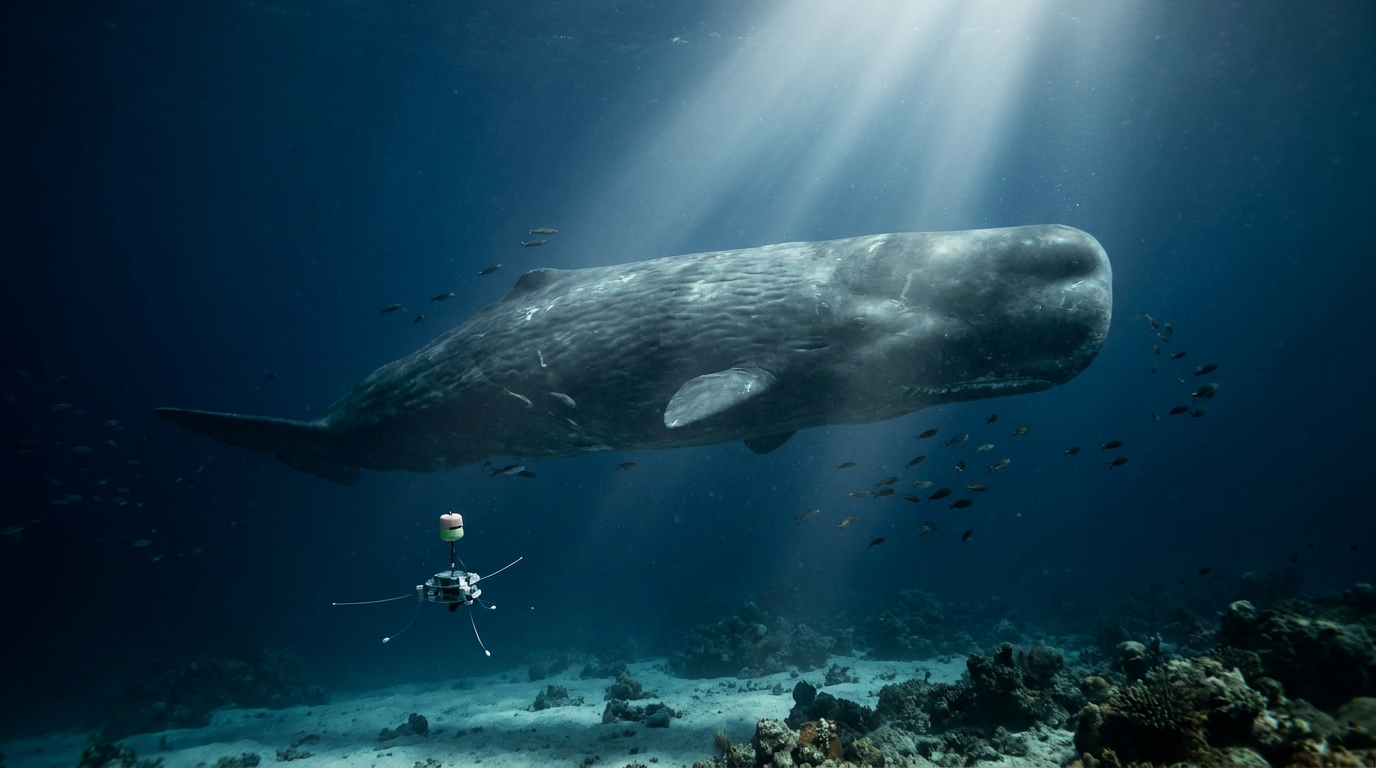
For centuries, the rhythmic clicks echoing through the deep ocean were a mystery, dismissed by early sailors as the sounds of underwater machinery and later understood merely as biological sonar used for navigation. Today, that paradigm has been permanently shattered. In a landmark announcement that bridges the gap between biology and computer science, researchers have confirmed that artificial intelligence has successfully decoded the communication system of sperm whales, revealing a complex, rule-bound language. This discovery fundamentally alters our understanding of intelligence on Earth, proving that humanity is not the only species capable of structured, grammatical communication.[1][2]
The breakthrough, spearheaded by the Cetacean Translation Initiative (Project CETI) and an international coalition of scientists, marks the first time humanity has translated the structural grammar of another species. By feeding decades of underwater acoustic recordings into advanced machine learning models, scientists identified a comprehensive 'phonetic alphabet' consisting of 156 distinct vocal patterns, known as codas. These codas serve as the foundational building blocks of sperm whale communication, much like vowels and consonants in human speech, allowing the animals to construct a vast array of meaningful expressions.[1][5]
Crucially, these codas are not just random bursts of sound or simple echolocation clicks used exclusively for hunting squid in the abyss. The AI models revealed that sperm whales combine these phonetic building blocks using specific, rigid rules of syntax and grammar to convey precise, context-dependent information to one another. Researchers observed that the arrangement of the clicks changes predictably based on the social situation, indicating that the whales are sharing complex data rather than simply broadcasting their presence or emotional state.[3][6]
'We are no longer just listening to the ocean; we are beginning to read its transcripts,' noted one lead researcher involved in the acoustic analysis. The models demonstrated that whales actively alter the tempo, rhythm, and sequence of their clicks depending on who they are addressing and the broader social context of the pod. This displays a level of linguistic sophistication and intentionality previously thought to be exclusively human, challenging long-held assumptions in both biology and linguistics. The ability to modify a message based on the recipient implies a deep level of social awareness and cognitive processing.[2][4]

The sheer scale of the computational power and data required to make this leap was staggering. Project CETI and its technology partners utilized specialized neural networks, including the Whale Acoustic Model (WhAM), to process over 100,000 individual whale clicks extracted from millions of hours of ocean audio. This dataset, collected over twenty years by the Dominica Sperm Whale Project, provided the massive volume of raw acoustic information necessary for the AI to begin recognizing recurring patterns and structural rules.[3][5]
Traditional human analysis could never have parsed this overwhelming volume of data with such precision. The AI systems were uniquely capable of filtering out the cacophony of modern ocean background noise—including the roar of commercial shipping engines, military sonar, and seismic airguns used in oil exploration—to isolate the subtle, rapid-fire variations in the whales' conversational exchanges. By separating the signal from the noise, the algorithms exposed a hidden world of continuous, structured dialogue occurring just beneath the waves.[1][3]
Perhaps the most astonishing revelation to emerge from the data is the definitive existence of regional dialects among whale populations. Just as human language varies dramatically by geography and culture, the AI identified that sperm whale pods in the Caribbean use distinct structural variations and slang compared to pods in the Pacific Ocean. Yet, despite these regional differences, both populations share a foundational grammatical root, suggesting a deep, evolutionary basis for their language that is passed down through generations.[4][6]
Perhaps the most astonishing revelation to emerge from the data is the definitive existence of regional dialects among whale populations.
This linguistic discovery recently culminated in a profound and unprecedented milestone: basic two-way communication. In a series of carefully controlled, non-invasive playback experiments conducted in the wild, researchers broadcasted synthesized greeting codas into the water using specialized underwater speakers. The goal was to see if the whales would recognize the AI-generated syntax as a legitimate attempt at communication, rather than just anomalous ocean noise. The team waited with bated breath as the synthesized clicks echoed into the deep, unsure if the pod would flee, ignore the signal, or engage.[2][5]

The response was immediate, structured, and unmistakable. The whales did not scatter; instead, they actively engaged, replying with conversational codas that perfectly matched the syntax and rhythm of the researchers' broadcast. While it was a brief, rudimentary exchange—akin to a basic greeting—it represented the first true, intentional interspecies dialogue in Earth's history, proving that the AI had accurately cracked the code of their phonetic alphabet. The whales even paused their own communications to listen to the broadcast before issuing their coordinated replies, demonstrating active listening and turn-taking.[1][2]
Gathering the pristine audio required for this breakthrough relied on a suite of cutting-edge, non-invasive technologies. The research team deployed soft robotics and drone-attached suction tags that adhere harmlessly to the whales' backs. These advanced sensors allowed researchers to record continuous, high-fidelity audio from within the pod for days at a time, capturing intimate social interactions without disrupting the animals' natural behavior or causing them distress. The tags also recorded depth, acceleration, and orientation, allowing the AI to correlate specific vocalizations with specific physical actions, such as diving, nursing, or hunting.[5][6]
The implications of this discovery extend far beyond the realm of marine biology, striking at the very core of human philosophy, linguistics, and our perceived place in the world. For decades, the prevailing scientific consensus held that complex, combinatorial language—the ability to combine meaningless sounds into meaningful phrases—was the defining evolutionary trait that separated humans from the rest of the animal kingdom. That barrier has now been permanently dismantled. Philosophers and scientists alike are now forced to grapple with the reality that human beings are not the sole proprietors of complex thought and structured expression, prompting a profound reevaluation of animal intelligence.[3][4]
With the scientific evidence now undeniable, legal and ethical scholars are rapidly mobilizing. Organizations like the More-Than-Human Life (MOTH) project are utilizing these linguistic findings to build a robust legal case for cetacean personhood. Advocates argue that if whales possess language, culture, individual names, and complex social structures, they can no longer be legally classified merely as property or natural resources. Instead, they must be granted fundamental legal rights, including the right to life, liberty, and a protected habitat.[4][8]

This looming shift in legal status is already sending ripples through the global economy, particularly within the maritime shipping and commercial fishing industries. Industry analysts are actively preparing for a near future where major ocean transit routes might require dynamic 'negotiation' or mandatory rerouting based on the real-time communications and movements of legally protected whale pods. Shipping conglomerates are investing heavily in acoustic monitoring systems to ensure their vessels do not disrupt the newly recognized sovereign territories of these marine cultures.[7]
However, the unprecedented ability to speak to whales also raises profound ethical concerns among the scientific community. Conservationists warn that humanity must establish strict, internationally recognized protocols to prevent acoustic harassment, commercial exploitation, or the weaponization of this translation technology. The primary goal, researchers emphasize, must remain focused on listening, understanding, and protecting these species, rather than attempting to interfere with, direct, or domesticate wild populations. There is a real fear that bad actors could use synthesized codas to lure whales into unprotected waters or disrupt their natural migratory patterns.[1][8]
As researchers continue to refine their AI models, the timeline for understanding other highly intelligent marine mammals is rapidly accelerating. Parallel AI projects are currently targeting the complex vocalizations of dolphins and orcas, with similar breakthroughs expected by 2028. For now, humanity stands at the threshold of a transformative new era, deeply humbled by the realization that as we look out into the universe for signs of intelligent life, we have never been the only intelligent voices speaking on our own planet.[2][7]
How we got here
2005
The Dominica Sperm Whale Project begins collecting thousands of hours of acoustic data.
2020
Project CETI is founded, bringing together marine biologists and AI researchers to decode whale clicks.
2024
Researchers publish initial findings suggesting context-dependent structures in sperm whale codas.
Early 2026
AI models successfully map the 156-coda phonetic alphabet and conduct the first two-way playback experiments.
Viewpoints in depth
Marine Biologists' view
Emphasizes the ecological importance of understanding whale culture and social bonds.
For marine biologists, the discovery of a phonetic alphabet validates decades of observational research. They argue that understanding the precise nature of whale communication allows for highly targeted conservation efforts. By mapping how pods share information about food sources or environmental threats, scientists can better protect critical habitats. Furthermore, the existence of regional dialects highlights the importance of preserving distinct cultural groups within the species, rather than just maintaining overall population numbers.
AI Researchers' view
Focuses on the technical triumph of pattern recognition in unstructured, non-human datasets.
From a computational perspective, decoding whale codas represents a monumental achievement in unsupervised machine learning. AI researchers point out that unlike human language models, which are trained on vast amounts of pre-labeled text, the whale acoustic models had to discover the underlying syntax entirely from scratch. This success proves that modern AI can identify complex, rule-based structures in alien datasets, paving the way for applications in decoding other animal languages or even analyzing extraterrestrial signals.
Legal & Ethical Scholars' view
Advocates for a paradigm shift in animal rights based on the evidence of complex language.
Legal scholars argue that language is a primary indicator of advanced cognition and self-awareness. With empirical evidence that sperm whales possess a structured phonetic alphabet, organizations like the Nonhuman Rights Project are building frameworks to grant cetaceans legal personhood. This viewpoint asserts that sentient beings capable of complex communication cannot be treated merely as property or resources, and must be afforded fundamental rights, including the right to a protected habitat free from human-induced acoustic trauma.
What we don't know
- Whether whales possess abstract concepts or merely communicate immediate environmental and social data.
- How the maritime and shipping industries will practically implement dynamic routing based on whale communications.
- The extent to which other marine species, such as dolphins and orcas, share similar grammatical structures.
Key terms
- Coda
- A distinct, rhythmic pattern of clicks used by sperm whales to communicate.
- Phonetic Alphabet
- A set of foundational sounds that can be combined using rules of grammar to create complex meanings.
- Legal Personhood
- A legal concept where non-human entities are granted certain fundamental rights and protections under the law.
- Machine Learning
- A branch of artificial intelligence where computer systems learn to identify patterns in massive datasets without explicit programming.
Frequently asked
Did scientists actually talk to whales?
Yes, in a rudimentary way. Researchers played synthesized greeting codas into the ocean, and the whales responded with matching conversational syntax.
How did AI help decode the language?
AI models processed millions of hours of ocean audio, filtering out background noise to identify complex grammatical patterns in the whales' clicks that humans couldn't detect.
What are the whales saying?
While full translation is ongoing, the decoded codas convey precise information about identity, social context, and regional dialects.
Will this change how we treat marine life?
Likely. Legal scholars are using this evidence of complex language to argue for expanded animal rights and protections against habitat disruption.
Sources
Source coverage
8 outlets
4 viewpoints surfaced








[1]ReutersAI Researchers
AI breakthrough allows scientists to decode sperm whale 'alphabet'
Read on Reuters →[2]National GeographicMarine Biologists
We just spoke to whales. Here is what they said.
Read on National Geographic →[3]Scientific AmericanAI Researchers
Machine Learning Uncovers Hidden Syntax in Sperm Whale Codas
Read on Scientific American →[4]BBC NewsLegal & Ethical Scholars
Scientists crack the code of whale communication
Read on BBC News →[5]Project CETIMarine Biologists
Understanding Communication Beneath the Waves: The Sperm Whale Phonetic Alphabet
Read on Project CETI →[6]NatureMarine Biologists
Contextual and combinatorial structure in sperm whale vocalisations
Read on Nature →[7]Maritime InnovationsMaritime Industry
The Race to First Contact: What Happens When Whales Have Lawyers?
Read on Maritime Innovations →[8]MOTH ProjectLegal & Ethical Scholars
Interspecies Communication and the Future of Legal Personhood
Read on MOTH Project →
More in ai
See all 7 stories →Edge AI
How On-Device AI and Quantization Are Moving LLMs Out of the Cloud
6 sources

Agentic AI
Agentic AI: How Large Action Models Are Automating Digital Chores
7 sources

Global AI Governance
EU Delays Key AI Act Enforcement as 'Brussels Effect' Fractures Under US Deregulation
8 sources
Drug Discovery
New AI Model Accelerates Molecular Simulations 10,000-Fold, Promising Faster Drug Discovery
6 sources
Every angle. Every day.
Get ai stories with full source coverage and perspective breakdowns delivered to your inbox.