
Absolute Scoring vs. Relative Ranking: The Algorithms That Decide What Wins
From Netflix recommendations to AI training, systems rely on two fundamentally different ways to evaluate quality. We break down the mathematical trade-offs between absolute scores and relative comparisons.
By Tariq Nasser

In short
- Absolute scoring evaluates items independently against a fixed rubric, such as a 5-star scale.
- Relative ranking compares items directly against each other, neutralizing human subjective bias.
- Studies show relative ranking yields significantly higher accuracy in human evaluation tasks.
The hidden engine of the modern digital economy is the ranking algorithm. Whether it is a streaming platform deciding which movie to display, a hospital evaluating the clarity of medical images, or an artificial intelligence lab training its next reasoning model, systems must constantly evaluate quality.
At the architectural level, this evaluation problem boils down to two fundamentally different paradigms: Absolute Scoring and Relative Ranking. While they attempt to solve the exact same problem, they process human preference and mathematical optimization in entirely different ways.
Understanding the mechanics, trade-offs, and ideal use cases of these two systems is crucial for anyone building recommendation engines, designing surveys, or deploying machine learning models.[1]
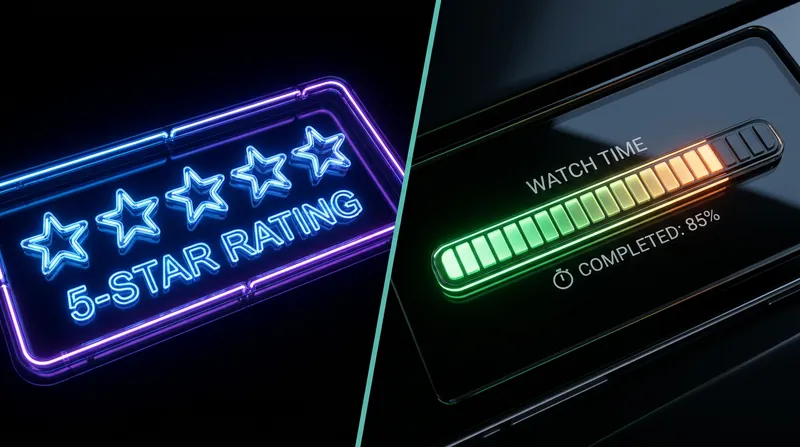
Absolute Scoring is the default language of the internet. It encompasses the ubiquitous 1-to-5 star rating, the 1-to-10 Likert scale, and the traditional 100-point academic grading system.
The core appeal of absolute scoring lies in its independence. An evaluator looks at a single item and assigns it a value based on an internal rubric, without needing to reference any other item in the dataset.
However, absolute scoring suffers from a fatal flaw: human subjectivity. Because the scale is fixed but the human baseline is not, one user's "average 3-star experience" is another user's "perfect 5-star experience."
This subjectivity inevitably leads to systemic grade inflation. On platforms ranging from ride-sharing apps to e-commerce storefronts, a 4.6-star rating is often considered a failure, compressing the entire useful signal into a tiny fraction of the top of the scale and rendering the bottom half mathematically useless.
Relative Ranking abandons the concept of an isolated score entirely. Instead of asking "How good is this item?", the system asks "Is this item better than that item?"
This paradigm includes pairwise comparisons, Elo rating systems originally designed for competitive chess, and tournament-style evaluation brackets. By forcing a choice between two concrete options, relative ranking neutralizes the evaluator's subjective baseline.
The empirical evidence heavily favors the accuracy of relative systems when measuring human perception. A study published in the American Journal of Roentgenology tested radiologists' ability to assess the sharpness of biomedical images.[2]
The researchers found that when radiologists used absolute Likert scales, their accuracy achieved a concordance correlation coefficient (CCC) of 0.83. But when forced to use pairwise relative comparisons, their accuracy jumped to a perfect 1.0.[2]
When evaluating Absolute Scoring, the trade-offs are distinct: • **For:** It is highly transparent, computationally cheap (scaling linearly at O(N)), and establishes clear quality gates. A score of 4.5 immediately communicates magnitude. • **Against:** It is highly vulnerable to subjective bias, grade inflation, and "discriminative collapse," where evaluators cluster scores at the top of the scale. • **Evidence:** Data from major platforms shows massive skew; 5-star systems routinely average 4.3 or higher, destroying the system's ability to differentiate between "good" and "great."
Conversely, Relative Ranking presents a different profile: • **For:** It neutralizes subjective baselines. It is cognitively easier to declare a winner between two options than to assign an isolated number, making it highly resilient to distribution shifts. • **Against:** It is computationally expensive, scaling quadratically (O(N²)) if every pair is tested.
More critically, it loses absolute magnitude—it can identify the best option in a set of terrible choices without revealing that all choices are terrible. • **Evidence:** The NIH-backed medical imaging study demonstrated that pairwise comparison yielded a perfect 1.0 accuracy score, proving it captures human preference far more reliably than isolated ratings.[2]
The debate between these two systems has recently moved from consumer software to the bleeding edge of artificial intelligence development.
Historically, Reinforcement Learning from Human Feedback (RLHF) relied on absolute reward models, where an AI judge would assign a scalar score to a language model's output.
But AI models suffer from the same discriminative collapse as humans, eventually assigning similar high scores to everything and stalling the training process.
To solve this, researchers are shifting to frameworks like Group Relative Policy Optimization (GRPO) and Reinforcement Learning with Relative Rewards (RLRR). By forcing the AI to rank a batch of responses against each other, the training signal remains sharp, stable, and mathematically robust.
Yet, relative ranking cannot entirely replace absolute scoring in production environments. A relative system might correctly identify the best AI model variant, but an absolute score is required to determine if that variant meets the safety thresholds required to deploy it.
Ultimately, neither system is universally superior. The choice depends entirely on the operational constraints of the environment. • **Absolute Scoring fits well when:** Systems require strict governance gates (e.g., "do not deploy if score < 4.0"), computational budgets are tight, or the absolute magnitude of quality matters more than the exact order of items. • **Absolute Scoring does not fit when:** Evaluators have wildly different subjective baselines, or when the system suffers from chronic grade inflation.[1]
• **Relative Ranking fits well when:** The primary goal is sorting a high volume of closely matched candidates, evaluators are inconsistent, or when training AI models where absolute reward signals are too noisy. • **Relative Ranking does not fit when:** You need to know if the "winner" is actually objectively good, or when the candidate pool is too massive to support the required number of pairwise comparisons.[1]
Key terms
- Absolute Scoring
- A system where an item is evaluated independently against a fixed rubric or scale, such as a 5-star rating.
- Relative Ranking
- A system where items are evaluated by comparing them directly against each other, such as a tournament bracket or pairwise choice.
- Concordance Correlation Coefficient (CCC)
- A statistical measure of agreement or accuracy between a rater's score and the true value.
- Discriminative Collapse
- A failure mode in evaluation where raters begin assigning the same high score to most items, destroying the system's ability to differentiate quality.
Frequently asked
Why do so many apps use 5-star ratings if they are flawed?
Absolute scoring systems like 5-star scales are highly intuitive for users and computationally cheap to implement, even if they suffer from grade inflation.
Can a relative ranking system tell me if an item is actually good?
No. Relative ranking only identifies the best option within a specific group; it cannot determine if the entire group is of high or low quality.
How does an Elo rating work outside of chess?
Elo systems update an item's score based on head-to-head comparisons. If a low-rated item beats a high-rated item, it gains more points than if it beat a similarly rated item.
Why are AI companies switching to relative ranking?
AI models trained on absolute scores often suffer from reward instability. Forcing models to rank responses against each other provides a much clearer mathematical signal for improvement.
Viewpoints in depth
Absolute Scale Defenders
Argue that absolute scoring provides necessary magnitude and governance thresholds.
This camp, often comprising compliance officers, product managers, and safety engineers, emphasizes that relative ranking is useless for establishing minimum quality bars. If a platform needs to ban users who fall below a 2.0 rating, or an AI needs to be blocked if its toxicity score exceeds a certain threshold, absolute scoring is the only mathematically viable option. They argue that grade inflation is a user-interface problem, not a fundamental mathematical flaw.
Relative Ranking Advocates
Argue that pairwise comparisons eliminate human bias and stabilize AI training.
Comprising AI researchers, psychometricians, and competitive gaming architects, this group argues that human beings are fundamentally incapable of objective absolute scoring. They point to decades of research showing that pairwise choices—asking a user to pick between A and B—yield vastly superior data. In the era of LLMs, they view the shift toward relative reward models as the only way to prevent models from gaming absolute rubrics.
Hybrid System Architects
Advocate for using relative ranking to sort items, followed by absolute gates to ensure baseline quality.
This pragmatic camp argues that the debate presents a false dichotomy. The most robust production systems use relative ranking (like pairwise comparisons) to establish the exact order of candidates, because it is highly resilient to noise. Once the list is sorted, they apply an absolute scoring rubric only to the top candidate to ensure it meets the minimum viable threshold for deployment, getting the best of both paradigms.
- Relative Ranking Advocates
- Argue that pairwise comparisons eliminate human bias and stabilize AI training.
- Hybrid System Architects
- Advocate for using relative ranking to sort items, followed by absolute gates to ensure baseline quality.
- Absolute Scale Defenders
- Argue that absolute scoring provides necessary magnitude and governance thresholds.
Perspectives this story doesn't cover
- End-users who find relative ranking systems confusing compared to simple 5-star scales.
Sources
Source coverage
2 outlets
3 viewpoints surfaced


- [1]Factlen Editorial TeamHybrid System Architects
Synthesis by Factlen editorial team
Read on Factlen Editorial Team → - [2]American Journal of RoentgenologyRelative Ranking Advocates
Pairwise Comparison Versus Likert Scale for Biomedical Image Assessment
Read on American Journal of Roentgenology →
More in Content Types
See all →Ranking Algorithms
Beyond Elo: How Glicko-2 and TrueSkill Are Rewriting the Rules of Competitive Ranking
3 sources

Frontier Models
Choosing the Right Frontier AI Model in 2026: GPT-5.4 vs. Claude 4.6 vs. Gemini 3.1
2 sources

AI Evaluation
Chatbot Arena vs. Static Benchmarks: How the AI Industry Ranks Intelligence in 2026
3 sources

Search Architecture
Evaluating Two-Tower vs. Late Interaction Architectures for Enterprise Search Ranking
3 sources

Comments
Every angle. Every day.
Get Content Types stories with full source coverage and perspective breakdowns, free every day.