
A Quantum State That Lasts Forever: How Time Crystals Are Moving From Theory to Reality
Once dismissed as a mathematical impossibility, time crystals—a new phase of matter that moves in a perpetual rhythm without losing energy—have been successfully linked to real-world devices.
By Factlen Editorial Team
- Fundamental Quantum Theorists
- Focused on the underlying physics of breaking time-translation symmetry and many-body localization.
- Applied Quantum Engineers
- Focused on harnessing time crystals for practical technologies like quantum memory and highly precise sensors.
- Macroscopic Physicists
- Focused on observing time-crystalline behavior in classical, visible systems using acoustics and fluid dynamics.
What's not represented
- · Commercial Quantum Hardware Manufacturers
- · Metrology Standards Organizations
Why this matters
Time crystals naturally resist the environmental noise that currently plagues quantum computers. By harnessing a phase of matter that ticks endlessly without degrading, engineers could unlock perfectly stable quantum memory and ultra-precise sensors.
Key points
- Time crystals are a phase of matter that exhibit perpetual, repeating motion without requiring energy input.
- Researchers at Aalto University successfully connected a time crystal to an external optomechanical device for the first time.
- TU Wien physicists proved that quantum fluctuations can actually stabilize time crystals in open systems.
- NYU researchers created a macroscopic, visible model of a time crystal using acoustic levitation.
- Because they resist thermalization, time crystals could serve as perfectly stable memory for future quantum computers.
The fundamental laws of thermodynamics dictate a grim ultimate fate for the universe: everything eventually winds down, loses its energy, and comes to a permanent, motionless rest. For centuries, this principle has been the bedrock of classical physics. But a bizarre phase of matter known as a "time crystal" is actively defying this rule. Operating in a realm where the standard rules of thermal equilibrium break down, these structures exhibit perpetual, synchronized motion without ever requiring an external power source. They tick like a clock that never needs winding, existing in a state of permanent unrest.[1][6]
What was once dismissed as a mathematical impossibility is now rapidly maturing into a tangible technology. A flurry of experimental breakthroughs in early 2026 has demonstrated that these frozen, everlasting quantum states are not only real but can be harnessed. Defying the traditional boundaries of thermodynamics, researchers are beginning to show that a quantum state frozen in an endless loop of time could unlock entirely new types of matter, fundamentally altering our understanding of the physical world.[1]
To understand a time crystal, one must first look at a standard spatial crystal, like a diamond or a grain of salt. In a spatial crystal, atoms are arranged in a rigid, repeating three-dimensional grid. They break "spatial symmetry" because the atoms occupy specific locations rather than being uniformly distributed. A time crystal does the exact same thing, but in the fourth dimension. Instead of its atoms repeating in space, their behavior repeats in time. The particles continuously oscillate, flip, or move in a highly synchronized rhythm, returning to their exact starting configuration at precise, regular intervals.[5][6]

The concept was first proposed fourteen years ago, in 2012, by Nobel Prize-winning physicist Frank Wilczek. He theorized that if crystals could spontaneously organize in space, certain quantum systems might spontaneously organize their behavior over time. Initially, the physics community pushed back heavily. The idea sounded uncomfortably close to a perpetual motion machine, a concept strictly forbidden by the laws of physics because it implies the creation of free energy from nothing.[2][3]
However, theoretical physicists soon found a loophole. Time crystals do not generate free energy. Instead, they exist in their "ground state"—the absolute lowest possible energy configuration a system can occupy. Because they are already at the bottom of the energy ladder, they have absolutely no thermal energy left to dissipate into their surrounding environment. They cannot lose energy, yet their quantum mechanical properties compel them to remain in constant, rhythmic motion. You cannot extract work from a time crystal, but you also cannot stop it from ticking.[1][5]
For years, creating these structures required isolating them in the most extreme environments imaginable, completely cut off from the outside world to prevent their delicate states from collapsing. But in May 2026, researchers at Aalto University achieved a monumental milestone. For the very first time, they successfully connected a functioning time crystal to an external device. By bridging the gap between an isolated quantum anomaly and a tangible piece of hardware, they proved that time crystals can interact with the real world.[2]
The Aalto team achieved this by converting the time crystal into an optomechanical system. They linked the endlessly ticking quantum structure to a tiny mechanical oscillator. Crucially, they demonstrated that the oscillator could "read" the rhythm of the time crystal and be controlled by it, all without destroying the crystal's fragile quantum coherence. This breakthrough effectively transforms the time crystal from a laboratory curiosity into a functional component that can drive external technologies.[2]

The Aalto team achieved this by converting the time crystal into an optomechanical system.
This leap in utility was made possible by a parallel discovery regarding how time crystals survive in noisy environments. Previously, physicists believed that quantum fluctuations—the unavoidable background noise of the universe—were a strictly disruptive force that would inevitably shatter a time crystal's rhythm. However, researchers at TU Wien recently proved the exact opposite. In certain "open" quantum systems that continuously interact with their surroundings, genuine quantum fluctuations actually provide the stabilizing force that allows the time crystal to maintain its perpetual beat.[3]
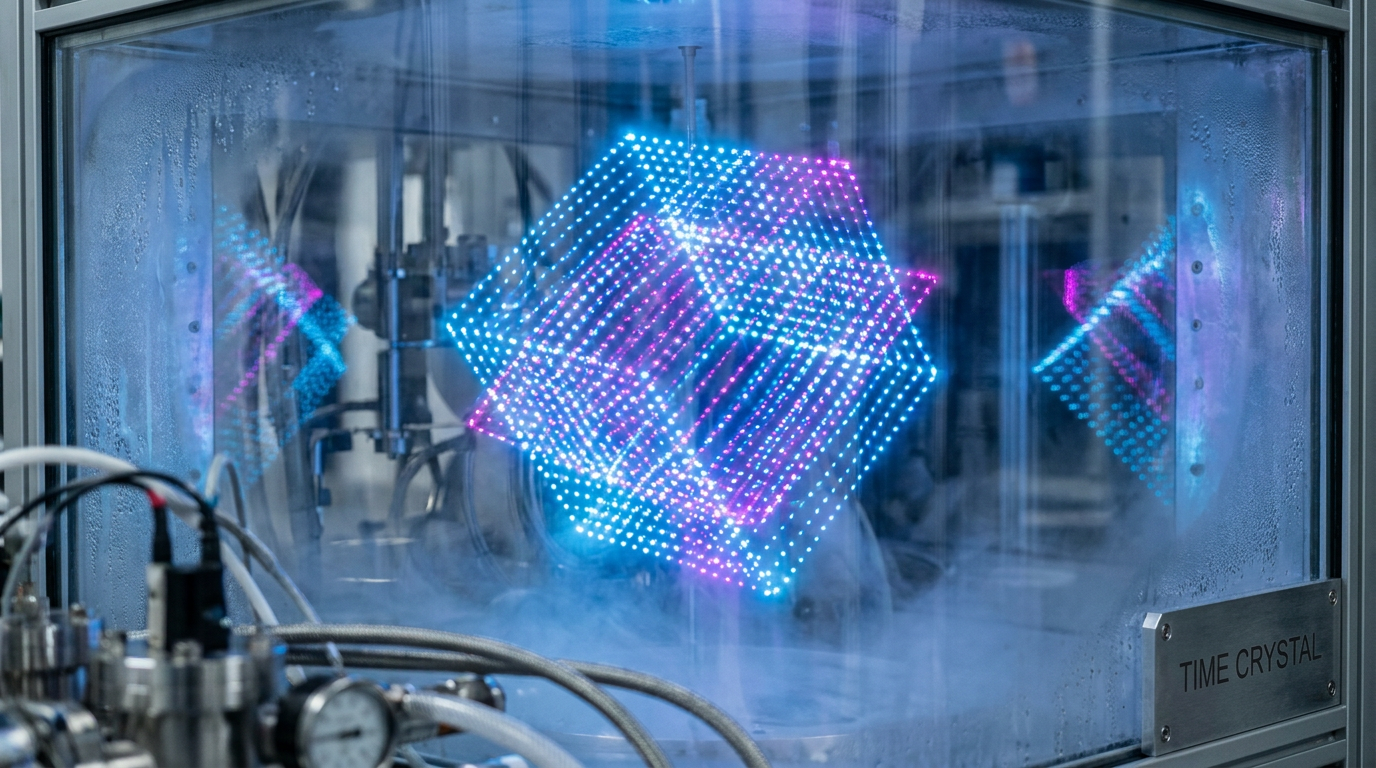
While quantum engineers manipulate invisible atoms in cryogenic chambers, other researchers are bringing time crystals into the macroscopic world. In February 2026, a team at New York University successfully created a levitating time crystal that is entirely visible to the naked eye. Moving away from ultracold qubits, the NYU team utilized acoustic levitation to suspend ordinary styrofoam beads in mid-air on a cushion of sound waves, creating a physical model of time-crystalline behavior.[4]
Inside this one-foot-high device, the suspended beads interact with one another by exchanging sound waves. In doing so, they exhibit nonreciprocal motion that actively defies Newton's Third Law, which states that every action must have an equal and opposite reaction. The beads move and oscillate independently, untethered from balanced forces, perfectly mimicking the continuous, repeating cycles of a quantum time crystal but on a scale that can be held in a researcher's hand.[4]
The collective evidence from these 2026 experiments points to a robust new paradigm: "many-body localization." In standard physics, interacting particles will eventually bump into each other, share their energy, and reach a boring, uniform thermal equilibrium—a process called thermalization. But in systems with specific types of engineered disorder, the particles become localized. They get stuck in their quantum states and refuse to thermalize, allowing the time-crystalline order to survive indefinitely despite the interactions between the particles.[5][6]
Despite these massive strides, significant uncertainties remain regarding the scalability of these systems. Current discrete time crystals realized on quantum processors typically involve only a few dozen qubits. As engineers attempt to scale these systems up to the thousands or millions of qubits required for commercial quantum computing, maintaining the precise driving frequencies and suppressing environmental decoherence becomes exponentially more difficult. A deviation in the driving pulse of even one percent can cause the entire crystalline phase to melt.[5]

If these scaling challenges can be overcome, the applications are staggering. The most immediate impact will likely be in quantum computing memory. Modern quantum computers are notoriously fragile; their qubits lose their data in mere microseconds when exposed to the slightest environmental heat or electromagnetic noise. Because time crystals inherently resist thermalization and maintain their structure indefinitely, they could serve as the ultimate quantum hard drive, storing delicate qubit states for orders of magnitude longer than current technologies allow.[2][6]
Beyond computing, the flawless, perpetual rhythm of a time crystal makes it an unparalleled timekeeper. Researchers envision using them to create advanced frequency combs—tools used to measure light and time with astonishing precision. Integrated into highly sensitive measurement devices, time crystals could serve as absolute frequency references, enabling sensors that can detect microscopic shifts in gravity, magnetic fields, or tectonic activity with a level of accuracy previously thought impossible.[2]

We are witnessing the birth of an entirely new branch of nonequilibrium physics. For generations, science has categorized matter by how it occupies space—as a solid, a liquid, a gas, or a plasma. Now, researchers have proven that matter can also be defined by how it occupies time. By taming a quantum state that lasts forever, humanity is taking its first steps toward technologies that operate outside the traditional boundaries of thermodynamics, unlocking a future where the ticking of a crystal could power the next great technological revolution.[1][6]
How we got here
2012
Nobel laureate Frank Wilczek first proposes the theoretical concept of a time crystal.
2016
The first experimental confirmations of discrete time crystals are achieved in isolated quantum systems.
Feb 2026
NYU researchers demonstrate a macroscopic, acoustic time crystal using levitating beads.
Mar 2026
TU Wien physicists prove that quantum fluctuations can stabilize time crystals in open systems.
May 2026
Aalto University successfully connects a time crystal to an external optomechanical device.
Viewpoints in depth
Fundamental Quantum Theorists
Focused on the underlying physics of breaking time-translation symmetry.
This camp views time crystals primarily as a profound shift in our understanding of thermodynamics and equilibrium. By proving that many-body localization can prevent a system from thermalizing, they argue that the textbook definitions of how energy dissipates must be rewritten. Their focus remains on isolating these states to study the pure, unadulterated physics of non-equilibrium matter.
Applied Quantum Engineers
Focused on harnessing time crystals for practical technologies.
For hardware engineers, the theoretical beauty of a time crystal is secondary to its utility. They view the phenomenon as a potential silver bullet for the quantum computing industry's biggest bottleneck: decoherence. By coupling time crystals to optomechanical devices and proving they can survive in open systems, this camp is racing to integrate them as stable memory banks and ultra-precise frequency combs in commercial quantum architectures.
Macroscopic Physicists
Focused on observing time-crystalline behavior in classical, visible systems.
This perspective argues that the fundamental principles of time crystals do not strictly require cryogenic quantum computers. By using acoustic levitation and fluid dynamics to create macroscopic models, they aim to study nonreciprocal forces and time-translation symmetry breaking in systems that can be observed with the naked eye, potentially bridging the gap between quantum mechanics and biological rhythms.
What we don't know
- Whether time-crystalline order can be maintained indefinitely in a fully scalable, million-qubit quantum computer.
- If continuous time crystals can be stabilized outside of highly specific, idealized laboratory conditions.
- How the nonreciprocal forces observed in macroscopic acoustic time crystals might translate to biological systems like circadian rhythms.
Key terms
- Time Crystal
- A phase of matter where particles exhibit continuous, repeating motion in time, even in their lowest energy state.
- Ground State
- The lowest possible energy state of a quantum system, where it theoretically has no energy left to lose to its environment.
- Many-Body Localization (MBL)
- A quantum phenomenon where interacting particles in a disordered system fail to reach thermal equilibrium, allowing delicate states to survive.
- Decoherence
- The process by which a quantum system loses its fragile quantum state due to interaction with its surrounding environment.
- Optomechanical System
- A device that couples light (photons) with mechanical motion (phonons), often used to measure or control quantum phenomena.
Frequently asked
Are time crystals perpetual motion machines?
No. While they move endlessly, they exist in their lowest energy state. You cannot extract usable energy or work from them without destroying the crystal.
What do time crystals actually look like?
In quantum computers, they are invisible arrangements of trapped ions or qubits. However, macroscopic physical models have been created using levitating beads that you can see with the naked eye.
Why are they useful for quantum computing?
Quantum computers struggle with 'decoherence,' where memory is lost to environmental noise. Time crystals naturally resist this noise, making them ideal candidates for perfectly stable quantum memory.
Sources
Source coverage
6 outlets
3 viewpoints surfaced






[1]New ScientistFundamental Quantum Theorists
A quantum state that lasts forever may finally be within our grasp
Read on New Scientist →[2]ScienceDailyApplied Quantum Engineers
Scientists connect 'time crystal' to real device in quantum breakthrough
Read on ScienceDaily →[3]TU WienApplied Quantum Engineers
Researchers discover quantum time crystal and define a new phase of matter
Read on TU Wien →[4]New York UniversityMacroscopic Physicists
Scientists Discover 'Levitating' Time Crystals that You Can Hold in Your Hand
Read on New York University →[5]arXivFundamental Quantum Theorists
Time Crystals on Quantum Devices
Read on arXiv →[6]Factlen Editorial TeamFundamental Quantum Theorists
Synthesis by Factlen editorial team
Read on Factlen Editorial Team →
Every angle. Every day.
Get science stories with full source coverage and perspective breakdowns delivered to your inbox.