
5,000-Year-Old Wooden 'Prototype' for Stonehenge Discovered Just Three Miles Away
Archaeologists have unearthed the remains of a precisely aligned wooden monument that predates Stonehenge's famous stone circle by 500 years, revealing a deep regional tradition of solar observation.
By Factlen Editorial Team
- Field Archaeologists
- Focused on the physical excavation evidence, stratigraphy, and the thrill of uncovering a foundational piece of British prehistory.
- Archaeoastronomers
- Focused on the mathematical precision of the monument and what it reveals about Neolithic scientific capabilities.
- Cultural Historians
- Focused on the evolution of religious practices and the transition from temporary wooden structures to permanent stone monuments.
What's not represented
- · Modern pagan and druid communities who view the landscape as actively sacred.
- · Indigenous heritage scholars studying the global phenomenon of ancient solar alignments.
Why this matters
This discovery fundamentally shifts our understanding of prehistoric Britain, proving that sophisticated astronomical observation and large-scale solar worship were deeply embedded in the region's culture centuries before the iconic stones of Stonehenge were ever raised.
Key points
- Archaeologists found a 5,000-year-old wooden structure three miles from Stonehenge.
- The monument consisted of two massive wooden poles placed 120 meters apart.
- The poles aligned perfectly with the summer solstice sunrise and winter solstice sunset.
- Radiocarbon dating proves the site is 500 years older than the main Stonehenge circle.
- Excavations uncovered 48 pits containing pottery, animal bones, and a rare sun-disc knife.
- The discovery proves sophisticated solar observation existed long before Stonehenge was built.
For millennia, the towering sarsen stones of Stonehenge have stood as the ultimate symbol of prehistoric Britain, a monumental calendar perfectly aligned with the movements of the sun. But the origins of that astronomical obsession have long been shrouded in mystery. Now, archaeologists have unearthed a stunning new piece of the puzzle just three miles (five kilometers) away.[1][2]
Beneath the soil of a modern military housing estate in Bulford, Wiltshire, researchers have discovered the remains of a 5,000-year-old wooden structure that perfectly tracks the summer and winter solstices. Radiocarbon dating places the site at roughly 2950 BC, making it a full 500 years older than the iconic stone circle of its famous neighbor.[3][4][5][6]
The discovery fundamentally rewrites the timeline of the Salisbury Plain, suggesting that the region was a bustling center for sophisticated solar observation long before the first megalith was ever dragged into place. Experts are already referring to the Bulford site as a potential "prototype" for Stonehenge, offering a rare glimpse into the early, experimental phases of Neolithic engineering.[1][2][4][7]
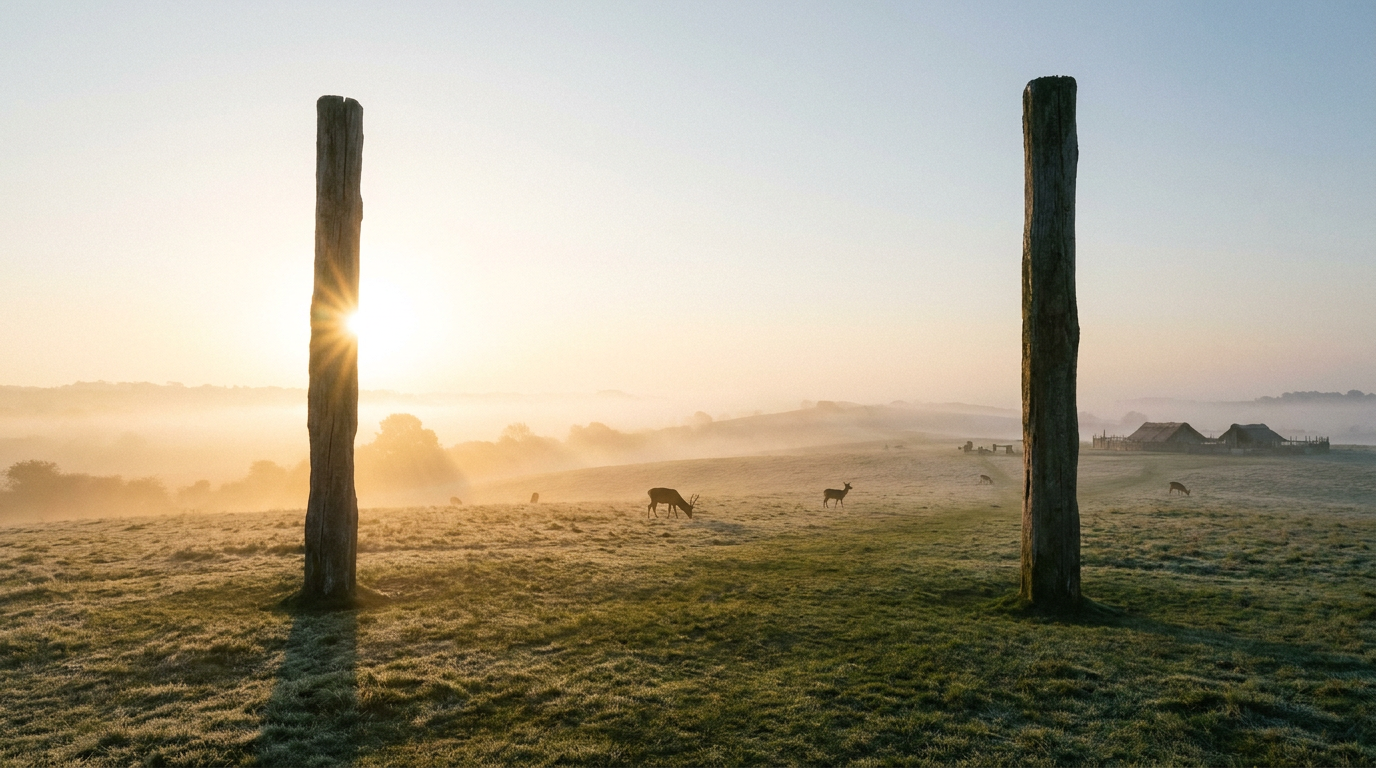
Unlike the enduring stone monoliths of Stonehenge, the Bulford monument was built from organic materials that have long since rotted away. The structure consisted of two massive wooden timber poles, positioned exactly 120 meters (394 feet) apart across the chalky landscape.[3][5][7]

While the wood is gone, the enormous pits dug to hold the poles survived. During excavations, archaeologists found these postholes packed with chalk, a deliberate engineering choice designed to wedge the towering timbers firmly upright against the harsh British weather.[7]
The true significance of these postholes remained hidden until archaeologists began mapping the site data. Phil Harding, a veteran archaeologist with Wessex Archaeology and a familiar face from the UK television series "Time Team," was reviewing the site plans when he noticed the peculiar spacing of the two largest pits.[2][4]
Harding drew a simple pencil line between the two anomalies on his map. When he checked the orientation of that line against the compass, he experienced what he described as a "giggle moment." The 120-meter axis pointed directly at the rising sun on the summer solstice in one direction, and the setting sun on the winter solstice in the other.[4][6][7]
To verify the alignment, Wessex Archaeology commissioned archaeoastronomers to reconstruct the Neolithic sky and the ancient horizon of the Salisbury Plain. The computer models confirmed Harding's suspicion: the wooden poles were aligned with the solstices to an astonishing accuracy of within a single degree.[6]
"These people were capable of establishing the points on the horizon where the sun rises in the midsummer and sets in midwinter," Harding explained, calling the 5,000-year-old feat a "pioneering achievement" in observational science.[5]
The discovery was made possible by a massive infrastructure project. Between 2015 and 2017, Wessex Archaeology was contracted to excavate the 13-hectare (32-acre) Bulford site ahead of a Ministry of Defence program to build new housing for troops returning from bases in Germany.[1][7]
The discovery was made possible by a massive infrastructure project.
Because the Salisbury Plain is one of the UK's largest military training grounds, vast swathes of the landscape have remained untouched by modern deep-plough farming, inadvertently preserving a treasure trove of prehistoric data beneath the turf.[3]
Surrounding the two massive postholes, the excavation team uncovered a cluster of 48 smaller pits. These pits were filled with a rich assortment of Neolithic life: animal bones, charcoal, worked flints, and a specific type of ancient ceramic known as "Woodlands" style pottery.[2][5][7]
The sheer volume of domestic refuse suggests that the Bulford site was not a quiet, isolated observatory, but rather a vibrant gathering place. Researchers believe large numbers of people converged on the site over relatively short periods to feast, celebrate, and observe the turning of the solar year.[2][7]
Among the debris, archaeologists found one artifact that stands out for its symbolic weight. In a pit that experts believe served as a specific "viewing station" for the solstice alignment, someone had deliberately buried a very rare, disc-shaped flint knife.[2][7]

The flint had been expertly knapped into a perfect circle. Archaeologists suspect this was no ordinary cutting tool, but rather a symbolic representation of the sun disc itself, placed into the earth as a ritual offering during a solstice celebration.[2][7]
The transition from the wooden poles of Bulford to the stone pillars of Stonehenge reflects a broader pattern in Neolithic British culture. Many archaeologists theorize that wood, a living material that eventually decays, was used to construct monuments for the living and for immediate, earthly celebrations.[5][6]
Stone, by contrast, is eternal. When the descendants of the Bulford builders eventually constructed Stonehenge 500 years later, the shift to massive sarsen stones may have represented a theological evolution—creating an immortal monument dedicated to the ancestors, while retaining the exact same mathematical alignment to the sun.[1][5]

Today, the physical site of the Bulford discovery is largely inaccessible to the public. The Ministry of Defence housing estate has been completed, and Harding noted with a touch of irony that one of the ancient, sacred postholes is now likely situated directly beneath someone's modern living room.[7]
Yet the cultural continuity remains unbroken. Every year, thousands of modern revelers, pagans, and tourists flock to the stones of Stonehenge to watch the sun rise on the longest day of the year.[1][3]
As Harding observed, those modern crowds are participating in a tradition with far deeper roots than they realize. "What few will realize is that 5,000 years ago on a nearby hillside overlooking modern day Bulford, people were doing the exact same thing—revering and celebrating the sunrise on Midsummer's Day."[3][7]

How we got here
2950 BC
The wooden poles are erected at Bulford and perfectly aligned with the solstices.
2500 BC
The iconic sarsen stone circle is erected at the main Stonehenge site 500 years later.
2015–2017
Wessex Archaeology conducts excavations at Bulford ahead of Ministry of Defence housing construction.
June 2026
Researchers publicly announce the discovery of the solstice alignment just days before the modern summer solstice.
Viewpoints in depth
Field Archaeologists
Focused on the physical evidence, stratigraphy, and the thrill of uncovering a foundational piece of British prehistory.
For field teams, the Bulford site is a triumph of meticulous data collection. The monument left no towering stones, only chalk-filled post pits surrounded by domestic refuse. It was only through careful mapping and radiocarbon dating of the 48 surrounding pits that the site's true significance emerged. Lead archaeologist Phil Harding described drawing a simple pencil line between the two largest anomalies on a site map and realizing they formed a perfect solstice axis—a moment he called the highlight of his career.
Archaeoastronomers
Focused on the mathematical precision of the monument and what it reveals about Neolithic scientific capabilities.
Archaeoastronomers view the Bulford structure as proof of highly sophisticated observational science. Reconstructions of the Neolithic sky and local horizon demonstrate that the 120-meter gap between the posts aligned with the summer solstice sunrise and winter solstice sunset to within a single degree of accuracy. This suggests that prehistoric Britons were not merely worshipping the sun, but actively tracking and measuring its multi-year cycles to establish reliable calendars for agriculture and ritual.
Cultural Historians
Focused on the evolution of religious practices and the transition from temporary wooden structures to permanent stone monuments.
Historians see the Bulford site as the "missing link" in the cultural evolution of the Salisbury Plain. The use of wood—a material that decays—suggests a monument meant for the living, perhaps representing temporary life or immediate celebration. The later transition to the immortal sarsen stones at Stonehenge 500 years later may represent a theological shift toward honoring eternal ancestors. The continuity of the solstice alignment, however, proves that the core religious focus remained unbroken across half a millennium.
What we don't know
- Whether the Bulford structure was a literal 'prototype' built by the same lineage of engineers, or simply part of a broader regional culture.
- Exactly how tall the wooden poles were, or if they were carved or decorated.
- Why the site was eventually abandoned in favor of the stone circle at Stonehenge.
Key terms
- Solstice
- The two times in the year when the sun reaches its highest or lowest point in the sky at noon, marking the longest and shortest days.
- Radiocarbon Dating
- A method for determining the age of an object containing organic material by measuring the decay of a radioactive isotope of carbon.
- Archaeoastronomy
- The study of how ancient people understood phenomena in the sky and how they incorporated astronomical alignments into their architecture and culture.
- Neolithic Period
- The final division of the Stone Age, characterized by the adoption of agriculture, the development of pottery, and the construction of megalithic monuments.
- Sarsen Stones
- The large sandstone blocks used to construct the main circle and inner horseshoe at the famous Stonehenge monument.
Frequently asked
How do we know the wooden poles were there if they rotted away?
Archaeologists found two massive postholes filled with chalk packing, which was originally used to wedge and support the massive wooden timber poles.
Is the new site open to the public?
No, the site is located on Ministry of Defence land in Bulford, and one of the ancient postholes is now situated beneath a modern housing development.
Did the same people build both monuments?
The Bulford structure was built around 2950 BC, roughly 500 years before the main stone circle at Stonehenge, meaning it was constructed by the ancestors of the Stonehenge builders.
Sources
Source coverage
7 outlets
3 viewpoints surfaced







[1]BBCField Archaeologists
Simpler, older version of Stonehenge found three miles from famous site
Read on BBC →[2]New ScientistCultural Historians
Ancient monument may have been an early Stonehenge prototype
Read on New Scientist →[3]Washington PostCultural Historians
Archaeologists say they have discovered a structure near Stonehenge that may have served as a 'prototype' for the monument
Read on Washington Post →[4]The GuardianField Archaeologists
Archaeologists unearth 5,000-year-old 'prototype' for Stonehenge solstice stones
Read on The Guardian →[5]Live ScienceArchaeoastronomers
Evidence of two ancient wooden posts aligned with the summer and winter solstices has been discovered near Stonehenge
Read on Live Science →[6]ForbesArchaeoastronomers
A 5,000-year-old discovery near Bulford, Wiltshire, reveals what archaeologists believe is a Stonehenge prototype
Read on Forbes →[7]ITV NewsField Archaeologists
Archaeologists have made a 'once in a lifetime' discovery of a 5,000-year-old structure thought to have been used as a Stonehenge 'prototype'
Read on ITV News →



Every angle. Every day.
Get science stories with full source coverage and perspective breakdowns delivered to your inbox.