
Why Schools Are Quietly Moving AI Out of the Cloud and Into the IT Closet
To solve the privacy and cost nightmares of cloud-based AI, school districts are increasingly running open-source language models on their own local servers.
By Factlen Editorial Team
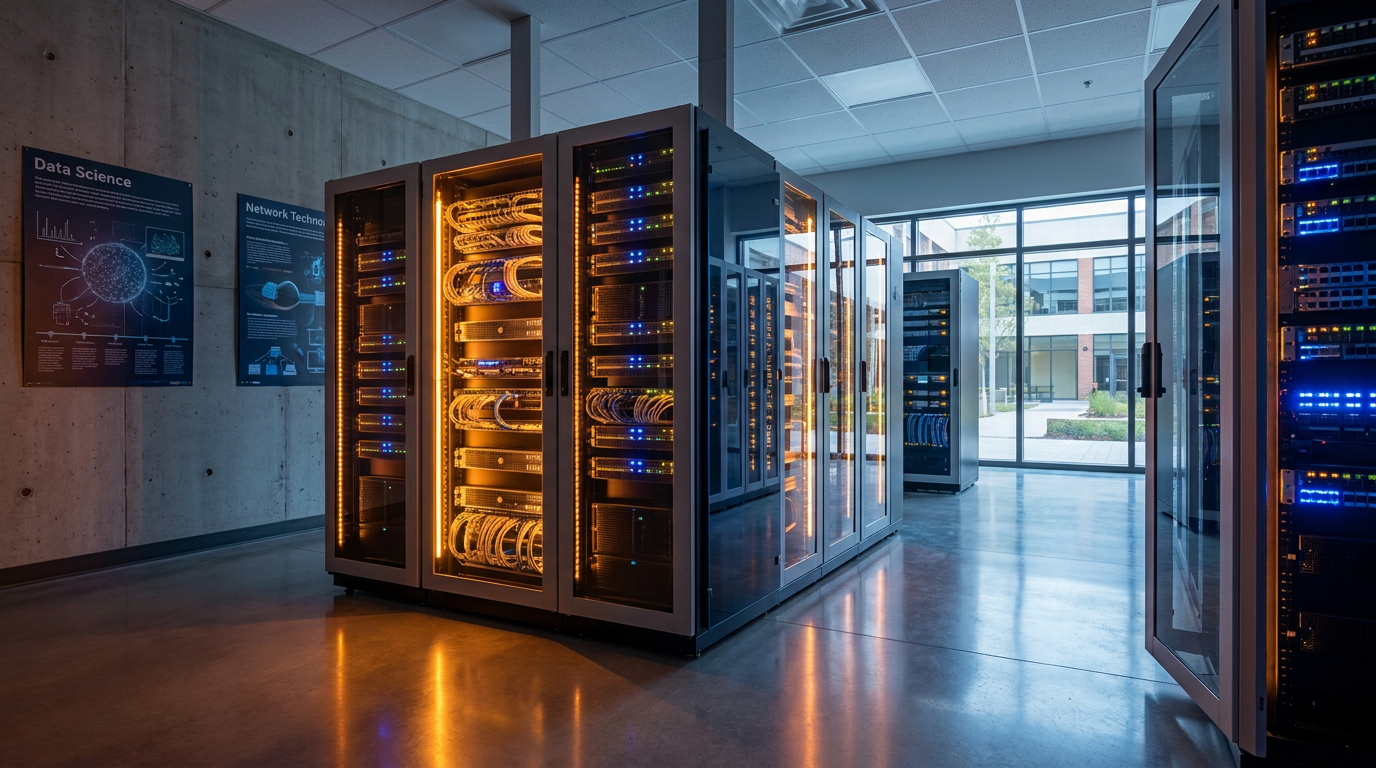
- Privacy-First IT Administrators
- Prioritize data sovereignty, FERPA compliance, and local control over AI guardrails.
- Open-Source Advocates
- Believe educational infrastructure should be free, modifiable, and untethered from Big Tech subscriptions.
- Pedagogical Innovators
- Focus on how AI can be used as a 'thinking partner' rather than an answer engine, regardless of where it is hosted.
- Commercial EdTech Providers
- Argue that cloud-based solutions offer better polish, easier deployment, and continuous updates without requiring schools to manage hardware.
What's not represented
- · Parents of students using local AI
- · Hardware vendors supplying school servers
Why this matters
As AI becomes foundational to education, the shift toward locally hosted models ensures that student data remains private and schools aren't locked into expensive corporate subscriptions. This approach allows districts to safely deploy AI tutors that guide students rather than just giving them the answers.
Key points
- Schools are increasingly hosting AI models on their own servers to protect student privacy.
- Local AI ensures data never leaves the building, automatically complying with FERPA regulations.
- Open-source models eliminate the $5-$20 monthly per-student subscription fees charged by cloud providers.
- Administrators can program local AI with 'Socratic guardrails' to ensure it tutors students rather than doing their work.
The artificial intelligence revolution in education is happening, but its most significant development isn’t taking place in a Silicon Valley data center. Instead, it is unfolding quietly inside the IT closets of public school districts. While consumer attention remains fixated on the latest cloud-based chatbots, a growing number of educational institutions are choosing a radically different path: running powerful AI models entirely on their own local hardware. This shift is not driven by a desire to be on the bleeding edge of technology, but rather by the practical realities of protecting student data and managing shrinking budgets. By bringing AI in-house, schools are transforming a massive privacy liability into a secure, owned piece of educational infrastructure.[2]
The primary catalyst for this localized approach is the fundamental architecture of cloud-based AI. When a student types a prompt into a commercial platform like ChatGPT or Claude, that text—along with any personal information, essay drafts, or vulnerable questions it contains—is transmitted to external servers. For school districts bound by the Family Educational Rights and Privacy Act (FERPA), this data migration is a compliance nightmare. Administrators cannot guarantee how third-party vendors might use student inputs for future model training, nor can they fully secure the data against external breaches.[2][5]
Local AI solves this problem by severing the internet connection entirely. Using open-source software tools like Ollama, school IT departments can download and host Large Language Models (LLMs) directly on the district’s own servers. When a student interacts with the AI, the processing happens locally, and the data never leaves the building. Because no information is transmitted to external companies, FERPA compliance is virtually automatic, and the need for complex data processing agreements evaporates.[1][2]
The financial math of local AI is equally compelling for resource-strapped districts. Commercial AI tools designed for education typically charge subscription fees ranging from $5 to $20 per user each month. Scaled across a district with thousands of students and hundreds of teachers, these recurring costs quickly become unsustainable. Open-source models, by contrast, are free to download, modify, and distribute. Once a school has the necessary hardware, the ongoing licensing cost to run a local AI system is exactly zero.[1]

Running these models does require specific hardware, but the barrier to entry has plummeted over the last year. To run a highly capable, compact model like Meta’s Llama 3 8B, a server only needs about 8 gigabytes of RAM and a standard processor. Many school districts already possess underutilized servers that meet these specifications. For more advanced reasoning tasks that require larger models—such as the 70-billion-parameter versions—schools must invest in GPU-equipped servers. While this requires an upfront capital expenditure, IT administrators view it as a one-time infrastructure investment rather than an endless subscription drain.[1]
Beyond privacy and cost, local hosting gives educators absolute control over the AI’s behavior. Cloud-based models come with generalized safety guardrails designed for the broad public, which often fail to align with specific pedagogical goals. When a school hosts its own model, administrators can hard-code the 'system prompt'—the invisible set of instructions that dictates how the AI interacts with users. This allows schools to tailor the AI strictly to their educational philosophy, ensuring it behaves like a teacher rather than an answer key.[2]
This control enables what educators call 'Socratic guardrails.' Instead of writing an essay for a student or providing the final answer to a calculus problem, a locally configured AI can be instructed to never give direct answers. If a student asks for the solution to an equation, the AI is programmed to respond with guiding questions, helping the student identify their own mistakes and work through the logic independently. This transforms the technology from a shortcut for cheating into a genuinely adaptive tutoring tool.[2][5]

This transforms the technology from a shortcut for cheating into a genuinely adaptive tutoring tool.
Local control also allows schools to implement strict, customized safety filters. Administrators can configure the model to flatly refuse any discussions related to violence, self-harm, or inappropriate content, while simultaneously logging flagged interactions for school counselors to review. Because the school owns the system, they have complete transparency into how the AI is being used, allowing them to monitor educational efficacy and intervene if a student is struggling academically or emotionally.[1][2]
The push for localized AI is also reshaping the devices students use every day. For over a decade, the education market has been dominated by Chromebooks—lightweight, web-first laptops that rely entirely on cloud connectivity. However, the hardware landscape is shifting to accommodate on-device AI inference. In 2026, the introduction of 'Googlebooks'—the premium successor to the Chromebook—signals a broader industry move toward laptops equipped with specialized neural processing units capable of running AI models natively.[3]
With an installed base of 38 million students globally, the ChromeOS ecosystem’s evolution is critical. As local AI processing moves from the server room directly onto the student’s device, the benefits of privacy and cost-efficiency are amplified. On-device inference means that an AI reading tutor or math assistant can function perfectly even if the school’s Wi-Fi network goes down, or if a student lacks reliable broadband access at home.[3]
The philanthropic sector is actively accelerating this open, localized ecosystem. Recognizing that proprietary cloud models could exacerbate educational inequality, organizations like the Bill & Melinda Gates Foundation have launched massive funding initiatives. Recent requests for proposals offer millions in grants to teams developing open-source AI models specifically fine-tuned for K-12 tutoring. The explicit goal is to create digital public goods that are as effective as human experts but freely available to any district.[4]

These specialized educational models are being trained on vast datasets of pedagogical best practices, formative assessments, and mastery learning techniques. By focusing on open-source development, researchers ensure that the underlying code can be audited for bias, modified for different cultural contexts, and continuously improved by a global community of educators and developers. Platforms like Hugging Face and SiliconFlow are already hosting these specialized models, making them easily accessible to school IT teams.[4][7]
The integration of these tools into the classroom is intentionally subtle. The most successful deployments are happening in schools that aren't trying to rebrand themselves as 'AI academies.' Instead, they are quietly integrating local AI into existing workflows. An English teacher might use a local model to generate differentiated reading passages for students at varying reading levels, while a science teacher might deploy it to help students brainstorm hypothesis ideas for a lab experiment.[2]
This quiet revolution represents a maturation of how the education sector views artificial intelligence. The initial panic over AI-facilitated cheating has given way to a pragmatic understanding of the technology's utility. Educators are realizing that the problem wasn't the AI itself, but rather the commercial, cloud-based delivery mechanism that stripped schools of their agency and compromised student privacy.[2][7]

By moving AI out of the cloud and into the IT closet, schools are reclaiming that agency. They are building a future where intelligent tutoring systems are treated like textbooks or library books—essential, locally owned resources that serve the specific needs of their students. In doing so, they are proving that the most advanced educational technology doesn't have to come at the cost of student privacy.[7]
How we got here
Nov 2022
ChatGPT launches, triggering widespread bans in schools due to cheating and privacy concerns.
2024
Schools begin experimenting with commercial cloud AI tools, but face mounting FERPA compliance challenges.
Jan 2026
Open-source models like Llama 3 become small and efficient enough to run on standard school servers.
May 2026
Google announces the transition from Chromebooks to AI-native 'Googlebooks', emphasizing local processing.
Jun 2026
The Gates Foundation launches a $3 million initiative to fund open-source AI tutoring models.
Viewpoints in depth
Privacy-First IT Administrators
School technology leaders focused on data sovereignty and FERPA compliance.
For IT administrators, the primary appeal of local AI is risk mitigation. Cloud-based platforms inherently require sending student data to external servers, creating a complex web of data processing agreements and potential FERPA violations. By hosting models like Llama 3 on internal servers, IT teams ensure that student prompts, essays, and personal queries never leave the school's firewall. This absolute data sovereignty allows schools to experiment with AI without exposing themselves to legal liability or parental backlash over data harvesting.
Open-Source Advocates
Proponents of free, modifiable educational infrastructure.
Open-source advocates argue that foundational educational tools should not be locked behind corporate paywalls. They point out that commercial AI subscriptions, which can cost up to $20 per user monthly, are financially unsustainable for public school districts. By leveraging open-source models, schools can eliminate ongoing licensing fees entirely. Furthermore, open-source models allow researchers and educators to audit the underlying code for bias and fine-tune the AI specifically for pedagogical best practices, rather than relying on a black-box commercial product.
Commercial EdTech Providers
Companies offering polished, cloud-based AI solutions for schools.
Commercial providers argue that while local AI offers privacy benefits, it places an undue technical burden on understaffed school IT departments. They maintain that cloud-based solutions offer superior polish, seamless integration with existing learning management systems, and continuous model updates without requiring schools to purchase or maintain expensive GPU servers. From this perspective, paying a subscription fee is a worthwhile trade-off for a turnkey solution that guarantees high uptime and dedicated customer support.
What we don't know
- Whether smaller, underfunded school districts will be able to afford the upfront hardware costs required to run local AI servers.
- How quickly open-source educational models will achieve parity with the most advanced commercial cloud models.
- If the shift toward on-device AI inference in laptops will fully eliminate the need for centralized school servers.
Key terms
- Local LLM
- A Large Language Model that runs entirely on a user's own hardware or a school's internal server, rather than relying on an internet connection to a cloud provider.
- FERPA
- The Family Educational Rights and Privacy Act, a US federal law that protects the privacy of student education records.
- Socratic Guardrails
- Custom instructions programmed into an AI that force it to ask guiding questions rather than providing direct answers to students.
- On-device Inference
- The ability of a laptop or tablet to process AI tasks using its own internal chips, allowing it to function without internet access.
Frequently asked
Is local AI completely free for schools?
The open-source software and models are free, meaning there are no ongoing subscription costs. However, schools do need to provide the physical servers or capable devices to run them.
Can students still use local AI to cheat?
It is much harder. Because schools control the system prompt, they can hard-code the local AI to refuse to write essays or give direct answers, forcing it to act as a tutor instead.
Does local AI require an internet connection?
No. Once the model is downloaded to a school server or a student's device, it processes all text locally and functions perfectly offline.
What happens to the data students type into a local AI?
The data never leaves the school's network. It is processed locally, ensuring complete compliance with student privacy laws like FERPA.
Sources
Source coverage
7 outlets
4 viewpoints surfaced







[1]EduGeniusPrivacy-First IT Administrators
Open-Source AI Education Tools — What's Available for Free
Read on EduGenius →[2]MediumPrivacy-First IT Administrators
The Hidden Reason Your School's AI System Isn't on the Internet
Read on Medium →[3]TNWPedagogical Innovators
Google killed the Chromebook. Its replacement turns your cursor into an AI agent.
Read on TNW →[4]Gates FoundationOpen-Source Advocates
Open Source AI Model for Tutoring (EDU AI) Request for Proposals
Read on Gates Foundation →[5]CoursivCommercial EdTech Providers
Best AI Tools for Education 2026: Students, Teachers & Study
Read on Coursiv →[6]SiliconFlowOpen-Source Advocates
Ultimate Guide – The Best Education and Tutoring Platforms of 2026
Read on SiliconFlow →[7]Factlen Editorial TeamPedagogical Innovators
Synthesis by Factlen editorial team
Read on Factlen Editorial Team →


Every angle. Every day.
Get education stories with full source coverage and perspective breakdowns delivered to your inbox.