
US Banking Regulators Pivot to Risk-Focused Supervision, Softening Basel III and Ending 'Reputation Risk'
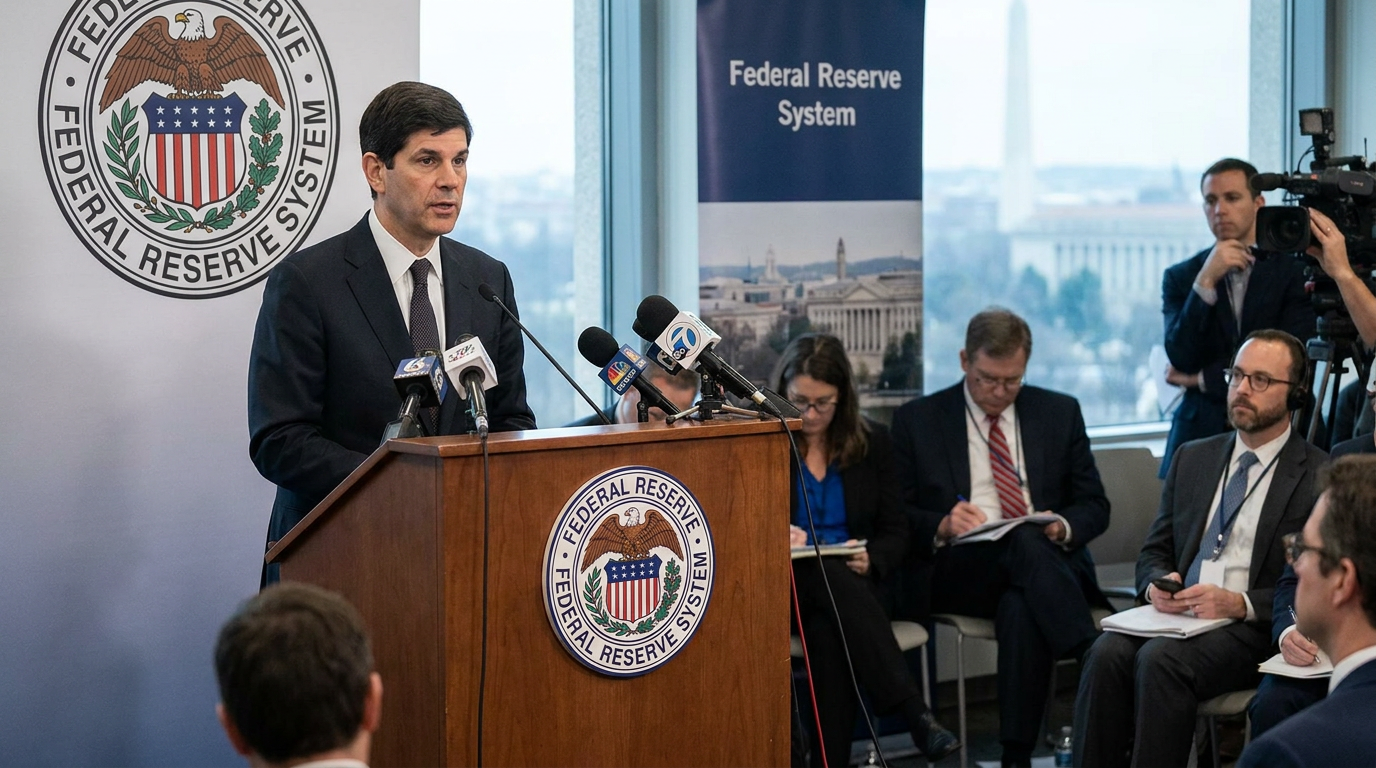
Federal regulators have finalized a sweeping overhaul of US banking supervision, slashing proposed capital requirements by $87.7 billion and legally barring examiners from using subjective 'reputation risk' to penalize banks.

- Regulatory Pragmatists
- Argue that supervision must focus on material financial risks rather than process-oriented checklists or subjective reputation metrics.
- Banking Industry & Asset Managers
- Value the $87.7 billion in capital relief and the end of subjective debanking, arguing it unlocks lending and economic growth.
- Systemic Safety Advocates
- Warn that reversing the 2023 capital increases and removing qualitative supervisory tools could leave the system vulnerable to unforeseen shocks.
Why this matters
This regulatory pivot determines how easily Americans can get a mortgage and how businesses secure funding. By slashing the capital banks must hold in reserve and ending subjective 'reputation' audits, regulators are prioritizing economic expansion over the ultra-conservative safety buffers proposed just three years ago.
Key points
- Federal regulators have replaced the stringent 2023 Basel III proposal with a growth-friendly 2026 framework.
- The new rules provide an estimated $87.7 billion in system-wide capital relief to encourage lending.
- The FDIC and OCC are now legally barred from using 'reputation risk' to penalize banks.
- Supervision will now focus strictly on material financial risks like credit quality and liquidity.
- Critics warn that removing qualitative supervisory tools could leave the system slightly more vulnerable to behavioral risks.
The United States banking sector is undergoing its most significant regulatory transformation in over a decade. Following years of contentious debate, federal regulators—including the Federal Reserve, the Federal Deposit Insurance Corporation (FDIC), and the Office of the Comptroller of the Currency (OCC)—have officially abandoned the stringent 2023 Basel III Endgame proposal. In its place, they have introduced a comprehensive 2026 framework that significantly softens capital requirements and fundamentally alters how bank examiners evaluate institutional health.[1][2]
This shift is defined by two major pillars: a quantitative reduction in the capital banks must hold in reserve, and a qualitative shift away from subjective examination metrics. Most notably, regulators have formally eliminated "reputation risk" as a basis for supervisory action, ending an era where examiners could pressure financial institutions to sever ties with lawful but controversial industries.
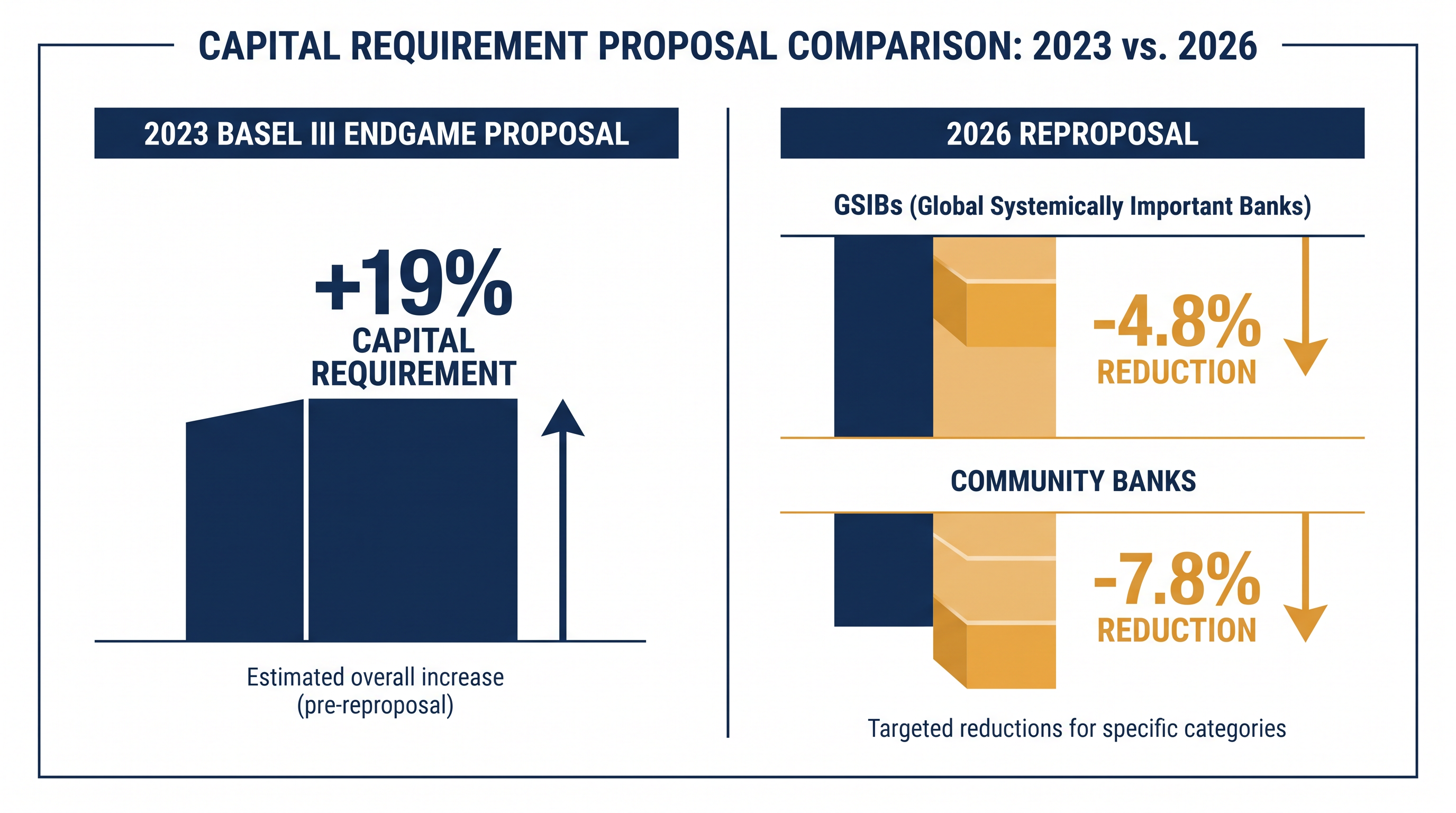
To understand the trade-offs of this pivot, it is essential to examine the previous regulatory trajectory. The original 2023 Basel III proposal was built on the premise of maximum systemic safety, aiming to increase capital requirements for large banks by an estimated 16 to 19 percent. Proponents of this heavy-capital regime argued that an impregnable balance sheet was the only guaranteed defense against the kind of contagion seen during the 2008 financial crisis and the 2023 regional banking turmoil.[1][2]
However, the evidence against the 2023 approach mounted rapidly. During the comment period, asset managers and banking trade groups demonstrated that such severe capital constraints would dramatically suppress real-economy lending. Financial models indicated that the original rules would increase the cost of mortgages, penalize green energy financing, and inevitably push riskier lending out of the regulated banking sector and into opaque, unregulated private credit markets.[2]
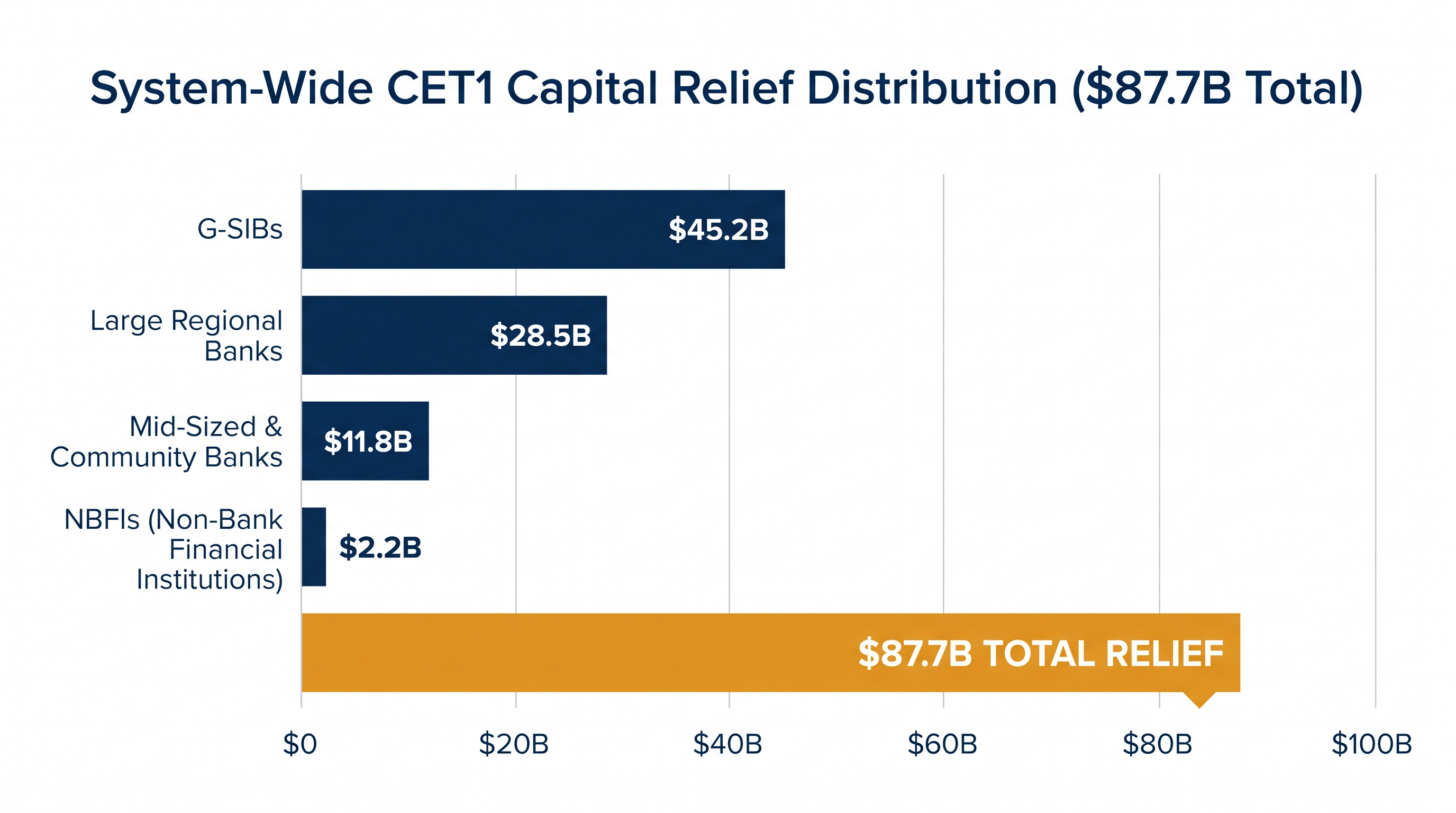
The March 2026 reproposal embraces a fundamentally different philosophy: risk-sensitive, tailored supervision. By eliminating overlapping requirements and right-sizing calibrations to match actual mathematical risk, the new framework delivers an estimated $87.7 billion in system-wide common equity tier 1 (CET1) capital relief. Regulators argue this approach retains the rigor of the Basel framework while easing punitive constraints that stifle growth.[1][2]
The March 2026 reproposal embraces a fundamentally different philosophy: risk-sensitive, tailored supervision.
The quantitative impact of this shift is stark. Global systemically important banks (GSIBs) will see their capital requirements decrease by approximately 4.8 percent, while large regional banks will experience a 5.2 percent reduction. Community and mid-size institutions benefit the most, with a projected 7.8 percent drop in their capital burdens. Proponents argue this exact calibration frees up billions for business expansion and consumer lending without compromising core institutional safety.[2]
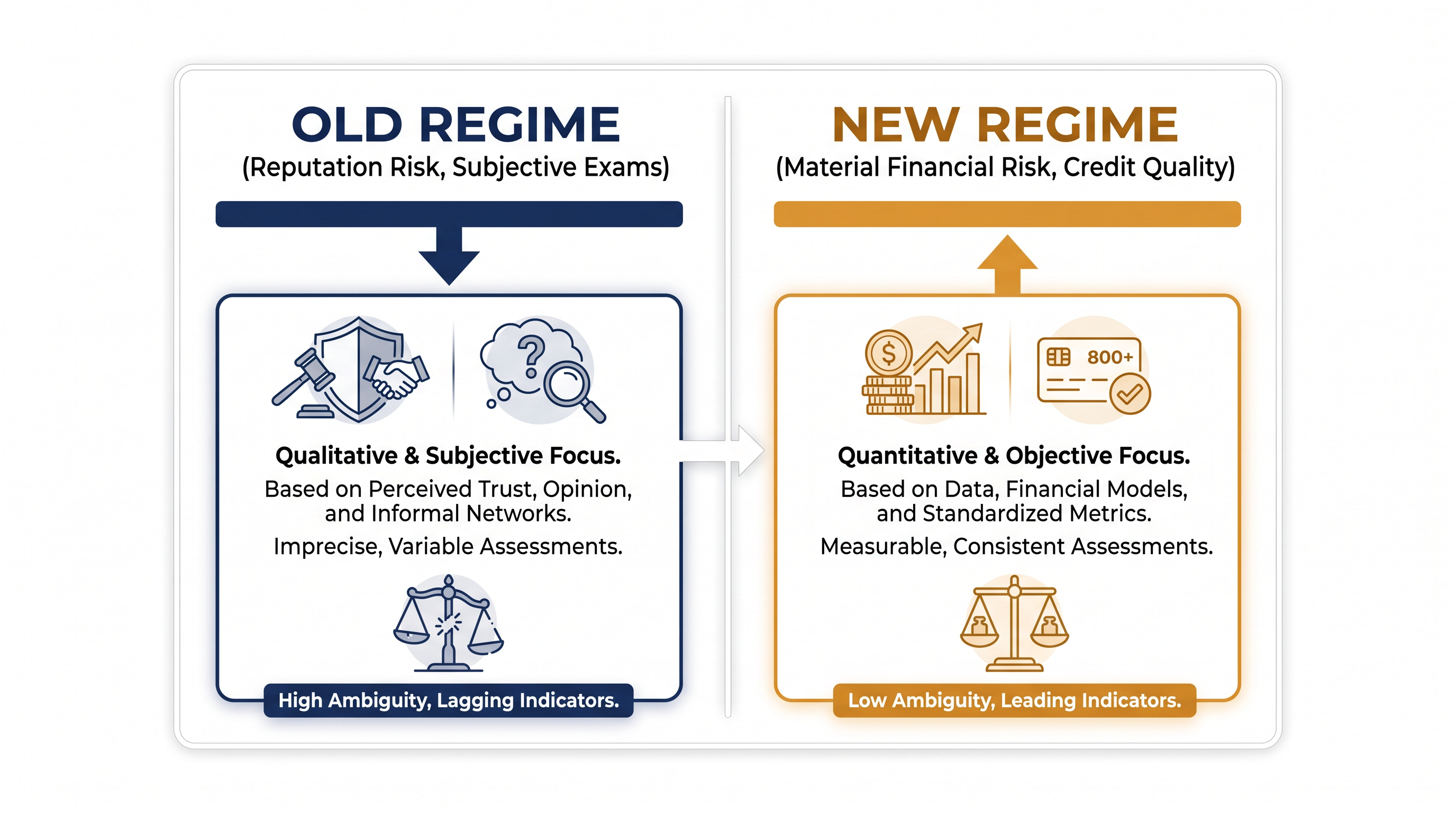
The second half of the 2026 pivot involves the elimination of "reputation risk." For years, examiners could downgrade a bank's rating if they felt its association with certain lawful businesses—such as firearms manufacturers, cryptocurrency firms, or fossil fuel companies—posed a risk to the bank's public standing. Critics argued this created a backdoor for politicized "debanking," where regulators could enforce ideological preferences without formal rulemaking.
Under final rules effective June 2026, the FDIC and OCC are legally barred from criticizing or taking adverse action against a bank based on reputation risk. Supervision is now strictly re-anchored to material financial risks: credit quality, liquidity, capital adequacy, and consumer harm. Regulators argue that focusing examiner time on these objective, mathematically verifiable metrics is inherently more effective than policing a bank's public relations.[3]
This lighter-touch, highly quantitative approach fits well in economic environments that require robust credit expansion and market fluidity. When the primary goal is to ensure that banks have the flexibility to support mortgage markets, fund corporate innovation, and serve all lawful commercial enterprises without fear of subjective regulatory reprisal, the 2026 framework provides the necessary clarity and capital efficiency.[3][4]
Conversely, this streamlined approach does not fit well in environments of extreme, unforeseen systemic contagion driven by behavioral or cultural rot within a financial institution. By stripping examiners of qualitative tools like reputation risk, regulators have fewer mechanisms to intervene early when a bank's aggressive culture or controversial client roster hints at deeper operational recklessness before it officially breaches capital thresholds.[4]
Ultimately, the 2026 banking reset is not a return to the deregulatory "Wild West," but rather a transition to precision engineering. Bank compliance departments are now pivoting away from exhaustive, process-oriented checklists and toward demonstrating the actual effectiveness of their risk management. As the industry adapts to these new rules of the road, the success of the regime will be measured by its ability to balance aggressive economic growth with quiet, mathematical resilience.[3][4]
How we got here
July 2023
Regulators issue the original Basel III Endgame proposal, sparking intense industry backlash over proposed 16-19% capital increases.
August 2025
Executive Order 14331 is signed, directing agencies to review and eliminate politicized debanking practices.
March 2026
The Fed, FDIC, and OCC release a comprehensive reproposal that slashes capital requirements across the banking sector.
April 2026
The FDIC issues a final rule codifying the removal of reputation risk from its supervisory programs.
June 2026
The legal prohibition on using reputation risk in bank examinations officially takes effect.
Viewpoints in depth
Regulatory Pragmatists
Federal Reserve and FDIC leadership driving the pivot toward objective metrics.
This camp argues that bank supervision had become overly focused on process-oriented checklists and subjective public relations metrics. By re-anchoring examinations to material financial risks—such as credit quality, liquidity, and capital adequacy—regulators believe they can foster a safer banking system without unnecessarily stifling economic growth or engaging in ideological policing.
Banking Industry & Asset Managers
Financial institutions and trade groups welcoming the capital relief and regulatory clarity.
Banks and asset managers view the 2026 pivot as a massive victory for the real economy. They argue that the $87.7 billion in capital relief will directly translate into more affordable mortgages, increased corporate lending, and better market liquidity. Furthermore, they celebrate the end of 'reputation risk' as a vital protection against politicized debanking, ensuring they can serve any lawful business without fear of regulatory retaliation.
Systemic Safety Advocates
Watchdogs concerned about reduced capital buffers and the loss of qualitative oversight.
Critics of the pivot warn that reversing the 2023 capital increases leaves the financial system with a thinner margin of error against macroeconomic shocks. They also express concern that stripping examiners of qualitative tools like 'reputation risk' removes an important early-warning mechanism, potentially allowing toxic corporate cultures or reckless client acquisition strategies to fester until they cause a mathematical capital breach.
What we don't know
- How the removal of reputation risk will impact banks' internal ESG and corporate social responsibility initiatives.
- Whether the $87.7 billion in capital relief will be deployed primarily into consumer lending or redirected toward stock buybacks and dividends.
- How quickly international regulatory bodies will react to the US softening its stance on the Basel III framework.
Key terms
- CET1 Capital
- Common Equity Tier 1 capital; the highest quality of regulatory capital a bank holds, consisting primarily of common stock and retained earnings.
- GSIB
- Global Systemically Important Bank; a financial institution whose size and complexity make its failure a threat to the international financial system.
- Reputation Risk
- The potential that negative publicity regarding an institution's business practices or client roster could cause a decline in the customer base or costly litigation.
- Risk-Weighted Assets
- A bank's assets or off-balance-sheet exposures, weighted according to risk, used to determine the minimum amount of capital that must be held.
Frequently asked
What is the Basel III Endgame?
It is a set of international banking regulations designed to standardize how banks calculate the capital they must hold in reserve against potential losses.
Why did regulators abandon the 2023 proposal?
The original proposal faced unprecedented backlash from the financial industry and asset managers, who provided evidence that a 16 to 19 percent increase in capital requirements would severely suppress lending and increase mortgage costs.
What does the end of 'reputation risk' mean for banks?
Examiners can no longer penalize or downgrade banks for doing business with lawful but controversial industries, ending what critics called politicized 'debanking.'
When do the new rules take effect?
The prohibition on using reputation risk in FDIC and OCC examinations takes effect in June 2026, while the broader capital rules will phase in over several years.
Sources
Source coverage
4 outlets
3 viewpoints surfaced




[1]ReutersBanking Industry & Asset Managers
Fed Plans Industry-Friendly Basel III Endgame Rule Revision by Early 2026
Read on Reuters →[2]Fox RothschildBanking Industry & Asset Managers
A Complete Reset: Federal banking regulators unveil comprehensive package
Read on Fox Rothschild →[3]Elliott DavisRegulatory Pragmatists
Banking regulation in 2026: A sharper, more risk-focused reset
Read on Elliott Davis →[4]Factlen Editorial TeamSystemic Safety Advocates
Synthesis by Factlen editorial team
Read on Factlen Editorial Team →

Every angle. Every day.
Get meta stories with full source coverage and perspective breakdowns delivered to your inbox.