
US and Taiwan Finalize $500 Billion Trade Deal to Shift Semiconductor Supply Chain to North America
Taiwanese tech firms and the government have committed $500 billion to build advanced chip factories in the U.S. in exchange for reduced tariffs.
By Naina Verma

Share this story
The United States and Taiwan have finalized a landmark $500 billion trade and investment agreement designed to fundamentally restructure the global semiconductor supply chain. Dubbed the "Silicon Pact" by industry analysts, the bilateral framework aims to relocate a significant portion of the world's most advanced chip manufacturing capacity from the Taiwan Strait to North America. The agreement represents one of the largest coordinated industrial reshoring efforts in modern history, securing the hardware foundation for artificial intelligence, advanced energy systems, and consumer electronics.[4]
At the heart of the agreement is a massive capital commitment from Taiwan's technology sector. Taiwanese semiconductor firms have pledged at least $250 billion in direct new investments to build and expand production facilities within the United States. This corporate capital is matched by an additional $250 billion in credit guarantees provided by the Taiwanese government, which is specifically designed to help smaller supply-chain vendors and component manufacturers migrate their operations to American soil.[3]
In exchange for this unprecedented half-trillion-dollar mobilization, the United States has agreed to lower its reciprocal tariffs on Taiwanese goods. Duties on Taiwanese shipments will drop from a baseline of 20 percent down to 15 percent, placing Taiwan on equal trade footing with key regional allies like Japan and South Korea, which secured similar tariff caps in previous negotiations. The deal also eliminates tariffs entirely for specific categories, including generic pharmaceuticals and aircraft components.[2]
The mechanism driving this shift relies heavily on targeted exemptions to Section 232 tariffs—a U.S. trade policy tool used to adjust imports based on national security considerations. Under the new framework, Taiwanese chipmakers that commit to building fabrication plants in the United States are granted a unique "2.5x/1.5x" tariff exemption quota. This allows them to import equipment and materials tariff-free to support their U.S. expansion.
The quota system operates on a sliding scale tied to domestic production. During the construction phase of a new U.S. facility, a Taiwanese company can import chips and materials from Taiwan tariff-free up to 2.5 times the planned output of their new American plant. Once the U.S. factory is operational, the company can continue to export up to 1.5 times its U.S. production capacity tariff-free. This structure effectively subsidizes the transition period while heavily penalizing companies that refuse to build domestic capacity.
U.S. Commerce Secretary Howard Lutnick, who spearheaded the negotiations, emphasized the punitive alternative for non-compliance. Companies that choose not to participate in the U.S. reshoring effort could face semiconductor tariffs as high as 100 percent. The stark contrast between duty-free access for participants and prohibitive taxes for holdouts is designed to force a rapid, industry-wide migration of the critical tech ecosystem.[1]
The primary anchor for this massive industrial shift is the Taiwan Semiconductor Manufacturing Company (TSMC), the world's largest contract chipmaker. TSMC manufactures the vast majority of the globe's most advanced processors, including the specialized accelerators that power artificial intelligence models from companies like NVIDIA and Apple. To meet the pact's requirements, TSMC has dramatically expanded its footprint in the American Southwest.[1][4]
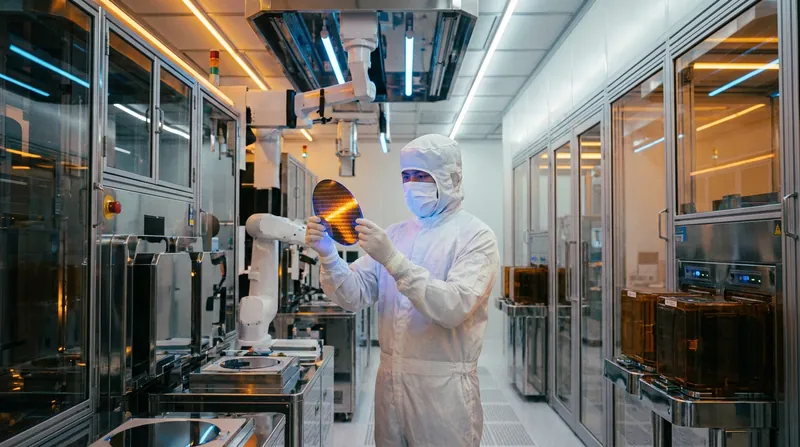
Following the agreement, TSMC acquired hundreds of additional acres adjacent to its existing facilities in Arizona, laying the groundwork for what officials describe as a "Gigafab" cluster. The company's capital expenditure is projected to surge as it builds out an 11-factory footprint capable of producing cutting-edge 2-nanometer and sub-2-nanometer chips by 2028. This expansion goes beyond raw silicon wafer production, incorporating the advanced "CoWoS" (Chip-on-Wafer-on-Substrate) packaging facilities that are essential for modern AI hardware.[1]
While TSMC's multi-billion-dollar fabs generate the headlines, the success of the U.S.-Taiwan deal hinges on the second half of the financial package: the $250 billion in state-backed credit guarantees. A semiconductor fab cannot operate in isolation; it requires a dense ecosystem of specialized chemical suppliers, precision machinery manufacturers, and testing facilities.[3]
Historically, this ecosystem has been tightly clustered in Taiwan's Hsinchu Science Park. The credit guarantees are designed to de-risk the transatlantic move for these vital mid-sized enterprises. By providing state-backed financial security, the Taiwanese government is enabling the wholesale transplantation of its domestic supply network into newly designated "world-class industrial parks" across the United States.[4]
For Taiwan, the agreement represents a strategic evolution in its geopolitical defense strategy. For decades, the island relied on a "Silicon Shield" concept—the theory that its monopoly on advanced chipmaking made it too vital to the global economy to be abandoned in the event of a conflict. By actively distributing its manufacturing base, Taiwanese officials argue they are multiplying their strength, transforming from a vulnerable single point of failure into a resilient, globally distributed network.[4]
For the United States, the pact is a cornerstone of a broader industrial policy aimed at achieving self-sufficiency in critical technologies. The Commerce Department has explicitly stated that the goal is to relocate roughly 40 percent of Taiwan's entire semiconductor supply chain to U.S. soil. If successful, this would insulate the American tech sector, military supply chains, and consumer markets from potential disruptions in the volatile Taiwan Strait.[3]
Despite the historic scale of the capital commitments, significant uncertainties remain regarding the execution of the pact. The most pressing bottleneck is human capital. Operating advanced semiconductor facilities requires thousands of highly specialized engineers and technicians—a workforce that the United States currently lacks in sufficient numbers.[4]
While the agreement includes provisions for "educational exchange corridors" to train American workers, bridging the skills gap will take years. Furthermore, the sheer logistical complexity of building dozens of hyper-clean manufacturing facilities simultaneously will strain local infrastructure, water resources, and construction labor markets in states like Arizona and Texas.[3]
Ultimately, the $500 billion U.S.-Taiwan semiconductor agreement marks a definitive turning point in the architecture of the global tech economy. By leveraging a combination of massive direct investment, state-backed credit, and aggressive tariff incentives, the pact aims to rewrite the map of where the future is manufactured. As ground is broken on these new industrial mega-sites, the focus now shifts from diplomatic signatures to the monumental task of industrial execution.[4]
Key points
- The U.S. and Taiwan signed a $500 billion agreement to reshore advanced semiconductor manufacturing to North America.
- Taiwanese tech firms will invest $250 billion directly into U.S. facilities, matched by $250 billion in government credit guarantees.
- In exchange, the U.S. will lower reciprocal tariffs on Taiwanese goods from 20% to 15%.
- A unique quota system allows participating companies to import chips and materials tariff-free while their U.S. factories are under construction.
Unanswered questions
- Whether the U.S. educational system can rapidly train the tens of thousands of specialized engineers needed to operate the new facilities.
- How local infrastructure in states like Arizona and Texas will handle the massive water and energy demands of the expanded 'Gigafabs.'
- The exact timeline for when smaller, specialized Taiwanese supply-chain vendors will complete their relocation to U.S. industrial parks.
How we got here
2022 - 2024
The U.S. and Taiwan negotiate early phases of the 21st-Century Trade Initiative, focusing on administrative hurdles.
Late 2024
The U.S. government awards TSMC $6.6 billion in direct funding under the CHIPS and Science Act.
March 2025
TSMC announces an initial $100 billion commitment to expand its U.S. manufacturing presence.
January 15, 2026
The U.S. and Taiwan officially sign the $500 billion semiconductor trade and investment agreement.
2028 (Projected)
TSMC's expanded Arizona facilities are expected to begin producing cutting-edge 2-nanometer chips.
- U.S. Policymakers
- Prioritizes national security and the reshoring of critical technology supply chains.
- Taiwanese Industry
- Seeks to maintain market dominance while navigating geopolitical pressures and securing favorable trade terms.
- Market & Supply Chain Analysts
- Evaluates the financial mechanics, execution risks, and infrastructure challenges of the massive migration.
Perspectives this story doesn't cover
- Local U.S. municipalities managing the infrastructure strain of new mega-fabs
- European and allied chipmakers facing increased competition from the U.S.-Taiwan bloc
Sources
Source coverage
4 outlets
3 viewpoints surfaced




- [1]CNBCU.S. Policymakers
SpaceX signs computing power deal with open-source AI startup Reflection worth up to $6.3 billion
Read on CNBC → - [2]The Wall Street JournalMarket & Supply Chain Analysts
Taiwan Pledges $250 Billion in U.S. Spending in Exchange for Lower Tariffs
Read on The Wall Street Journal → - [3]MeriTalkU.S. Policymakers
Commerce, Taiwan Deal Pledges $500B to Expand US Chip Manufacturing
Read on MeriTalk → - [4]CommonWealth MagazineTaiwanese Industry
U.S.–Taiwan Seal $500B Semiconductor Pact to Reshore Chips and Secure Supply Chains
Read on CommonWealth Magazine →
More in Technology
See all →Silicon Scaling
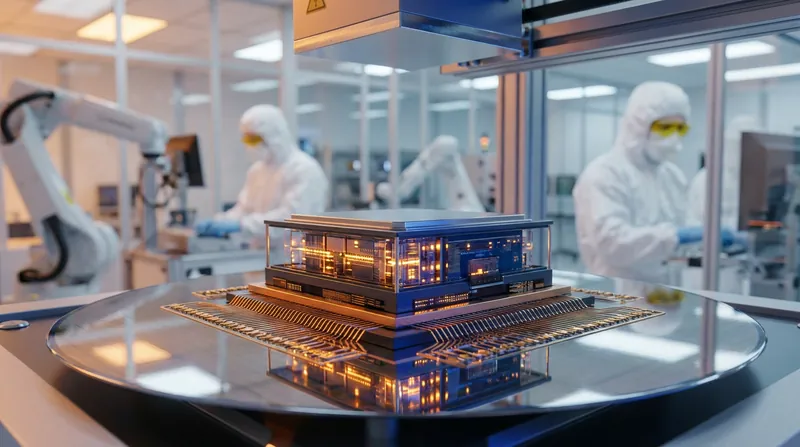
How IBM's 0.7-Nanometer 'Nanostack' Chip Breaks the Physical Limits of Silicon
2 sources
AI Supply Chain
Samsung and SK Hynix Announce $518 Billion Chipmaking Hub to Meet Global AI Demand
2 sources
AI Export Controls
US Congress Introduces Bipartisan Bill to Close Cloud Computing Loophole in AI Chip Export Controls
5 sources
Advanced Packaging
Intel Carves Out Advanced Packaging as Independent Division, Appointing Former SK Hynix CEO to Lead Effort
4 sources
Comments
Every angle. Every day.
Get Technology stories with full source coverage and perspective breakdowns, free every day.