
US and Saudi Forces Launch Joint Precision Strikes Against Iran-Backed Militias in Iraq
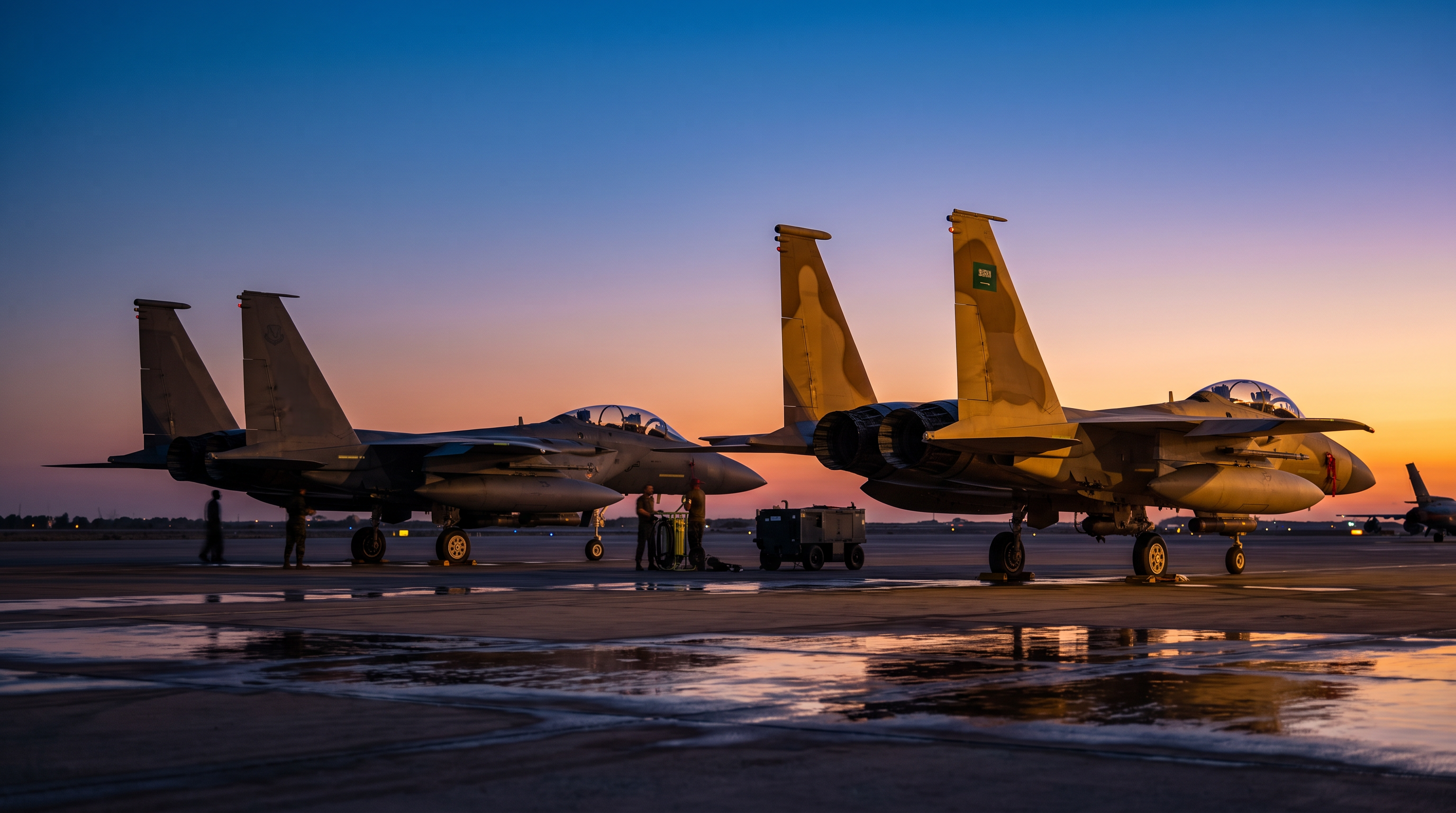
In an unprecedented joint operation, US and Saudi fighter aircraft struck logistics and weapons sites in Iraq following a barrage of drone attacks on coalition forces and energy infrastructure.
By Factlen Editorial Team
- US & Saudi Defense Coalition
- Argues the joint strikes are a lawful and necessary deterrent to protect personnel and global energy infrastructure.
- Iraqi Sovereignty Advocates
- Views the military action as a violation of territorial integrity and an attack on official state security organs.
- Regional Security Analysts
- Focuses on the strategic implications of Saudi Arabia's shift toward direct military action alongside the US.
What's not represented
- · Iranian Government Officials
- · Local Iraqi Civilians in Targeted Areas
Why this matters
This joint military operation marks a significant shift in Gulf security dynamics, signaling that Saudi Arabia is now willing to take direct military action alongside the US to protect its energy infrastructure. The strikes introduce new volatility into global oil markets while testing the limits of Iraq's sovereignty.
Key points
- US and Saudi forces conducted joint precision airstrikes against Iran-backed militias in eastern Iraq on July 28.
- The operation was launched in response to more than 30 drone attacks targeting US personnel and Saudi oil facilities over 72 hours.
- Saudi Arabia invoked Article 51 of the UN Charter, citing its inherent right to self-defense against irresponsible escalation.
- Iraq's Popular Mobilization Forces reported at least 20 fighters killed and 32 wounded across multiple provinces.
- The Iraqi government condemned the joint strikes as a dangerous escalation and a violation of its national sovereignty.
On July 28, 2026, the United States and Saudi Arabia executed an unprecedented joint military operation, launching precision airstrikes against Iran-aligned militia targets across eastern Iraq. The coordinated mission marks a significant evolution in Middle Eastern security dynamics, representing the first confirmed joint combat strikes by a Gulf state alongside US forces in the current geopolitical cycle. By combining their aerial capabilities, Washington and Riyadh have signaled a new phase in their strategic alliance, moving beyond intelligence sharing and logistical support into direct, synchronized kinetic action against shared regional adversaries.[1][4]
The strikes were authorized in direct response to a sudden and severe escalation in aerial hostilities across the region. According to US Central Command (CENTCOM), Iranian-backed factions launched more than 30 drone attacks directed at US military personnel and Saudi Arabian petroleum infrastructure within a compressed 72-hour window. These drone swarms represented a sophisticated and coordinated effort to disrupt energy markets and threaten coalition forces, prompting an immediate reassessment of the defensive posture maintained by both the United States and its Gulf allies.[1][3]
Utilizing advanced fighter aircraft from both nations, the coalition targeted logistics hubs and weapons depots operated by the Popular Mobilization Forces (PMF). The PMF is an umbrella organization of predominantly Shiite armed groups that are formally integrated into the Iraqi state security apparatus but maintain deep operational and ideological ties to Iran’s Islamic Revolutionary Guard Corps (IRGC). By striking these specific nodes, the joint operation aimed to degrade the militias' capacity to launch complex drone and missile attacks, focusing on the supply chains that enable their cross-border operations.[2][5]

For Saudi Arabia, the operation signals a stark departure from its recent diplomatic posture of de-escalation with Tehran. After enduring intermittent drone and missile harassment over the past several years, Riyadh formally invoked Article 51 of the United Nations Charter, asserting its inherent right to self-defense. Saudi defense officials emphasized that the strikes were a necessary and proportionate deterrent against militias that had chosen a path of irresponsible escalation, indicating that the Kingdom will no longer tolerate proxy attacks on its critical economic infrastructure without a direct military response.[2][4]
Washington framed the joint mission as a defensive necessity to protect its citizens and stabilize a volatile region. CENTCOM disclosed that between February and April 2026 alone, Iran-aligned militias attempted over 600 attacks on US facilities and personnel in Iraq. By partnering directly with Saudi forces for these retaliatory strikes, the US aims to project a unified front and distribute the strategic burden of regional deterrence, demonstrating that attacks on American or allied assets will be met with a coordinated, multinational military response.[1][7]
Washington framed the joint mission as a defensive necessity to protect its citizens and stabilize a volatile region.
In Baghdad, the joint strikes have triggered a severe diplomatic and political crisis. The Iraqi government and the PMF leadership swiftly condemned the operation as a dangerous escalation and a blatant violation of national sovereignty. Because the PMF is officially recognized as a component of Iraq's armed forces, the strikes technically targeted state-affiliated infrastructure. This reality complicates Baghdad's delicate balancing act, placing immense pressure on the Iraqi Prime Minister to navigate the competing demands of maintaining security ties with Washington while managing the powerful, Iran-backed factions within his own government.[2][6]
Initial reports from the PMF indicate that the joint strikes hit official facilities across multiple Iraqi provinces, including Baghdad, Nineveh, Basra, and Karbala. The militia network reported at least 20 fighters killed and 32 wounded in the immediate aftermath, with specialized committees deployed to assess the extensive material damage to buildings, military vehicles, and equipment. Furthermore, Sabreen News, a media outlet closely linked to the militias, claimed that several Iranian military advisers were among the casualties, underscoring the deep integration of IRGC personnel within the Iraqi proxy networks.[2][3]

The joint strikes occurred against a backdrop of heightened volatility and shifting alliances across the broader Middle East. Earlier in July, the US had paused a separate, intensive bombing campaign against Iran, a move that reportedly prompted Tehran to mobilize its proxy networks to increase pressure on US allies, including Saudi Arabia and Jordan. This complex web of retaliatory actions highlights the fragility of regional security, where a pause in direct state-on-state conflict often translates into an immediate surge in asymmetric warfare conducted by non-state actors.[4][6]
The targeting of Saudi energy infrastructure by Iraqi-based militias carries immediate and profound implications for global economic stability. Brent crude prices have experienced significant volatility, swinging from $72 to over $102 a barrel in recent weeks due to mounting fears of supply disruptions in the Strait of Hormuz and the broader Gulf region. The joint US-Saudi strikes are fundamentally designed to secure these critical energy corridors, reassuring global markets that the coalition possesses both the will and the capability to defend the infrastructure that powers the global economy.[3][4]
Executing a joint strike package of this magnitude requires deep interoperability between US and Saudi command structures. The operation relied on shared satellite intelligence, synchronized targeting protocols, and coordinated airspace management to ensure precision hits on logistics sites while attempting to minimize collateral damage in populated areas like the Nineveh Plain. This level of tactical integration serves as a proof of concept for future coalition operations, demonstrating that Gulf militaries can seamlessly plug into US Central Command's operational framework during high-stakes combat missions.[1][2]

The diplomatic timing of the strikes adds another layer of complexity to an already fraught geopolitical situation. Iraqi Prime Minister Ali al-Zaidi was visiting Turkey when the operation occurred, having recently concluded high-stakes diplomatic trips to both the United States and Iran in an effort to mediate regional tensions. The strikes underscore the immense, perhaps insurmountable, pressure on his administration to rein in autonomous armed factions operating within Iraq's borders, highlighting the severe limits of Baghdad's authority over the very security forces it nominally commands and funds.[5][7]
While CENTCOM issued a stark warning that the IRGC and its proxies must cease attacks to avoid further military responses, the immediate aftermath suggests continued friction rather than capitulation. Iran reportedly launched ballistic missiles at a US facility in Jordan shortly after the Iraq strikes, though all projectiles were successfully intercepted. The critical question moving forward is whether this unprecedented US-Saudi joint action will successfully establish a new threshold of deterrence, or whether it will catalyze a broader, more coordinated regional retaliation from Iran's extensive network of allied militias.[2][3]
How we got here
Feb–Apr 2026
Iran-aligned militias attempt more than 600 attacks on US citizens and facilities in Iraq.
July 26–28, 2026
Militias launch over 30 aerial drone attacks targeting US forces and Saudi petroleum facilities.
July 28, 2026
US and Saudi fighter aircraft conduct joint precision strikes against PMF logistics and weapons sites across eastern Iraq.
July 29, 2026
The PMF reports at least 20 fighters killed, while Iraq condemns the strikes as a breach of sovereignty.
Viewpoints in depth
US & Saudi Defense Coalition
Argues the joint strikes are a lawful and necessary deterrent to protect personnel and global energy infrastructure.
From the perspective of Washington and Riyadh, the operation was a legally justified response under Article 51 of the UN Charter. Military officials point to the barrage of over 30 drone attacks in a 72-hour period as an unacceptable escalation by IRGC-directed proxies. By conducting the strikes jointly, the US and Saudi Arabia aim to demonstrate a unified security architecture capable of actively degrading the logistics and weapons capabilities of hostile militias, shifting away from passive defense to active deterrence.
Iraqi Sovereignty Advocates
Views the military action as a violation of territorial integrity and an attack on official state security organs.
For the Iraqi government and the Popular Mobilization Forces (PMF), the US-Saudi strikes represent a severe breach of national sovereignty. Because the PMF is formally integrated into Iraq's state security apparatus, advocates argue that foreign powers are bombing official government facilities. This camp views the strikes not as self-defense, but as a dangerous escalation that undermines the Iraqi Prime Minister's authority and turns the country into a proxy battlefield for the broader US-Iran conflict.
Regional Security Analysts
Focuses on the strategic implications of Saudi Arabia's shift toward direct military action alongside the US.
Security analysts highlight the unprecedented nature of a Gulf state directly participating in combat strikes against Iran-backed targets in Iraq. This marks a significant departure from Riyadh's recent preference for diplomatic de-escalation. Experts suggest this new posture is designed to send a clear message to Tehran that proxy attacks on Saudi oil infrastructure will incur direct military costs, while also testing the interoperability of the US-Saudi military alliance in high-stakes combat scenarios.
What we don't know
- The exact number of casualties and the full extent of the damage to PMF infrastructure, as recovery and verification operations are still ongoing.
- Whether the joint strikes will successfully deter future militia attacks or provoke a wider, more coordinated regional retaliation from Iran-aligned groups.
- How the Iraqi government will balance its diplomatic relationships with Washington and Tehran following a direct strike on its state-affiliated security forces.
Key terms
- Popular Mobilization Forces (PMF)
- An umbrella organization of predominantly Shiite armed groups in Iraq, formally integrated into the state security apparatus but maintaining close ties to Iran.
- Islamic Revolutionary Guard Corps (IRGC)
- A multi-service primary branch of the Iranian Armed Forces, accused by the US of directing and supplying proxy militias across the Middle East.
- Article 51 of the UN Charter
- A provision in international law that recognizes the inherent right of a state to use military force in self-defense if an armed attack occurs against it.
- US Central Command (CENTCOM)
- The unified combatant command of the US Department of Defense responsible for military operations in the Middle East, Central Asia, and parts of South Asia.
Frequently asked
Why did the US and Saudi Arabia launch joint strikes in Iraq?
The strikes were a coordinated response to more than 30 drone attacks launched by Iran-backed militias against US military personnel and Saudi petroleum facilities over a 72-hour period.
Who was targeted in the operation?
The coalition targeted logistics hubs and weapons sites belonging to the Popular Mobilization Forces (PMF), an umbrella group of predominantly Shiite militias integrated into Iraq's security forces but aligned with Iran.
How did Iraq respond to the strikes?
The Iraqi government and the PMF strongly condemned the operation, calling it a dangerous escalation and a direct violation of Iraq's national sovereignty.
What is the legal justification for the strikes?
Saudi Arabia and the US invoked Article 51 of the United Nations Charter, which guarantees the inherent right of individual or collective self-defense in response to an armed attack.
Sources
Source coverage
7 outlets
3 viewpoints surfaced







[1]CENTCOMUS & Saudi Defense Coalition
U.S., Saudi Forces Strike Iran-Backed Terrorist Sites in Iraq
Read on CENTCOM →[2]The National NewsUS & Saudi Defense Coalition
At least 20 Iran-backed militia fighters killed in US-Saudi strikes on Iraq
Read on The National News →[3]CBS NewsUS & Saudi Defense Coalition
Iran-backed militia group says at least 20 fighters killed in U.S.-Saudi strikes in Iraq
Read on CBS News →[4]The Jerusalem PostRegional Security Analysts
US and Saudi Arabia launch joint strikes on Iran-linked militias in Iraq
Read on The Jerusalem Post →[5]Anadolu AgencyIraqi Sovereignty Advocates
US, Saudi forces strike Iran-backed groups, sites in Iraq: CENTCOM
Read on Anadolu Agency →[6]Taipei TimesIraqi Sovereignty Advocates
US and Saudi hit Iran-backed fighters in Iraq
Read on Taipei Times →[7]Foundation for Defense of DemocraciesRegional Security Analysts
US, Saudi Arabia Strike Iranian-Backed Militias in Iraq
Read on Foundation for Defense of Democracies →
Every angle. Every day.
Get world stories with full source coverage and perspective breakdowns delivered to your inbox.