
UN Confirms Famine in Sudan and Gaza Simultaneously, Warns 266 Million Face Acute Hunger as Global Food System Unravels
The UN Secretary-General has characterized the simultaneous famines in Sudan and Gaza as a 'shameful milestone,' warning the Security Council that 266 million people now face acute food insecurity. Officials highlighted how regional conflicts and maritime choke points are disrupting global food and fertilizer supplies, creating a vicious cycle of war and starvation.

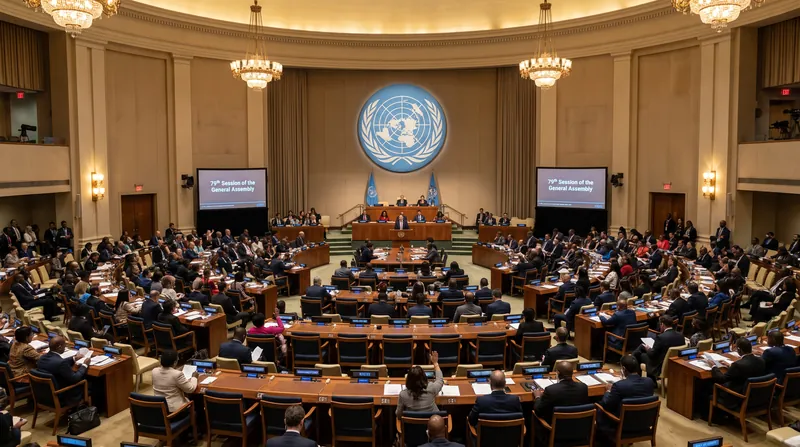
The UN Security Council convened on Tuesday to address a global food system under unprecedented strain, as Secretary-General António Guterres confirmed that famines are now occurring simultaneously in Sudan and the Gaza Strip. Calling the dual famines a "shameful milestone," Guterres warned that 2025 and 2026 have seen the highest number of armed conflicts since World War II, pushing at least 266 million people into acute food insecurity.[1][2]
The crisis marks the first time this century that two famines have been confirmed at the same time. While the immediate causes are localized violence and restricted humanitarian access, UN officials emphasized that the economic consequences of these conflicts are rippling across the globe. Violence remains the primary driver of starvation in 12 of the 13 most critical hunger hotspots identified by the United Nations.[1][4]
Carl Skau, acting executive director of the World Food Program (WFP), detailed how regional wars are severing maritime arteries and creating a "triple choke point" crisis across the Strait of Hormuz, the Red Sea, and the Black Sea. Restrictions in the Strait of Hormuz, which handles a third of the global fertilizer trade, have caused availability to plummet, while oil prices have surged 36 percent since the outbreak of war in Iran.[2][5]
"An oil tanker anchored in the Strait of Hormuz can mean one less meal a day for a child in Sudan," Skau told the Council. He noted that grain shipments through the Istanbul Strait are down 40 percent year-on-year, leaving import-dependent nations highly exposed to price shocks. In Sudan, basic food costs have surged nearly 40 percent since February alone.[2][5]
The situation in Sudan is particularly severe, with food systems facing systematic destruction. Perrine Benoist, CEO of Action Against Hunger, reported more than 900 attacks on agricultural infrastructure in Sudan since April 2023, including the bombing of markets and the looting of livestock. She warned the Council that being a woman in Sudan is now a "statistically significant predictor of starvation."[2]
The diplomatic response at the Security Council highlighted the geopolitical fractures exacerbating the crisis. UK Deputy Permanent Representative Kate Foster condemned the famines as entirely man-made, pointing to choices that deny civilians food and essential services. Foster specifically called out Russia's attacks on Black Sea ports and Iran's closure of the Strait of Hormuz, arguing that these actions have disrupted global supply chains and driven up global food prices.[3]
Guterres proposed a time-bound effort to build confidence in global shipping, focusing initially on the neutral verification and registration of ships carrying fertilizers. However, he stressed that this mechanism cannot substitute for the full restoration of navigational rights. He also called for the full implementation of UN Resolution 2417 to prevent the deprivation of food and water for civilians, suggesting sanctions against those who unlawfully deny humanitarian access.[1][2]
Despite a "glimmer of hope" in Gaza following increased aid access since the October 2025 ceasefire, the broader humanitarian funding landscape remains bleak. The WFP reported that funding for food assistance has dropped by nearly 60 percent since 2022, forcing the agency to turn away six in seven malnourished children in Afghanistan. "We cannot wait for famine or catastrophic conditions to be formally confirmed," Guterres urged, pleading for proactive intervention.[2][4]
Viewpoints in depth
The Humanitarian Perspective
UN agencies and relief organizations focus on the immediate need for access and funding.
For organizations like the World Food Program and Action Against Hunger, the dual famines represent a catastrophic failure of the international community to act on early warnings. They argue that the crisis is not a lack of global food production, but a systemic weaponization of hunger. Relief workers emphasize that without immediate, unimpeded access to conflict zones and a reversal of the 60 percent drop in humanitarian funding, the malnutrition clock will continue to accelerate, causing irreversible organ failure in children within weeks of food deprivation.
The Geopolitical Perspective
Western nations view the food crisis as a direct consequence of hostile state actions.
Diplomats from the UK and allied nations frame the unraveling food system as a deliberate consequence of aggression by states like Russia and Iran. From this viewpoint, the crisis cannot be solved purely through aid; it requires holding state actors accountable for attacking Black Sea grain ports and blockading the Strait of Hormuz. They argue that these actions are calculated maneuvers to exert geopolitical pressure by holding import-dependent nations hostage to surging fertilizer and energy costs.
Key points
- The UN confirmed simultaneous famines in Sudan and Gaza, marking the first time this century two famines have occurred at once.
- At least 266 million people globally are now facing acute food insecurity, driven primarily by armed conflict.
- Maritime choke points in the Strait of Hormuz and the Black Sea have severely restricted global fertilizer and grain shipments.
- Humanitarian funding for food assistance has dropped by nearly 60 percent since 2022, forcing agencies to cut aid to vulnerable populations.
- UN Humanitarian Agencies
- Emphasizes the immediate need for funding, unimpeded humanitarian access, and the protection of global food systems from conflict.
- Western Diplomats
- Frames the crisis as a man-made consequence of deliberate geopolitical actions, specifically targeting Russia and Iran.
- Regional Observers
- Focuses on the localized devastation in Sudan and Gaza, highlighting the direct impact of military blockades on civilian survival.
Perspectives this story doesn't cover
- Governments of import-dependent nations in the Global South
- Agricultural producers facing fertilizer shortages
Sources
Source coverage
5 outlets
3 viewpoints surfaced





- [1]UN NewsUN Humanitarian Agencies
Address 'dangerous and evolving reality' of food insecurity now, Secretary-General urges
Read on UN News → - [2]Anadolu AgencyRegional Observers
'Shameful milestone': UN chief on dual famines in Sudan, Gaza
Read on Anadolu Agency → - [3]GOV.UKWestern Diplomats
Statement by Ambassador Kate Foster, UK Deputy Permanent Representative to the UN, at the UN Security Council meeting on Food Security
Read on GOV.UK → - [4]AP NewsUN Humanitarian Agencies
UN food agencies warn acute hunger will worsen in 13 hot spots as famine risks rise
Read on AP News → - [5]Middle East MonitorRegional Observers
UN chief on dual famines in Sudan, Gaza
Read on Middle East Monitor →

More in World
See all →Arabian Sea Standoff
India Summons Pakistani Envoy Following Naval Collision in the Arabian Sea
8 sources

Global Security
UN Global Risk Report Identifies Large-Scale War as Fastest-Rising Global Threat
7 sources
African Union Law
How the African Union's Principle of Non-Indifference Reconciles Intervention with State Sovereignty
8 sources
Baltic Security
NATO Jets Down Drone Over Lithuania as Russian Warship Fires on Danish Helicopter
4 sources

Comments
Every angle. Every day.
Get World stories with full source coverage and perspective breakdowns, free every day.