
U.S. Federal Government Moves to Centralize AI Regulation, Proposing State Preemption
A new White House executive order and a bipartisan congressional draft aim to override state-level AI laws with a unified federal security and compliance framework.
By Factlen Editorial Team
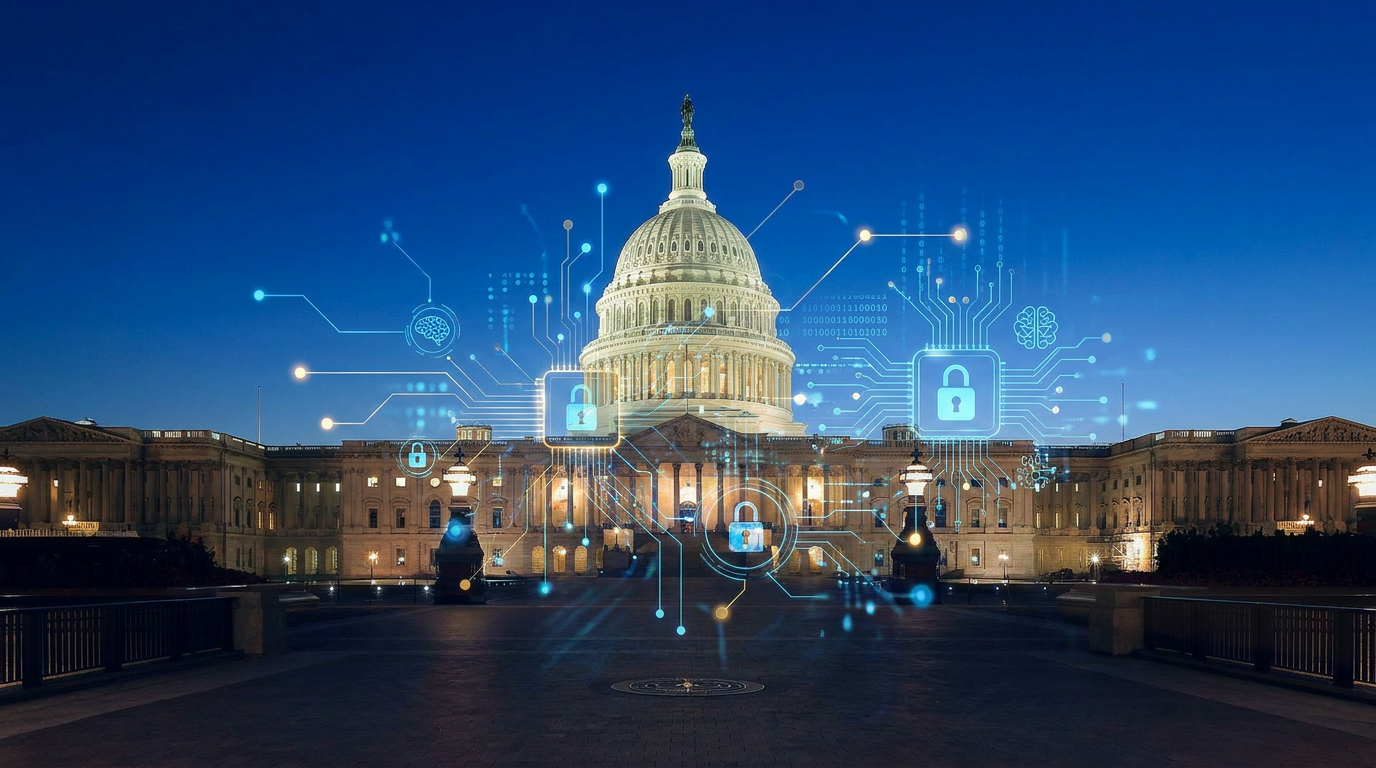
- Federal Standardization Advocates
- Argue that a fragmented patchwork of state laws stifles domestic AI innovation and that a single national standard is required.
- Cyber Defense & Security Focus
- Prioritize the immediate threat of AI-scaled cyberattacks, focusing on securing critical infrastructure and benchmarking advanced models.
- Decentralized & Strict Regulators
- Maintain that federal proposals are too lenient and that states and international bodies must enforce strict consumer protection laws.
What's not represented
- · Open-Source AI Developers
- · Civil Rights Organizations
Why this matters
The outcome of this federal push will determine whether American AI companies follow a single set of national rules or a complex web of state laws. For consumers and workers, it dictates whether protections against algorithmic bias and deepfakes will be enforced by local authorities or overseen by a centralized federal agency.
Key points
- The White House issued an executive order on June 2 prioritizing AI-enabled cyber defense and voluntary security frameworks.
- A bipartisan House draft, the Great American AI Act, proposes preempting state-level AI regulations for three years.
- The legislative push is a direct response to stringent new AI laws taking effect in California, Colorado, and Texas.
- The House draft mandates the creation of a Center for AI Standards and Innovation within the Commerce Department.
- Competing Senate proposals focus more heavily on algorithmic bias audits and creator rights regarding deepfakes.
- The U.S. debate occurs as the European Union prepares to enforce strict transparency and high-risk AI rules in August 2026.
In early June 2026, the United States federal government initiated its most comprehensive effort to date to centralize artificial intelligence regulation. The push is characterized by two parallel actions: a June 2 executive order focused on national security, and a June 4 bipartisan congressional draft aimed at establishing a uniform national AI standard. Together, these moves represent a definitive claim by federal policymakers that the current patchwork of state-level AI laws is untenable for American technological leadership. The evidence of this shift is visible in the explicit preemption clauses drafted by House lawmakers and the White House's pivot toward federal cybersecurity mandates.[2][3]
The primary mechanism of the executive branch's strategy is the "Promoting Advanced Artificial Intelligence Innovation and Security" order, issued by President Trump. The text of the order provides strong evidence that the administration is prioritizing cyber defense over mandatory consumer protection regulations. It directs federal agencies to accelerate the hiring of cybersecurity specialists within a 60-day window and instructs the Department of War and National Security Systems to prioritize the defense of critical information networks. By focusing on the intersection of AI and critical infrastructure, the executive branch is attempting to secure the nation's digital perimeter against increasingly capable automated threats.[1][2]
Further evidence of this security-first approach is the executive order's directive to the Attorney General. The mandate explicitly requires the prioritization of federal criminal statutes—including 18 U.S.C. §§ 1028, 1030, and 1343—against actors who utilize artificial intelligence to illegally access or damage computer systems. This includes the deployment of autonomous AI agents to breach public or private information technology networks for unlawful purposes. This specific legal targeting indicates a federal consensus that the most immediate, actionable risk posed by AI is its capacity to scale and automate cybercrime.[1]
To manage the risks of the most powerful systems, the executive order mandates the creation of a classified benchmarking process. Multiple departments are tasked with assessing the advanced cyber capabilities of AI models to determine the threshold at which a system becomes a "covered frontier model." Additionally, the Secretary of the Treasury, alongside the National Security Agency and CISA, is directed to form an AI cybersecurity clearinghouse. This body will coordinate the discovery, validation, and remediation of software vulnerabilities in collaboration with operators of critical infrastructure.[1][2]

However, the evidentiary weight of the executive order is currently limited by its reliance on voluntary compliance for the private sector. The directive outlines a framework for government and industry collaboration regarding the secure development of frontier models, but explicitly states that this should not be construed as a mandatory licensing or preclearance requirement. Legal analysts note a high degree of uncertainty regarding how this will be enforced, as the order leaves foundational terms like "advanced AI" undefined. Until federal agencies issue formal implementation guidelines, the practical impact on commercial AI developers remains speculative.[2]
While the White House focuses on voluntary security frameworks, Congress is advancing concrete statutory requirements. On June 4, House Representatives Jay Obernolte and Lori Trahan released a 269-page bipartisan discussion draft titled the "Great American AI Act." The central claim of the legislation is that American innovation requires a single regulatory environment. To achieve this, the draft proposes preempting state regulations targeting AI development for a period of three years. This preemption clause is the strongest evidence yet that federal lawmakers intend to override the fragmented compliance landscape that has emerged across the country.[3]
While the White House focuses on voluntary security frameworks, Congress is advancing concrete statutory requirements.
The urgency behind this federal preemption is driven by the activation of several stringent state laws in early 2026. California has created the most complex compliance environment, enforcing the Transparency in Frontier AI Act, which requires developers of large models to publish risk frameworks and report safety incidents. Furthermore, California's AI Training Data Transparency Act now mandates that developers publish detailed summaries of their training datasets, including intellectual property and personal information details. Industry groups argue that navigating these state-specific transparency mandates stifles domestic AI research.[5]
Beyond California, Colorado has implemented the most comprehensive state-level AI governance law in the country, which took effect in mid-2026 after industry pushback. The Colorado AI Act targets developers and deployers of "high-risk" systems making consequential decisions about employment, healthcare, and housing, requiring extensive risk management programs and consumer disclosures. Similarly, Texas enacted the Responsible AI Governance Act, placing categorical bans on AI systems designed for behavioral manipulation or unlawful discrimination. The House draft explicitly aims to replace this state-by-state friction with a unified federal code.[5]

To replace the preempted state laws, the Great American AI Act introduces a formalized federal oversight structure. The draft mandates the creation of a Center for AI Standards and Innovation, to be housed within the Commerce Department. This center would be tasked with evaluating AI systems, monitoring technological progress, and developing best practices for AI security. Furthermore, the legislation introduces independent auditing requirements and transparency reporting obligations for certain AI companies, effectively shifting the regulatory burden from state attorneys general to federal auditors.[3][4]
The congressional draft also claims that federal intervention is necessary to manage the macroeconomic impacts of artificial intelligence. Evidence for this is found in the bill's workforce development provisions, which direct the National Institute of Standards and Technology (NIST) and the National Science Foundation to establish grants funding AI education and reskilling. Additionally, the bill requires the Census Bureau and the Bureau of Labor Statistics to revise federal surveys to track AI adoption and usage in the workplace, signaling a long-term federal commitment to monitoring algorithmic labor displacement.[4]
Recognizing the global nature of AI development, the House draft also addresses international coordination. The legislation directs the Department of Energy and NIST to lead international AI standards coordination and drive U.S.-led standards adoption efforts abroad. This provision is designed to ensure that American technical specifications, rather than those developed by foreign competitors or international bodies, become the default architecture for global AI deployment. The bill also directs the Government Accountability Office to evaluate the safety protocols of open-source AI software, a critical vector for international proliferation.[4]

Despite the comprehensive nature of the House draft, the path to a unified federal law remains highly uncertain. In the Senate, competing frameworks such as the "TRUMP AMERICA AI Act" present differing priorities. The Senate proposal includes mandates for high-risk AI providers to undergo audits specifically regarding viewpoint or political affiliation discrimination. It also incorporates the "NO FAKES Act," which would hold AI companies liable for the unauthorized use of a creator's visual likeness. Reaching a consensus between the House's focus on uniform commercial standards and the Senate's focus on algorithmic bias and creator rights will be a significant legislative hurdle.[3]
The uncertainty surrounding the U.S. federal framework stands in stark contrast to the regulatory environment in the European Union. While American lawmakers debate preemption and voluntary guidelines, the EU AI Act is approaching a critical enforcement milestone on August 2, 2026. On this date, the EU's Article 50 transparency obligations for AI-generated content and the core compliance requirements for Annex III high-risk AI systems become actively enforceable. This divergence provides strong evidence that, regardless of domestic preemption debates, multinational AI developers will be forced to calibrate their global compliance strategies to European standards in the immediate future.[6]
How we got here
Jan 2026
California and Texas enact stringent state-level AI governance and transparency laws.
Mar 2026
The Senate releases the TRUMP AMERICA AI Act draft, focusing on viewpoint discrimination audits.
Jun 2, 2026
The White House issues an executive order prioritizing AI-enabled cyber defense and voluntary frontier model frameworks.
Jun 4, 2026
House lawmakers release the Great American AI Act draft, proposing a 3-year preemption of state AI laws.
Aug 2, 2026
The EU AI Act's transparency and high-risk system obligations become actively enforceable.
Viewpoints in depth
The Federal Standardization View
Advocates for a single national AI regulatory framework to replace state laws.
Proponents of the Great American AI Act argue that the U.S. cannot maintain its geopolitical lead in artificial intelligence if domestic developers are forced to navigate 50 different compliance regimes. They cite the heavy reporting burdens of California's SB 53 and Colorado's AI Act as active deterrents to innovation. From this perspective, a three-year federal preemption is a necessary mechanism to clear the runway for commercial development, shifting the focus from state-level consumer protection to national economic competitiveness.
The Cyber Defense View
Prioritizes immediate national security threats and voluntary industry collaboration.
This camp, reflected in the June 2 executive order, views artificial intelligence primarily through the lens of critical infrastructure vulnerability. Rather than focusing on algorithmic bias or consumer transparency, these officials are concerned with AI's ability to automate and scale cyberattacks. They argue that mandatory licensing would slow down the deployment of defensive AI systems, advocating instead for classified benchmarking of 'frontier' models and voluntary vulnerability sharing between the government and top-tier developers.
The State & Strict Regulatory View
Defends local consumer protection laws and mandatory compliance frameworks.
State attorneys general and consumer advocacy groups argue that federal preemption is a tactic to water down meaningful AI oversight. They point to the robust requirements in California and the impending enforcement of the EU AI Act as the gold standard for accountability. From this viewpoint, voluntary federal guidelines and industry self-auditing are insufficient to protect the public from algorithmic discrimination, deepfakes, and the misuse of personal training data, making state-level enforcement essential.
What we don't know
- Whether the House's proposed three-year preemption of state AI laws can survive negotiations with the Senate.
- How federal agencies will define ambiguous terms like 'advanced AI' and 'covered frontier models' in the executive order.
- If the voluntary security frameworks proposed by the White House will eventually transition into mandatory licensing requirements.
Key terms
- Frontier AI Models
- Highly capable foundation models that could possess dangerous capabilities sufficient to pose severe risks to public safety or national security.
- Federal Preemption
- A legal doctrine where federal law supersedes and invalidates conflicting state laws, creating a single national standard.
- Annex III High-Risk Systems
- A classification under the EU AI Act for AI systems used in sensitive areas like employment, education, and law enforcement, which face strict regulatory requirements.
- Red Teaming
- A cybersecurity practice where independent experts rigorously test an AI system to identify vulnerabilities, biases, or security flaws before public release.
Frequently asked
What does the June 2026 executive order on AI actually do?
It directs federal agencies to accelerate cybersecurity hiring, prioritizes criminal enforcement against AI-driven cyberattacks, and establishes a voluntary security framework for developers of advanced "frontier" AI models.
Will the Great American AI Act cancel state AI laws?
If passed in its current draft form, the bill would preempt state-level AI regulations, such as those in California and Colorado, for a period of three years to establish a uniform national standard.
Are AI companies required to get a federal license under the new executive order?
No. The executive order explicitly states that its framework for government and industry collaboration is voluntary and does not constitute a mandatory licensing or preclearance requirement.
How does the U.S. approach compare to the European Union?
While the U.S. is currently debating voluntary guidelines and federal preemption, the EU is preparing to enforce strict, mandatory compliance rules for high-risk AI systems starting August 2, 2026.
Sources
Source coverage
6 outlets
3 viewpoints surfaced






[1]SkaddenCyber Defense & Security Focus
New AI Executive Order Calls for Frontier Model Security, Early Government Access and AI-Enabled Cyber Defense
Read on Skadden →[2]Global Policy WatchCyber Defense & Security Focus
White House Issues Executive Order on AI Innovation and Security
Read on Global Policy Watch →[3]JD SupraFederal Standardization Advocates
The Great American AI Act: Bipartisan Draft Released
Read on JD Supra →[4]SHRMFederal Standardization Advocates
Congress Proposes National AI Governance Framework
Read on SHRM →[5]VerifyWiseDecentralized & Strict Regulators
State AI Laws in 2026: California, Colorado, Texas
Read on VerifyWise →[6]Augment CodeDecentralized & Strict Regulators
EU AI Act Timeline: What Enforces on August 2, 2026
Read on Augment Code →

More in ai
See all 5 stories →On-Device AI
How Local AI Replaced the Cloud: Running Frontier Models on Your Laptop
0 sources

Enterprise AI
The Rise of Small Language Models: How Enterprises Are Running AI Locally in 2026
0 sources

Drug Discovery
New AI Model Accelerates Molecular Simulations 10,000-Fold, Slashing Drug Discovery Timelines
0 sources

Every angle. Every day.
Get ai stories with full source coverage and perspective breakdowns delivered to your inbox.