
Trail Running Shoes vs. Hiking Boots: The 2026 Backpacking Footwear Debate
As ultralight backpacking goes mainstream, the debate between nimble trail runners and sturdy hiking boots comes down to biomechanics, pack weight, and terrain.
By Factlen Editorial Team
- Ultralight Backpackers
- Advocates for minimizing weight to maximize daily mileage and comfort.
- Traditional Mountaineers & Guides
- Prioritizes durability, weather protection, and load-bearing stability.
- Biomechanics Researchers
- Focuses on the physiological impact of footwear on joints and energy expenditure.
What's not represented
- · Casual day-hikers who prioritize aesthetic and budget over technical performance.
- · Trail maintenance crews who require steel-toe safety but want lightweight comfort.
Why this matters
Choosing the wrong footwear is the leading cause of blisters, joint fatigue, and ruined backpacking trips. Understanding the biomechanics of foot weight allows hikers to match their shoes to their specific load and terrain, ensuring a safer and more comfortable time outdoors.
Key points
- Trail running shoes save significant energy, as one pound on the foot equals four to six pounds on the back.
- Traditional hiking boots provide essential stability and armor for heavy packs and off-trail scrambling.
- Non-waterproof trail runners dry much faster than waterproof boots, reducing the risk of severe blisters.
- Modern biomechanics research suggests flexible shoes may help build natural ankle strength better than rigid collars.
- The optimal choice depends entirely on a hiker's base pack weight, terrain, and weather conditions.
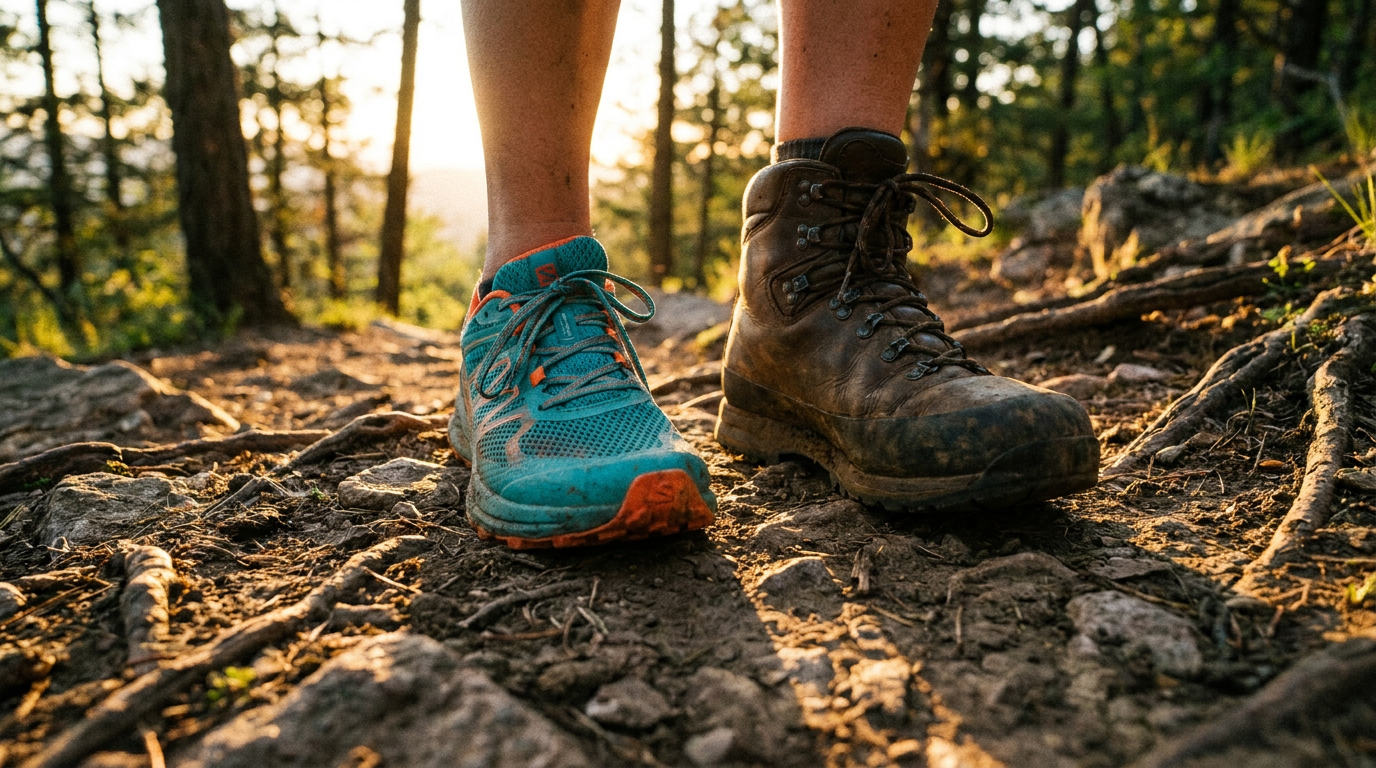
The debate between trail running shoes and hiking boots has become the most defining gear choice in modern outdoor recreation. Walk onto any major long-distance route in the summer of 2026, and you will see a stark divide: traditionalists in sturdy leather boots grinding uphill, alongside ultralight backpackers moving swiftly in mesh running shoes. This is no longer just a fringe trend driven by eccentric thru-hikers; it is a fundamental shift in how the outdoor industry approaches foot health, fatigue, and biomechanics. However, the decision is rarely as simple as picking the lightest option on the shelf or blindly following the latest trail fad. The right choice depends entirely on a hiker's pack weight, the specific terrain they plan to cross, and their individual foot strength. As gear technology evolves, understanding the precise trade-offs between these two philosophies is essential for anyone looking to step into the backcountry comfortably.[1][2]
The primary argument for trail running shoes centers on energy conservation and out-of-the-box comfort. Trail runners are built with flexible midsoles, highly breathable mesh uppers, and aggressive rubber lugs designed to grip dirt and rock without restricting the foot's natural movement. Because they lack rigid shanks and heavy leather collars, they require virtually no break-in period, drastically reducing the friction that causes debilitating trail blisters. For hikers aiming to cover high mileage day after day, the sheer comfort of a shoe that conforms to the foot—rather than forcing the foot to conform to a stiff boot—is a massive advantage. This flexibility allows the foot to splay naturally upon impact, absorbing shock through the body's own biomechanical systems rather than relying entirely on the shoe's architecture.[1][6]
The evidence supporting this shift toward lighter footwear is heavily rooted in biomechanics and energy expenditure. Research consistently demonstrates that weight carried on the feet requires roughly four to six times more energy to move than the equivalent weight carried in a backpack. Trading a two-and-a-half-pound pair of traditional hiking boots for a one-pound pair of trail runners effectively removes the metabolic equivalent of six to nine pounds from a hiker's back. This compounding energy savings is precisely why the 2025 Appalachian Trail Thru-Hiker Survey found that over half of all long-distance hikers now wear trail runners, reporting overwhelmingly high satisfaction rates. When lifting a shoe thousands of times over a twenty-mile day, saving just a few ounces per step translates to a monumental reduction in overall leg fatigue by the time camp is reached.[3]

The argument against trail runners, however, highlights their distinct lack of durability and structural protection. A standard trail running shoe is designed to last between 300 and 500 miles before the EVA foam midsole compresses permanently and the upper mesh begins to tear at the flex points. For a casual weekend hiker, this might mean replacing shoes every two years, but for a thru-hiker, it means purchasing four or five pairs over a single summer expedition. Furthermore, the soft mesh offers zero protection against dropped rocks, sharp scree, or abrasive desert flora, leaving the toes and sides of the feet highly vulnerable in off-trail environments. When the terrain shifts from a groomed dirt path to a jagged boulder field, the minimalist nature of a trail runner can quickly become a liability.[1][5]
Conversely, the case for traditional hiking boots is built entirely on stability, weather resistance, and protective armor. Modern boots have evolved significantly by 2026, incorporating lighter foams borrowed directly from the running industry, but they retain the stiff torsional shanks and reinforced toe caps that define the category. When carrying a heavy backpack—generally anything over thirty-five pounds—the rigid sole of a boot acts as a supportive platform. This rigidity prevents foot fatigue by stopping the foot from bending over every individual root and rock on the trail. Instead of the foot muscles working overtime to balance the load, the boot absorbs the micro-impacts, providing a stable base that is crucial when hauling heavy winter gear or expedition-level supplies.[2][7]
Conversely, the case for traditional hiking boots is built entirely on stability, weather resistance, and protective armor.
The evidence favoring boots becomes undeniable in technical, wet, or freezing conditions where exposure is a genuine risk. In environments like the boggy Scottish Highlands or the rocky alpine traverses of the Pacific Northwest, boots provide a critical shield against the elements. Waterproof membranes like Gore-Tex are highly effective in boots because the higher collar prevents deep mud and water from easily overtopping the shoe. When kicking steps into early-season snow or navigating miles of sharp talus, the structural integrity of a boot prevents deep bone bruising that a soft trail runner simply cannot absorb. In these rugged scenarios, the extra weight on the foot is a necessary trade-off for the safety and insulation required to complete the journey without injury.[2][7]

The primary argument against hiking boots involves moisture management and the sheer weight penalty. While waterproof boots excel at keeping external water out, they also trap internal moisture with ruthless efficiency. A hiker's foot can produce a significant amount of sweat during a steep climb, and once the inside of a heavy boot gets wet—whether from perspiration or a misjudged stream crossing—it can take days to fully dry. This trapped moisture softens the skin, creating the perfect environment for severe, trip-ending blisters. In stark contrast, a non-waterproof trail runner will flood instantly during a river crossing but can pump the water out through the mesh and dry within a few hours of walking in the sun.[4][6]
The most fiercely contested battleground in this footwear debate is the concept of ankle support. For decades, conventional outdoor wisdom dictated that high-cut boots were absolutely necessary to prevent ankle sprains on uneven ground. However, modern sports medicine and biomechanics studies, including research indexed by the National Center for Biotechnology Information, suggest a more nuanced reality. Rigid ankle collars may actually limit the natural mobility of the foot, transferring torque up to the knee and preventing the ankle tendons from building their own natural strength. While boots undoubtedly protect the ankle bone from scraping against sharp rocks, many experts now argue that a lighter shoe with a lower stack height prevents sprains by keeping the foot closer to the ground, allowing for faster, more accurate proprioceptive reactions when a hiker steps on a loose stone.[3][4][8]

Ultimately, trail running shoes fit well when a hiker is carrying a base weight under fifteen pounds, traveling on established trails, and prioritizing speed and breathability in three-season conditions. They are the optimal choice for hikers who want to avoid blisters, minimize leg fatigue over long distances, and prefer a nimble, athletic feel on the trail. Conversely, they do not fit well when navigating deep snow, carrying expedition-level loads, or bushwhacking through dense, thorny underbrush where the lightweight mesh upper will be shredded in a matter of hours.[1][5]
Hiking boots fit well when the journey involves heavy loads, off-trail scrambling, or sustained cold and wet weather. They remain the right tool for hikers who need a stiff platform to prevent foot fatigue on jagged rocks, or those who require the thermal insulation and waterproofing of a full leather upper to prevent frostbite. They do not fit well for fast-and-light summer backpacking on well-groomed dirt trails, where their heavy weight, stiff soles, and poor ventilation will only lead to sweaty feet, blisters, and unnecessary exhaustion.[2][7]
How we got here
1980s–1990s
Heavy, rigid leather boots dominate the backpacking industry as the unquestioned standard for all terrain.
Early 2000s
The ultralight backpacking movement gains traction, with early adopters experimenting with standard running shoes on long trails.
2010s
Outdoor brands begin designing dedicated trail running shoes with aggressive lugs and rock plates, specifically targeting hikers.
2025
The Appalachian Trail Thru-Hiker Survey reports that over 50% of long-distance hikers now exclusively use trail runners.
2026
Boot manufacturers adopt running-shoe foams and geometries to create hybrid mid-cut boots that bridge the weight gap.
Viewpoints in depth
Ultralight Backpackers
Advocates for minimizing weight to maximize daily mileage and comfort.
This camp argues that the traditional hiking boot is an outdated relic for most three-season hiking. By keeping pack weights under fifteen pounds, they eliminate the need for stiff, heavy footwear. They point to the biomechanical reality that weight on the feet is exponentially more exhausting than weight on the back. For ultralight hikers, wet feet are an accepted reality; they prefer shoes that drain and dry quickly over waterproof boots that trap sweat and take days to dry out.
Traditional Mountaineers & Guides
Prioritizes durability, weather protection, and load-bearing stability.
Guides and traditionalists emphasize that trail runners are highly specialized tools that fail dangerously outside of their ideal conditions. When carrying heavy group gear, traversing sharp scree fields, or navigating early-season snow, the rigid shank and protective upper of a boot are non-negotiable safety features. They argue that the ultralight trend often misleads beginners into wearing flimsy mesh shoes in rugged alpine environments, leading to bruised feet, shredded footwear, and unnecessary exposure to the elements.
Biomechanics Researchers
Focuses on the physiological impact of footwear on joints and energy expenditure.
Sports scientists look past the marketing to study how footwear alters human gait. Their research highlights that heavy boots increase metabolic demand and alter proprioception, potentially transferring stress to the knees. However, they also note that while flexible shoes can help build natural ankle tendon strength over time, they offer zero mechanical protection against sudden impacts or deep bone bruising from sharp rocks. This camp advocates for matching the shoe's structural support directly to the total weight the body is being asked to carry.
What we don't know
- Whether long-term use of zero-drop trail runners on rugged terrain increases the risk of Achilles tendonitis compared to traditional boots.
- How emerging super-critical foams from the marathon world will impact the durability of future hiking footwear.
Key terms
- Base Weight
- The total weight of a loaded backpack excluding consumables like food, water, and fuel.
- EVA Foam
- Ethylene-vinyl acetate, a lightweight, shock-absorbing foam commonly used in the midsoles of running shoes.
- Stack Height
- The amount of shoe material between the bottom of the foot and the ground, affecting cushioning and ground feel.
- Shank
- A stiff, supportive insert placed in the midsole of a hiking boot to provide load-bearing rigidity.
- Proprioception
- The body's ability to sense its location, movements, and actions, which helps feet react quickly to uneven terrain.
Frequently asked
Do I need hiking boots if I have weak ankles?
Not necessarily. While boots protect against scrapes and impacts, studies suggest lower, flexible shoes can help build natural ankle strength and improve ground feel, reducing the chance of rolling an ankle.
How do you cross streams in trail runners?
Hikers usually walk straight through the water. Because trail runners lack waterproof membranes and heavy padding, they pump the water out as you walk and dry within a few hours.
Are waterproof trail runners a good compromise?
Often no. Waterproof trail runners keep light rain out, but if water gets in through the low ankle collar, the membrane traps the water inside, taking much longer to dry than non-waterproof mesh.
When should I absolutely wear hiking boots?
Boots are strongly recommended for winter hiking in snow, carrying heavy packs over 35 pounds, and traversing off-trail terrain with sharp rocks and scree.
Sources
Source coverage
8 outlets
3 viewpoints surfaced








[1]Unplug MagazineUltralight Backpackers
Trail Running Shoes vs. Hiking Boots: The Debate
Read on Unplug Magazine →[2]Expedition DetroitTraditional Mountaineers & Guides
The Great Trail Debate: Trail Running Shoes vs. Hiking Boots
Read on Expedition Detroit →[3]BootsGuruUltralight Backpackers
Trail Running Shoes vs Hiking Boots (2026): The Research-Backed Guide
Read on BootsGuru →[4]The TrekBiomechanics Researchers
Why Trail Runners are Better than Boots
Read on The Trek →[5]The Hiking LifeUltralight Backpackers
Trail Runners vs Boots: A 30 Year Perspective
Read on The Hiking Life →[6]CleverHikerUltralight Backpackers
Footwear is Key – Trail Runners vs. Boots
Read on CleverHiker →[7]HikeLoadTraditional Mountaineers & Guides
Best Hiking Boots of 2026
Read on HikeLoad →[8]National Center for Biotechnology InformationBiomechanics Researchers
Biomechanics of Ankle Support in Footwear
Read on National Center for Biotechnology Information →

More in shopping
See all 5 stories →


Every angle. Every day.
Get shopping stories with full source coverage and perspective breakdowns delivered to your inbox.