
The Zero-Carbon Cloud: How Geothermal Energy and AI Are Decarbonizing Data Centers
As artificial intelligence drives global computing power demand to record highs, the tech industry is turning to next-generation geothermal energy and smart grid management to build a sustainable, carbon-negative cloud.
By Lila Morgan

In short
- Global data center electricity consumption is projected to reach 1,050 terawatt-hours in 2026 due to AI workloads.
- Tech giants are investing heavily in geothermal energy to secure 24/7 carbon-free baseload power.
- AI-driven power management and liquid cooling are pushing Power Usage Effectiveness (PUE) scores down to 1.09.
The artificial intelligence boom has a hidden physical footprint: electricity. As large language models and high-performance computing scale globally, the infrastructure required to train and run them is drawing unprecedented amounts of power. According to the International Energy Agency, global data center electricity consumption is projected to approach 1,050 terawatt-hours in 2026, making the sector one of the largest electricity consumers worldwide.
For years, cloud providers offset this consumption by purchasing renewable energy credits from solar and wind farms. But the intermittent nature of weather-dependent renewables creates a fundamental mismatch. Data centers require constant, uninterrupted power—a "baseload" that solar and wind cannot provide alone without massive, currently unscalable battery storage.[3]
To bridge this gap and achieve true 24/7 carbon-free energy, the industry is increasingly turning to an ancient power source: the heat of the Earth itself. Next-generation geothermal energy is emerging as the holy grail for cloud providers, offering the constant, firm baseload capacity of fossil fuels without the greenhouse gas emissions.[1][2]
The shift is already materializing in massive infrastructure deals. Google recently signed a landmark agreement with Ormat Technologies to develop up to 150 megawatts of new geothermal power across Nevada, designed to directly support its expanding digital infrastructure. Microsoft has similarly partnered with ENEL for a 120-megawatt geothermal data center link in Iceland.[1]
"Unlike many clean technologies, geothermal is local, stable, and shielded from geopolitical shocks," noted the European Geothermal Energy Council in a June 2026 declaration supporting the integration of data centers into sustainable energy systems. By tapping into deep underground heat, tech giants are future-proofing their operations against grid instability.[2]
But generating clean power is only half the equation; the other half is radical efficiency. To manage the massive power fluctuations and high-density deployments characteristic of AI workloads, data centers are turning artificial intelligence inward to optimize their own operations.
AI-driven power management systems now use predictive models, such as reinforcement learning, to anticipate IT loads and ambient environmental changes in real time. Instead of relying on static cooling rules, these systems dynamically adjust power distribution, scaling seamlessly across distributed facilities to prevent energy waste.
Another breakthrough technique is carbon-aware workload scheduling. Because cloud infrastructure is globally distributed, AI systems can automatically route non-urgent computational tasks—like training a new machine learning model or processing large batch analytics—to data centers in regions where the sun is currently shining or the wind is blowing.[6]
This spatial and temporal shifting ensures that heavy workloads consume excess renewable energy that might otherwise be curtailed. At the hardware level, the development of custom, energy-efficient silicon is also playing a crucial role, with application-specific chips processing data much faster and with significantly less power than general-purpose processors.[6]
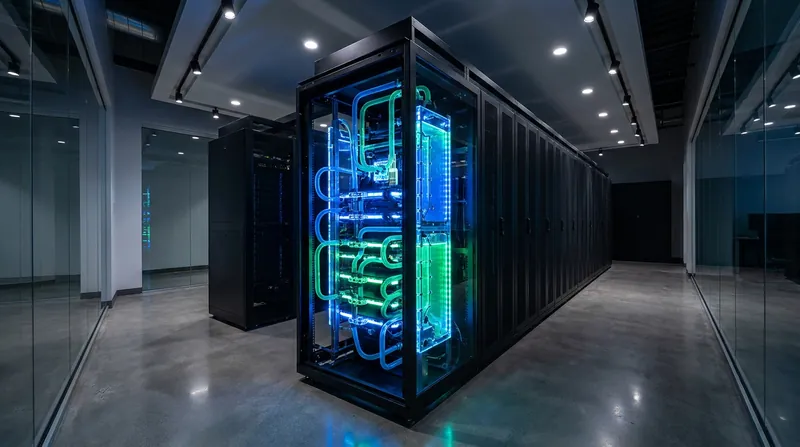
Cooling represents the largest non-computational energy burden in any facility, typically accounting for 30 to 40 percent of total energy consumption. By replacing traditional air conditioning with AI-optimized liquid cooling and dynamic environmental controls, operators are drastically reducing the energy required to keep servers from overheating.
The industry measures this efficiency using a metric called Power Usage Effectiveness (PUE). While the industry average for traditional facilities hovers around 1.56, leading green data centers are now achieving PUE scores as low as 1.09—meaning nearly all the electricity drawn goes directly to computing rather than overhead.
Beyond internal efficiency, green data centers are being redesigned to act as active participants in local energy ecosystems through a concept known as "sector coupling." Because nearly all the electricity consumed by servers is ultimately rejected as heat, modern facilities are capturing this thermal byproduct to warm surrounding communities.[5]
In France, energy company Idex is developing an urban heating project that combines geothermal heating with a waste heat recovery system from a local data center. This approach not only reduces the cooling burden on the data center but also displaces fossil fuels that would otherwise be used for residential heating.[5]
Regulatory pressure is accelerating this transition. The European Union's revised Energy Performance of Buildings Directive and the Climate Neutral Data Centre Pact mandate that data centers achieve climate neutrality by 2030. This has transformed sustainability from a secondary public relations metric into a primary driver of architectural design.[4]
The transition to a zero-carbon cloud proves that operational growth and environmental stewardship do not have to be mutually exclusive. By combining the firm baseload of geothermal energy with the hyper-efficiency of AI power management, the infrastructure of the future is being built to sustain both the digital economy and the planet.[6]
Key terms
- Power Usage Effectiveness (PUE)
- A metric used to determine the energy efficiency of a data center, calculated by dividing total facility energy by the energy used strictly for computing.
- Baseload Power
- The minimum amount of electric power needed to be supplied to the electrical grid at any given time, requiring constant and reliable generation.
- Sector Coupling
- The integration of energy-consuming sectors (like data centers) with energy-producing or distributing networks (like district heating) to improve overall efficiency.
- Carbon-Aware Computing
- The practice of scheduling and routing digital workloads to times and locations where renewable energy is most abundant.
Frequently asked
Why can't data centers just run on solar and wind power?
Solar and wind are intermittent, meaning they only generate power when the sun shines or wind blows. Data centers require constant, 24/7 power, making firm sources like geothermal necessary.
How does AI help reduce data center energy use?
AI systems predict computing loads and environmental changes in real time, dynamically adjusting cooling and power distribution to eliminate waste.
What happens to the heat generated by data centers?
In modern green data centers, waste heat is captured and repurposed through district heating networks to warm nearby homes and businesses.
Viewpoints in depth
Cloud Infrastructure Providers
Prioritize scalable, firm clean energy to meet AI demand while honoring corporate net-zero commitments.
For hyperscale cloud operators, the transition to green energy is an existential business requirement. As AI workloads demand unprecedented power, relying on local grids powered by fossil fuels threatens both their corporate net-zero pledges and their operational stability. These providers argue that investing in firm, 24/7 clean energy like geothermal is the only way to decouple computational growth from carbon emissions. They view data centers not just as consumers of power, but as anchor tenants that can fund the development of next-generation renewable infrastructure.
Environmental & Policy Advocates
Focus on absolute emission reductions and regulatory frameworks to ensure the tech sector doesn't derail global climate goals.
Environmental advocates acknowledge the efficiency gains made by the tech industry, but caution that relative efficiency (like lower PUE scores) is not enough if absolute energy consumption continues to skyrocket. This camp pushes for strict regulatory frameworks, such as the EU's Energy Performance of Buildings Directive, to mandate climate neutrality. They argue that without government oversight, the rapid deployment of AI could force older coal and gas plants to remain online longer than planned to meet the surging baseload demand.
Grid & Energy Operators
View data centers as potential assets for grid stability and district heating, provided their power draw is managed dynamically.
Utility companies and grid operators face the immediate challenge of balancing massive new electrical loads without destabilizing local networks. From their perspective, data centers must evolve from passive consumers into active grid participants. By utilizing AI to dynamically reduce power draw during peak grid stress, and by exporting waste heat to municipal district heating systems, operators argue that data centers can actually improve overall grid resilience and support broader community decarbonization efforts.
- Cloud Infrastructure Providers
- Prioritize scalable, firm clean energy to meet AI demand while honoring corporate net-zero commitments.
- Environmental & Policy Advocates
- Focus on absolute emission reductions and regulatory frameworks to ensure the tech sector doesn't derail global climate goals.
- Grid & Energy Operators
- View data centers as potential assets for grid stability and district heating, provided their power draw is managed dynamically.
Perspectives this story doesn't cover
- Local communities living near proposed hyperscale data center sites
- Fossil fuel grid operators facing rapid demand shifts
Sources
Source coverage
6 outlets
3 viewpoints surfaced






- [1]CarbonCredits.comCloud Infrastructure Providers
Google Taps Earth's Heat in 150MW Geothermal Deal with Ormat Technologies to Power Data Centers
Read on CarbonCredits.com → - [2]EGECGrid & Energy Operators
Strategic Roadmap for Digitalisation and AI in the Energy sector
Read on EGEC → - [3]DataBankCloud Infrastructure Providers
Five Sustainability Trends That Will Define Data Centers in 2026
Read on DataBank → - [4]European CommissionEnvironmental & Policy Advocates
Green cloud and green data centres | Shaping Europe's digital future
Read on European Commission → - [5]District EnergyGrid & Energy Operators
Data Centers & District Energy
Read on District Energy → - [6]Factlen Editorial Team
Synthesis by Factlen editorial team
Read on Factlen Editorial Team →
More in Technology
See all →Cloud Architecture
Beyond Containers: How WebAssembly is Rewriting the Rules of Cloud Computing
3 sources

Sustainable Cloud
How 'Zero-Water' Liquid Cooling is Solving the AI Cloud's Thirst
3 sources
AI Orchestration
How Open-Source AI Agent Orchestration is Changing Cloud Workflows
6 sources
Green Tech
How Carbon-Aware Cloud Computing Routes Workloads to Chase the Sun and Wind
3 sources
Comments
Every angle. Every day.
Get Technology stories with full source coverage and perspective breakdowns, free every day.