
The Weight of History: Iconic Moments That Defined the UEFA European Championship
As the two-year countdown to Euro 2028 in the UK and Ireland begins, a look back at the records, legends, and unforgettable goals that built the tournament's legacy.
By Omar Haddad
Share this story
In exactly two years, the whistle will blow on the 18th UEFA European Championship. Kicking off on June 9, 2028, the tournament will be co-hosted by the United Kingdom and the Republic of Ireland, bringing Europe's premier international football competition back to the British Isles.
For a continent that breathes football, the Euros represent the pinnacle of regional pride, offering a density of talent and tactical rigor that often rivals the World Cup. Spain will enter as the defending champions, having defeated England 2-1 in the 2024 final in Berlin, but the 2028 edition promises a fresh canvas across a slate of historic stadiums.
The scale of the upcoming tournament is unprecedented for the region. Over three million match tickets will be available as 24 national teams compete across 51 matches. Host cities span the length and breadth of the islands, from London's Wembley Stadium and Glasgow's Hampden Park to the Dublin Arena and the National Stadium of Wales in Cardiff.
For the Republic of Ireland, Wales, and Northern Ireland, this marks the first time they will host matches of this magnitude, while England and Scotland build upon their experiences of hosting Euro 1996 and matches during the pan-European Euro 2020.
To fully grasp the cultural weight of Euro 2028, one must look back at the competition's storied 68-year history. The European Championship has consistently served as the stage where footballing immortality is forged. Originally conceived by UEFA's first general secretary, Henri Delaunay, the inaugural 1960 tournament in France featured just four teams, culminating in a victory for the Soviet Union over Yugoslavia. It wasn't until 1980 that the finals expanded to eight teams, eventually growing to 16 in 1996, and reaching its current 24-team format in 2016.[1][3]
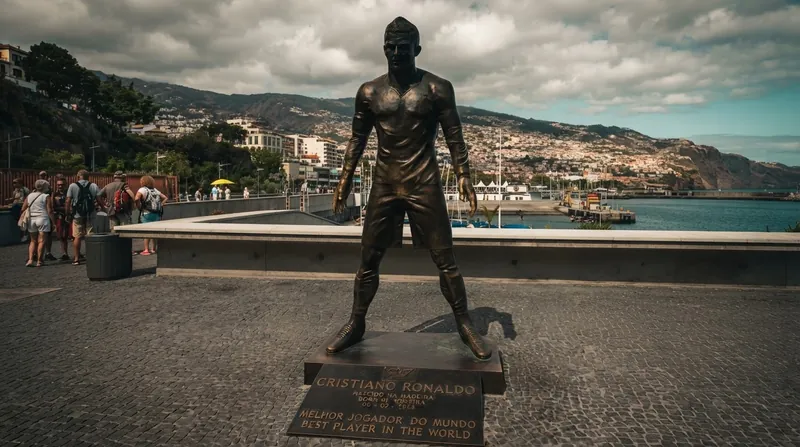
Throughout its evolution, the tournament has been defined by individual brilliance that defies the intense tactical structures of international football. At the summit of the goalscoring charts sits Portugal's Cristiano Ronaldo, whose unmatched longevity has yielded a record 14 goals across five different European Championships. Ronaldo's sustained excellence is contrasted by the explosive singular peak of France's Michel Platini. Operating as an attacking midfielder in 1984, Platini registered an astonishing nine goals in a single tournament—a record that remains entirely unchallenged four decades later.[3]
Beyond the raw statistics, the Euros are etched into the public consciousness through moments of sheer audacity. The 1976 final in Belgrade birthed one of the sport's most enduring techniques. With Czechoslovakia and West Germany tied in a penalty shootout, Antonin Panenka stepped up to take the decisive kick.
Instead of blasting the ball with power, he delicately chipped it down the center of the goal as the legendary German goalkeeper Sepp Maier dived to the side. The "Panenka" penalty secured the trophy for Czechoslovakia and introduced a new form of psychological warfare to the game.[2]
The 1980s delivered what is widely considered the greatest goal in the competition's history. In the 1988 final, the Netherlands faced the Soviet Union. From a seemingly impossible angle near the right touchline, Dutch striker Marco van Basten met a looping cross with a ferocious, dipping volley that arced perfectly over the goalkeeper. The strike secured the Netherlands' first major international trophy and remains the gold standard for technical perfection on the grandest stage.
That same 1988 tournament featured a moment of magic that remains deeply cherished by one of the 2028 host nations. Republic of Ireland midfielder Ronnie Whelan executed a breathtaking acrobatic volley against the Soviet Union, launching his body horizontally to meet a long throw-in. As Dublin prepares to host seven matches in 2028, memories of Whelan's strike serve as a reminder of the euphoric highs the tournament can deliver for underdog nations.
The European Championship is also synonymous with the unpredictable nature of knockout football. In 1992, Denmark was drafted into the tournament at the last minute following the disqualification of Yugoslavia. The Danes orchestrated a miraculous run, culminating in a 2-0 victory over heavily favored Germany in the final, sealed by Kim Vilfort's decisive strike. Twelve years later, Greece engineered an even more astonishing upset, suffocating opponents with a rigid defensive structure to win Euro 2004 against host nation Portugal, proving that tactical discipline could overcome star-studded rosters.[2]
For the United Kingdom, the history of the Euros is inextricably linked to the summer of 1996, the last time England hosted the tournament outright. That edition introduced the "Golden Goal" rule, which dictated that the first goal scored in extra time would instantly end the match. Germany's Oliver Bierhoff etched his name into history by scoring the first-ever Golden Goal in a major international final, breaking Czech hearts at Wembley Stadium.[2]
Yet, for domestic fans, Euro 1996 is equally remembered for Paul Gascoigne's moment of genius against Scotland. Gascoigne famously flicked the ball over a defender's head with his left foot before volleying it into the net with his right, sparking wild celebrations that captured the zeitgeist of 1990s British football culture. As Scotland and England prepare to co-host again, the echoes of that historic rivalry add a layer of narrative tension to the upcoming tournament.[2]
In the modern era, the physical and technical demands of the tournament have only escalated, producing moments of breathtaking athleticism. Sweden's Zlatan Ibrahimovic delivered a stunning kung-fu style volley against France in 2012, contorting his body to lash the ball into the net. More recently, in 2021, Czech forward Patrik Schick spotted the Scottish goalkeeper off his line and launched a perfectly judged lob from just over the halfway line at Hampden Park—a venue that will once again take center stage in 2028.[2]
As the countdown to June 2028 continues, the organizing committees across the UK and Ireland are focused on delivering a tournament that honors this rich heritage while driving community impact. The infrastructure investments and the projected billions in socio-economic benefits are substantial, but the true currency of the European Championship is memory. When the first ball is kicked in two years' time, a new generation of players will step onto the pitch, ready to write the next chapter in football's most dramatic continental saga.[1]
The essentials
- Euro 2028 will kick off in exactly two years, co-hosted by the UK and Ireland.
- The tournament has expanded from just four teams in 1960 to 24 teams today.
- Cristiano Ronaldo holds the all-time scoring record with 14 goals.
- Iconic moments like the 1976 Panenka penalty and Marco van Basten's 1988 volley define the tournament's legacy.
- Over three million tickets will be available across ten stadiums in nine host cities.
Timeline
1960
The inaugural European Championship is held in France, featuring just four teams and won by the Soviet Union.
1976
Antonin Panenka introduces his famous chipped penalty in the final, securing the title for Czechoslovakia.
1984
Michel Platini scores a record nine goals in a single tournament, leading France to victory on home soil.
1988
Marco van Basten scores his iconic volley as the Netherlands win their first major international trophy.
1996
England hosts the tournament, which features the first-ever Golden Goal scored by Germany's Oliver Bierhoff.
2024
Spain defeats England 2-1 in the final in Berlin to become the defending champions.
June 2028
The UK and Ireland will co-host the 18th edition of the tournament across ten stadiums.
- National Team Supporters
- Fans view the tournament as a deeply emotional arena where national pride and generational memories are forged.
- Football Historians
- Analysts focus on how the tournament has driven the tactical and structural evolution of the global game.
- Host Nation Organizers
- Organizing bodies prioritize the logistical execution, economic windfall, and long-term infrastructure legacy of the event.
Perspectives this story doesn't cover
- Local Residents in Host Cities
- Grassroots Football Clubs
Sources
Source coverage
3 outlets
3 viewpoints surfaced



- [1]Factlen Editorial TeamFootball Historians
Synthesis by Factlen editorial team
Read on Factlen Editorial Team → - [2]Olympics.comNational Team Supporters
Five memorable moments from football's European Championships
Read on Olympics.com → - [3]Jobs In FootballFootball Historians
The 12 European Championship Top Scorers Of All Time
Read on Jobs In Football →
More in Sports
See all →Looking back
How Spain's direct revolution conquered Euro 2024: A look back at the Berlin final
3 sources
World Cup Qualification
Italy Misses 2026 World Cup as Curaçao Becomes Smallest Nation Ever to Qualify
7 sources
National Team Discipline
Cristiano Ronaldo Handed 30-Day Suspension and Fine by Portuguese FA Over Squad Walkout
4 sources
Football Governance
Aleksander Čeferin Reverses Decision to Seek Fourth Term as UEFA President
6 sources
Comments
Every angle. Every day.
Get Sports stories with full source coverage and perspective breakdowns, free every day.