
The Synthetic Data Revolution: How AI is Generating Its Own Training Ground
As real-world data runs dry and privacy regulations tighten, researchers are turning to mathematically generated "synthetic data" to train models and study rare diseases safely.
By Factlen Editorial Team
- AI Industry Analysts
- Focus on overcoming data scarcity and accelerating model training.
- Privacy & Security Researchers
- Focus on the mathematical vulnerabilities and the illusion of perfect anonymity.
- Clinical & Social Scientists
- Focus on democratizing access to research while maintaining scientific validity.
What's not represented
- · Patients whose original data is used to train the synthetic generators
- · Regulators tasked with auditing synthetic datasets for compliance
Why this matters
Artificial intelligence and medical research are hitting a wall where the data they need is too sensitive to share. Synthetic data solves this bottleneck, potentially accelerating everything from drug discovery to fraud detection—provided it doesn't accidentally leak the very secrets it was designed to protect.
Key points
- Real-world data scarcity and strict privacy laws are creating severe bottlenecks for AI training and medical research.
- Synthetic data solves this by mathematically generating artificial datasets that mirror the statistical properties of real populations.
- The methodology allows researchers to artificially upsample rare events, such as credit card fraud or rare genetic diseases, to reduce AI bias.
- A fundamental mathematical trade-off exists between a dataset's fidelity, its utility, and the privacy of the original subjects.
- Without differential privacy guardrails, high-fidelity synthetic data is vulnerable to membership inference attacks.
- Industry experts emphasize the need for human-in-the-loop validation to prevent 'model collapse' as AI increasingly trains on AI-generated data.
The AI industry and the medical research community are colliding with a shared, insurmountable wall: the real-world data they need is either exhausted, heavily siloed, or legally protected. For years, the default solution was anonymization—stripping names and social security numbers from datasets. But as machine learning models grew more sophisticated, anonymization proved fragile, with researchers repeatedly demonstrating how easily "de-identified" records could be re-identified. In 2026, a more robust methodology has moved from academic theory to enterprise infrastructure: synthetic data.[5][7]
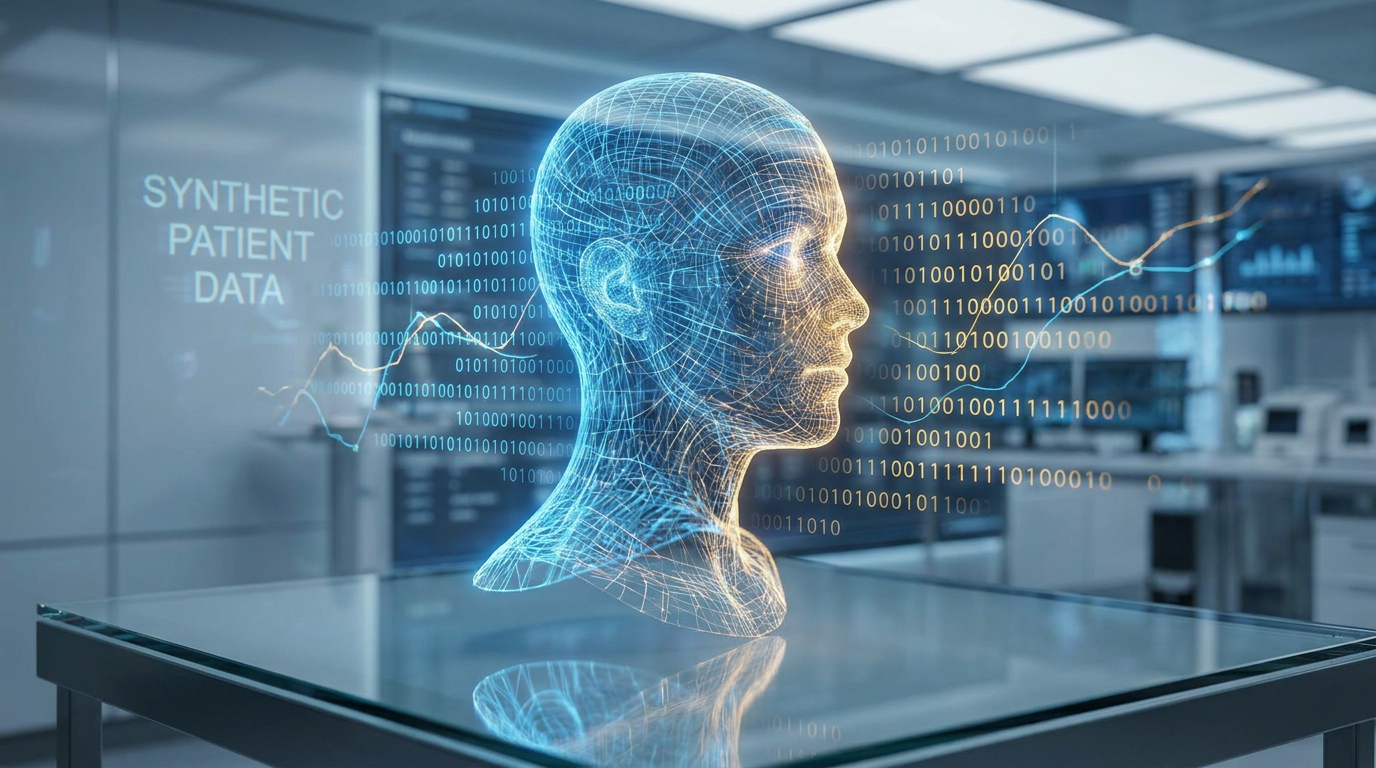
Synthetic data is not simply fake data or a randomized spreadsheet. It is information generated by artificial intelligence algorithms designed to mathematically mirror the statistical properties, correlations, and structures of a real-world dataset, without containing a single actual record. If a hospital wants to share patient data with a university to study diabetes, they no longer send masked patient files. Instead, they train a generative model on their records, which then spits out a brand-new population of "synthetic patients" who exhibit the exact same age distributions, blood sugar trends, and comorbidity rates as the real patients.[1][2]
The scale of this shift is massive. Industry analysts previously projected that by 2024, 60% of the data used to develop AI and analytics projects would be synthetically generated, a trajectory that has only accelerated into 2026 as frameworks like the EU AI Act and GDPR strictly govern the use of personal information. Today, synthetic generation is a production-grade strategy adopted by central banks, pharmaceutical giants, and educational institutions to bypass privacy bottlenecks and accelerate research.[4][5]

The primary mechanism behind this revolution relies on advanced generative architectures, most notably Generative Adversarial Networks (GANs), Variational Autoencoders (VAEs), and Diffusion models. These systems learn the complex, multi-dimensional relationships within a source dataset. For example, the model learns that if a synthetic patient is 85 years old, their likelihood of having hypertension must statistically align with the real-world 85-year-old cohort. The resulting dataset looks and acts real, allowing data scientists to run statistical analyses or train downstream AI models with high confidence.[1][3][7]
Beyond privacy, synthetic data solves the critical issue of data scarcity and algorithmic bias. Real-world datasets are often heavily skewed, lacking sufficient representation of minority demographics or rare events. In finance, actual instances of credit card fraud make up a tiny fraction of total transactions; in medicine, rare genetic disorders yield very small sample sizes. Synthetic data allows researchers to artificially "upsample" these rare events, generating thousands of realistic examples of fraud or rare diseases to train AI models more effectively, ensuring the resulting algorithms perform equitably across all populations.[1][5]
This methodology is also democratizing access to data in the social sciences. The UK's Education Endowment Foundation (EEF), for instance, utilizes synthetic data to allow researchers to explore educational archives safely. By providing "low-fidelity" synthetic datasets—where plausible values like secondary school ages (11–16) are maintained but complex variable relationships are not—researchers can write and test their analytical code before they are granted secure access to the highly sensitive original data.[4]
However, the methodology is not a magic bullet, and the scientific community is currently grappling with a fundamental mathematical constraint known as the "No Free Lunch" theorem for synthetic data. Researchers have empirically proven that there is an inescapable, three-dimensional trade-off between fidelity (how closely the synthetic data matches the real data), utility (how useful it is for training downstream models), and privacy (how well it protects the original subjects).[3]

If a synthetic dataset is generated with extremely high fidelity, it captures the nuanced, complex relationships of the original data perfectly. This makes it highly useful for medical research or AI training. But this high fidelity also means the generative model has essentially memorized the unique outliers in the original dataset, drastically increasing the risk of privacy leakage.[3][6]
If a synthetic dataset is generated with extremely high fidelity, it captures the nuanced, complex relationships of the original data perfectly.
This vulnerability manifests in "membership inference attacks." In these sophisticated privacy breaches, an adversary analyzes the synthetic dataset to determine whether a specific individual's real data was used to train the generator. Security research has demonstrated that high-quality synthetic data generators without proper mathematical guardrails can exhibit concerning vulnerability rates, with some models showing 88% to 94% susceptibility to membership inference. If an attacker knows a target's basic demographics, they can use the synthetic data to infer highly sensitive attributes, such as a specific medical diagnosis.[2][6]

To combat this, data scientists are increasingly enforcing "Differential Privacy" during the generation process. Differential privacy is a rigorous mathematical framework that injects calibrated statistical noise into the training process. It provides a mathematical guarantee that the output of the model will not significantly change whether any single individual's data is included in the training set or not.[6][7]
The introduction of differential privacy forces the trade-off back into the spotlight. By adding noise to protect individuals, the synthetic data loses some of its statistical sharpness. For a bank predicting broad economic trends, this slight degradation in utility might be perfectly acceptable. But for a medical researcher looking for a highly specific, weak correlation between a new drug and a rare side effect, the injected noise might obscure the very signal they are trying to find.[1][3]
Another looming challenge in the 2026 landscape is the phenomenon of "model collapse." As synthetic data becomes the dominant material on the internet and in enterprise databases, new AI models are increasingly being trained on data generated by older AI models. Without the continuous injection of fresh, real-world "ground truth" data, these models begin to amplify their own biases, forget edge cases, and eventually collapse into a narrow, inaccurate distribution of reality.[2][7]
To prevent model collapse and ensure quality, the industry is shifting toward hybrid pipelines that mandate a "Human-in-the-Loop" (HITL) review process. Rather than relying entirely on autonomous synthetic generation, domain experts—such as clinicians or financial auditors—are required to validate the synthetic outputs, ensuring that the artificial data remains clinically or economically plausible and hasn't drifted from reality.[2][7]

The World Economic Forum and leading medical journals are now urgently calling for standardized governance frameworks. The consensus is that synthetic data should not be treated as a loophole to bypass privacy laws, but as a powerful tool that requires its own set of rigorous safety guidelines, clear labeling, and traceability.[1][2]
Ultimately, synthetic data represents a profound methodological leap. It offers a pathway out of the data scarcity trap, enabling faster scientific discovery and more equitable AI systems. By understanding and mathematically managing the inherent trade-offs between fidelity and privacy, researchers are successfully building a new, artificial foundation for the next generation of evidence-based science.[1][3][7]
How we got here
2014
Ian Goodfellow introduces Generative Adversarial Networks (GANs), laying the foundation for modern synthetic data generation.
2018
Early demonstrations show that traditional data anonymization techniques are highly vulnerable to re-identification attacks.
2021
Gartner predicts that synthetic data will overshadow real data in AI models by the mid-2020s.
2024
The EU AI Act accelerates enterprise adoption of synthetic data as companies seek privacy-compliant training methods.
2026
Differential privacy becomes a standard requirement for high-fidelity synthetic data in healthcare and finance.
Viewpoints in depth
AI Industry Analysts
Focus on overcoming data scarcity and accelerating model training.
For AI developers, synthetic data is the ultimate unblocker. They argue that waiting for perfectly clean, legally cleared real-world data is no longer viable in a fast-moving industry. By generating their own edge cases and upsampling rare events, they can build more robust, less biased models in a fraction of the time. They view the privacy trade-offs as manageable engineering challenges rather than dealbreakers.
Privacy & Security Researchers
Focus on the mathematical vulnerabilities and the illusion of perfect anonymity.
Security researchers warn against treating synthetic data as a flawless privacy shield. They emphasize that high-fidelity models inherently memorize the training data, leaving them vulnerable to membership inference attacks. This camp advocates for strict, mathematically proven frameworks like differential privacy, arguing that without injected noise, synthetic data is just a more complicated form of data leakage.
Clinical & Social Scientists
Focus on democratizing access to research while maintaining scientific validity.
Medical and social researchers see synthetic data as a bridge to democratized science. They value "low-fidelity" synthetic datasets that allow them to test hypotheses and write analytical code without navigating years of red tape for data access. However, they remain cautious about using synthetic data for final clinical conclusions, warning that artificial data cannot replace the "ground truth" of real human biology.
What we don't know
- How courts will ultimately rule on the intellectual property rights of models trained entirely on synthetic data derived from copyrighted real-world data.
- The long-term impact of 'model collapse' if synthetic data completely saturates the internet over the next decade.
Key terms
- Synthetic Data
- Information generated by AI algorithms that mathematically mirrors the statistical properties of real data without containing actual individual records.
- Differential Privacy
- A mathematical framework that protects individual privacy by injecting calibrated statistical noise into a dataset.
- Membership Inference Attack
- A security breach where an attacker analyzes an AI model or synthetic dataset to determine if a specific person's data was used to train it.
- Model Collapse
- A phenomenon where AI models degrade in quality and forget edge cases because they are trained on too much synthetic data instead of real-world information.
- Fidelity
- In data science, the degree to which a synthetic dataset accurately replicates the complex statistical relationships of the original real-world data.
Frequently asked
Is synthetic data just fake data?
No. While it doesn't represent real individuals, it is mathematically generated to preserve the exact statistical correlations, trends, and demographics of the original real-world dataset.
Can synthetic data be reverse-engineered to find real people?
If generated with very high fidelity and without privacy guardrails, it can be vulnerable to 'membership inference attacks.' This is why researchers use differential privacy to add protective mathematical noise.
Why do we need synthetic data if we can just anonymize real data?
Traditional anonymization (like removing names) has proven fragile; modern algorithms can easily cross-reference 'anonymous' data with other sources to re-identify individuals. Synthetic data breaks the 1:1 link entirely.
How does synthetic data reduce AI bias?
Real-world data often lacks representation of minority groups or rare events. Synthetic data allows developers to artificially generate more examples of these underrepresented groups, balancing the training data.
Sources
Source coverage
7 outlets
3 viewpoints surfaced







[1]The Lancet Digital HealthClinical & Social Scientists
Governing synthetic data in medical research: the time is now
Read on The Lancet Digital Health →[2]World Economic ForumClinical & Social Scientists
Synthetic Data: The New Data Frontier
Read on World Economic Forum →[3]arXivPrivacy & Security Researchers
No Free Lunch for Synthetic Images under Data Scarcity Conditions
Read on arXiv →[4]Education Endowment FoundationClinical & Social Scientists
Synthetic data for the EEF Archive
Read on Education Endowment Foundation →[5]Fintel AnalyticsAI Industry Analysts
Synthetic Data Generation for AI Training: 2026 Guide
Read on Fintel Analytics →[6]BlueGen AIPrivacy & Security Researchers
Why do you need differential privacy on your synthetic data?
Read on BlueGen AI →[7]Factlen Editorial TeamAI Industry Analysts
Synthesis by Factlen editorial team
Read on Factlen Editorial Team →
Every angle. Every day.
Get data analysis stories with full source coverage and perspective breakdowns delivered to your inbox.