
The SpaceX IPO and the Space Economy: How Mega-Listings and Leveraged ETFs Actually Work
As SpaceX prepares for its historic public debut and space-tech enters the Nasdaq 100, retail investors face a complex landscape of new leveraged ETFs and IPO mechanics. Here is a breakdown of how these financial instruments operate and what the evidence says about navigating mega-listings.
By Factlen Editorial Team

- Institutional Allocators
- Focus on long-term valuation metrics, recurring revenue models like satellite internet, and the mechanical benefits of index inclusion.
- Retail Enthusiasts
- View the public debut of space-tech as a generational wealth-building opportunity and embrace leveraged products to maximize exposure.
- Regulatory & Risk Advocates
- Warn that the structural decay of leveraged ETFs and the behavioral risks of IPO FOMO pose severe dangers to retirement portfolios.
What's not represented
- · Venture Capitalists exiting positions
- · Aerospace industry competitors
Why this matters
Generational market events often attract complex financial products that can amplify both gains and losses. Understanding the underlying mechanics of IPO pricing and leveraged ETFs allows everyday investors to participate in the space economy's growth without taking on unintended structural risks.
Key points
- SpaceX's impending IPO is generating historic global demand, marking a major milestone for the commercial space economy.
- Retail investors rarely pay the headline IPO price, instead buying at the market-driven opening cross.
- Rocket Lab's inclusion in the Nasdaq 100 highlights how space-tech is becoming foundational market infrastructure.
- New leveraged ETFs offer amplified daily returns but suffer from structural decay if held long-term.
- Regulators warn that chasing mega-IPOs with leveraged products poses severe risks to retirement portfolios.
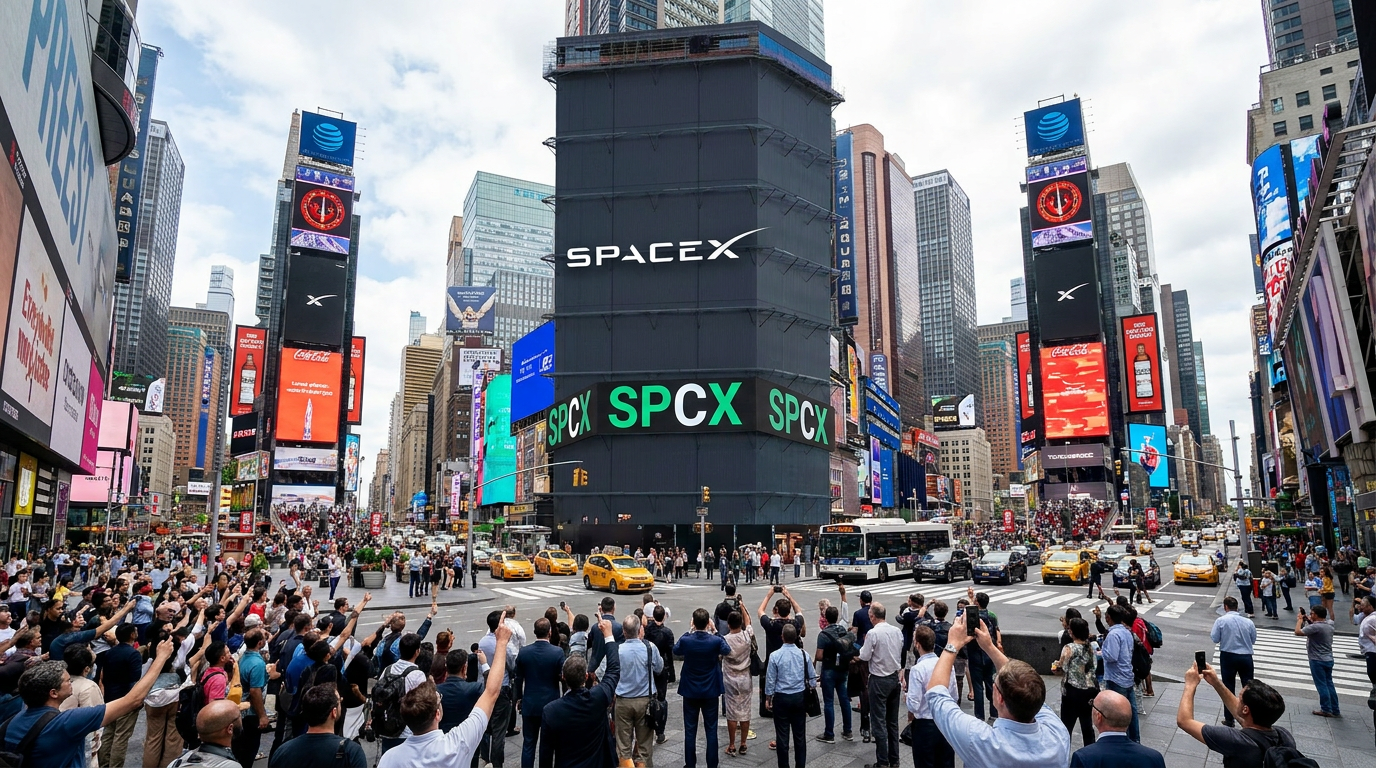
The commercial space economy is officially crossing the threshold from venture capital exclusivity to public market accessibility. For years, retail investors could only watch as private valuations for aerospace companies soared, but a wave of public listings is fundamentally changing the landscape. At the center of this transition is the impending Initial Public Offering (IPO) of SpaceX, an event that is drawing historic demand from both domestic and foreign investors eager to secure a stake in the orbital economy.[1][8]
However, participating in a mega-IPO requires navigating a complex set of financial mechanics that often operate differently than standard stock purchases. When a company goes public, the headline "IPO price" broadcast on financial networks is rarely the price everyday investors pay. That initial figure is determined through a process called book-building, where investment banks gauge demand from large institutional clients—like pension funds and endowments—and allocate shares to them before the market opens.[6][8]
For the retail public, access begins during the "opening cross" on the stock exchange. This is an auction process that matches buy and sell orders to determine the first public trading price. Because hype around companies like SpaceX is so massive, retail buy orders often flood the exchange, driving the opening cross price significantly higher than the institutional IPO price. Understanding this gap is crucial, as buying at the opening cross means acquiring shares at a premium built on immediate market sentiment.[6][8]

Beyond the IPO itself, the broader space sector is maturing into established market indices. Rocket Lab, alongside several other technology firms, is imminently joining the Nasdaq 100 index, with analysts noting that SpaceX is waiting in the wings for future inclusion. Index inclusion is a major milestone because it triggers a wave of mandatory buying. Passive index funds and ETFs that track the Nasdaq 100 are mechanically required to purchase shares of the newly added companies to accurately reflect the index's composition.[2][8]
This passive flow creates a baseline of institutional demand that operates independently of daily news cycles or retail sentiment. When a company enters a major index, its stock becomes embedded in the retirement accounts and 401(k)s of millions of passive investors. For the space economy, this represents a graduation from speculative growth to foundational market infrastructure, providing a stabilizing force against the inherent volatility of aerospace engineering.[2][8]

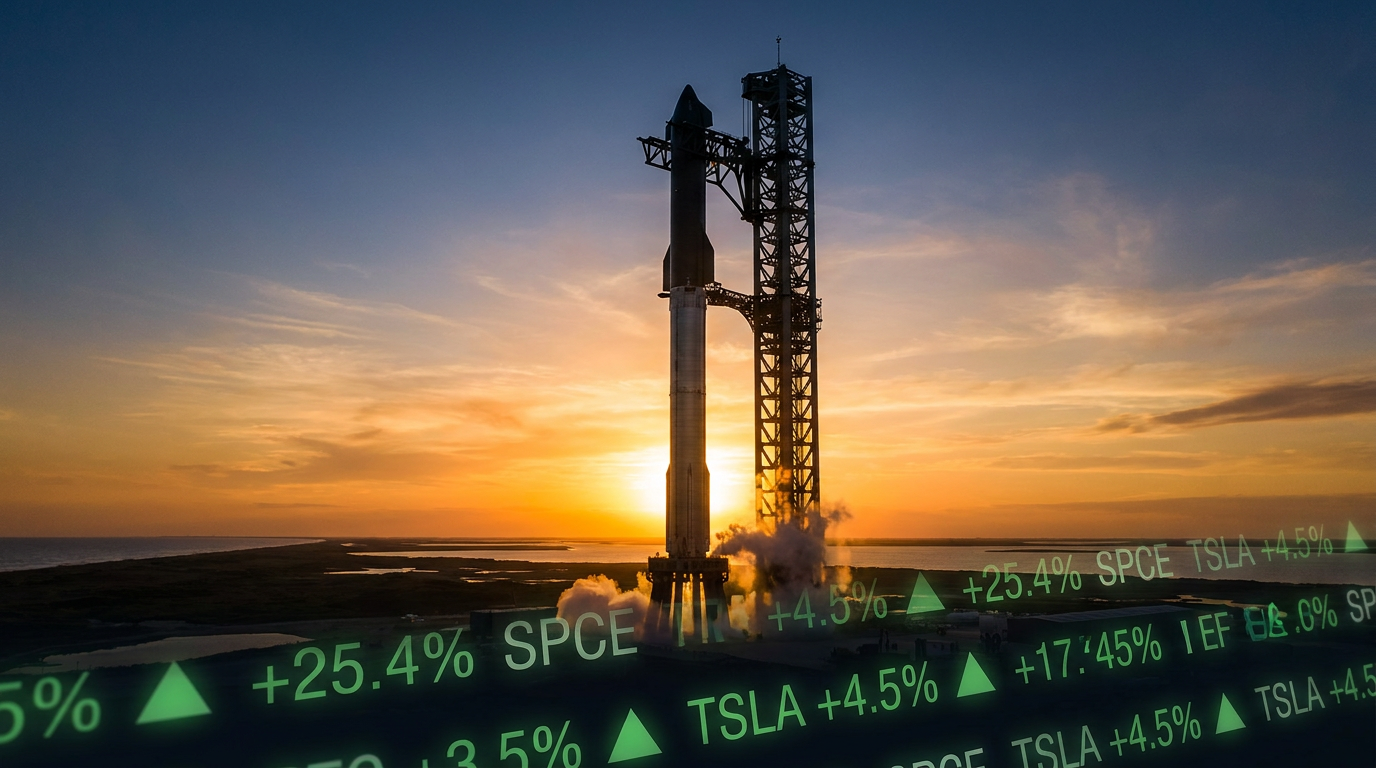
But alongside this stabilization, a highly speculative derivative ecosystem is springing up. The financial industry is rapidly launching new exchange-traded funds (ETFs) designed to give traders a way to make risky, leveraged bets on SpaceX's stock immediately after its market debut. These single-stock leveraged ETFs are engineered to deliver two or three times the daily return—or the inverse return—of the underlying asset.[1][8]
But alongside this stabilization, a highly speculative derivative ecosystem is springing up.
To achieve these amplified returns, leveraged ETFs do not simply buy shares on margin. Instead, they utilize complex financial derivatives, primarily total return swaps negotiated with major investment banks. These swap agreements guarantee the ETF will receive the multiplied return of the stock for a single trading day. While this sounds appealing during a bull run, the underlying mathematics of these instruments make them uniquely unsuited for long-term holding.[5][8]
The critical mechanism to understand is the "daily reset." Leveraged ETFs rebalance their derivative exposure at the end of every trading session to ensure they can deliver the stated multiple the following day. Over periods longer than one day, this constant rebalancing interacts with market volatility to create a phenomenon known as beta slippage, or volatility drag. In choppy markets, a leveraged ETF can lose significant value even if the underlying stock ends the month exactly where it started.[5][8]
Financial regulators, including the SEC and FINRA, have issued explicit warnings regarding these products. They emphasize that leveraged and inverse ETFs are tactical trading tools designed for sophisticated investors to use over extremely short horizons. They are not intended to be buy-and-hold investments, and holding them in a long-term retirement portfolio can lead to severe, unexpected capital erosion due to the compounding math of the daily reset.[5][8]

This structural risk is compounded by behavioral finance factors. Financial advisors warn that the hype surrounding a generational IPO can trigger intense Fear Of Missing Out (FOMO), leading investors—particularly those nearing retirement—to abandon diversified strategies in favor of concentrated, leveraged bets. A stock that dips 20% is a temporary blip for a thirty-year-old, but a leveraged portfolio disaster for someone relying on those funds for near-term income.[3][8]
Academic research into the long-term performance of mega-cap IPOs provides further context for caution. Studies frequently show that while highly anticipated IPOs often experience massive first-day "pops" driven by retail enthusiasm, they tend to underperform the broader market over the subsequent 12 to 36 months. This underperformance typically occurs as the initial hype fades, lock-up periods expire allowing insiders to sell, and the company transitions to the grueling reality of quarterly earnings expectations.[7][8]

Despite these structural and historical headwinds, fundamental analysts see massive underlying value in the maturing space sector. Leading Silicon Valley investors point out that the biggest upside surprises for companies like SpaceX may not come from their headline-grabbing launch vehicles, but from high-margin, recurring-revenue business units like the Starlink satellite internet constellation. These infrastructure plays offer the kind of predictable cash flows that public markets traditionally reward.[4][8]
Ultimately, the opening of the space economy to public markets is a profoundly positive development for retail investors, democratizing access to one of the century's most important technological frontiers. By understanding the mechanics of the opening cross, the impact of index inclusion, and the mathematical realities of leveraged ETFs, investors can separate the genuine fundamental growth of the orbital economy from the transient noise of financial engineering.[8]
How we got here
Pre-2020
The commercial space sector is almost entirely funded by private venture capital and government contracts.
2021-2023
Early space-tech companies begin testing public markets via SPACs and smaller traditional IPOs.
Early 2026
Rocket Lab and other space-tech firms are slated for inclusion in the Nasdaq 100 index.
Mid 2026
Historic demand builds for the SpaceX IPO, prompting the creation of single-stock leveraged ETFs.
Viewpoints in depth
Retail Enthusiasts
Viewing the space economy as a generational wealth opportunity.
For many retail investors, the transition of space technology to public markets represents a once-in-a-generation opportunity to invest in a new industrial frontier. This camp often embraces the high volatility of the sector, utilizing single-stock leveraged ETFs to maximize their exposure to anticipated explosive growth. They argue that traditional valuation metrics fail to capture the total addressable market of orbital infrastructure, satellite internet, and eventual interplanetary logistics.
Institutional Allocators
Focusing on index mechanics and recurring revenue.
Institutional investors and fundamental analysts take a more measured approach, looking past the romance of rocket launches to focus on unit economics. This perspective values milestones like Nasdaq 100 inclusion, which provides a mechanical floor for stock prices through passive fund buying. They are particularly interested in high-margin, recurring-revenue businesses within the space sector, such as global satellite broadband networks, which offer the predictable cash flows required to sustain massive public valuations.
Regulatory & Risk Advocates
Warning against the structural dangers of financial engineering.
Financial regulators, consumer protection advocates, and academic researchers express deep concern over the gamification of mega-IPOs. This camp highlights the mathematical reality of volatility drag in leveraged ETFs, warning that these products are designed for intraday hedging by professionals, not for retail retirement accounts. They point to decades of data showing that highly hyped IPOs often underperform the broader market in their first few years, urging everyday investors to avoid FOMO-driven portfolio concentration.
What we don't know
- The exact pricing and valuation SpaceX will achieve during its final institutional book-building phase.
- How the newly launched leveraged ETFs will perform during a sustained period of high market volatility.
- Whether retail demand at the opening cross will create an unsustainable premium over the fundamental IPO price.
Key terms
- Opening Cross
- The auction process on a stock exchange that matches buy and sell orders to determine the very first public trading price of an IPO.
- Leveraged ETF
- An exchange-traded fund that uses financial derivatives and debt to amplify the daily returns of an underlying index or stock.
- Volatility Drag
- The mathematical decay of a leveraged ETF's value over time, caused by the fund having to rebalance its derivative exposure at the end of every single trading day.
- Index Inclusion
- The event where a company is added to a major stock market index, triggering mandatory share purchases by passive funds.
Frequently asked
Can I buy shares at the exact IPO price?
Generally, no. The headline IPO price is usually reserved for institutional investors during the book-building phase. Retail investors typically buy at the 'opening cross' price, which is determined by market demand when the stock begins trading.
Are leveraged ETFs safe for a retirement account?
Regulators like the SEC strongly advise against holding leveraged ETFs long-term. Their daily reset mechanism causes 'volatility drag,' which can erode capital over time even if the underlying stock performs well.
Why does joining the Nasdaq 100 matter?
Index inclusion forces passive mutual funds and ETFs that track the index to automatically buy the company's stock, creating a massive, stable base of institutional demand.
Sources
Source coverage
8 outlets
3 viewpoints surfaced





[1]MarketWatchRetail Enthusiasts
Upcoming SpaceX IPO spawns leveraged ETFs for bullish and bearish bets on its stock
Read on MarketWatch →Rocket Lab and these four stocks are joining the Nasdaq 100, with SpaceX waiting in the wings
Read on MarketWatch →SpaceX IPO hype is massive — and the FOMO can ruin your retirement
Read on MarketWatch →Here’s what could be SpaceX’s biggest upside surprise, according to a leading Silicon Valley investor
Read on MarketWatch →[5]U.S. Securities and Exchange CommissionRegulatory & Risk Advocates
Investor Bulletin: Leveraged and Inverse ETFs
Read on U.S. Securities and Exchange Commission →[6]FINRARegulatory & Risk Advocates
Understanding the Initial Public Offering (IPO) Process
Read on FINRA →[7]SSRNRegulatory & Risk Advocates
Long-Term Performance of Mega-Cap Initial Public Offerings
Read on SSRN →[8]Factlen Editorial TeamInstitutional Allocators
Synthesis by Factlen editorial team
Read on Factlen Editorial Team →
Every angle. Every day.
Get finance stories with full source coverage and perspective breakdowns delivered to your inbox.