
The SpaceX IPO and the Dawn of the New Space Economy
As SpaceX executes the largest IPO in history, the milestone validates a booming commercial space sector that is opening new frontiers for venture capital and orbital entrepreneurship.
By Factlen Editorial Team
- New Space Founders & Optimists
- Argues that the commercialization of space will unlock trillion-dollar markets and solve terrestrial problems.
- Financial Realists
- Focuses on the extreme capital intensity, high failure rates, and unprecedented valuation multiples of space ventures.
- Regulatory & Institutional Observers
- Emphasizes the need for updated governance, property rights, and international frameworks to manage orbital commerce.
What's not represented
- · Environmental advocates concerned about orbital debris
- · Taxpayer advocates questioning the privatization of space infrastructure
Why this matters
The commercialization of space is shifting from a government-funded science project to a multi-trillion-dollar private industry. The massive liquidity generated by the SpaceX IPO is expected to fuel a new generation of startups, fundamentally changing how we manufacture goods, generate energy, and transmit data on Earth.
Key points
- SpaceX debuted on the Nasdaq at a fixed price of $135 per share, targeting a record-breaking $1.75 trillion valuation.
- The IPO marks a definitive milestone in the 'New Space Economy,' transitioning orbital operations from government agencies to private enterprise.
- Reusable rocketry has drastically lowered launch costs, enabling new downstream business models like satellite broadband and Earth observation.
- Entrepreneurs are now targeting in-orbit manufacturing and space-based solar power, leveraging the unique properties of microgravity.
- Despite the influx of $300 billion in private capital, space startups face extreme engineering challenges and a 50% early-stage failure rate.
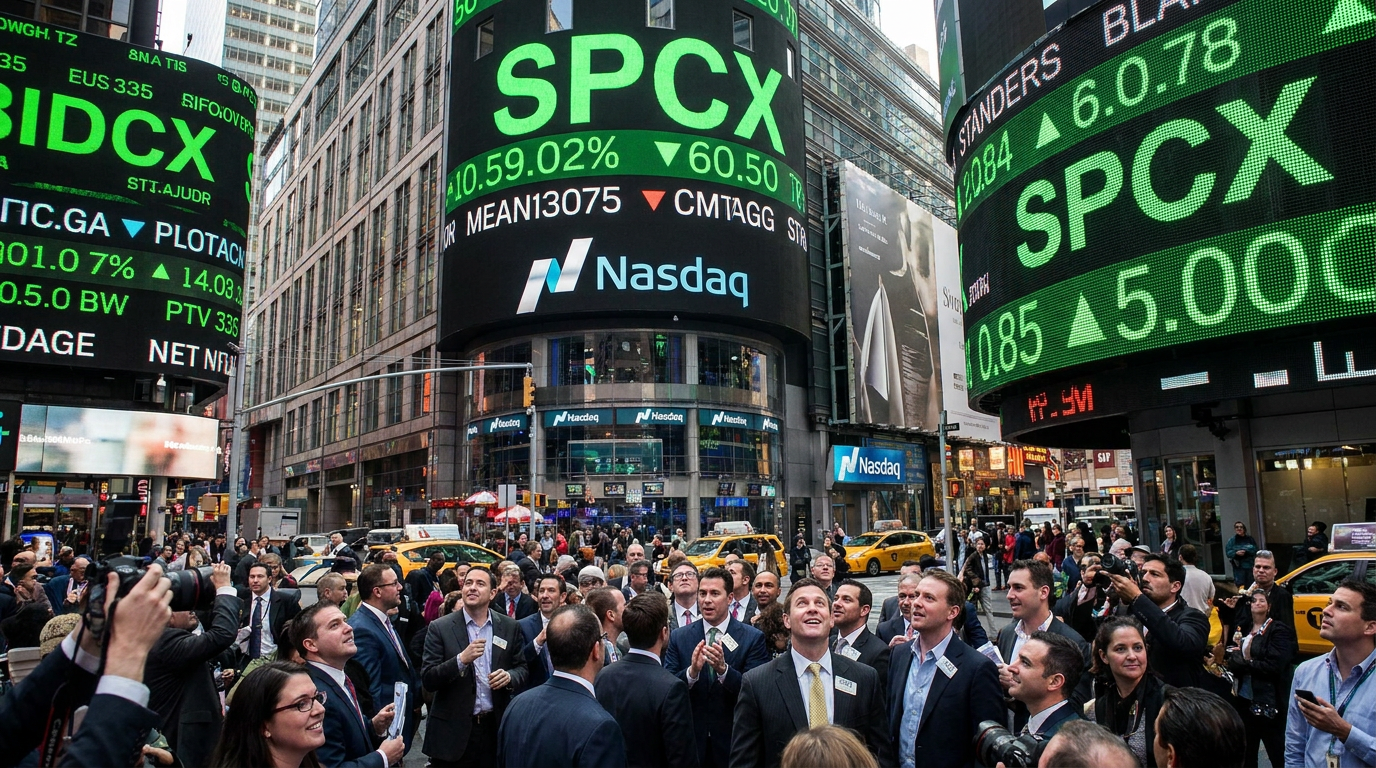
On Friday morning, the financial and aerospace worlds collided as SpaceX prepared to debut on the Nasdaq under the ticker SPCX. Bypassing the traditional months-long price discovery process, the company handed Wall Street a fixed, take-it-or-leave-it price of $135 per share. The offering is designed to raise $75 billion, minting a staggering $1.75 trillion valuation that instantly makes it the largest initial public offering in the history of capital markets. Retail and institutional demand shattered records, with order books reportedly swelling past $250 billion before the opening bell.[1][2][3]
But while the sheer scale of the IPO dominates the headlines, the listing represents something far more profound than a single company's liquidity event. It is the definitive ringing of the bell for the "New Space Economy." For decades, space was the exclusive domain of superpowers—a theater for geopolitical posturing funded by taxpayer dollars. Today, it is a rapidly expanding commercial ecosystem where venture capital, agile startups, and scalable business models are turning the cosmos into an industrial park.[7]
The transition from "Old Space" to "New Space" hinges on a fundamental shift in economics. Historically, space exploration relied on cost-plus government contracts and single-use rockets that were discarded after a single flight, making access to orbit prohibitively expensive. The breakthrough of reusable rocketry—pioneered and normalized by SpaceX—has acted as a deflationary wrecking ball. By drastically lowering the cost of launching mass into orbit, the industry has removed the primary barrier to entry for a new generation of space entrepreneurs.[6][7]

This paradigm shift has bifurcated the space economy into two distinct but symbiotic sectors: upstream and downstream. The upstream market consists of the heavy lifters—the companies building the rockets, manufacturing the satellites, and providing the launch infrastructure. They are the freight rails and shipyards of the orbital economy. However, the true commercial explosion is happening in the downstream market, which leverages that orbital infrastructure to solve terrestrial problems.[7]
Currently, downstream applications account for more than 70% of total space economy revenues. This includes Earth observation constellations that monitor crop health and track supply chains, as well as massive satellite broadband networks like SpaceX's own Starlink. Starlink alone has grown into a recurring revenue engine with over 12 million subscribers, proving that space-based infrastructure can generate software-like margins once deployed.[4][6]
With launch costs continuing to fall, entrepreneurs are now looking beyond data transmission toward in-orbit physical operations. The unique environment of microgravity offers manufacturing capabilities that are physically impossible on Earth. Startups are currently developing orbital factories to produce flawless fiber optic cables, grow perfect protein crystals for novel pharmaceuticals, and engineer advanced alloys without the distorting effects of terrestrial gravity.[5]

With launch costs continuing to fall, entrepreneurs are now looking beyond data transmission toward in-orbit physical operations.
Energy is another frontier attracting aggressive venture capital. Several companies across the United States and Europe are actively developing orbital solar power stations. These systems aim to harvest solar energy in space—where the sun shines 24 hours a day without atmospheric interference—and beam it back to Earth via targeted microwaves or lasers. While still in the developmental phase, 2026 is widely viewed as a cornerstone year for demonstrating the viability of these technologies.[5]
The capital markets have taken notice of this expanding frontier. Total private investment in the sector has reached nearly $300 billion, distributed across more than 1,800 space ventures worldwide. This influx of capital is not just funding hardware; it is building a comprehensive supply chain of specialized software, legal frameworks, and insurance products tailored specifically to the risks of orbital commerce.[7]
Yet, the New Space Economy remains a brutal arena for founders. Space is inherently unforgiving, characterized by extreme engineering tolerances and massive upfront capital requirements. Unlike software startups that can pivot over a weekend, space ventures face years of research and development before generating a single dollar of revenue. Consequently, industry analysts estimate that more than 50% of early-stage space startups fail, underscoring the high-stakes nature of orbital entrepreneurship.[7]
This risk profile is precisely why SpaceX's $1.75 trillion valuation is facing intense scrutiny from financial realists. At $135 per share, the company is trading at roughly 95 times its estimated 2025 revenue. There is no established public market comparable for a company at this scale trading at such a multiple. Investors are not pricing SpaceX based on its current launch cadence; they are pricing it as an enduring monopoly over the foundational infrastructure of a multi-trillion-dollar future economy.[2][4]

Beyond the immediate financial metrics, the SpaceX IPO is expected to trigger a massive secondary effect within the startup ecosystem. By providing liquidity to thousands of early employees and engineers, the listing will likely mint a "Space Mafia"—a cohort of newly wealthy, highly experienced operators who will leave to found and fund their own space ventures. This cycle of wealth creation and redeployment is the hallmark of every mature tech hub, from Silicon Valley to the emerging orbital economy.[7]
The institutionalization of space commerce is also accelerating within academia. Universities are launching dedicated business degrees focused entirely on the sector. Programs like the University of South Florida's "New Space Economy" curriculum are teaching undergraduates how to navigate the global space value chain, evaluate orbital business models, and manage the unique intellectual property challenges of off-planet enterprise. Space is no longer treated as an aerospace engineering niche; it is a standard commercial discipline.[6]
As SpaceX executives ring the Nasdaq bell, they are doing more than taking a rocket company public. They are validating a thesis that seemed like science fiction a decade ago: that space can be a sustainable, scalable, and highly profitable theater for private enterprise. For the entrepreneurs waiting in the wings, the launchpad has never been more crowded, and the sky is no longer the limit.[3][7]
How we got here
2002
Elon Musk founds SpaceX with the goal of reducing space transportation costs and enabling the colonization of Mars.
December 2015
SpaceX successfully lands the first stage of its Falcon 9 rocket, proving the viability of reusable orbital launch vehicles.
May 2026
SpaceX publicly files its S-1 registration statement with the SEC, revealing the financial engine behind its Starlink and launch businesses.
June 12, 2026
SpaceX debuts on the Nasdaq at a $1.75 trillion valuation, marking the largest initial public offering in history.
Viewpoints in depth
New Space Founders & Optimists
Argues that the commercialization of space will unlock trillion-dollar markets and solve terrestrial problems.
This camp views the reduction in launch costs as the equivalent of the internet's broadband rollout. They argue that the true value of the space economy lies not in the rockets themselves, but in the downstream applications they enable. By moving heavy industry, energy generation, and specialized manufacturing into microgravity, these founders believe space commerce is the key to sustainable economic growth on Earth.
Financial Realists
Focuses on the extreme capital intensity, high failure rates, and unprecedented valuation multiples of space ventures.
While acknowledging the technological achievements of the sector, financial realists urge caution regarding the economics. They point out that SpaceX's $1.75 trillion valuation prices in decades of flawless execution and absolute market dominance. Furthermore, they highlight that the broader space startup ecosystem suffers from a 50% early-stage failure rate, warning that the capital-intensive nature of orbital hardware makes it a uniquely dangerous sector for venture capital.
Regulatory & Institutional Observers
Emphasizes the need for updated governance, property rights, and international frameworks to manage orbital commerce.
As private companies deploy tens of thousands of satellites and plan commercial space stations, institutional observers warn that the regulatory environment is lagging dangerously behind. They argue that the current framework, based on Cold War-era treaties, is ill-equipped to handle issues like orbital debris management, spectrum allocation, and the monopolistic power of mega-constellations. For this group, the success of the space economy depends entirely on establishing clear, enforceable rules of the road.
What we don't know
- How the public markets will absorb SpaceX's unprecedented $1.75 trillion valuation over the long term, given its high revenue multiple.
- Whether emerging business models like in-orbit manufacturing and space solar power can achieve commercial viability within the next decade.
- How international regulators will handle the rapid privatization of low Earth orbit, particularly regarding satellite traffic and debris management.
Key terms
- New Space Economy
- The commercialization of the space sector driven by private enterprise, venture capital, and scalable business models, rather than government agencies.
- Upstream
- The segment of the space industry focused on sending objects into space, including rocket manufacturing, launch services, and satellite construction.
- Downstream
- The segment focused on utilizing space infrastructure to provide services on Earth, such as satellite broadband, GPS, and Earth observation data.
- Microgravity
- The condition in which people or objects appear to be weightless, enabling unique manufacturing and biological research impossible under Earth's gravity.
- S-1 Filing
- The initial registration form for new securities required by the SEC for public companies, detailing a company's business model and financials.
Frequently asked
Why is the SpaceX IPO considered historic?
SpaceX is targeting a $1.75 trillion valuation and raising $75 billion, which makes it the largest initial public offering in the history of capital markets.
Can regular investors buy SpaceX stock?
Yes, once the stock begins trading on the Nasdaq under the ticker SPCX, retail investors can purchase shares through standard brokerages.
What makes space startups so risky?
Space ventures require massive upfront capital, face long development cycles, and must overcome extreme engineering challenges, leading to an estimated 50% failure rate for early-stage startups.
How does SpaceX make money?
SpaceX generates revenue primarily through its Starlink satellite internet service, which accounts for the majority of its income, alongside commercial and government launch contracts.
Sources
Source coverage
7 outlets
3 viewpoints surfaced







[1]ForbesFinancial Realists
SpaceX Will Trade Today After Largest IPO Ever (Live Updates)
Read on Forbes →[2]BloombergFinancial Realists
What Stock Traders Can Expect From SpaceX’s Trading Debut
Read on Bloomberg →[3]The GuardianRegulatory & Institutional Observers
SpaceX to list on US stock market at $1.77tn valuation in largest ever debut
Read on The Guardian →[4]Wealth ClubNew Space Founders & Optimists
SpaceX IPO: is a $1.75 trillion valuation warranted?
Read on Wealth Club →[5]SpaceQuest VenturesNew Space Founders & Optimists
2026 to be a key moment in space innovation
Read on SpaceQuest Ventures →[6]University of South FloridaNew Space Founders & Optimists
USF professor delivers Rome keynote, expands space economy courses
Read on University of South Florida →[7]Factlen Editorial TeamRegulatory & Institutional Observers
Synthesis by Factlen editorial team
Read on Factlen Editorial Team →
Every angle. Every day.
Get business stories with full source coverage and perspective breakdowns delivered to your inbox.