
The Solid-State Shift: How 2026 Became the Breakout Year for Next-Gen EV Batteries
After decades of lab research, solid-state batteries are entering real-world pilot production in 2026, promising 10-minute charging times, 700-mile ranges, and the elimination of battery fire risks.
By Factlen Editorial Team
- Legacy Automakers
- Established car manufacturers view solid-state batteries as the key to unlocking premium, high-margin EVs that outperform combustion engines.
- Pure-Play Innovators
- Specialized battery startups are adopting a licensing model to bypass the immense capital costs of building gigafactories.
- Chinese Battery Giants
- The world's largest battery manufacturers are prioritizing a pragmatic, stepwise transition through semi-solid technology.
- Industry Skeptics
- Analysts and competitors warn that scaling from pilot lines to mass production involves massive cost and engineering hurdles.
What's not represented
- · Raw material mining sector
- · Independent repair shops
Why this matters
Solid-state batteries solve the three biggest hurdles to mass EV adoption: range anxiety, charging wait times, and fire safety. By doubling energy density and enabling gas-station-speed charging, this technology effectively removes the final practical advantages of the internal combustion engine.
Key points
- Solid-state batteries replace flammable liquid electrolytes with stable solid materials, drastically reducing the risk of thermal runaway.
- The technology allows for energy densities up to 500 Wh/kg, potentially doubling the range of current electric vehicles.
- Major automakers and tech firms, including Toyota and QuantumScape, have launched pilot production lines in early 2026.
- Initial commercial rollout is targeted for premium vehicles in 2027 and 2028, with mass-market adoption expected by 2030.
For the better part of a decade, the electric vehicle industry has chased a singular "holy grail" of energy storage: a battery that charges as fast as a gas tank fills, never catches fire, and powers a car for weeks on a single charge. In 2026, that pursuit is finally moving off the laboratory bench and onto the factory floor. Across the globe, major automakers and specialized tech firms are firing up pilot production lines for solid-state batteries (SSBs), marking what industry analysts consider the most significant leap in battery chemistry since the commercialization of lithium-ion cells in the 1990s.[4][7]
To understand why this shift is monumental, one must look at the ceiling of current technology. Today's electric vehicles rely on lithium-ion batteries, which use a liquid electrolyte—a chemical "juice" that shuttles ions between the positive and negative sides of the cell. While effective, this liquid is fundamentally limiting. It is heavy, it degrades over time, and crucially, it is composed of highly flammable organic solvents. If a conventional battery is punctured in a crash or overheats during rapid charging, that liquid can ignite, triggering a dangerous chain reaction known as thermal runaway.[6][7]
Solid-state batteries solve this by replacing the liquid with a solid, non-flammable material—typically a specialized ceramic, polymer, or sulfide glass. This simple structural swap unlocks a cascade of physical advantages. Because the solid electrolyte is inherently stable, the risk of thermal runaway is drastically reduced. Comparative testing shows that while conventional lithium-ion cells can begin to experience thermal events at around 90 degrees Celsius, solid-state systems remain stable up to approximately 247 degrees Celsius.[6][7]

With the safety constraints lifted, engineers can push the battery's performance to unprecedented levels. The most immediate benefit is energy density—the amount of power a battery can store relative to its physical weight. Today's best lithium-ion packs max out between 200 and 260 watt-hours per kilogram (Wh/kg). By utilizing solid electrolytes, manufacturers can safely incorporate energy-dense lithium-metal anodes, pushing commercial targets to between 400 and 500 Wh/kg.[6]
For the consumer, this translates directly into the death of range anxiety. By doubling the energy density, automakers can either build a battery pack that is half the weight and size of today's models—drastically improving vehicle efficiency—or keep the pack the same size and double the driving range. Toyota, which is leading the legacy automotive charge into solid-state tech, estimates its early SSB-equipped vehicles will deliver a theoretical range of roughly 745 miles (1,200 kilometers) on a single charge.[2][5]

Just as importantly, solid-state chemistry fundamentally alters the math of EV charging. Because the solid materials are highly resistant to heat buildup, the batteries can accept massive amounts of electrical current without degrading. Both Toyota and California-based battery developer QuantumScape have demonstrated cells capable of charging from 10 percent to 80 percent in under 15 minutes, with some targets aiming as low as 10 minutes. At that speed, recharging an EV becomes virtually indistinguishable from a traditional gas station pit stop.[2][4][5]
The race to commercialize this technology has accelerated dramatically in early 2026. In Japan, the Ministry of Economy, Trade, and Industry recently validated Toyota's aggressive production roadmap. The automaker, in partnership with petrochemical giant Idemitsu Kosan, has broken ground on a large-scale pilot plant for solid electrolytes. Toyota expects to begin limited production of next-generation cells this year, aiming to launch its first all-solid-state passenger vehicles by 2027 or 2028.[2][3]

The race to commercialize this technology has accelerated dramatically in early 2026.
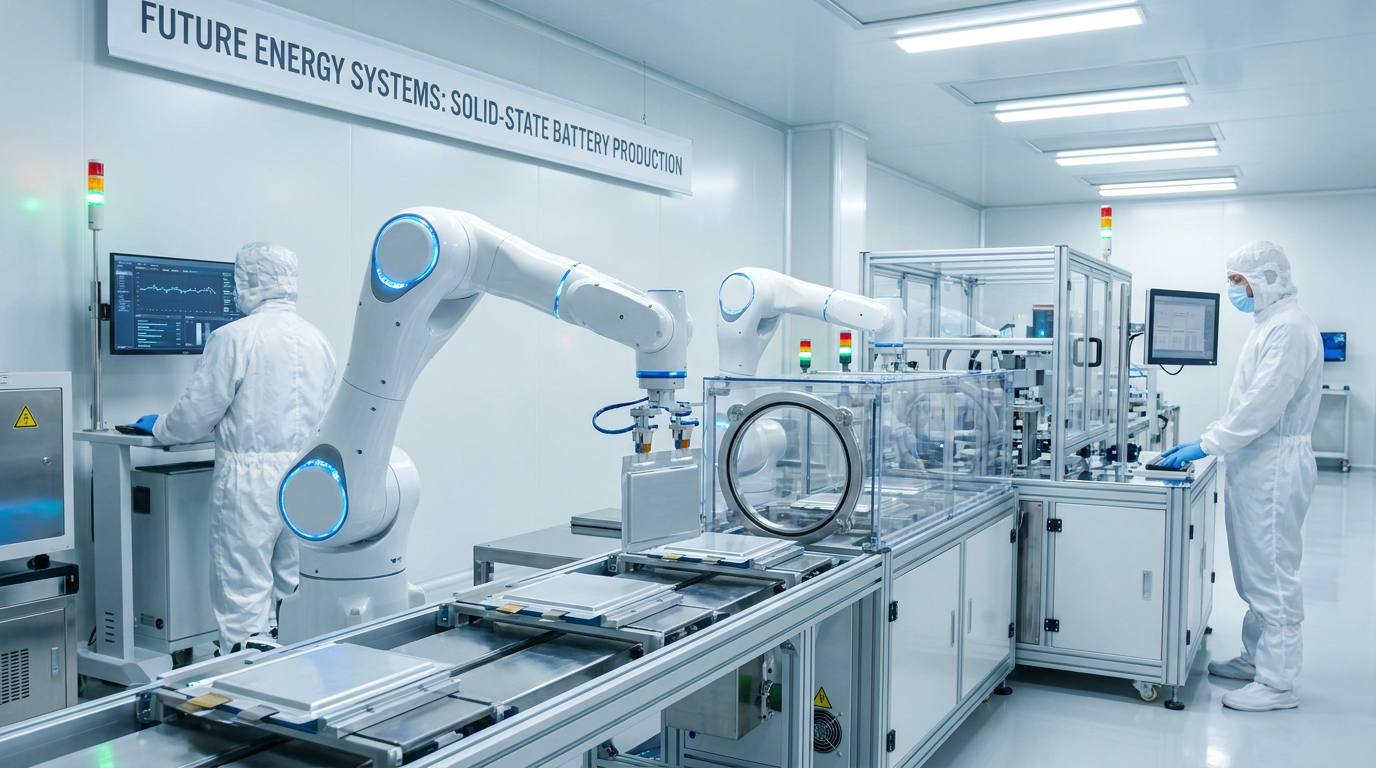
Meanwhile, in Silicon Valley, QuantumScape officially opened its "Eagle Line" in San Jose this February. The highly automated pilot facility is designed to prove that solid-state cells can be manufactured at a massive scale. QuantumScape's proprietary "Cobra" process produces a unique ceramic separator that allows the company to build anode-free lithium-metal cells. These QSE-5 cells are already being shipped to automotive partners, including Volkswagen's PowerCo division, for real-world integration testing.[1][4]
Rather than building its own gigafactories, QuantumScape is pioneering a licensing model akin to the semiconductor industry. By acting as a technology developer and licensing its ceramic separator designs to established manufacturing partners, the company hopes to bypass the multi-billion-dollar capital requirements that have historically bottlenecked battery startups.[1]
Across the Pacific, Chinese battery behemoths like CATL and BYD are taking a more stepwise approach. Rather than leaping directly to all-solid-state designs, they have dominated the transitional market of "semi-solid" batteries. These hybrid cells use a mix of solid materials and a small amount of liquid electrolyte, allowing them to be manufactured on existing lithium-ion assembly lines. Vehicles like NIO's flagship sedan are already utilizing 150-kilowatt-hour semi-solid packs to achieve near-600-mile ranges on public roads today.[6]
The intense competition has also bred industry skepticism. At the 2026 Consumer Electronics Show, a startup named Donut Lab made waves by announcing an all-solid-state battery ready for immediate OEM production, slated for Verge Motorcycles by the first quarter of the year. The claim was swiftly met with intense pushback from established battery executives, who argued that the physics and manufacturing yields required for such an accelerated timeline simply do not exist yet, underscoring the hype that still surrounds the sector.[8]
The skeptics have a point: moving from a pristine laboratory environment to gigawatt-scale manufacturing is notoriously brutal. One of the primary engineering hurdles is the formation of dendrites. When a battery charges, lithium ions can clump together to form microscopic, needle-like structures. In liquid batteries, these dendrites can pierce the separator and cause a short circuit. While solid electrolytes are designed to physically block dendrite growth, ensuring the ceramic or sulfide layers remain perfectly intact over hundreds of thousands of miles of vibration and thermal expansion is a massive materials science challenge.[6][7]
Furthermore, solid-state cells require immense mechanical pressure to maintain contact between the solid layers. Unlike a liquid that naturally flows into every microscopic crevice of an electrode, solid materials must be pressed tightly together to prevent interface resistance. Designing battery packs that can maintain this internal pressure while remaining lightweight and cost-effective is a puzzle that automotive engineers are actively solving in 2026.[6][7]

Then there is the inescapable reality of cost. Early solid-state batteries will carry a significant price premium over today's highly optimized lithium-iron-phosphate (LFP) cells. Industry analysts project that the first wave of all-solid-state EVs will be flagship luxury sedans and high-performance sports cars, where buyers can absorb the technological premium. It will likely take until the end of the decade for manufacturing efficiencies to drive the cost per kilowatt-hour down to mass-market parity.[6][8]
Despite these hurdles, the trajectory is now locked in. The pilot lines spinning up in 2026 represent the crossing of the Rubicon for automotive energy storage. As production scales from megawatt-hours to gigawatt-hours over the next four years, the final practical compromises of electric vehicle ownership will begin to vanish. By delivering gas-station convenience, unprecedented range, and absolute thermal safety, solid-state batteries are poised to close the book on the internal combustion era.[4][7]
How we got here
2020–2023
Decades of laboratory research culminate in critical materials science breakthroughs regarding ceramic separators and sulfide electrolytes.
2024–2025
Semi-solid batteries enter the Chinese market in niche, high-end EVs, serving as a transitional stepping stone.
February 2026
QuantumScape officially opens its 'Eagle Line' pilot facility in San Jose to prove scalable manufacturing of anode-free cells.
Mid 2026
Toyota and Idemitsu Kosan break ground on a large-scale pilot plant for solid electrolytes in Japan.
2027–2028
Automakers target the release of the first limited-production passenger EVs equipped with all-solid-state batteries.
Viewpoints in depth
Legacy Automakers
Established car manufacturers view solid-state batteries as the key to unlocking premium, high-margin EVs that outperform combustion engines.
Companies like Toyota and Volkswagen are leveraging their massive industrial footprints to bring solid-state tech in-house. By partnering with chemical giants like Idemitsu Kosan, they aim to control the entire supply chain, from solid electrolyte synthesis to final pack assembly. Their strategy relies on introducing the technology in low-volume, high-priced flagship vehicles around 2027 to recoup R&D costs before scaling down to mass-market models by the 2030s.
Pure-Play Innovators
Specialized battery startups are adopting a licensing model to bypass the immense capital costs of building gigafactories.
Firms like QuantumScape argue that the fastest path to global commercialization is to act as technology developers rather than traditional manufacturers. By perfecting the core innovations—such as proprietary ceramic separators and anode-free cell designs—they plan to license their blueprints to existing battery makers and automotive OEMs. This "Intel Inside" approach allows them to scale rapidly across multiple brands without bearing the multi-billion-dollar burden of constructing global manufacturing plants.
Chinese Battery Giants
The world's largest battery manufacturers are prioritizing a pragmatic, stepwise transition through semi-solid technology.
Market leaders like CATL and BYD are highly protective of their current dominance in lithium-iron-phosphate (LFP) production. Rather than pivoting abruptly to all-solid-state designs, they are aggressively deploying "semi-solid" batteries that blend solid electrolytes with minimal liquid. This allows them to utilize their existing, highly optimized manufacturing lines to deliver immediate range improvements—such as NIO's 150 kWh pack—while steadily researching fully solid architectures for the next decade.
What we don't know
- The exact price premium that early solid-state EVs will carry over traditional lithium-ion models.
- How well the solid ceramic and sulfide separators will hold up to a decade of real-world road vibration and thermal expansion.
- Which manufacturing approach—in-house automotive production or third-party licensing—will ultimately dominate the supply chain.
Key terms
- Solid-State Battery
- A battery that replaces the liquid electrolyte found in conventional lithium-ion cells with a solid material, like ceramic or sulfide.
- Energy Density
- A measure of how much energy a battery can store relative to its weight, typically expressed in watt-hours per kilogram (Wh/kg).
- Thermal Runaway
- A dangerous chain reaction where a battery cell overheats and catches fire, often spreading rapidly to adjacent cells.
- Dendrites
- Microscopic, needle-like lithium structures that can grow inside batteries over time and cause short circuits, which solid electrolytes help block.
Frequently asked
When can I buy a car with a solid-state battery?
While some semi-solid batteries are in vehicles today, fully solid-state EVs will debut in limited premium batches around 2027–2028, with mass-market availability expected by 2030.
Will solid-state batteries make EVs cheaper?
Initially, no. They will carry a premium price tag. However, as manufacturing scales up and raw material efficiencies improve, they are projected to drive down overall EV costs in the next decade.
Are solid-state batteries completely fireproof?
While not entirely immune to extreme heat, they are vastly safer. Solid-state cells don't contain flammable liquids, pushing the threshold for thermal runaway from 90°C up to around 247°C.
Sources
Source coverage
8 outlets
4 viewpoints surfaced







[1]Battery Tech OnlineIndustry Skeptics
QuantumScape CEO updates on solid-state battery commercialization
Read on Battery Tech Online →[2]ElectrekLegacy Automakers
Toyota partner breaks ground on solid electrolyes plant for all-solid-state EV batteries
Read on Electrek →[3]Green Car ReportsLegacy Automakers
Toyota will ramp up EV production, manufacture solid-state batteries in Japan
Read on Green Car Reports →[4]ArenaEVPure-Play Innovators
QuantumScape opens pilot production line for solid-state EV batteries
Read on ArenaEV →[5]Vision TimesLegacy Automakers
Toyota Bets on Solid-State Batteries to Redefine EV Industry
Read on Vision Times →[6]Bonnen BatteriesChinese Battery Giants
Solid-State Batteries in 2026: Tech Roadmap and Challenges
Read on Bonnen Batteries →[7]IDTechExIndustry Skeptics
Solid-State Batteries 2026-2036: Technology, Forecasts, Players
Read on IDTechEx →Solid-state battery production timelines: Who is ready for 2026?
Read on Battery Tech Online →
Every angle. Every day.
Get automotive stories with full source coverage and perspective breakdowns delivered to your inbox.