
The Solid-State Battery Era Arrives: How 2026 Became the Tipping Point for EV Range and Safety
After decades of laboratory promises, solid-state battery technology is finally crossing into commercial production, promising to double electric vehicle ranges and eliminate fire risks.
By Factlen Editorial Team
- Legacy Automakers
- View solid-state technology as a strategic reset button to leapfrog current EV leaders and eliminate reliance on rare-earth supply chains.
- Next-Gen Battery Developers
- Argue that proprietary material breakthroughs, like lithium-metal anodes and ceramic separators, are ready for commercial scaling.
- Pragmatic Analysts
- Warn that true all-solid-state cells remain too expensive for mass production, noting that 2026 rollouts are largely transitional 'semi-solid' hybrids.
- Consumer Advocates
- Focus on the immediate safety benefits and the elimination of range anxiety, welcoming standardized definitions to prevent marketing deception.
What's not represented
- · Lithium-ion manufacturing workers facing industry transition
- · Raw material suppliers for legacy liquid electrolytes
Why this matters
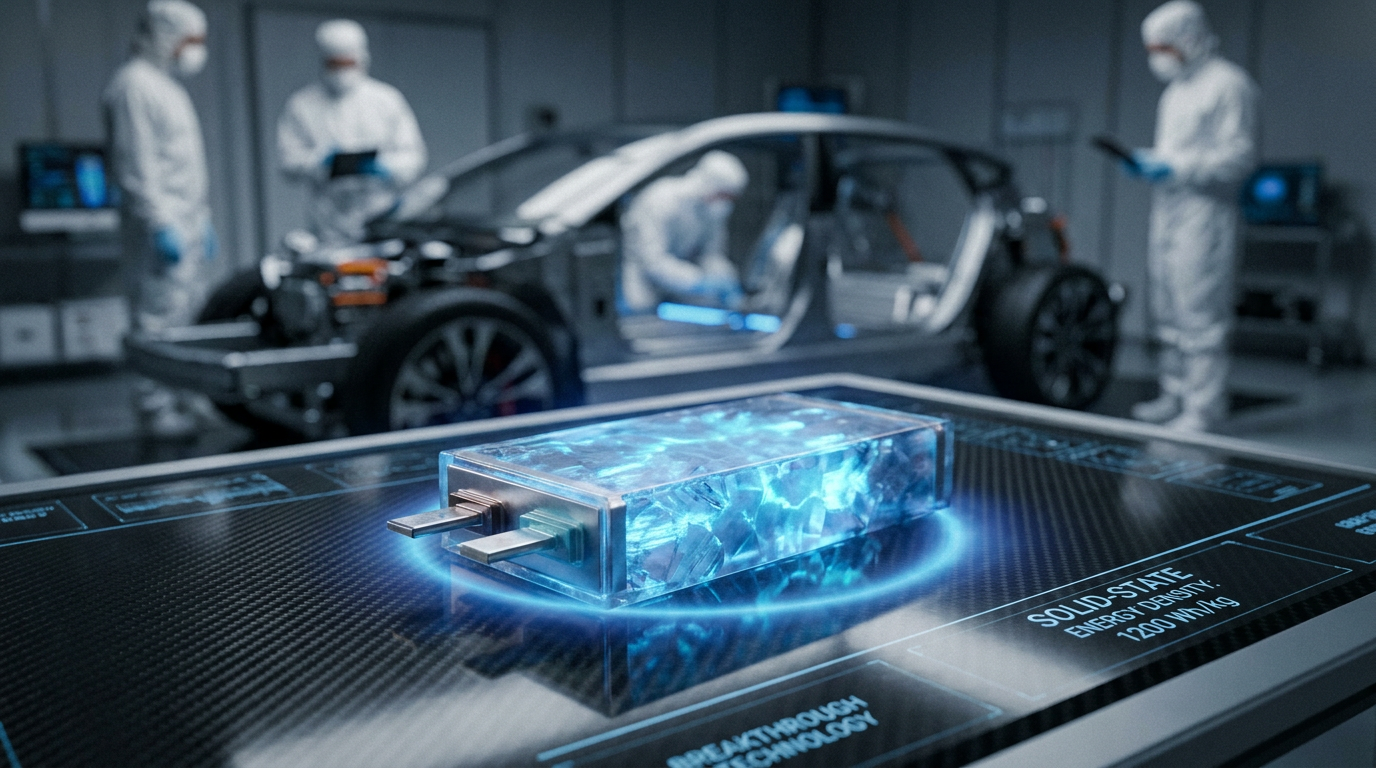
Solid-state batteries are the 'holy grail' of electric mobility. By doubling driving range, cutting charging times to under 15 minutes, and removing the flammable liquids that cause battery fires, this technology removes the final barriers to mass EV adoption.
Key points
- QuantumScape and Honda announced a multi-year joint research agreement to commercialize solid-state lithium-metal batteries.
- Solid-state technology replaces flammable liquid electrolytes with stable solid materials, eliminating EV fire risks.
- The technology enables the use of pure lithium-metal anodes, which can double driving range and cut charging times to under 15 minutes.
- Many 2026 commercial rollouts are actually 'semi-solid' batteries, which retain a small amount of liquid to ease manufacturing.
- China is introducing a strict new standard in July 2026 to classify battery types and prevent deceptive marketing.
- Automakers like Nissan are developing sulfur-based solid-state cells to break reliance on expensive, rare-earth metals.
For the past decade, the solid-state electric vehicle battery has been the automotive industry's white whale—a theoretical marvel perpetually "five years away." But in 2026, the technology is definitively crossing the chasm from laboratory prototype to factory floor. The shift accelerated today when QuantumScape, a leading American battery developer, announced a multi-year joint research agreement with Honda to commercialize its solid-state lithium-metal platform. The partnership follows a rigorous benchmarking study by Honda and marks QuantumScape's second major automotive alliance after Volkswagen.[1][2]
The Honda-QuantumScape pact is just one piece of a sudden, industry-wide mobilization. This month, Nissan launched a £3.4 million collaboration with Oxford University and Gelion to develop sulfur-based solid-state cells, targeting a 2028 mass-market launch. Meanwhile, Chinese automaker Dongfeng confirmed it will begin installing 350 Wh/kg solid-state packs in consumer vehicles in the second half of this year, promising ranges exceeding 1,000 kilometers (620 miles). After years of hype, the timeline has compressed into immediate reality.[3][4]
To understand why automakers are pouring billions into this transition, one must look at the fundamental mechanism of energy storage. Traditional lithium-ion batteries rely on a liquid electrolyte—a chemical soup that shuttles ions between the battery's positive and negative sides. While effective, this liquid is highly flammable. If the battery is punctured in a crash or overheats during rapid charging, the liquid can ignite, causing a dangerous chain reaction known as thermal runaway.[7]

Solid-state batteries eliminate this vulnerability entirely. By replacing the liquid soup with a solid, non-flammable material—typically a ceramic, polymer, or sulfide glass—the fire risk drops to near zero. Comparative thermal testing shows that solid-state systems can withstand temperatures up to 247°C before degrading, compared to just 90°C for conventional lithium-ion cells. This inherent stability allows engineers to pack the cells much tighter, fundamentally altering the geometry of the electric vehicle.[7]
But safety is only half the equation; the true prize is energy density. Because the solid electrolyte acts as an impenetrable physical barrier, battery designers can swap out the traditional graphite anode for pure lithium metal. In liquid batteries, lithium metal tends to grow microscopic, needle-like structures called "dendrites" that pierce the separator and short-circuit the cell. A solid ceramic separator physically blocks these dendrites from forming.[1][7]
The performance gains from this "golden combination" of a solid separator and a lithium-metal anode are staggering. QuantumScape's latest QSE-5 cells boast an energy density of 844 Watt-hours per liter (Wh/L). In practical terms, this allows a vehicle to charge from 10% to 80% in just 12.2 minutes, while holding enough energy to drive from Los Angeles to San Francisco without stopping. Volkswagen has already begun testing these cells in a modified Ducati electric motorcycle, proving the architecture works outside the lab.[1]

The performance gains from this "golden combination" of a solid separator and a lithium-metal anode are staggering.
However, as the technology hits the market in 2026, a critical distinction is emerging between marketing claims and engineering reality. Manufacturing a "true" all-solid-state battery requires pressing the solid layers together with immense force to ensure microscopic contact, a process that is notoriously difficult and expensive to scale. As a result, many of the "solid-state" vehicles hitting the road this year actually utilize "semi-solid" technology.[5][6]
Semi-solid batteries use a solid framework but retain a small amount of liquid electrolyte (typically 5% to 15% by weight) to help the ions flow smoothly. This hybrid approach allows manufacturers to use existing lithium-ion assembly lines with only a 10% to 15% equipment upgrade cost. While semi-solid cells offer a massive 50% improvement in thermal safety and push energy densities up to 420 Wh/kg, they are a transitional step rather than the final destination.[6]
The semantic blurring between semi-solid and all-solid has become so prevalent that regulators are stepping in. In July 2026, China's National Automotive Standardization Technical Committee is set to release the world's first official solid-state EV battery standard. The new regulations will strictly categorize cells based on their liquid content, mandating that a "true" all-solid-state battery must have a liquid weight-loss rate of no more than 0.5%. This standard aims to protect consumers from deceptive marketing as the technology scales.[6]
For legacy automakers, the race to true all-solid-state production is viewed as a geopolitical reset button. Nissan's strategy, for example, heavily relies on a new sulfur-based cathode developed by Gelion. By swapping expensive, supply-constrained metals like nickel and cobalt for abundant, ultra-low-cost sulfur, Nissan hopes to break the industry's reliance on Chinese-dominated rare-earth supply chains. The UK government recently awarded the consortium a £2.4 million grant to accelerate this exact capability.[3]
Toyota is taking a similarly aggressive, vertically integrated approach. Earlier this year, Toyota's partner Idemitsu Kosan broke ground on a massive solid-electrolyte pilot plant in Chiba Prefecture. Backed by a $13.5 billion corporate commitment, Toyota aims to bypass the semi-solid phase entirely, targeting 2027-2028 for the mass-market launch of a true all-solid-state vehicle capable of charging in 10 minutes.[7]

The manufacturing hurdles remain formidable. Engineers are currently wrestling with "interface resistance"—the tendency for solid materials to pull apart slightly as the battery swells and shrinks during charging, which degrades performance over time. Startups like QuantumScape and established giants like CATL are deploying proprietary dry-electrode manufacturing techniques and warm isostatic pressing to solve this, but the equipment is highly specialized and currently limits production to premium, low-volume vehicles.[1][5]
Despite these scaling challenges, the 2026 milestones represent a point of no return. With Honda validating QuantumScape's platform, Dongfeng pushing semi-solid packs to consumers, and global standards formalizing the chemistry, the era of liquid lithium-ion dominance is beginning to sunset. For the everyday driver, the promise is simple: within the next few vehicle generations, the electric car will charge as fast as a gas pump and drive further than a full tank.[1][4][6]
How we got here
2020–2023
Major automakers announce initial solid-state ambitions, but face repeated delays due to manufacturing challenges.
Jan 2025
Honda begins pilot production of solid-state batteries at its Sakura plant in Japan.
Jan 2026
Toyota partner Idemitsu Kosan breaks ground on a large-scale solid electrolyte pilot plant in Chiba, Japan.
Jun 2026
QuantumScape and Honda announce a multi-year joint research agreement to advance solid-state manufacturing.
Jul 2026
China is scheduled to release the world's first official standard defining solid-state and semi-solid EV batteries.
Late 2026
Dongfeng Motor targets the commercial launch of vehicles equipped with 350 Wh/kg semi-solid battery packs.
2027–2028
Toyota and Nissan target the mass-market launch of their first true all-solid-state electric vehicles.
Viewpoints in depth
Legacy Automakers' View
Established car brands see solid-state batteries as their chance to reclaim EV dominance.
For companies like Toyota, Honda, and Nissan, the transition to electric vehicles has been rocky, often leaving them trailing behind aggressive pure-EV startups and Chinese manufacturing giants. Solid-state technology represents a strategic reset button. By investing heavily in proprietary solid-state architectures—such as Nissan's sulfur-based chemistry and Toyota's massive in-house electrolyte production—these legacy brands aim to leapfrog the current lithium-ion generation entirely. They argue that waiting to perfect a fundamentally superior, fireproof battery is a better long-term strategy than fighting a price war over older, liquid-based technology.
Next-Gen Battery Developers' View
Startups and specialized chemical firms believe they have solved the fundamental physics problems of energy storage.
Companies like QuantumScape and Gelion operate on the bleeding edge of material science. For decades, the industry knew that a pure lithium-metal anode was the holy grail of energy density, but couldn't stop the formation of short-circuiting dendrites. These developers argue that their proprietary breakthroughs—specifically flexible ceramic separators and dry-electrode manufacturing processes—have finally cracked the code. Their focus is now entirely on scale: proving to massive automotive partners that these lab-perfected cells can be manufactured by the millions without losing their miraculous charging and safety properties.
Pragmatic Analysts' View
Industry watchdogs warn that the hype is outpacing the reality of factory-floor economics.
While acknowledging the scientific breakthroughs, manufacturing analysts and supply-chain experts urge caution regarding the 2026 timelines. They point out that almost all 'solid-state' batteries hitting the road this year are actually 'semi-solid' hybrids that still rely on liquid electrolytes to function efficiently. True all-solid-state cells require immense pressure and hyper-dry cleanrooms to manufacture, driving costs to nearly five times that of traditional lithium-ion. Analysts argue that until these manufacturing bottlenecks are solved, true solid-state EVs will remain luxury novelties rather than mass-market solutions.
What we don't know
- It remains unclear how quickly the specialized manufacturing equipment required for true all-solid-state batteries can be scaled to bring costs down to parity with traditional lithium-ion cells.
- Real-world degradation rates of solid-state cells over a 10-to-15 year vehicle lifespan are still largely based on accelerated laboratory testing rather than decades of road data.
- The exact pricing premium consumers will have to pay for the first generation of true solid-state vehicles in 2027-2028 is not yet known.
Key terms
- Solid-State Battery
- A battery technology that uses solid electrodes and a solid electrolyte, instead of the liquid or polymer gel electrolytes found in conventional lithium-ion batteries.
- Electrolyte
- The medium (liquid, gel, or solid) inside a battery that allows electrical charge (ions) to flow between the cathode and anode during charging and discharging.
- Energy Density
- The amount of energy a battery can hold relative to its weight or volume, usually measured in Watt-hours per kilogram (Wh/kg). Higher density means more driving range.
- Dendrites
- Microscopic, needle-like metallic structures that can grow inside a liquid battery, potentially piercing the separator and causing a dangerous short circuit.
- Semi-Solid Battery
- A transitional battery design that uses a mostly solid structure but retains a small percentage of liquid electrolyte to facilitate ion movement and ease manufacturing.
Frequently asked
When can I buy a car with a solid-state battery?
Vehicles with 'semi-solid' batteries are hitting the market in late 2026, primarily in China. True all-solid-state vehicles from automakers like Toyota and Nissan are targeted for mass-market release between 2027 and 2028.
Are solid-state batteries completely fireproof?
They are vastly safer than current batteries. By removing the flammable liquid electrolyte, the risk of thermal runaway (battery fires) is virtually eliminated, even if the battery is punctured or overheats.
What is the difference between semi-solid and all-solid?
Semi-solid batteries use a solid framework but retain 5% to 15% liquid electrolyte to help ions move, making them easier to manufacture today. True all-solid batteries contain zero liquid, offering maximum safety and energy density, but are harder to produce at scale.
Will solid-state batteries make EVs cheaper?
Eventually, yes. While early solid-state batteries will carry a premium price, innovations like Nissan's sulfur-based chemistry aim to replace expensive metals like nickel and cobalt with abundant, cheap materials, driving down long-term costs.
Sources
Source coverage
7 outlets
4 viewpoints surfaced







[1]ElectrekNext-Gen Battery Developers
Honda, QuantumScape enter solid-state battery tie-up
Read on Electrek →[2]GlobeNewswireNext-Gen Battery Developers
QuantumScape Announces Agreement with Honda on Solid-State Battery Technology
Read on GlobeNewswire →[3]Batteries NewsLegacy Automakers
Nissan, University of Oxford and Gelion collaborate for solid-state EV batteries
Read on Batteries News →[4]CarsGuideLegacy Automakers
Huge update on groundbreaking EV tech: Dongfeng announces mass-production
Read on CarsGuide →[5]CarNewsChinaPragmatic Analysts
Technical parameters delay true solid state battery commercialization within global automotive markets
Read on CarNewsChina →[6]Bonnen BatteriesPragmatic Analysts
Don't Get Fooled by Solid-State Hype: In 2026, Only Semi-Solid Batteries Are Hitting the Road!
Read on Bonnen Batteries →[7]To7MotorConsumer Advocates
Solid-state batteries are no longer simply lab experiments
Read on To7Motor →


Every angle. Every day.
Get automotive stories with full source coverage and perspective breakdowns delivered to your inbox.