
The Solid-State Battery Breakthrough: How 2026 Became the Year EVs Changed Forever
After decades of research, solid-state batteries are finally moving from laboratory prototypes to real-world production lines in 2026. By replacing flammable liquid electrolytes with solid materials, this technology promises to double EV range, cut charging times to 10 minutes, and virtually eliminate battery fire risks.
By Factlen Editorial Team
- Automotive Incumbents
- Legacy automakers investing heavily to secure exclusive access to next-generation battery chemistry.
- Battery Innovators
- Startups and specialized firms focused on proving the core chemistry and scaling pilot production.
- Industry Pragmatists
- Analysts focused on the manufacturing costs, supply chain bottlenecks, and realistic commercial timelines.
What's not represented
- · Raw Material Miners
- · EV Charging Infrastructure Providers
Why this matters
For consumers, solid-state batteries mean the end of range anxiety and long charging stops, making electric vehicles as convenient to refuel as gas cars while virtually eliminating the risk of battery fires.
Key points
- Solid-state batteries replace flammable liquid electrolytes with stable solid materials, eliminating fire risks.
- The technology suppresses dendrite growth, allowing for energy-dense lithium-metal anodes.
- Pilot production lines, like QuantumScape's Eagle Line, are officially spinning up in 2026.
- Toyota aims to launch its first consumer-ready solid-state EVs between 2027 and 2028.
- High manufacturing costs mean early solid-state batteries will debut exclusively in luxury and performance vehicles.
- Mass-market affordability is projected to arrive around 2030 as raw material supply chains scale.
The electric vehicle industry has chased a singular "holy grail" for over a decade: a battery that charges as fast as a gas tank fills, never catches fire, and drives over 600 miles on a single charge. For years, this sounded like science fiction. But in 2026, the transition from laboratory theory to industrial reality is finally underway.
The breakthrough centers on a fundamental shift in chemistry. Traditional lithium-ion batteries—the kind powering everything from smartphones to current electric vehicles—rely on a liquid electrolyte to move ions back and forth between the anode and cathode. While effective, this liquid is highly flammable and limits how much energy the cell can safely store.
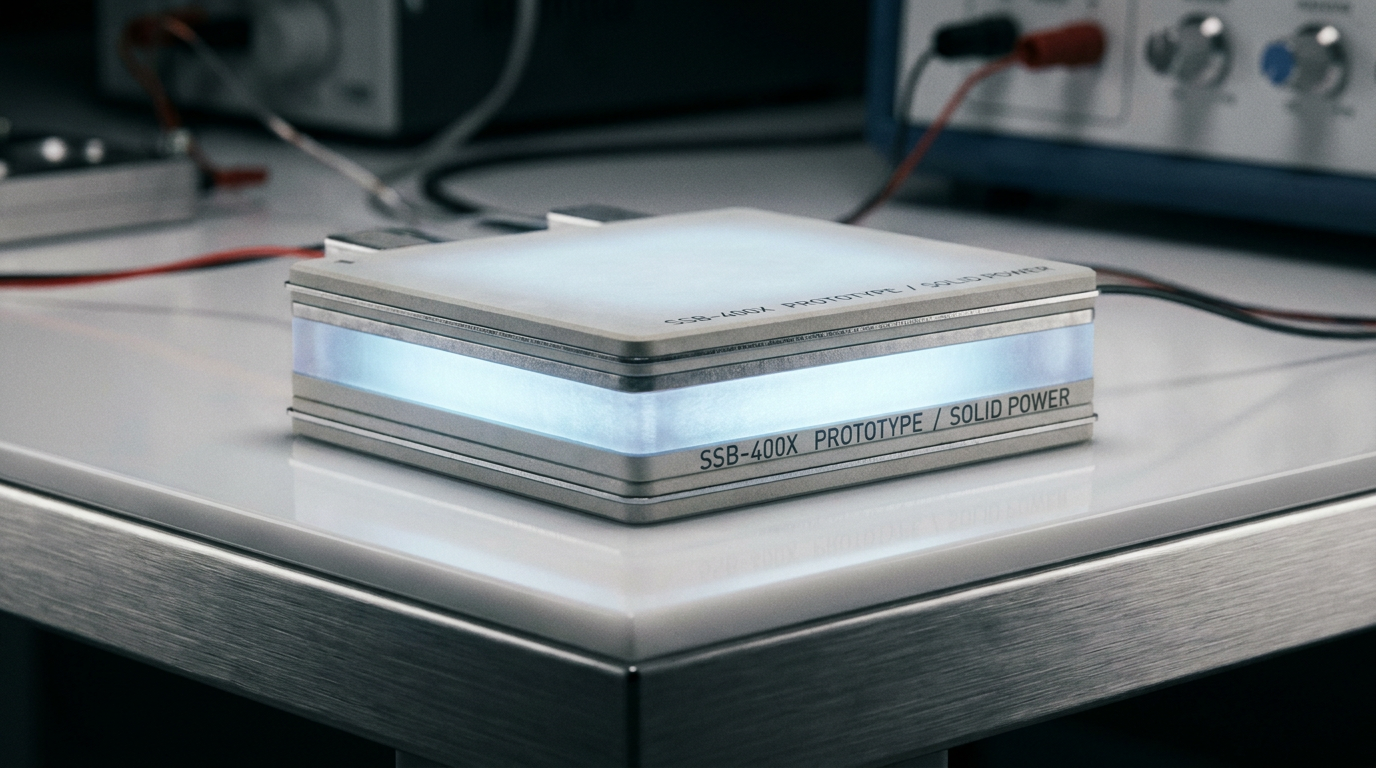
Solid-state batteries replace that liquid with a solid material, such as a ceramic, polymer, or sulfide glass. This single swap unlocks a cascade of benefits. Because the solid electrolyte is non-combustible, the risk of thermal runaway—the chain reaction that causes battery fires—is virtually eliminated. In recent tests by Greater Bay Technology (GBT), their solid-state "A-sample" cells successfully passed needle penetration and thermal shock tests without any fire or explosion.[7]

Beyond safety, the solid electrolyte solves a critical chemical bottleneck: dendrites. In liquid batteries, fast charging or using high-capacity lithium-metal anodes can cause microscopic, needle-like structures called dendrites to grow, eventually piercing the separator and short-circuiting the cell. Solid electrolytes act as a physical barrier, suppressing dendrite growth and allowing manufacturers to safely use lithium-metal anodes.[2]
This unlocks a massive leap in energy density—the amount of power stored per kilogram. Today's best lithium-ion batteries hover around 200 to 300 Wh/kg. Solid-state cells entering pilot production in 2026 are targeting 400 to 500 Wh/kg. For drivers, this means future EVs could deliver over 1,000 kilometers (621 miles) of range without increasing the physical size or weight of the battery pack.[4][7]

The race to commercialize this technology has accelerated dramatically. In February 2026, California-based QuantumScape inaugurated its "Eagle Line" in San Jose, a highly automated pilot facility designed to produce solid-state cells for its primary backer, Volkswagen. The facility utilizes a proprietary "Cobra" separator process that is roughly 25 times faster and far more compact than previous iterations, a crucial step toward mass manufacturing.[1][2][5]
QuantumScape's technology has already demonstrated remarkable performance in testing. The company's QSE-5 cells boast an energy density of over 844 Wh/L and can charge from 10% to 80% in just over 12 minutes. Volkswagen's battery subsidiary, PowerCo, recently committed up to $131 million in milestone-based payments to accelerate this pilot line, signaling deep confidence in the platform.[1][5]
QuantumScape's technology has already demonstrated remarkable performance in testing.
Meanwhile, legacy automakers are leveraging their massive scale to dominate the impending market. Toyota currently leads the world in solid-state battery development, holding over 1,300 patents—nearly four times as many as its closest competitor. The Japanese giant has focused heavily on sulfide-based electrolytes, which offer excellent conductivity and stability across extreme temperature ranges, from -30°C to 100°C.[4]
Toyota is moving aggressively to secure its supply chain. The automaker recently partnered with petrochemical giant Idemitsu Kosan to break ground on a large-scale solid electrolyte pilot plant. Expected to be completed by the end of 2027, the facility will produce the specialized materials needed for Toyota's target of launching consumer-ready solid-state EVs between 2027 and 2028.[4][6]
China's battery sector is executing an equally aggressive sprint. Industry analysts have dubbed 2026 the "year one" for solid-state mass production efforts in the region. Companies like GAC Group and its backed startup, GBT, are aiming to achieve gigawatt-hour-level mass production of all-solid-state batteries by the end of the year.[3][7]
However, significant hurdles remain before these batteries reach the average driveway. The primary obstacle is cost. Currently, all-solid-state cells cost between 1.6 and 2.2 yuan per Watt-hour to produce—roughly three to five times the price of mainstream liquid lithium-ion batteries.[3]
This price premium stems from the sheer difficulty of manufacturing. Traditional liquid battery production has been refined over decades into highly efficient, continuous roll-to-roll processes. Solid-state manufacturing requires entirely new machinery, hermetic sealing to protect sensitive materials from moisture, and expensive raw materials like lithium sulfide.[3]

Because of these high costs, the first wave of solid-state EVs arriving in the late 2020s will not be budget-friendly commuters. They will debut in high-end luxury vehicles, performance sports cars, and specialized applications like low-altitude aviation and electric motorcycles. For instance, QuantumScape's cells are already being tested in Ducati electric motorcycles.[1][3]
To bridge the gap, the industry is currently leaning on "semi-solid" batteries. These cells use a hybrid approach, containing 5% to 20% liquid electrolyte alongside solid materials. Semi-solid packs are already hitting the roads in premium Chinese EVs, offering a middle ground of improved safety and ranges approaching 600 miles, while utilizing existing manufacturing infrastructure.[3]
The ultimate goal is the "one-yuan era"—the point at which solid-state cell costs drop to parity with today's batteries. Supply chain analysts project that as raw material production scales up and manufacturing yields improve, this tipping point could arrive around 2030.[3]

When that happens, the electric vehicle landscape will be fundamentally transformed. By eliminating range anxiety, slashing charging times to match a trip to the gas station, and ensuring absolute safety, solid-state batteries are poised to remove the final barriers to global EV adoption.
How we got here
1991
Sony commercializes the first lithium-ion battery, setting the standard for portable electronics and eventually EVs.
2020
QuantumScape releases testing results for its single-layer solid-state cell, proving the viability of its ceramic separator.
2024
Semi-solid batteries, containing a mix of liquid and solid electrolytes, begin appearing in premium Chinese electric vehicles.
Feb 2026
QuantumScape inaugurates the Eagle Line in California, a highly automated pilot facility for solid-state cell production.
2027–2028
Automakers like Toyota project the launch of their first consumer-ready solid-state electric vehicles.
Viewpoints in depth
Automakers & OEM Partners
Legacy carmakers view solid-state technology as the ultimate differentiator to win the EV range war.
Companies like Toyota and Volkswagen are investing billions to secure exclusive access to solid-state chemistry. For these incumbents, the technology is a way to justify premium pricing and overcome consumer hesitation around charging infrastructure. By offering a vehicle that charges in 10 minutes and drives over 600 miles, they aim to make the EV experience indistinguishable from refueling a combustion engine.
Battery Innovators
Startups and specialized battery firms emphasize rapid technological milestones and licensing models.
Firms like QuantumScape and Greater Bay Technology are focused on proving the core chemistry works at scale. Rather than building massive gigafactories themselves, many are adopting a licensing approach—providing the intellectual property and pilot-line blueprints to larger automakers. They argue that breakthroughs like the "Cobra" separator process prove that the manufacturing bottlenecks are solvable in the near term.
Supply Chain Analysts
Industry pragmatists caution that manufacturing costs and raw material scaling will delay mass-market affordability.
While acknowledging the scientific breakthroughs, analysts point out that solid-state cells currently cost three to five times more than traditional lithium-ion batteries. They emphasize that the supply chain for specialized materials, such as lithium sulfide, must expand exponentially to drive costs down. Consequently, they predict true mass-market adoption won't occur until 2030, with semi-solid batteries serving as the bridge technology for the rest of the decade.
What we don't know
- Exactly how quickly the supply chain for specialized raw materials like lithium sulfide can scale to meet global demand.
- Whether unforeseen degradation issues will appear when solid-state cells are subjected to years of real-world driving conditions.
Key terms
- Electrolyte
- The medium inside a battery that allows ions to flow between the anode and cathode, enabling the battery to charge and discharge.
- Dendrites
- Microscopic, needle-like metallic growths that can form inside a battery, potentially piercing internal barriers and causing short circuits.
- Energy Density
- A measure of how much energy a battery can store relative to its weight, typically expressed in Watt-hours per kilogram (Wh/kg).
- Thermal Runaway
- A dangerous chain reaction inside a battery where excess heat causes further heating, often leading to fires or explosions in traditional lithium-ion cells.
- Lithium-Metal Anode
- An advanced battery component that uses pure lithium metal instead of graphite, drastically increasing the amount of energy the battery can hold.
Frequently asked
What makes a solid-state battery different?
Instead of using a flammable liquid to move ions inside the battery, it uses a solid material like ceramic or sulfide. This makes the battery significantly safer and allows it to store much more energy.
When will solid-state EVs be available to buy?
Pilot production is beginning in 2026, but the first consumer vehicles—likely high-end luxury models—are expected between 2027 and 2028. Mass-market affordability is projected around 2030.
How fast can a solid-state battery charge?
Current prototypes from leading developers are demonstrating the ability to charge from 10% to 80% in approximately 10 to 12 minutes, rivaling the time it takes to fill a gas tank.
Why are they so expensive right now?
The manufacturing process requires entirely new machinery, hermetic sealing to prevent moisture contamination, and expensive raw materials like lithium sulfide, which haven't yet reached mass-market scale.
Sources
Source coverage
7 outlets
3 viewpoints surfaced






[1]ElectriveBattery Innovators
Solid-state batteries: QuantumScape ready to launch its pilot line
Read on Electrive →[2]Inc. MagazineBattery Innovators
EV Rivals Are Closing In—Can QuantumScape and Volkswagen Bring Solid-State Batteries to Market First?
Read on Inc. Magazine →[3]GasgooIndustry Pragmatists
How Far Away Is the 'Affordable Era' for All-Solid-State Batteries?
Read on Gasgoo →[4]PatSnapAutomotive Incumbents
Toyota vs Samsung Solid-State Battery Patents 2026 Comparison
Read on PatSnap →[5]TradingViewBattery Innovators
How QuantumScape's 2025 Milestones Set the Stage for 2026
Read on TradingView →[6]ElectrekAutomotive Incumbents
Toyota partner breaks ground on solid electrolyes plant for all-solid-state EV batteries
Read on Electrek →Solid-state EV batteries are coming sooner than expected after another breakthrough
Read on Electrek →
Every angle. Every day.
Get automotive stories with full source coverage and perspective breakdowns delivered to your inbox.