
The Science of Umami: How to Build Savory Depth in Plant-Based Recipes
Understanding the chemical synergy between glutamates and nucleotides can transform flat vegetarian meals into deeply satisfying dishes. By layering ingredients like dried mushrooms, fermented pastes, and seaweed, home cooks can replicate the savory depth traditionally associated with meat.
By Factlen Editorial Team
- Plant-Based Chefs
- Emphasize practical kitchen techniques, such as layering fermented pastes and dried fungi, to replicate the depth of meat.
- Culinary Scientists
- Focus on the chemical interactions between amino acids and taste receptors to explain why certain food combinations taste delicious.
- Public Health Researchers
- View umami as a strategic tool to reduce dietary sodium and encourage the adoption of environmentally sustainable diets.
What's not represented
- · Traditional meat-centric chefs
- · Food allergy advocates regarding soy and yeast sensitivities
Why this matters
As more households look to reduce their meat consumption for health or environmental reasons, the biggest hurdle is often a perceived lack of flavor. Mastering the chemistry of umami allows home cooks to create plant-based meals that are genuinely satisfying, making sustainable eating a pleasure rather than a sacrifice.
Key points
- Plant-based meals often taste flat due to a lack of umami, not a lack of fat or salt.
- Umami is triggered by glutamates, found abundantly in tomatoes, miso, and nutritional yeast.
- Combining glutamates with nucleotides (found in mushrooms and seaweed) creates a multiplied 'synergistic' flavor.
- Chefs build depth by layering umami sources at the base, body, and finish of a recipe.
- Using umami-rich ingredients allows cooks to reduce added sodium while maintaining deliciousness.
A common complaint among home cooks attempting to transition to plant-based meals is that the food tastes "flat" or lacks a certain satisfying weight. This missing element is rarely a lack of salt or fat, but rather an absence of umami—the deeply savory, mouth-filling fifth basic taste. While meat and aged dairy naturally deliver massive doses of umami, achieving that same depth in vegetarian cooking requires a deliberate understanding of flavor chemistry.[1][6]
At its core, umami is the taste of glutamates, a type of amino acid that occurs naturally in various foods. When proteins break down through cooking, aging, or fermentation, these glutamates are released, signaling to the human brain that the food is rich in essential proteins. This evolutionary mechanism explains why humans are biologically hardwired to crave savory flavors.[2][6]
However, glutamates are only half of the umami equation. The true secret to professional-level flavor building lies in a phenomenon known as "synergistic umami." This occurs when glutamates are combined with a different set of compounds called nucleotides. When these two chemical families meet on the tongue, the savory sensation is not merely added together; it is exponentially multiplied.[1][4]

In traditional Western cooking, this synergy is often achieved by pairing meat (high in nucleotides) with tomatoes or cheese (high in glutamates), resulting in dishes like cheeseburgers or spaghetti bolognese. For plant-based cooking, the challenge is to source both halves of this equation entirely from the vegetable kingdom. Fortunately, the plant world is abundant in both.[3][6]
Plant-based glutamates are relatively easy to find. Ripe tomatoes, especially when roasted or sun-dried, are packed with them. Fermented soy products like miso paste and soy sauce are essentially liquid umami, as the fermentation process breaks down the soy proteins into free glutamates. Nutritional yeast, a staple in vegan pantries, and fermented vegetables like kimchi and sauerkraut also provide massive glutamate boosts.[2][3]
Ripe tomatoes, especially when roasted or sun-dried, are packed with them.
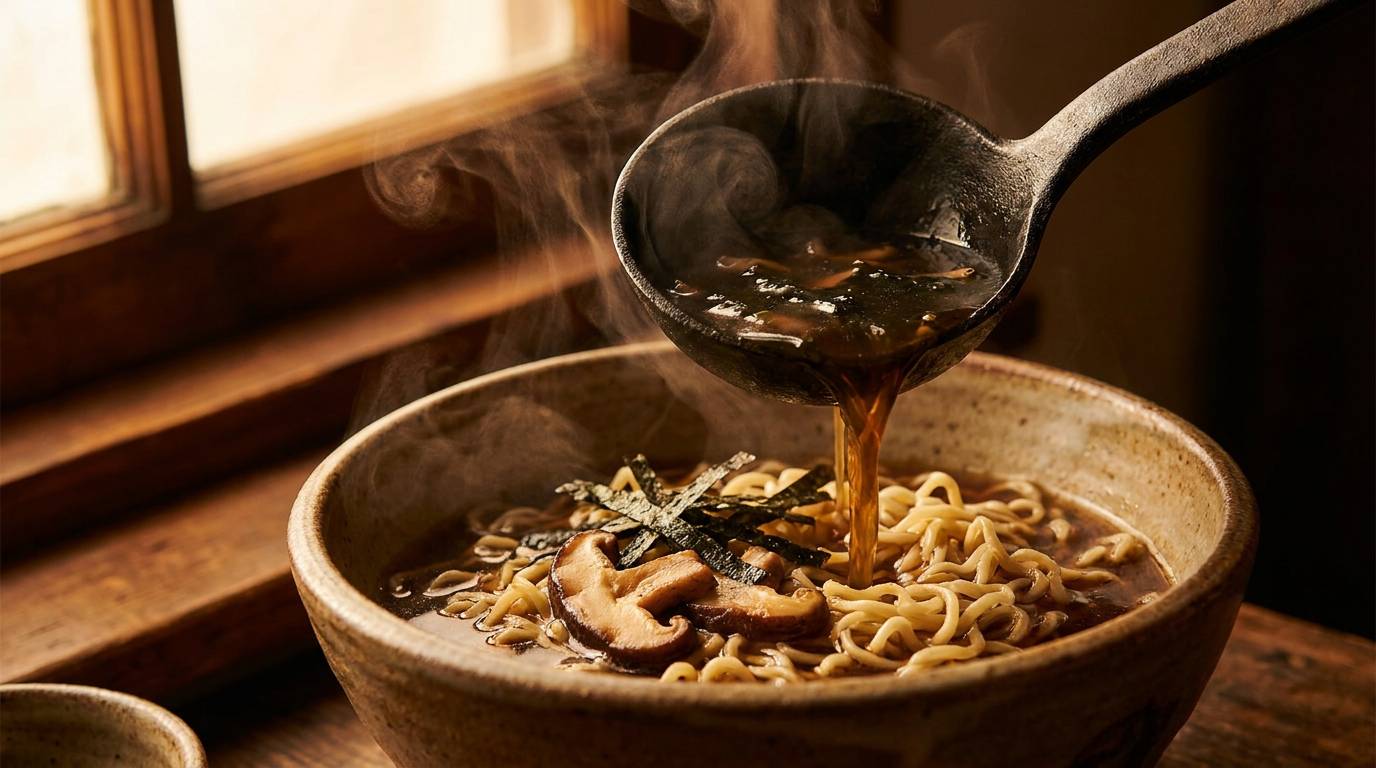
Sourcing plant-based nucleotides requires looking toward fungi and the ocean. Mushrooms are the premier terrestrial source of nucleotides, but their power is unlocked through dehydration. Dried mushrooms, such as shiitake or porcini, contain three to five times more umami compounds than their fresh counterparts. Seaweed, particularly kombu and nori, is another potent source, serving as the savory engine behind much of Asian cuisine.[1][3]

Understanding these ingredients is only the first step; the technique of layering is what separates a good dish from a great one. Culinary experts warn against the common mistake of simply dumping a single umami source into a pot at the end of cooking. Instead, depth is built by introducing different umami sources at multiple stages of the recipe.[1][5]
A robust plant-based stew, for example, should begin with a base of aromatics sautéed with a fermented paste like miso or tomato paste. The body of the dish can then be built using a stock made from steeped dried mushrooms and kombu, rather than plain water or boxed vegetable broth. Finally, the dish is finished with a splash of soy sauce or a sprinkle of nutritional yeast to lock in the savory notes.[1][3]

Beyond culinary satisfaction, mastering umami has significant public health implications. Researchers at the University of Copenhagen have highlighted umami as a critical tool for the "green transition" of the global food system. By using science-based knowledge to boost the deliciousness of plant-based foods, consumers are far more likely to adopt sustainable diets voluntarily.[4]
Furthermore, umami can dramatically improve the nutritional profile of a meal. Because umami enhances the perception of saltiness and sweetness, cooks can significantly reduce the amount of added sodium and sugar in a recipe without sacrificing palatability. It also helps mask the bitter notes found in nutrient-dense cruciferous vegetables like kale and broccoli.[2][4]

There are, however, nuances to balance. A dish overloaded with umami compounds can become heavy, muddy, or overwhelmingly rich. Culinary scientists emphasize that umami must be balanced with the other basic tastes. A squeeze of lemon or a dash of vinegar (sour) can cut through the richness, while a touch of sweetness from carrots or bell peppers can round out the flavor profile.[2][6]
Ultimately, the science of umami demystifies the art of cooking. It proves that deep, satisfying flavor is not an exclusive property of meat or dairy, but a chemical reaction that can be orchestrated with plants. By stocking the pantry with dried mushrooms, seaweed, and fermented pastes, any home cook can engineer meals that are both deeply nourishing and profoundly delicious.[1][6]
Viewpoints in depth
Culinary Scientists
Focus on the chemical interactions between amino acids and taste receptors.
For food scientists, umami is a measurable chemical interaction. They study how specific amino acids, primarily glutamates, bind to specialized receptors on the human tongue. Their research emphasizes that the 'deliciousness' of a meal isn't magic, but a predictable biological response to protein density. By mapping out which plants contain high levels of glutamates and nucleotides, scientists provide a literal formula for flavor that can be manipulated in a laboratory or a home kitchen.
Plant-Based Chefs
Emphasize practical kitchen techniques to replicate the depth of meat.
Professional chefs approach umami as a structural building block for recipes. Rather than focusing on the molecular science, they focus on the technique of layering. A plant-based chef knows that a single splash of soy sauce at the end of a recipe is insufficient. Instead, they advocate for building a foundation with caramelized tomato paste, simmering a broth with dried shiitakes, and finishing with fermented miso. Their goal is to create a sensory experience so robust that the absence of meat goes entirely unnoticed.
Public Health Researchers
View umami as a strategic tool to improve global diets and sustainability.
Public health experts look at umami through the lens of behavioral change. Knowing that humans are biologically driven to seek out savory flavors, researchers argue that lecturing the public about the environmental benefits of eating vegetables is ineffective if the food doesn't taste good. By utilizing umami to make plant-based foods genuinely craveable, and by using it to naturally lower sodium levels in recipes, they see flavor chemistry as a vital mechanism for driving the 'green transition' in global eating habits.
What we don't know
- How individual genetic differences in taste receptors affect the perception of umami intensity.
- The exact long-term impact of highly concentrated umami extracts on the gut microbiome compared to whole-food sources.
Key terms
- Umami
- The fifth basic taste, characterized by a savory, rich, and mouth-filling sensation.
- Glutamate
- An amino acid that occurs naturally in foods like tomatoes and fermented soy, responsible for triggering umami taste receptors.
- Nucleotide
- A compound found in high concentrations in mushrooms and seaweed that, when combined with glutamates, exponentially increases savory flavor.
- Synergistic Umami
- The multiplied flavor effect achieved by combining ingredients rich in glutamates with ingredients rich in nucleotides.
- Kombu
- A type of edible kelp widely used in East Asian cuisine to create deeply savory broths and stocks.
Frequently asked
What exactly is umami?
Umami is the fifth basic taste, alongside sweet, sour, salty, and bitter. It is a deeply savory, mouth-filling flavor derived from glutamates, which are amino acids found in protein-rich foods.
Why do dried mushrooms have more flavor than fresh?
The dehydration process concentrates the savory compounds in mushrooms, resulting in three to five times more umami-boosting nucleotides than fresh mushrooms.
How can I add umami without adding too much sodium?
Ingredients like nutritional yeast, tomato paste, and dried mushroom powder add massive umami without the high sodium content of soy sauce. Furthermore, umami naturally enhances the perception of salt, allowing you to use less overall.
What is synergistic umami?
It is a chemical reaction that occurs when glutamates (found in tomatoes and soy) are combined with nucleotides (found in mushrooms and seaweed), multiplying the savory flavor exponentially rather than just adding it.
Sources
Source coverage
6 outlets
3 viewpoints surfaced






[1]Vegan Asian KitchenPlant-Based Chefs
Vegan Umami: The Science of Layering Flavor
Read on Vegan Asian Kitchen →[2]Olives for DinnerCulinary Scientists
Understanding Umami: The Fifth Taste
Read on Olives for Dinner →[3]Savory KitchinPlant-Based Chefs
Maximizing Umami in Plant-Based Cooking
Read on Savory Kitchin →[4]University of CopenhagenPublic Health Researchers
The umami taste is key to the green transition
Read on University of Copenhagen →[5]SubstackPlant-Based Chefs
The Science of Umami: Building Depth in Plant-Based Korean Broths
Read on Substack →[6]Factlen Editorial TeamPublic Health Researchers
Synthesis by Factlen editorial team
Read on Factlen Editorial Team →

Every angle. Every day.
Get lifestyle stories with full source coverage and perspective breakdowns delivered to your inbox.