
The Science of Umami: How Glutamates, MSG, and Koji Transform Home Cooking
Understanding the biology of the fifth taste allows home cooks to naturally amplify savory flavors, tenderize ingredients, and significantly reduce sodium intake.
By Factlen Editorial Team
- Culinary Scientists
- Focuses on the molecular interactions of amino acids and how they biologically trigger flavor receptors on the tongue.
- Public Health Advocates
- Views umami compounds primarily as a strategic tool for reducing global sodium intake without sacrificing food palatability.
- Traditional Fermentation Practitioners
- Values the historical, slow-food methods of developing umami through microbes and aging to preserve cultural heritage.
What's not represented
- · Individuals with specific glutamate sensitivities
- · Industrial food manufacturers scaling umami production
Why this matters
Mastering umami isn't just about making food taste better—it is a scientifically proven method to reduce your sodium intake by up to 30% without sacrificing the satisfying, savory depth of your favorite meals.
Key points
- Umami is the fifth basic taste, triggered by the amino acid glutamate binding to specific receptors on the tongue.
- Combining glutamates with nucleotides creates 'umami synergy,' multiplying the savory flavor exponentially.
- MSG is simply the sodium salt of glutamate and is recognized as safe by global health authorities.
- Replacing a portion of table salt with MSG can reduce a dish's sodium content by up to 30%.
- Koji, a Japanese mold, produces enzymes that break down proteins into umami-rich amino acids.
- Shio koji is an accessible home marinade that tenderizes meat and amplifies the natural sweetness of vegetables.
For decades, home cooks have intuitively reached for a splash of soy sauce, a sprinkle of Parmesan, or a spoonful of tomato paste to rescue a flat-tasting dish. That irresistible, mouth-coating depth they are chasing is umami, widely recognized today as the fifth basic taste alongside sweet, salty, sour, and bitter. Unlike the sharp hit of salt or the immediate rush of sugar, umami provides a lingering, savory richness that rounds out flavors and makes food deeply satisfying. While chefs have long relied on this secret weapon to elevate their menus, a growing understanding of the underlying chemistry is now empowering everyday cooks to harness umami deliberately. By mastering the science of savory flavor, anyone can transform ordinary ingredients into restaurant-quality meals.[1][8]
The story of umami as a distinct scientific concept began in 1908 with Japanese chemist Kikunae Ikeda. While savoring a bowl of traditional dashi broth, Ikeda noticed a savory quality that could not be categorized by the four established tastes. He traced this flavor to kombu, a type of kelp used to make the broth, and eventually isolated the compound responsible: glutamate, a naturally occurring amino acid. Ikeda named this taste umami, derived from the Japanese word umai, meaning delicious. Despite his breakthrough, it took nearly a century for the global scientific community to formally recognize umami. It was not until the early 2000s that researchers identified specific taste receptors on the human tongue dedicated exclusively to detecting glutamates, confirming Ikeda's century-old intuition.[3][7][8]
At a biological level, the perception of umami is a sophisticated chemical signaling process. When we consume foods rich in free glutamates, these molecules bind to specialized T1R1 and T1R3 receptors on our taste buds. This interaction sends a signal to the brain that is interpreted as a brothy, meaty, or savory sensation. Sensory scientists note that umami is unique because it is a true taste modality—carried by receptors rather than nerves—and it actively alters how we perceive other flavors. It bridges the gap between sweet and salty notes, suppresses bitterness, and triggers salivation, which physically coats the palate and prolongs the tasting experience. This biological mechanism explains why a slow-simmered stew tastes fundamentally richer than its raw ingredients.[2][3][8]
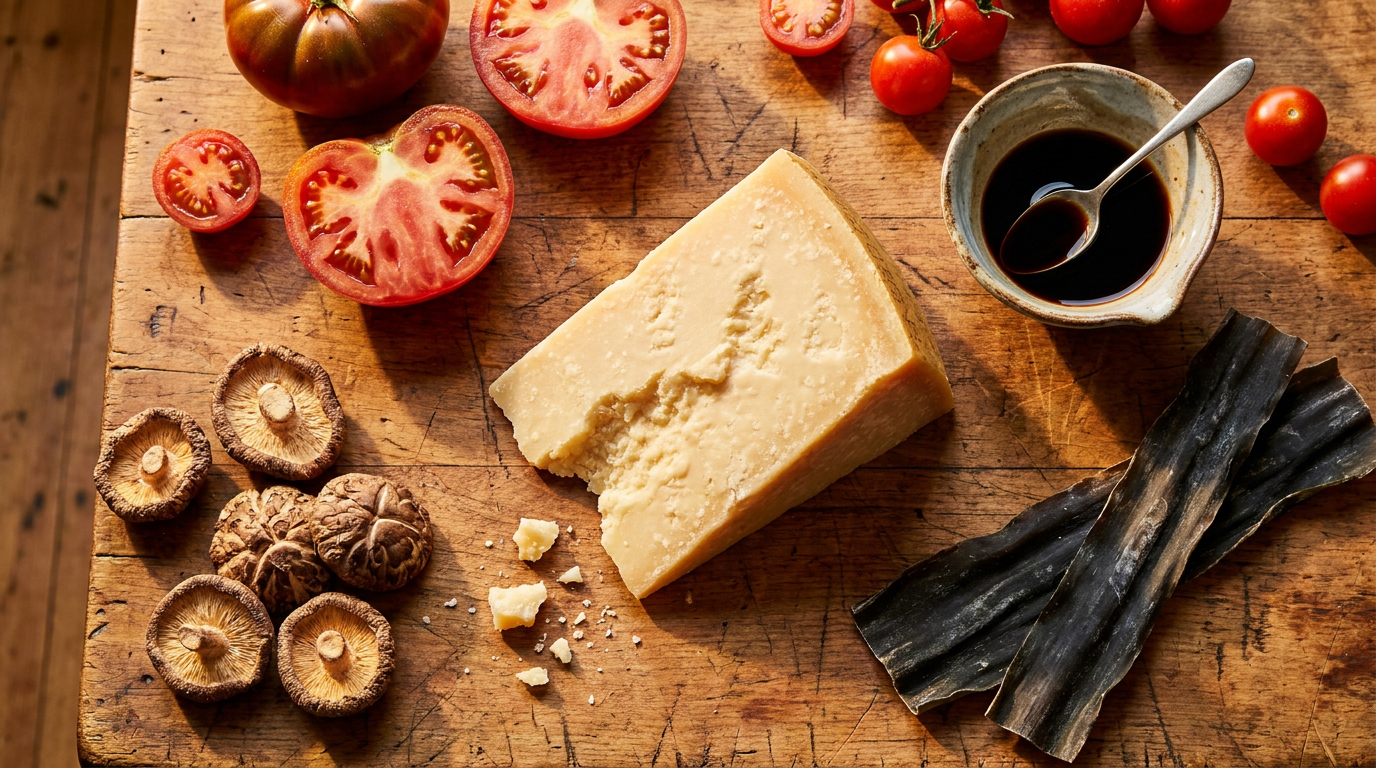
Fortunately for home cooks, glutamate is one of the most abundant amino acids in nature, meaning umami is readily accessible in everyday ingredients. It is particularly concentrated in foods that have been aged, cured, dried, or cooked down. Ripe tomatoes, especially when concentrated into a paste, are a powerhouse of natural glutamates. Aged cheeses like Parmigiano-Reggiano, cured meats such as prosciutto, and dried shiitake mushrooms are all dense with the compound. Even human breast milk contains high levels of glutamate, suggesting that our evolutionary preference for savory flavors is hardwired from infancy. By deliberately incorporating these glutamate-rich ingredients into a recipe—such as dropping a Parmesan rind into a simmering soup—cooks can naturally amplify the dish's savory baseline.[5][7]
The true magic of umami, however, lies in a phenomenon known as umami synergy. While glutamate alone provides a savory baseline, its flavor-enhancing power is magnified exponentially when combined with a different class of compounds called ribonucleotides—specifically inosinate, found primarily in meats and fish, and guanylate, found in mushrooms. When glutamate receptors on the tongue are exposed to both glutamates and nucleotides simultaneously, the perceived intensity of the savory flavor multiplies far beyond the sum of its parts. This biochemical synergy explains the universal appeal of classic culinary pairings across different cultures: the Japanese combination of kombu (glutamate) and bonito flakes (inosinate) in dashi, the Italian pairing of tomato sauce (glutamate) with beef (inosinate), or a classic cheeseburger topped with mushrooms (guanylate).[3][7][8]

The most direct way to introduce umami into a dish is through monosodium glutamate, universally known as MSG. At its core, MSG is simply the sodium salt of glutamic acid. It is produced by fermenting plant-based starches—such as corn, sugar beets, or sugarcane—in a process very similar to the fermentation used to make yogurt, beer, or soy sauce. The resulting white, crystalline powder is chemically indistinguishable from the glutamate found naturally in a tomato or a wedge of cheese. When added to food, MSG dissolves into sodium and free glutamate, instantly binding to the tongue's umami receptors and acting as a pure flavor amplifier that rounds out existing savory notes without adding distinct flavors of its own.[5][8]
Despite its effectiveness, MSG has carried a heavy burden of stigma in Western countries for decades, stemming from flawed, anecdotal reports in the late 1960s that linked it to various mild ailments. However, modern scientific consensus has thoroughly debunked these claims. Extensive reviews by global health authorities, including the U.S. Food and Drug Administration, the World Health Organization, and independent academic panels, have consistently reaffirmed that MSG is safe for the general population when consumed in typical dietary amounts. The scientific community now views the historical demonization of MSG as a product of flawed methodology and cultural bias, rather than rooted in physiological reality.[2][6]
However, modern scientific consensus has thoroughly debunked these claims.
For the modern home cook, embracing MSG opens up a highly efficient avenue for flavor enhancement. Because it is pure umami, a little goes a very long way. Culinary experts recommend starting with just a pinch—roughly a quarter teaspoon for a family-sized dish—added toward the end of the cooking process. It works exceptionally well in savory applications like soups, stir-fries, marinades, and salad dressings, particularly in dishes that lack a heavy meat presence, such as vegetarian or plant-based meals. By acting as a flavor bridge, a tiny amount of MSG can make a simple vegetable stir-fry taste as complex and deeply satisfying as a dish that has been simmering for hours.[5]
Beyond flavor, the strategic use of umami compounds like MSG offers a compelling public health benefit: significant sodium reduction. The overconsumption of sodium chloride (table salt) is a major driver of hypertension and cardiovascular disease globally. Because MSG contains roughly one-third the amount of sodium as regular table salt, it can be used to replace a portion of the salt in a recipe. Studies have demonstrated that by substituting MSG for some of the salt, food manufacturers and home cooks can reduce the overall sodium content of a dish by up to 30 percent without sacrificing palatability. The umami receptors compensate for the lower salt levels by boosting the overall perception of flavor, making it a valuable tool for heart-healthy cooking.[6]

While MSG offers a shortcut to umami, traditional culinary practices have long relied on the slow, transformative power of fermentation to unlock savory depth. During fermentation and aging, microbial enzymes systematically dismantle complex, tasteless proteins into their constituent amino acids, including free glutamate. This biochemical dismantling is the engine behind the world's most profoundly savory condiments. It is the reason why fermented fish sauce was a staple in ancient Rome, why soy sauce has been a cornerstone of Chinese cuisine for millennia, and why a block of cheddar becomes sharper and more savory as it ages in a cave.[3][7]
In recent years, one specific fermentation agent has captured the imagination of chefs and ambitious home cooks globally: koji. Koji is not a food itself, but rather a grain—typically rice, barley, or soybeans—that has been inoculated with the spores of Aspergillus oryzae, a microscopic fungus so revered in Japan that it is designated as the national mold. When kept in a warm, humid environment, the mold spores germinate and colonize the grains, wrapping them in a fragrant, fluffy white mycelium. This domesticated fungus has been the invisible architect of Japanese cuisine for over two thousand years, serving as the foundational ingredient for miso, soy sauce, sake, and rice vinegar.[4]
The culinary power of koji lies in its prolific production of enzymes during its growth phase. As the Aspergillus oryzae mold colonizes the rice, it secretes over a hundred different enzymes to digest its environment. The two most critical are amylase, which breaks down complex starches into simple, sweet sugars, and protease, which cleaves long protein chains into savory amino acids, including glutamic acid. When koji is introduced to other ingredients—whether a soybean paste or a piece of raw chicken—these enzymes go to work on the new substrate. They essentially pre-digest the food, tenderizing its structure while simultaneously flooding it with naturally generated umami and subtle sweetness.[4]

For home cooks looking to experiment with this ancient science, the most accessible entry point is shio koji. Shio koji is a simple, fermented marinade made by combining koji rice, water, and salt, and allowing the mixture to ferment at room temperature for a week or two. The result is a thick, porridge-like paste that acts as a multi-purpose seasoning, marinade, and umami booster. Because it is packed with active protease and amylase enzymes, shio koji does much more than just salt a dish; it fundamentally alters the chemical structure of whatever it touches, drawing out natural sweetness and amplifying savory depth without overpowering the ingredient's original character.[4]
The practical applications of shio koji in a home kitchen are vast. When used as a marinade for proteins like chicken, fish, or tough cuts of beef, the protease enzymes break down the muscle fibers, resulting in an incredibly tender texture while infusing the meat with a deep, aged flavor profile. When tossed with hearty vegetables before roasting, the amylase enzymes convert the vegetables' starches into sugars, accelerating caramelization and creating a beautifully browned, sweet-and-savory crust. It can even be whisked into salad dressings, stirred into soups, or used as a direct substitute for salt to add a layer of complex, rounded flavor that plain sodium chloride simply cannot provide.[4]

The growing accessibility of ingredients like MSG and shio koji represents a broader shift in how we approach home cooking. We are moving away from relying solely on heavy fats and excessive salt for flavor, and instead leaning into the elegant, efficient science of amino acids and enzymes. Michelin-starred kitchens have already embraced this umami-centric philosophy, using koji to age meats rapidly or crafting bespoke fermented sauces to surprise diners. Now, as the science becomes demystified, everyday cooks are realizing that achieving restaurant-level depth does not require expensive ingredients or days of simmering—it simply requires an understanding of how to trigger the right receptors on the tongue.[1][4]
Ultimately, mastering the science of umami transforms cooking from a game of guesswork into an exercise in deliberate flavor architecture. Whether it is the intuitive addition of a Parmesan rind to a pot of beans, the strategic pinch of MSG in a weeknight stir-fry, or the patient application of a shio koji marinade, these techniques all tap into the same biological reality. By learning to harness glutamates, nucleotides, and the transformative power of enzymes, cooks can elevate their daily meals, reduce their sodium intake, and consistently create dishes that leave everyone at the table deeply satisfied and reaching for a second helping.[1][6][8]
How we got here
1908
Japanese chemist Kikunae Ikeda isolates glutamate from kombu broth and coins the term 'umami'.
1985
The term umami is officially recognized as the scientific term for the fifth basic taste at an international symposium.
Early 2000s
Scientists discover the specific T1R1 and T1R3 taste receptors on the human tongue dedicated to detecting umami.
2010s
Koji and shio koji gain widespread popularity in Western high-end dining as natural flavor enhancers.
Viewpoints in depth
Culinary Scientists
Focuses on the molecular interactions of amino acids and how they biologically trigger flavor receptors.
From a biochemical perspective, umami is not just a flavor, but a highly specific receptor activation. Researchers emphasize that the T1R1 and T1R3 receptors evolved to detect the presence of proteins and essential amino acids in food. When glutamates bind to these receptors, especially in the presence of nucleotides, the resulting 'synergy' is a measurable neurological event. This scientific framework has allowed the food industry to map exactly why certain traditional pairings work, moving culinary arts from intuition to predictable chemistry.
Public Health Advocates
Views umami compounds primarily as a strategic tool for reducing global sodium intake.
Public health experts are increasingly looking past the outdated stigma of MSG to embrace its utility in combating hypertension. Because MSG contains only a third of the sodium found in table salt, it offers a rare 'stealth health' intervention. By substituting MSG for a portion of the salt in processed foods and home recipes, advocates note that sodium levels can drop by 30% without consumers rejecting the food for being bland. In this view, umami is a critical lever for improving cardiovascular outcomes on a population scale.
Traditional Fermentation Practitioners
Values the historical, slow-food methods of developing umami through microbes and aging.
For artisans and traditional chefs, umami is best achieved through time and microbial collaboration rather than isolated powders. Practitioners revere Aspergillus oryzae (koji) not just as an enzyme factory, but as a living cultural heritage that requires careful tending. They argue that the slow breakdown of proteins during the fermentation of miso, soy sauce, or shio koji creates a complex web of secondary flavors and aromas that pure MSG cannot replicate, offering a more holistic and deeply rooted culinary experience.
What we don't know
- The exact evolutionary timeline of when humans developed specific receptors for umami, though it is theorized to help identify protein-rich foods.
- How the human microbiome interacts long-term with a diet heavily supplemented by active koji enzymes.
Key terms
- Glutamate
- A naturally occurring amino acid that triggers the savory umami taste on the tongue.
- Nucleotides
- Compounds found in meat and mushrooms that multiply the intensity of umami when combined with glutamates.
- Koji
- Grains, usually rice, inoculated with the Aspergillus oryzae mold, used as a starter for Japanese fermentation.
- Shio Koji
- A versatile, umami-rich marinade and seasoning made from fermented koji rice, salt, and water.
- Protease
- An enzyme produced by koji that breaks down proteins into savory amino acids, tenderizing food in the process.
Frequently asked
Is MSG safe to eat?
Yes. Major global health organizations, including the FDA and WHO, have extensively reviewed MSG and classified it as safe for the general population.
Does MSG have less sodium than salt?
Yes. MSG contains approximately one-third the amount of sodium found in regular table salt.
How much MSG should I use in cooking?
A little goes a long way. Culinary experts recommend starting with about a quarter teaspoon for a family-sized dish and adjusting to taste.
What does shio koji taste like?
Shio koji has a complex, mildly salty, and subtly sweet flavor with a deep, savory umami backbone that enhances other ingredients.
Sources
Source coverage
8 outlets
3 viewpoints surfaced







[1]Factlen Editorial TeamTraditional Fermentation Practitioners
Synthesis by Factlen editorial team
Read on Factlen Editorial Team →[2]National Institutes of HealthCulinary Scientists
Glutamate and the UMAMI taste: sensory, metabolic, nutritional and behavioural considerations
Read on National Institutes of Health →[3]Cape Crystal BrandsCulinary Scientists
The Science of Umami: The Fifth Taste That Changed How We Eat
Read on Cape Crystal Brands →[4]The House of UmamiTraditional Fermentation Practitioners
3 types of Koji sauces for chefs: Shio Koji, Soy Koji, Sweet Koji
Read on The House of Umami →[5]Street Smart NutritionPublic Health Advocates
Cooking with MSG: Getting Started
Read on Street Smart Nutrition →[6]ConsensusPublic Health Advocates
Does monosodium glutamate help us limit our salt intake?
Read on Consensus →[7]Japanese Kitchen BrothersCulinary Scientists
Chapter 1: What is Umami? The Discovery and Definition of the Fifth Basic Taste
Read on Japanese Kitchen Brothers →[8]WikipediaCulinary Scientists
Umami
Read on Wikipedia →

Every angle. Every day.
Get lifestyle stories with full source coverage and perspective breakdowns delivered to your inbox.