
The Science of the Maillard Reaction: Unlocking Flavor in Everyday Cooking
The chemical process responsible for the golden crust on bread and the savory sear on a steak is a complex cascade of reactions between amino acids and sugars. Understanding how to control it is the secret to elevating home cooking.
By Factlen Editorial Team
- Culinary Professionals
- Focuses on the practical application of heat and moisture control to maximize flavor.
- Food Scientists
- Focuses on the precise chemical pathways, intermediate compounds, and molecular structures.
- Public Health Researchers
- Focuses on the toxicological byproducts of high-heat cooking, such as acrylamide.
What's not represented
- · Industrial Food Manufacturers
- · Dietitians
Why this matters
Mastering the Maillard reaction allows home cooks to intentionally build complex, restaurant-quality flavors rather than just following recipe steps. Understanding the chemistry of heat and moisture is the most reliable way to improve everyday meals.
Key points
- The Maillard reaction is a chemical process between amino acids and sugars that creates complex flavors and browning.
- It requires temperatures between 140°C and 165°C (280°F to 330°F) to proceed rapidly.
- Surface moisture prevents the reaction by capping the temperature at the boiling point of water (100°C).
- The reaction produces hundreds of distinct flavor compounds, including pyrazines and furans.
- Unlike caramelization, which only involves sugars, the Maillard reaction requires the presence of proteins.
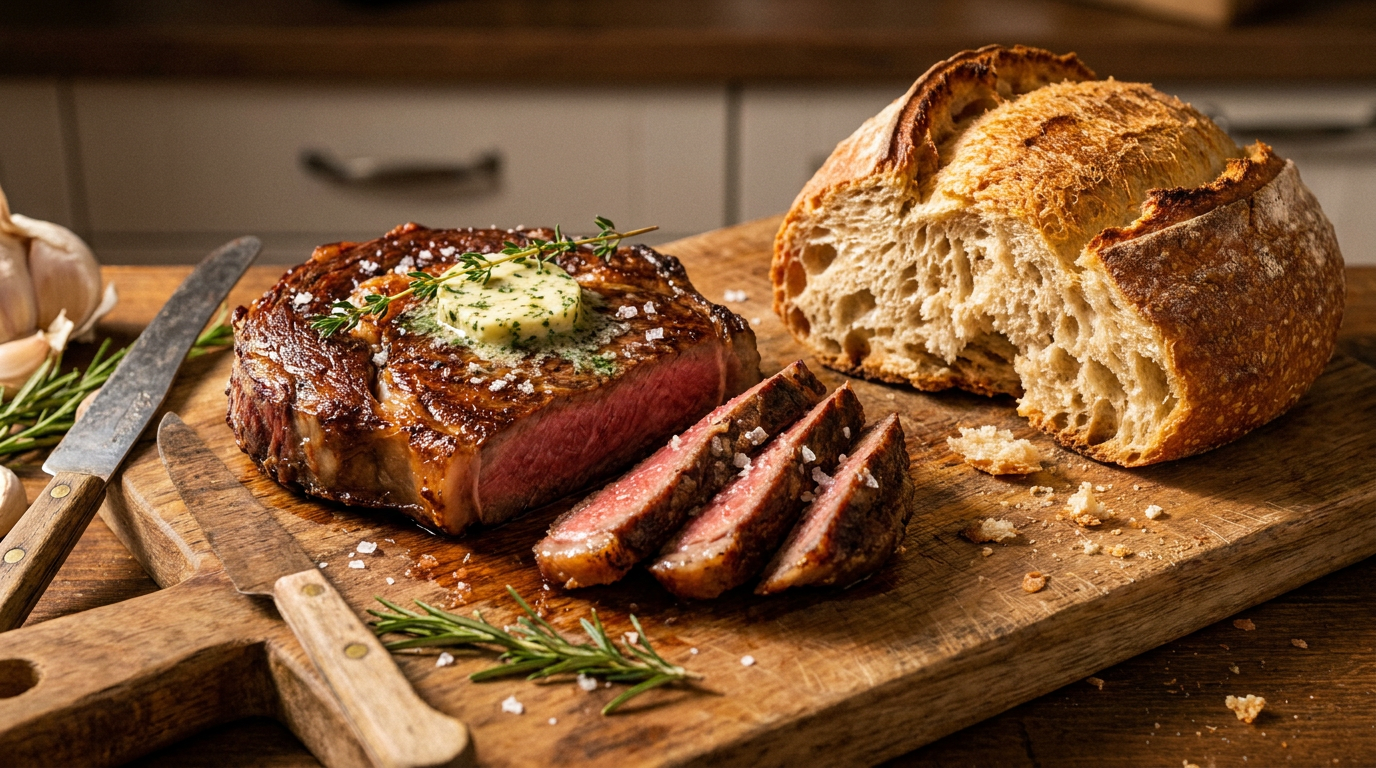
Every time a slice of pale dough transforms into a crusty, golden loaf of bread, or a raw cut of beef develops a rich, savory crust in a hot pan, a profound chemical transformation is taking place. This phenomenon is not merely a change in color; it is the sudden creation of hundreds of new aromatic compounds that define what humans perceive as delicious. The process responsible for this culinary alchemy is known as the Maillard reaction.[1][3]
First described in 1912 by French chemist Louis Camille Maillard, the reaction was initially observed while he was attempting to reproduce biological protein synthesis. Today, it is recognized as one of the most important flavor-producing mechanisms in food science. Often colloquially referred to as the "browning reaction," culinary experts argue that this label is incomplete. The true value of the Maillard reaction lies not in the visual browning, but in the explosive generation of complex flavors and aromas that distinguish roasted, baked, and fried foods from those that are boiled or steamed.[1][3][6][7]
At its core, the Maillard reaction is a form of non-enzymatic browning—meaning it occurs without the aid of enzymes, unlike the process that turns a sliced apple brown. The reaction requires three primary components: amino acids (the building blocks of proteins), reducing sugars (such as glucose or fructose), and heat. When these elements are subjected to high temperatures, the reactive carbonyl group of the sugar interacts with the nucleophilic amino group of the amino acid, kicking off a cascading sequence of chemical rearrangements.[1][2][4][6]

Temperature is the critical gatekeeper for this reaction. While the Maillard process can technically occur at lower temperatures over extended periods—such as the slow browning of aging champagne or the preservation of bog bodies in archaeology—in the kitchen, it requires significant heat to proceed rapidly. The reaction typically accelerates and becomes noticeable at temperatures between 140°C and 165°C (280°F to 330°F). Below this threshold, the reaction is too sluggish to produce meaningful flavor; above it, the food risks crossing into pyrolysis, or burning, which yields acrid, bitter flavors.[1][6]
Because the ideal temperature for the Maillard reaction is well above the boiling point of water (100°C or 212°F), moisture is the fundamental enemy of browning. Water acts as a thermal clamp; as long as liquid water is present on the surface of the food, the temperature cannot exceed 100°C, as the heat energy is entirely consumed by the process of evaporation. This is why boiling, poaching, or steaming will never produce a brown crust or the associated roasted flavors.[3][5][7]
For home cooks, managing surface moisture is the single most effective way to encourage the Maillard reaction. Culinary professionals routinely advise patting meats dry with a paper towel before searing, or leaving them uncovered in a refrigerator to dehydrate the exterior. Furthermore, overcrowding a pan traps the steam released by the cooking food, inadvertently boiling the ingredients in their own juices and preventing the temperature from reaching the crucial 140°C threshold.[5][7]

Once the surface is dry and the temperature climbs, the chemical cascade begins. The initial reaction between the sugar and the amino acid produces an unstable intermediate compound called a glycosylamine. This molecule rapidly undergoes a structural shift known as the Amadori rearrangement, transforming into a ketosamine. From this point, the reaction branches out into a dizzying array of pathways, degrading and fragmenting into hundreds of distinct, highly reactive molecules.[2][4]
Once the surface is dry and the temperature climbs, the chemical cascade begins.
These newly formed molecules are the volatile flavor compounds that waft through the kitchen. Depending on the specific amino acids and sugars present in the raw ingredient, the reaction produces different chemical families. Pyrazines contribute toasted, roasted, and nutty notes; furans deliver meaty and caramel-like aromas; and furanones provide sweet, fruity scents. This is why the Maillard reaction makes baking bread smell entirely different from roasting coffee or searing a steak, even though the underlying chemical mechanism is identical.[3][4][7]
As the reaction progresses into its final stages, the smaller flavor molecules begin to polymerize, linking together to form large, complex structures called melanoidins. These melanoidins are the brown pigments that give a seared steak its dark crust, a pretzel its mahogany sheen, and a dark beer its deep color. While they are responsible for the visual appeal of cooked food, they also contribute to the texture and mouthfeel of the crust.[1][4][5][7]

It is a common misconception that the Maillard reaction and caramelization are the same process. While both require high heat and result in browning, caramelization is strictly the pyrolysis of sugars in the absence of amino acids. Caramelization typically requires even higher temperatures than the Maillard reaction and produces a different profile of sweet, nutty, and buttery flavors. However, in many foods—like roasted vegetables or baked goods—both reactions occur simultaneously, layering their distinct flavor profiles together.[1][6][7]
The chemical environment also dictates the speed and intensity of the Maillard reaction. The process is highly sensitive to pH levels; it accelerates significantly in alkaline (basic) conditions. In an alkaline environment, the amino groups are deprotonated, making them more reactive. Bakers exploit this quirk of chemistry by dipping pretzel dough in a lye solution or boiling bagels in water with baking soda before baking, which rapidly accelerates browning and produces a distinctively dark, glossy crust.[1][2][7]
The food industry relies heavily on the Maillard reaction to engineer flavors. Flavorists use controlled Maillard reactions in laboratories to synthesize artificial meat, roasted, and savory flavors for processed foods. The production of yeast extract, a common additive used to boost umami in soups and snacks, leverages the reaction between the yeast's natural amino acids and sugars during heating to create a deep, savory profile.[1][2][7]

However, the Maillard reaction is not without its drawbacks. When starchy foods, such as potatoes or bread, are subjected to very high temperatures for extended periods, the reaction can produce a compound called acrylamide. Acrylamide is classified as a probable human carcinogen, prompting public health researchers to study ways to mitigate its formation. Strategies include cooking at slightly lower temperatures, avoiding over-browning, and soaking potatoes in water before frying to remove excess surface sugars.[1][4][6]
In agricultural and industrial contexts, the Maillard reaction can also degrade the nutritional quality of food. Because the reaction consumes amino acids—particularly lysine—excessive heat during the processing of animal feed or the pasteurization of dairy can reduce the bioavailability of essential proteins. Food scientists must constantly balance the desire for optimal flavor and color development against the preservation of nutritional integrity.[1][2][7]
Ultimately, the Maillard reaction represents the intersection of chemistry and culinary art. By understanding the variables that govern this process—temperature, moisture, pH, and time—cooks can move beyond blindly following recipes to actively manipulating the chemical reactions in their pans. Mastering the Maillard reaction is the key to unlocking the deep, complex flavors that transform raw ingredients into extraordinary meals.[3][5][6][7]
How we got here
1912
French chemist Louis Camille Maillard first describes the reaction between amino acids and sugars.
1953
Chemist John E. Hodge publishes the definitive mechanism detailing the steps of the Maillard reaction.
2002
Researchers discover that acrylamide, a probable carcinogen, is a byproduct of the Maillard reaction in certain foods.
Viewpoints in depth
Food Scientists
Focuses on the precise chemical pathways, intermediate compounds, and molecular structures.
For food chemists, the Maillard reaction is a complex network of molecular degradation and polymerization. They study the Amadori rearrangement and the specific pathways that lead to hundreds of volatile compounds, using this knowledge to synthesize artificial flavors and optimize industrial food processing.
Culinary Professionals
Focuses on the practical application of heat and moisture control to maximize flavor.
Chefs and culinary educators view the Maillard reaction as a foundational technique. Their primary concern is manipulating the cooking environment—managing surface moisture, preheating cast-iron pans, and avoiding overcrowding—to reliably trigger the reaction and build complex flavor profiles in everyday dishes.
Public Health Researchers
Focuses on the toxicological byproducts of high-heat cooking.
Health researchers monitor the Maillard reaction for its role in producing acrylamide, a probable carcinogen formed when starchy foods are cooked at high temperatures. Their focus is on developing mitigation strategies, such as lowering cooking temperatures or altering food preparation methods, to reduce exposure without entirely sacrificing flavor.
What we don't know
- Because the reaction produces hundreds of rapidly changing compounds, scientists have yet to map every single chemical pathway involved.
- The exact long-term health impacts of dietary acrylamide exposure from browned foods remain a subject of ongoing epidemiological study.
Key terms
- Maillard reaction
- A chemical reaction between amino acids and reducing sugars that gives browned food its distinctive flavor.
- Melanoidins
- Large, brown polymer molecules formed at the end of the Maillard reaction that give cooked food its dark color.
- Caramelization
- The browning of simple sugars subjected to high heat, occurring without the presence of amino acids.
- Pyrolysis
- The chemical breakdown of organic materials at very high temperatures, commonly known in cooking as burning.
- Amadori rearrangement
- A crucial intermediate step in the Maillard reaction where a glycosylamine molecule structurally shifts into a ketosamine.
Frequently asked
Why doesn't boiled food turn brown?
Boiling water caps the cooking temperature at 100°C (212°F). The Maillard reaction requires temperatures around 140°C (280°F) to occur rapidly.
Is the Maillard reaction the same as caramelization?
No. Caramelization involves only sugars breaking down under high heat, while the Maillard reaction requires both sugars and amino acids (proteins).
How can I get a better sear on my steak?
Pat the meat completely dry with a paper towel before cooking, ensure your pan is preheated, and avoid overcrowding the pan so moisture can escape.
Why do pretzels have such a dark brown crust?
Pretzel dough is dipped in an alkaline lye solution before baking. The high pH accelerates the Maillard reaction, resulting in a deep, glossy brown crust.
Sources
Source coverage
7 outlets
3 viewpoints surfaced







[1]WikipediaFood Scientists
Maillard reaction
Read on Wikipedia →[2]National Center for Biotechnology InformationFood Scientists
Maillard Reaction: Mechanism, Influencing Parameters, Advantages, Disadvantages, and Food Industrial Applications: A Review
Read on National Center for Biotechnology Information →[3]Modernist CuisineCulinary Professionals
The Maillard Reaction
Read on Modernist Cuisine →[4]BBC Science FocusPublic Health Researchers
What is the Maillard reaction?
Read on BBC Science Focus →[5]BBC Good FoodCulinary Professionals
The science of browning
Read on BBC Good Food →[6]MasterClassCulinary Professionals
Maillard Reaction Explained: What Is the Maillard Reaction?
Read on MasterClass →[7]Factlen Editorial TeamCulinary Professionals
Synthesis by Factlen editorial team
Read on Factlen Editorial Team →
Every angle. Every day.
Get food drink stories with full source coverage and perspective breakdowns delivered to your inbox.