
The Science of the Maillard Reaction: How Heat Transforms Food
The Maillard reaction is the chemical process responsible for the complex flavors and golden-brown crusts of seared meats, roasted coffee, and baked bread. Understanding how to control heat and moisture allows home cooks to unlock deeper, more savory flavors in their everyday meals.
By Factlen Editorial Team
- Food Scientists
- Focuses on the molecular breakdown and chemical pathways of the reaction.
- Culinary Educators
- Focuses on practical techniques to manipulate the reaction in the kitchen.
- Home Cooks
- Focuses on the sensory results and everyday application of browning.
What's not represented
- · Raw Food Diet Advocates
Why this matters
Mastering the Maillard reaction is the single most effective way to elevate home cooking. By understanding the science of browning, cooks can stop relying on guesswork and consistently produce restaurant-quality flavors, textures, and aromas.
Key points
- The Maillard reaction is a chemical process between amino acids and reducing sugars that creates savory flavors and brown colors.
- The reaction requires high heat, typically beginning to occur rapidly at temperatures above 285°F (140°C).
- Moisture prevents the Maillard reaction because water boils at 212°F, keeping the food's surface temperature too low to brown.
- Caramelization is a separate chemical process that involves only the breakdown of sugars, without the presence of proteins.
- Cooks can accelerate the Maillard reaction by patting food dry, pre-salting meat, or slightly raising the food's pH with baking soda.
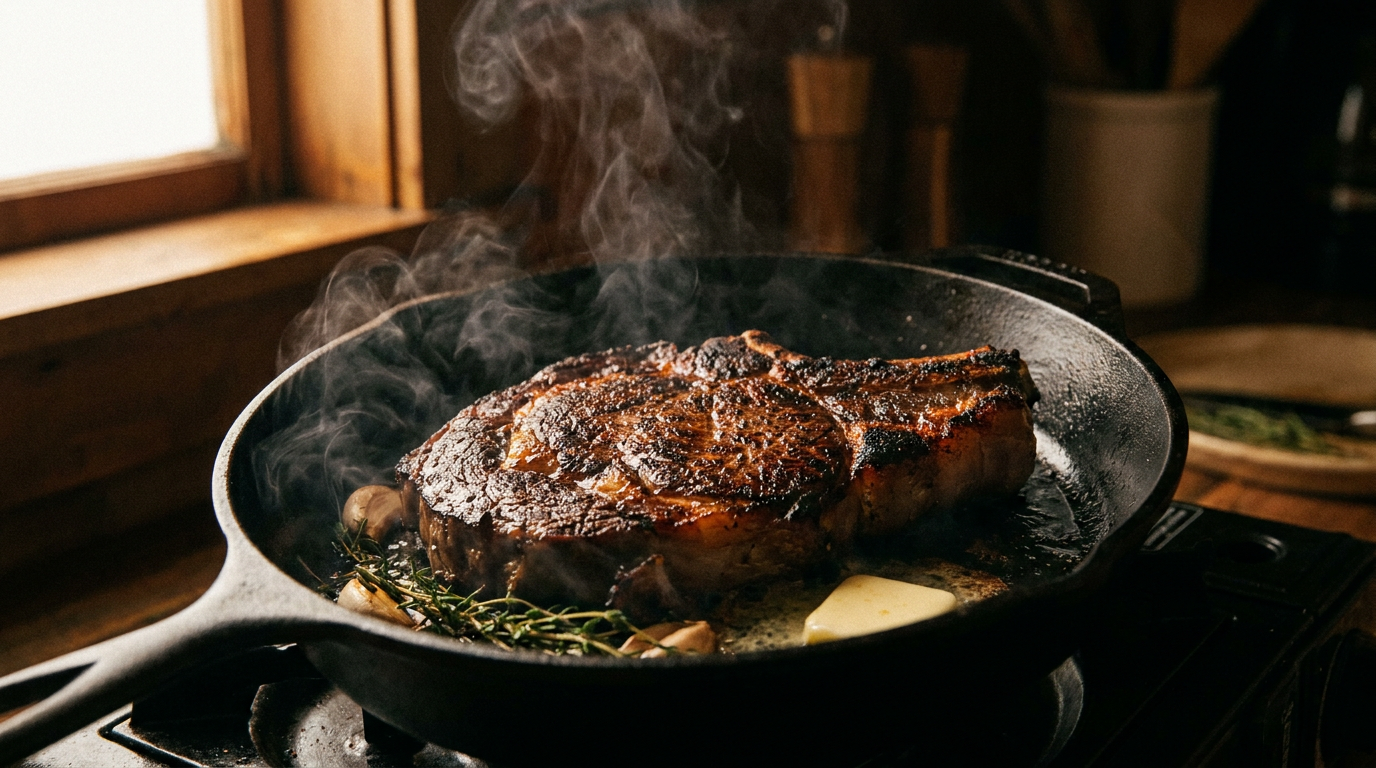
You know the moment cooking transforms from a chore into a sensory experience. It is the smell of bread toasting in the morning, the sizzle of a steak hitting a hot cast-iron skillet, or the rich aroma of coffee brewing. These seemingly disparate foods all share a common chemical transformation that elevates them from raw ingredients into deeply savory, complex meals.[4][7]
That transformation is called the Maillard reaction. Dubbed the "flavor reaction" by culinary scientists, it is arguably the most important chemical process in everyday cooking. Without it, our food would be pale, bland, and entirely lacking the roasted, nutty, and meaty flavors we crave.[1][6]
The reaction is named after Louis-Camille Maillard, a French chemist who first described the phenomenon in 1912. Maillard was not actually trying to revolutionize the culinary world; he was studying biological protein synthesis and trying to understand how amino acids behaved in living organisms. But his observations perfectly explained the magic that happens when food meets high heat.[3][4][7]
At its core, the Maillard reaction is a cascade of chemical changes that occur when amino acids—the building blocks of proteins—and reducing sugars are subjected to heat. When the temperature rises, the carbonyl group of the sugar reacts with the amino group of the protein, forming an unstable intermediate compound.[1][6]

This is where the magic begins. That initial reaction sets off a cascading waterfall of subsequent chemical changes. The molecules break down and recombine in increasingly complex ways, generating hundreds of brand new flavor and aroma compounds.[1][3]
These new compounds include pyrazines, which provide roasted and toasted notes; furans, which offer sweet, caramel-like aromas; and thiophenes, which deliver rich, meaty flavors. Because different foods contain different ratios of specific amino acids and sugars, the exact cocktail of flavor compounds varies wildly. This is why roasted coffee smells entirely different from a seared steak, even though both rely on the exact same chemical reaction.[1][4][7]
As the reaction reaches its final stages, the smaller molecules link together to form large, complex structures called melanoidins. These melanoidins are responsible for the visual hallmark of the Maillard reaction: the deep, golden-brown crust on a loaf of bread, the dark sear on a burger, and the rich color of roasted vegetables.[5][6]
But this chemical symphony does not happen by accident. It requires a very specific set of environmental conditions, the most important of which is temperature. The Maillard reaction only begins to occur rapidly at temperatures between 285°F and 330°F (140°C to 165°C).[2][4]
It requires a very specific set of environmental conditions, the most important of which is temperature.
This temperature threshold explains why moisture is the ultimate enemy of browning. Water boils and turns to steam at 212°F (100°C). As long as there is liquid water on the surface of your food, its temperature cannot rise above that boiling point.[1][5]

If you drop a wet piece of meat into a hot pan, the heat energy is entirely consumed by evaporating the water. The meat will essentially steam in its own juices, turning gray and rubbery rather than developing a savory brown crust.[2][3]
This is why culinary educators relentlessly advise home cooks to thoroughly pat their meat dry with paper towels before searing. For even better results, chefs use a technique called "dry brining," where meat is salted and left uncovered in the refrigerator overnight. The salt seasons the meat, while the circulating air dehydrates the surface, creating the perfect canvas for a rapid, intense Maillard reaction.[3][5][7]
It is also important not to overcrowd the pan. When too much food is packed into a skillet, the collective moisture released by the ingredients gets trapped, dropping the temperature of the pan and halting the browning process in its tracks.[5][7]
A common point of confusion in the kitchen is the difference between the Maillard reaction and caramelization. While both processes result in browning and complex flavors, they are chemically distinct. Caramelization involves the breakdown of sugars alone, without the presence of proteins.[1][3][6]

Caramelization also requires higher temperatures to begin—typically around 320°F (160°C) for common table sugar. While the two reactions frequently occur side-by-side in foods that contain both proteins and high amounts of sugar, such as roasted carrots or caramelized onions, the Maillard reaction is the true engine of savory depth.[3][7]
For cooks looking to hack the science of browning, manipulating the pH level of the food offers a powerful shortcut. The Maillard reaction proceeds much faster in an alkaline (basic) environment.[2][7]
Test kitchen experts have found that adding a tiny pinch of baking soda—an alkaline powder—to onions can cut their caramelization and browning time in half. Similarly, a fraction of a teaspoon of baking soda mixed into ground beef or rubbed onto a roast can dramatically accelerate the development of a dark, flavorful crust.[2][7]

However, cooks must tread carefully. If the temperature is pushed too high—generally above 355°F (180°C)—the Maillard reaction gives way to pyrolysis. Pyrolysis is the chemical term for burning, which destroys the delicate flavor compounds and leaves behind bitter, acrid, and blackened carbon.[1][4]
Understanding the Maillard reaction elevates cooking from blind instruction-following to true culinary mastery. It explains why we crave the crispy edges of a fried egg, the crust of a smashed burger, and the golden shell of a roasted potato. By controlling heat, eliminating moisture, and giving the chemistry time to work, any home cook can unlock the deepest, most satisfying flavors their ingredients have to offer.[2][3][7]
Viewpoints in depth
Food Scientists' view
Focuses on the molecular breakdown and chemical pathways of the reaction.
Chemists view the Maillard reaction as a highly complex, non-enzymatic browning process. They study the specific pathways where amino acids and reducing sugars form Amadori compounds, which then degrade into hundreds of volatile flavor molecules like pyrazines and furans. For food scientists, the exact ratio of these compounds dictates the specific aromatic profile of the food, explaining why roasted coffee and seared meat taste entirely different despite undergoing the same fundamental reaction.
Culinary Educators' view
Focuses on practical techniques to manipulate the reaction in the kitchen.
Test kitchen experts and culinary educators translate the complex chemistry into actionable kitchen rules. Their primary focus is on moisture control and temperature management. They advocate for techniques like dry-brining meat, pre-heating cast-iron skillets, and occasionally using alkaline ingredients like baking soda to artificially raise the pH of food, thereby accelerating the browning process and maximizing flavor development without overcooking the interior.
Home Cooks' view
Focuses on the sensory results and everyday application of browning.
For the everyday cook, the Maillard reaction is less about molecular structures and more about the sensory cues of a successful meal. Home recipe developers emphasize the visual indicator of a golden-brown crust and the rich, savory aromas that signal food is ready to eat. They rely on the reaction to build foundational flavors in stews, pan sauces, and roasted vegetables, turning basic ingredients into deeply satisfying comfort food.
What we don't know
- Because the Maillard reaction produces tens of thousands of unique chemical compounds depending on the specific food, scientists have still only mapped a fraction of the exact flavor molecules generated.
- The precise health impacts of all Maillard byproducts are still being studied, as the reaction produces both beneficial antioxidants and potentially harmful compounds like acrylamide at very high temperatures.
Key terms
- Amino Acids
- The building blocks of proteins, which are essential for the Maillard reaction to take place.
- Reducing Sugars
- Simple sugars, like glucose and fructose, that react with amino acids under high heat.
- Melanoidins
- Large, complex polymer molecules created at the end of the Maillard reaction that give browned food its dark color.
- Pyrolysis
- The chemical breakdown of food caused by excessively high temperatures, resulting in a burnt, bitter taste.
- Caramelization
- A distinct browning process that involves only the breakdown of sugars, without the presence of proteins.
Frequently asked
Can the Maillard reaction happen when boiling food?
No. Water boils at 212°F, which is too low to trigger the Maillard reaction. The reaction requires temperatures around 285°F to occur rapidly.
Is the Maillard reaction the same as caramelization?
No. Caramelization only involves sugars breaking down under heat, while the Maillard reaction requires both sugars and amino acids (proteins).
Why do recipes say to pat meat dry before searing?
Surface moisture turns to steam, keeping the temperature of the food at 212°F and preventing the meat from reaching the high heat needed for browning.
Does adding baking soda help food brown?
Yes. Baking soda raises the pH level of the food, creating an alkaline environment that significantly accelerates the Maillard reaction.
Sources
Source coverage
7 outlets
3 viewpoints surfaced







[1]Modernist CuisineFood Scientists
The Maillard Reaction: The Science of Flavor
Read on Modernist Cuisine →[2]America's Test KitchenCulinary Educators
Searing with Authority–Becoming a Maillard Master
Read on America's Test Kitchen →[3]Serious EatsCulinary Educators
The Food Lab: The Science of the Maillard Reaction
Read on Serious Eats →[4]MasterClassHome Cooks
What Is the Maillard Reaction? 5 Phases of the Maillard Reaction
Read on MasterClass →[5]BBC Good FoodHome Cooks
The Science of Browning Meat
Read on BBC Good Food →[6]HowStuffWorksFood Scientists
The Maillard Reaction and the Science of Browning Foods
Read on HowStuffWorks →[7]Factlen Editorial TeamCulinary Educators
Synthesis by Factlen editorial team
Read on Factlen Editorial Team →
Every angle. Every day.
Get food drink stories with full source coverage and perspective breakdowns delivered to your inbox.