
The Science of the Maillard Reaction: How Heat Transforms Food
Discovered in 1912, the Maillard reaction is the complex chemical process between amino acids and sugars that gives browned food its distinctive flavor. Understanding how to manipulate heat, moisture, and pH can help home cooks achieve restaurant-quality results.

In short
- The Maillard reaction is a chemical process between amino acids and sugars that creates browned food's distinct flavor.
- The reaction typically requires temperatures above 285°F (140°C) to proceed rapidly.
- Surface moisture blocks browning because water cannot exceed 212°F (100°C) before evaporating.
The smell of coffee roasting, bread baking, or a steak searing in a hot pan triggers an almost primal hunger. While these foods seem entirely unrelated, their mouthwatering aromas are all the result of a single, extraordinary chemical process: the Maillard reaction. Often referred to simply as "browning," this reaction is the cornerstone of flavor development in the culinary world.[4]
Named after French chemist Louis-Camille Maillard, who first described the phenomenon in 1912 while attempting to reproduce biological protein synthesis, the reaction is a form of non-enzymatic browning. It occurs when amino acids—the building blocks of proteins—react with reducing sugars in the presence of heat. The result is a complex mixture of poorly characterized molecules responsible for a vast range of aromas and flavors.[3]
What begins as a simple chemical handshake quickly cascades into a deeply complex waterfall of reactions. The initial byproducts continue to react with each other in increasingly intricate ways, generating hundreds of new molecules. These compounds, known as melanoidins, give browned food its distinctive color, while volatile compounds like pyrazines deliver roasted, nutty, and savory notes.[1][2]
According to food science pioneer Harold McGee, this chemical transformation serves an evolutionary purpose. Raw proteins and complex carbohydrates are often too large for our sensory receptors to detect. The heat of cooking breaks these macromolecules into smaller, volatile, aromatic pieces that our noses and taste buds can perceive, signaling to our bodies that the food is now digestible and nutrient-dense.
However, the Maillard reaction does not happen spontaneously at room temperature; it requires a significant energy threshold. Culinary scientists note that while the reaction can occur very slowly at lower temperatures, it typically proceeds rapidly only when surface temperatures reach between 280°F and 330°F (140°C to 165°C).[2][3]
This temperature requirement introduces the greatest enemy of the Maillard reaction: water. Because water boils and turns to steam at 212°F (100°C), any moisture on the surface of food acts as a thermal ceiling. As long as water is evaporating, the surface temperature of the food cannot exceed the boiling point, making rapid browning impossible.[1][2]
This is the scientific reason why boiled, poached, or steamed foods look pale and taste fundamentally different from their roasted or grilled counterparts. It is also why recipe developers universally insist on patting meat completely dry with paper towels before searing it in a pan. If a steak is wet, the heat of the pan is wasted on evaporating the surface moisture, resulting in steamed, gray meat rather than a deeply flavored crust.[1][4]
While the Maillard reaction is often conflated with caramelization, the two are distinct chemical processes. Caramelization is the pyrolysis, or thermal decomposition, of sugar. It requires higher temperatures (often above 330°F) and does not involve proteins. However, the two reactions frequently occur side-by-side in the kitchen, such as when baking a batch of chocolate chip cookies or roasting carrots.[1][3]
Understanding the chemistry of the Maillard reaction allows cooks to manipulate it. One of the most effective variables to control is pH. The reaction accelerates significantly in an alkaline (basic) environment because the amino groups are deprotonated, increasing their reactivity.[3][4]
The test cooks at America's Test Kitchen have harnessed this principle to speed up everyday cooking. By adding a quarter-teaspoon of baking soda (an alkaline powder) to a batch of sliced onions, cooks can achieve deeply browned, caramelized-style onions in a fraction of the traditional time. The same trick can be applied to ground beef for chili or stews, yielding a richer, more savory flavor profile.
Another counterintuitive technique born from understanding the Maillard reaction is the "cold sear" method for steaks. Rather than preheating a skillet until it smokes, some culinary experts recommend placing a well-marbled steak into a cold nonstick pan and slowly bringing up the heat. This allows the fat to render out gradually, essentially frying the steak in its own beef tallow and creating a spectacular crust without the risk of burning the exterior before the interior cooks.[4]
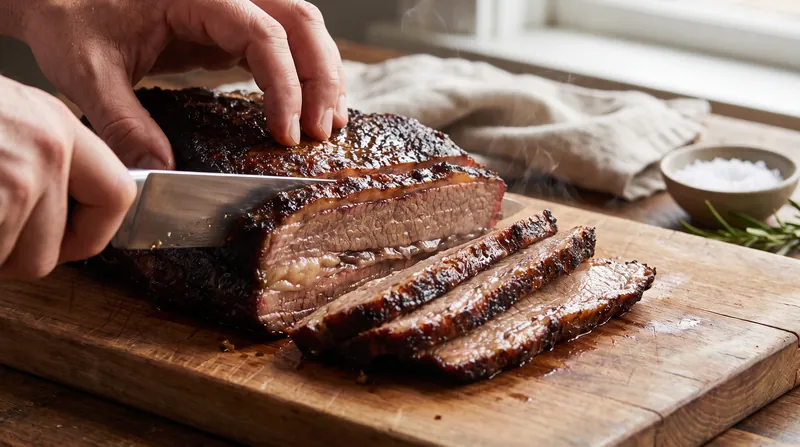
Time is also a crucial factor, particularly in barbecue. While high-heat grilling triggers the Maillard reaction in minutes, low-and-slow smoking at 225°F can still produce a dark, deeply flavored "bark" on a brisket. Over the course of several hours, the surface of the meat dries out completely, allowing the slow accumulation of Maillard compounds to build a robust, savory exterior.[4]
While the Maillard reaction is overwhelmingly positive for flavor, food scientists do monitor its extremes. At very high temperatures, particularly when foods are charred or burnt, the reaction can produce acrylamide, a compound that health organizations classify as a probable carcinogen. This is most common in starchy foods like potatoes and bread when cooked to a dark brown or black color.[3]
While the Maillard reaction is overwhelmingly positive for flavor, food scientists do monitor its extremes.
To mitigate this, experts recommend aiming for a golden-brown color rather than a dark char, and avoiding the routine consumption of heavily blackened foods. However, the moderate browning that defines a good sear or a perfectly baked loaf of bread is widely considered safe and is a hallmark of good cooking.[3][4]
Ultimately, the kitchen is a laboratory, and cooking is applied chemistry. By understanding the mechanics of the Maillard reaction—managing surface moisture, controlling temperature, and occasionally tweaking the pH—home cooks can unlock the hidden potential in their ingredients, transforming raw proteins and sugars into culinary masterpieces.[4]
Jargon, explained
- Maillard Reaction
- A chemical reaction between amino acids and reducing sugars that gives browned food its distinctive flavor.
- Caramelization
- The browning of sugar caused by heat, distinct from the Maillard reaction because it does not involve proteins.
- Amino Acids
- Organic compounds that combine to form proteins, serving as one of the two key ingredients in the Maillard reaction.
- Melanoidins
- The complex, brown-colored polymer compounds formed at the end of the Maillard reaction.
- Acrylamide
- A chemical that can form in some foods during high-temperature cooking processes, currently studied for potential health risks.
Common questions
Why doesn't boiled meat turn brown?
Boiling water cannot exceed 212°F (100°C). The Maillard reaction requires temperatures around 285°F (140°C) to occur rapidly, meaning boiled food never gets hot enough to brown.
Is the Maillard reaction the same as caramelization?
No. Caramelization involves only sugars breaking down under high heat. The Maillard reaction requires both sugars and amino acids (proteins).
How can I get a better crust on my steak?
Pat the steak completely dry with paper towels before cooking. Any surface moisture will turn to steam, keeping the temperature too low for a crust to form.
Does the Maillard reaction happen in vegetables?
Yes. Vegetables contain both proteins and natural sugars. Roasting vegetables like carrots or broccoli triggers the Maillard reaction, creating deep, savory flavors.
Competing readings
Culinary Scientists
Focus on the molecular breakdown and precise temperature control required for flavor development.
For food chemists and researchers, the Maillard reaction is a marvel of molecular transformation. They emphasize that cooking is not just about making food hot, but about breaking down large, flavorless macromolecules into volatile compounds that our olfactory systems can detect. This camp advocates for precision in the kitchen—using thermometers to ensure surfaces reach the critical 285°F threshold and understanding the distinct chemical differences between Maillard browning and sugar caramelization.
Practical Recipe Developers
Focus on actionable techniques home cooks can use to manipulate the reaction.
Test kitchen chefs and recipe developers translate the complex chemistry into practical kitchen rules. Their primary focus is moisture management: aggressively patting meats dry, salting in advance to draw out and evaporate surface water, and avoiding overcrowding the pan to prevent steaming. They also pioneer "kitchen hacks" based on the science, such as using baking soda to create an alkaline environment that speeds up the browning of onions or ground beef.
Health & Nutrition Experts
Focus on the digestibility benefits of cooking, balanced against the risks of over-charring.
Nutritionists view the Maillard reaction through the lens of human digestion and safety. On one hand, the reaction signals that food has been cooked, making its nutrients more bioavailable and easier to digest. On the other hand, they caution against taking the reaction too far. When starchy foods are subjected to extreme heat and turn dark brown or black, they can form acrylamide, a probable carcinogen. This camp advises aiming for a golden-brown finish rather than a heavy char.
- Culinary Scientists
- Focus on the molecular breakdown and precise temperature control required for flavor development.
- Practical Recipe Developers
- Focus on actionable techniques home cooks can use to manipulate the reaction.
- Food Historians & Chemists
- Focus on the discovery, classification, and chemical byproducts of the reaction.
Perspectives this story doesn't cover
- Commercial flavor manufacturers who synthesize Maillard compounds for processed foods
Sources
Source coverage
4 outlets
3 viewpoints surfaced




- [1]Serious EatsPractical Recipe Developers
What Is the Maillard Reaction? The Science of Browning
Read on Serious Eats → - [2]Modernist CuisineCulinary Scientists
The Maillard Reaction
Read on Modernist Cuisine → - [3]WikipediaFood Historians & Chemists
Maillard reaction
Read on Wikipedia → - [4]Factlen Editorial TeamFood Historians & Chemists
Synthesis by Factlen editorial team
Read on Factlen Editorial Team →
More in Lifestyle
See all →Food Science
The 3-Millimeter Myth: Why Your 24-Hour Marinade Isn't Penetrating the Meat
2 sources

Nutrition Policy
The UPF Reckoning: How the Federal Government's New Definition of Ultra-Processed Food Will Reshape the Grocery Aisle
3 sources
Culinary Science
The Science of Dry Brining: How Osmosis and Protein Denaturation Transform Home Cooking
4 sources
Molecular Gastronomy
The Science of Flavor Pairing: How Shared Chemical Compounds Are Rewriting the Rules of Cooking
5 sources
Comments
Every angle. Every day.
Get Lifestyle stories with full source coverage and perspective breakdowns, free every day.