
The Science of Tangzhong and Yudane: How Water Roux Transforms Bread
By pre-cooking a small portion of flour and water, bakers can harness starch gelatinization to create ultra-soft, long-lasting bread without relying on heavy fats or preservatives.
By Factlen Editorial Team
- Food Scientists
- Focuses on the molecular mechanics of starch gelatinization and retrogradation.
- Home Bakers
- Values the technique for its accessibility and dramatic improvement of homemade bread.
- Commercial Bakeries
- Prioritizes the method for scaling production, extending shelf life, and reducing ingredient costs.
What's not represented
- · Gluten-Free Bakers
- · Traditional European Bakers
Why this matters
Understanding the science of a water roux empowers home bakers to achieve professional-quality, long-lasting softness in their breads without relying on chemical dough conditioners or excessive amounts of butter and eggs.
Key points
- Tangzhong and yudane are Asian baking techniques that pre-cook a portion of flour and liquid to create a water roux.
- Heating the flour to 65°C causes starch gelatinization, allowing the dough to hold up to four times more water.
- The trapped moisture creates a remarkably soft, feathery crumb and delays the staling process by several days.
- Tangzhong uses a 1:5 ratio cooked on a stove, while yudane uses a 1:1 ratio mixed with boiling water.
- The technique makes highly hydrated doughs easier to knead and shape without excessive stickiness.
- It is ideal for sandwich breads and rolls, but should be avoided for crusty artisan loaves like sourdough.
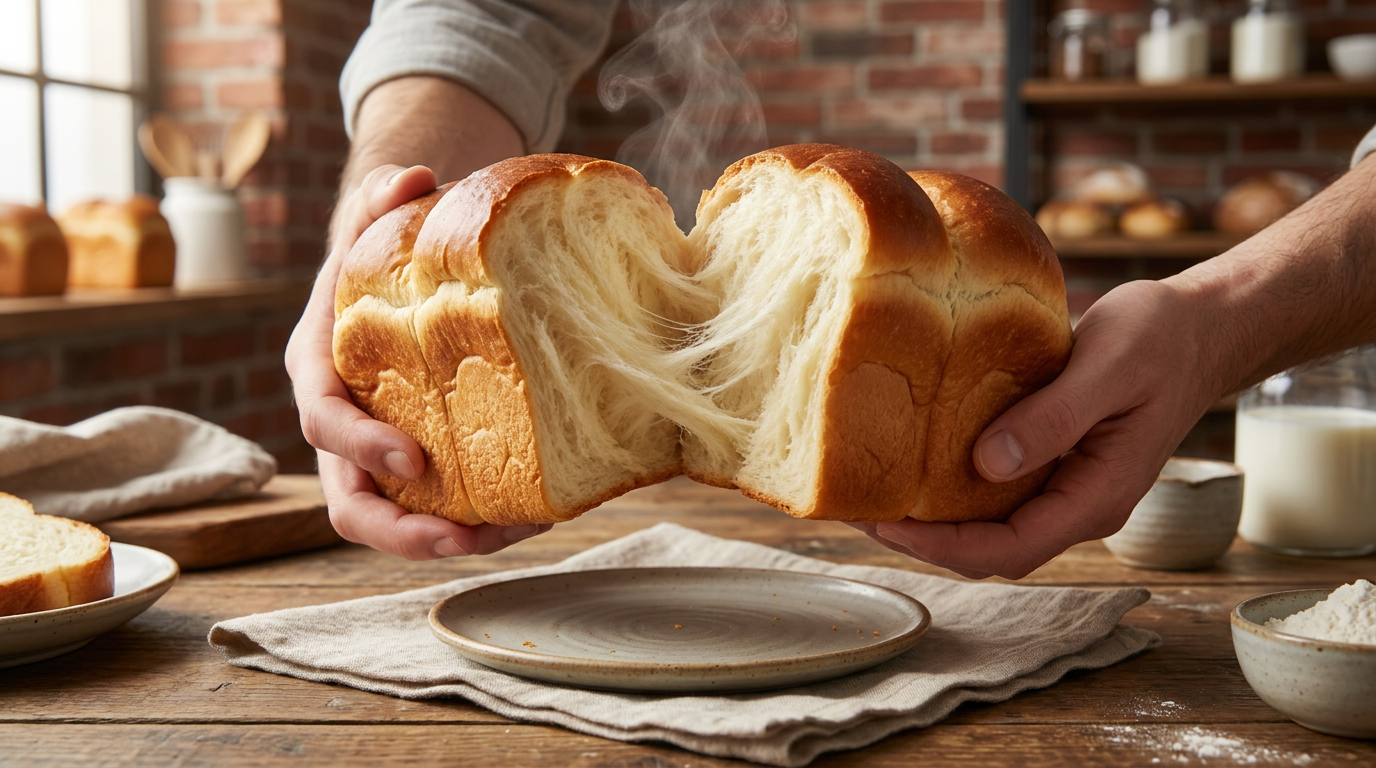
The holy grail of home baking is a loaf of bread that emerges from the oven impossibly soft and remains that way for days. For generations, Western bakers relied on heavy enrichments—copious amounts of butter, eggs, and sugar—or commercial dough conditioners to achieve a tender crumb and delay the inevitable onset of staling. But an alternative approach, rooted in Asian baking traditions, achieves cloud-like softness and extended shelf life using nothing more than the flour and water already present in the recipe.[2][4]
The techniques, known as tangzhong and yudane, revolve around a simple pre-cooking step that fundamentally alters the chemistry of the dough. By isolating a small percentage of the recipe's flour and hydrating it with hot liquid to form a "water roux," bakers can force the flour to absorb significantly more moisture than it could at room temperature. The result is a dough that is easier to handle, bakes up taller, and yields a remarkably feathery texture.[1][2]
While the terms are often used interchangeably, they trace back to distinct culinary origins. Yudane originated in Japan, where it was pioneered by commercial milling companies to create the signature bounce and chew of Japanese milk bread, or shokupan. Tangzhong, a Chinese adaptation of the same concept, was later popularized across Asia and the West by Taiwanese cookbook author Yvonne Chen in her seminal book, "65°C Bread Doctor."[2][6]
The underlying mechanism for both methods is a food science phenomenon known as starch gelatinization. Raw wheat flour consists of roughly 70 percent starch granules, which are encased in semi-crystalline structures that naturally resist water absorption. When mixed with cold or lukewarm water, these granules only absorb a fraction of their weight in liquid.[7]

However, when that same flour is heated with water to approximately 65°C (149°F), the kinetic energy disrupts the crystalline structure. The starch granules swell irreversibly, rupture, and release molecules of amylose and amylopectin into the surrounding liquid. This process transforms the watery mixture into a viscous, pudding-like gel that possesses an extraordinary water-binding capacity.[1][7]
The quantitative difference is striking. According to food science research, raw starch can hold about 0.8 grams of water per gram of starch. Once gelatinized, that same starch forms hydrogen bonds that can hold up to 3.2 grams of water—a fourfold increase. This locked-in moisture acts as a microscopic reservoir throughout the dough, ensuring the final loaf remains hydrated from the inside out.[7]
Beyond initial softness, this trapped moisture is the key to delaying retrogradation, the scientific term for bread staling. Staling is not merely the evaporation of water, but the recrystallization of starches as they cool and age over days. Because the amylopectin chains in a water roux remain dispersed within the gel matrix, this recrystallization process is significantly slowed, extending the bread's shelf life from a couple of days to nearly a week at room temperature.[2][7]

Beyond initial softness, this trapped moisture is the key to delaying retrogradation, the scientific term for bread staling.
While the science is identical, the preparation of tangzhong and yudane differ in their ratios and thermal application. The tangzhong method typically utilizes a 1:5 ratio of flour to liquid by weight. The mixture is whisked continuously over medium heat on a stovetop until it thickens into a glossy paste, a process that takes just a few minutes. Once cooled to room temperature, this slurry is seamlessly incorporated into the main dough.[1][5]
Yudane, conversely, relies on a 1:1 ratio of flour to boiling water. Instead of sustained cooking on a stove, the boiling water is poured directly over the raw flour and stirred vigorously. The immediate shock of the heat gelatinizes the starches, creating a dense, dough-like mass. Traditional yudane is often wrapped and left to rest in the refrigerator overnight, allowing endogenous enzymes to further break down the starches into complex sugars, which enhances the bread's natural sweetness and yields a slightly chewier, mochi-like texture.[1][5]
Incorporating a pre-gelatinized roux also solves a common mechanical problem for bakers: handling highly hydrated doughs. Normally, adding excess water to a bread recipe results in a sticky, unmanageable mess that is difficult to knead and shape. But because the water in a tangzhong or yudane is chemically bound to the starch, it does not contribute to the dough's surface stickiness.[3][4]

This structural advantage is particularly useful for intricate baking projects. Test kitchen experts note that doughs enriched with a water roux feel stronger, tighter, and more cohesive. When making braided breads like challah, a tangzhong dough resists tearing and holds its shape beautifully, preventing the strands from stretching awkwardly during the braiding process.[3]
The technique is also a boon for dietary adaptations, particularly vegan baking. Because the water roux provides the tenderness and open crumb structure traditionally supplied by eggs and dairy fats, bakers can achieve a brioche-like texture using only water, flour, yeast, and salt. Furthermore, because the gelatinization process relies entirely on starch rather than gluten, the method can be highly effective in gluten-free baking, where moisture retention and structural binding are notorious challenges.[4][5]
Despite its versatility, the water roux method is not a universal solution for all styles of bread. The technique is explicitly designed to produce a soft, fine crumb and a tender crust. Therefore, it is counterproductive when baking rustic, artisan loaves like sourdough boules, baguettes, or ciabatta, which rely on a lean dough and high-heat baking to develop a thick, crackling crust and a chewy, irregular interior.[3]
For home bakers looking to adapt their existing recipes for sandwich loaves, dinner rolls, or cinnamon buns, the conversion math is straightforward. Baking experts generally recommend taking 5 to 10 percent of the total flour weight called for in the recipe and using it to create the roux, adjusting the liquid accordingly to maintain the dough's overall hydration.[2][5]
Ultimately, the widespread adoption of tangzhong and yudane represents a perfect intersection of traditional culinary wisdom and modern food science. By taking just five extra minutes to manipulate the thermal properties of flour and water, bakers can fundamentally upgrade the architecture of their bread, proving that sometimes the most profound transformations require the simplest ingredients.[2][6][8]
How we got here
Centuries ago
Early forms of water roux are used in various Asian baking traditions to improve dough texture.
2000s
Japanese commercial bakeries popularize the yudane method to mass-produce ultra-soft shokupan (milk bread).
2007
Taiwanese author Yvonne Chen publishes '65°C Bread Doctor,' popularizing the tangzhong method across Asia.
2010s
The technique spreads globally through baking blogs and test kitchens, becoming a staple for Western home bakers.
Viewpoints in depth
Food Scientists
Focuses on the molecular mechanics of starch gelatinization and retrogradation.
For cereal chemists and food scientists, the magic of the water roux is entirely quantifiable. They view tangzhong and yudane as precise thermal interventions that manipulate the crystalline structure of amylose and amylopectin. By measuring moisture retention and tracking the delayed onset of starch recrystallization via differential scanning calorimetry, scientists validate that these methods fundamentally alter the bread's staling kinetics, offering a natural alternative to chemical dough conditioners.
Home Bakers
Values the technique for its accessibility and dramatic improvement of homemade bread.
In the home baking community, the water roux is celebrated as a low-effort, high-reward 'hack' that elevates amateur loaves to professional standards. Home bakers appreciate that tangzhong requires no specialty ingredients or complex equipment—just a stovetop and a few minutes of stirring. The resulting dough is notoriously forgiving, easier to knead by hand, and yields the kind of pillowy dinner rolls and sandwich breads that stay soft on the counter for days.
Commercial Bakeries
Prioritizes the method for scaling production, extending shelf life, and reducing ingredient costs.
For large-scale bakeries, particularly in Asia, the yudane method is often preferred over tangzhong for logistical reasons. Pouring boiling water over massive vats of flour is significantly easier to execute at scale than cooking a slurry. Commercial operators value the technique because the extended shelf life reduces food waste, while the enhanced moisture retention allows them to cut back on expensive fats like butter and eggs without sacrificing the bread's luxurious texture.
What we don't know
- Whether the enzymatic breakdown of starches during yudane's overnight rest provides a measurable nutritional difference compared to tangzhong.
- The exact maximum threshold of water roux a dough can support before the gluten structure becomes too compromised to rise.
Key terms
- Tangzhong
- A Chinese baking technique where a small portion of flour and liquid is cooked into a paste to pre-gelatinize starches.
- Yudane
- A Japanese method of pouring boiling liquid over flour to create a dough-like mass for moisture retention.
- Starch Gelatinization
- The process where starch granules absorb water and swell when heated, forming a viscous gel.
- Retrogradation
- The recrystallization of starches as bread cools and ages, which is the primary cause of staling.
- Water Roux
- A general term for a mixture of flour and liquid heated together to thicken and bind moisture.
Frequently asked
Can I use the tangzhong method for gluten-free baking?
Yes. Because the technique relies on starch gelatinization rather than gluten development, it is highly effective at adding moisture and structure to gluten-free doughs.
Can I use water instead of milk for the roux?
Absolutely. Water works perfectly to gelatinize the starches, making it an excellent technique for creating soft, vegan bread without relying on dairy or eggs.
Should I use a water roux for sourdough or crusty artisan breads?
No. Tangzhong and yudane are designed to create a soft crumb and tender crust, which directly conflicts with the chewy interior and crackling crust desired in rustic artisan loaves.
How long does tangzhong bread stay fresh?
Because the pre-gelatinized starches trap moisture and delay recrystallization, bread made with a water roux can remain soft and fresh at room temperature for up to five to seven days.
Sources
Source coverage
8 outlets
3 viewpoints surfaced







[1]ChainBakerCommercial Bakeries
Tangzhong & Yudane Explained
Read on ChainBaker →[2]King Arthur BakingHome Bakers
What is the tangzhong method?
Read on King Arthur Baking →[3]America's Test KitchenHome Bakers
The Science Behind Tangzhong
Read on America's Test Kitchen →[4]The Perfect LoafHome Bakers
How to Make Tangzhong
Read on The Perfect Loaf →[5]Carter's BakeshopCommercial Bakeries
Yudane vs Tangzhong
Read on Carter's Bakeshop →[6]Institute of Culinary EducationCommercial Bakeries
Tangzhong Method: A Revolutionary Baking Technique
Read on Institute of Culinary Education →[7]Journal of Cereal ScienceFood Scientists
Starch Gelatinization and Retrogradation in Bread Baking
Read on Journal of Cereal Science →[8]Factlen Editorial Team
Synthesis by Factlen editorial team
Read on Factlen Editorial Team →
Every angle. Every day.
Get food drink stories with full source coverage and perspective breakdowns delivered to your inbox.