
The Science of Reformer Pilates: How Spring Resistance Actually Changes Your Muscles
Recent biomechanical studies reveal how the variable resistance of Reformer Pilates triggers deep core activation and eccentric muscle growth differently than traditional weightlifting.
By Factlen Editorial Team
- Biomechanists and Researchers
- Focus on the measurable physiological adaptations driven by variable spring resistance.
- Strength and Conditioning Coaches
- View the Reformer as a potent supplementary tool for functional power and injury prevention.
- Clinical Rehabilitation Specialists
- Prioritize the low-impact, highly modifiable nature of the equipment for recovery and longevity.
What's not represented
- · Traditional weightlifting purists
- · Yoga practitioners comparing mind-body benefits
Why this matters
Understanding the biomechanics of spring resistance allows you to make informed decisions about your fitness routine. Knowing how the Reformer targets deep stabilizing muscles can help you break through strength plateaus, prevent injuries, and improve your daily posture.
Key points
- Reformer Pilates uses variable spring resistance, which gets heavier as it stretches, unlike the constant gravity of free weights.
- The unstable sliding carriage forces deep stabilizing muscles to activate at significantly higher levels than mat-based exercises.
- Controlling the carriage's return trip (the eccentric phase) is highly effective for building lean muscle endurance.
- Lighter springs often make exercises harder by removing stability and forcing the core to balance the carriage.
- While it won't maximize raw muscle bulk like heavy weightlifting, it significantly improves functional strength, balance, and proprioception.
Pilates has shed its outdated reputation as merely a stretching routine for dancers. In recent years, the practice has surged into the mainstream fitness consciousness, with the specialized, spring-loaded machine known as the Reformer taking center stage.[7]
But as its popularity explodes, a fundamental question has emerged among fitness enthusiasts and sports scientists alike: what exactly is the Reformer doing to the human body? The answer lies in the unique biomechanics of the machine, which challenges the muscular system in ways that traditional weightlifting and bodyweight exercises simply cannot replicate.[6][7]
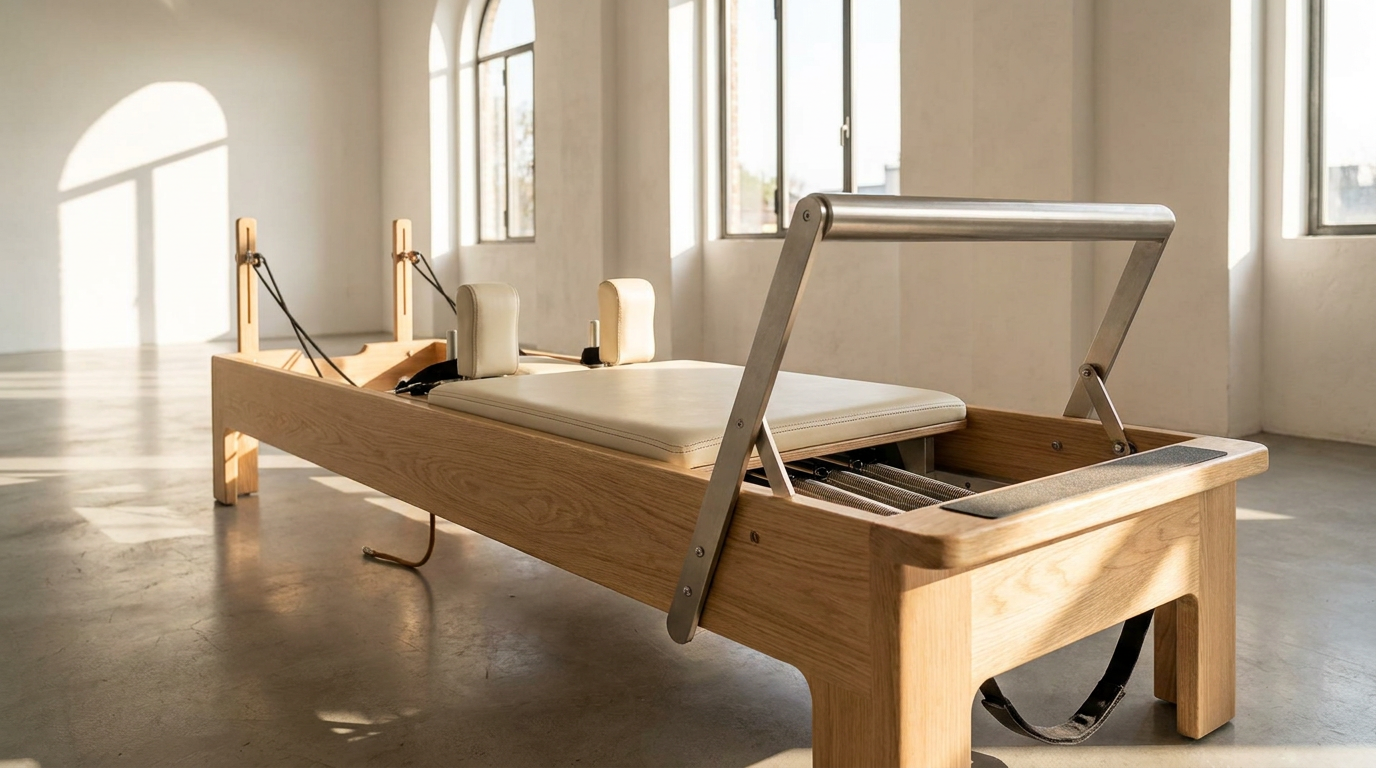
At first glance, a Reformer looks like a medieval torture device, consisting of a sliding carriage, a footbar, ropes, pulleys, and a set of heavy metal springs. It is this spring system that forms the scientific heart of the workout. Unlike a dumbbell or a barbell, which provides a constant downward force dictated by gravity, springs provide what biomechanists call variable resistance.[4][6]
When a person lifts a 20-pound dumbbell, it weighs 20 pounds at the bottom of the movement and 20 pounds at the top. A spring, however, behaves differently. As the carriage is pushed away and the spring stretches, the resistance progressively increases, reaching its peak load at the very end of the movement's range.[6]

This variable tension forces the muscles to adapt continuously throughout the entire range of motion. Furthermore, a standard Reformer equipped with five springs can generate an astonishing amount of force. When fully engaged during pulling movements, those springs can collectively produce over 100 kilograms of resistance, thoroughly debunking the myth that Pilates is a light workout.[3][6]
The true magic of the Reformer, however, happens on the return trip. Every exercise consists of a concentric phase, where the carriage is pushed away, and an eccentric phase, where the practitioner must control the carriage as the springs attempt to snap it back to the starting position.[3]
Traditional weightlifting often neglects the eccentric phase, as gym-goers frequently let gravity drop the weight after lifting it. On a Reformer, the springs demand constant, agonizingly slow control during the return. This eccentric loading is highly effective at recruiting muscle fibers, building pure strength, and creating the long, lean muscle endurance that practitioners often seek.[3]
This mechanical advantage also explains the physiological differences between Reformer Pilates and traditional Mat Pilates. While mat exercises rely solely on body weight and gravity, the Reformer introduces an unstable, moving platform.[1]
Recent electromyography (EMG) studies have quantified this difference. Researchers measuring the electrical activity of muscles found that the unstable carriage of the Reformer forces deep stabilizing muscles to fire at significantly higher rates than they do on a stable floor mat.[2]

Recent electromyography (EMG) studies have quantified this difference.
Specifically, muscles like the transversus abdominis—the deep corset-like muscle that wraps around the spine—and the multifidus are recruited much more aggressively to keep the body balanced as the carriage glides back and forth.[2]
Counterintuitively, researchers have discovered that using lighter springs can actually make an exercise harder on the core. While heavy springs provide stability and target the large, primary moving muscles like the quadriceps or latissimus dorsi, dropping down to a single, light spring removes that structural support.[1]
On a light spring, the carriage becomes highly volatile. The body must suddenly rely entirely on its own internal stabilizers to prevent the platform from sliding out of control. Studies show that this low-resistance instability can push core muscle activation above 60 percent of a person's maximum voluntary contraction, an optimal threshold for developing deep spinal stability.[1]
Despite these intense demands, the question of whether Pilates can replace traditional strength training for muscle hypertrophy—the physical growth of muscle tissue—remains nuanced.[7]

Because Pilates relies on variable spring tension rather than the progressive, heavy loading of iron plates, it is not the most efficient tool for maximizing raw muscle bulk or absolute power. A person looking to build the physique of a bodybuilder will still need to lift heavy weights.[6][7]
However, clinical trials confirm that consistent Reformer training does alter body composition. An eight-week study tracking participants in a structured Reformer program recorded statistically significant reductions in body fat percentage alongside measurable increases in lean body mass.[5]
Beyond aesthetics, the neuromuscular adaptations are profound. The combination of resistance and instability improves proprioception—the brain's ability to sense the body's position in space. This is why elite male athletes, from professional soccer players to wide receivers, are increasingly incorporating the Reformer into their routines.[2][4]
For athletes, the machine serves as high-level prehab, correcting asymmetrical muscle imbalances, improving landing mechanics, and building the explosive power and agility required for multidirectional sports.[4]

The benefits extend equally to older adults and rehabilitation patients. The low-impact nature of the sliding carriage allows individuals to build strength without placing concussive stress on the joints. Studies show that older adults utilizing the Reformer experience significant improvements in dynamic balance, drastically reducing their risk of falls.[4][5]
Ultimately, the science suggests that Reformer Pilates is neither a fad nor a direct replacement for the weight room, but rather a distinct, highly sophisticated training modality.[7]
By leveraging the physics of spring resistance and the neurological demands of an unstable surface, the Reformer builds a resilient, highly coordinated body. It teaches the muscular system not just how to push heavy things, but how to control them with absolute precision.[7]
How we got here
Early 20th Century
Joseph Pilates develops 'Contrology,' using bed springs to rehabilitate injured soldiers.
1990s
Pilates gains mainstream popularity, primarily marketed toward dancers and flexibility training.
2017
Landmark meta-analyses begin confirming the superior core activation of equipment-based Pilates over mat exercises.
2024–2026
Clinical studies increasingly validate Reformer Pilates as a potent tool for eccentric strength, neuromuscular control, and athletic prehab.
Viewpoints in depth
Biomechanists and Researchers
Focus on the measurable physiological adaptations driven by variable spring resistance.
This camp emphasizes the electromyography (EMG) data that separates Reformer training from other modalities. They point to the measurable spikes in transversus abdominis and multifidus activation caused by the unstable carriage. For researchers, the value of Pilates lies in its ability to force the nervous system to recruit deep stabilizers that are often bypassed during traditional, gravity-based weightlifting.
Strength and Conditioning Coaches
View the Reformer as a potent supplementary tool for functional power and injury prevention.
Athletic trainers and strength coaches argue that while the Reformer cannot replace heavy barbell squats for maximal hypertrophy, it is unparalleled for 'prehab.' They value the eccentric loading phase of the springs, which builds the deceleration strength athletes need to prevent ACL tears and joint injuries. To this camp, Pilates is the foundation that makes heavy compound lifts safer and more effective.
Clinical Rehabilitation Specialists
Prioritize the low-impact, highly modifiable nature of the equipment for recovery and longevity.
Physical therapists and rehabilitation experts focus on the Reformer's ability to provide a closed-chain, low-impact environment. Because the springs can be adjusted to assist movement rather than resist it, clinicians use the machine to safely rebuild strength in post-operative patients, correct severe postural imbalances, and improve dynamic balance in older adults to prevent life-threatening falls.
What we don't know
- The exact long-term hypertrophy limits of spring-based resistance compared to progressive barbell overload.
- How different brands of Reformer springs degrade over time and affect the variable resistance curve.
Key terms
- Variable Resistance
- Resistance that changes throughout a movement, such as a spring becoming heavier the further it is stretched.
- Eccentric Contraction
- The phase of an exercise where the muscle lengthens while under tension, such as controlling the Reformer carriage as it returns to the starting position.
- Transversus Abdominis
- The deepest layer of abdominal muscle that wraps around the torso like a corset, crucial for spinal stability.
- Electromyography (EMG)
- A diagnostic technique that measures the electrical activity produced by skeletal muscles, used to determine how hard a muscle is working.
- Proprioception
- The body's subconscious ability to sense its movement, action, and location in space.
Frequently asked
Does Reformer Pilates build muscle mass?
It builds lean muscle and significant functional strength through eccentric loading, but it is not designed to maximize raw muscle bulk like heavy barbell lifting.
Is Mat Pilates as effective as Reformer Pilates?
Mat Pilates is excellent for mobility and baseline core control, but electromyography (EMG) studies show the Reformer's unstable carriage forces deeper stabilizing muscles to activate at higher levels.
Can beginners start directly on a Reformer?
Yes. The springs can be adjusted to provide assistance rather than resistance, making it highly adaptable for beginners or those recovering from injuries.
Why do lighter springs sometimes feel harder?
Lighter springs provide less stability to the moving carriage, forcing your deep core and stabilizing muscles to work much harder to maintain balance.
Sources
Source coverage
7 outlets
3 viewpoints surfaced







[1]MDPIBiomechanists and Researchers
Effect of Reformer Spring Resistance on Core Muscle Activity
Read on MDPI →[2]Peak Primal WellnessBiomechanists and Researchers
Reformer vs. Mat Pilates: Muscle Activation Profiles
Read on Peak Primal Wellness →[3]EnergiiStrength and Conditioning Coaches
Why Reformer Pilates Is Actually Strength Training
Read on Energii →[4]Medical News TodayClinical Rehabilitation Specialists
Reformer vs. Mat Pilates: Benefits and Differences
Read on Medical News Today →[5]National Institutes of HealthBiomechanists and Researchers
Effects of an 8-Week Reformer Pilates Program on Balance and Body Composition
Read on National Institutes of Health →[6]Pilates JournalStrength and Conditioning Coaches
The Biomechanics of Spring Resistance vs. Free Weights
Read on Pilates Journal →[7]Factlen Editorial Team
Synthesis by Factlen editorial team
Read on Factlen Editorial Team →
Every angle. Every day.
Get fitness stories with full source coverage and perspective breakdowns delivered to your inbox.