
The Science of Pilates: How Low-Impact Resistance Training Reshapes the Body and Brain
Once dismissed as a niche fitness trend, Pilates is increasingly recognized by medical researchers as a potent tool for neuromuscular rehabilitation, core stabilization, and longevity.
By Factlen Editorial Team
- Clinical Researchers
- Focus on neuromuscular control, spinal stability, and injury rehabilitation.
- Public Health Advocates
- Focus on longevity, fall prevention, and accessibility for aging populations.
- Fitness Practitioners
- Focus on functional strength, posture, and the complementary nature of the practice.
What's not represented
- · Traditional weightlifting advocates
- · High-intensity interval training (HIIT) proponents
Why this matters
Understanding the biomechanics of Pilates allows individuals to choose the right modality—mat or reformer—to effectively rehabilitate injuries, correct posture, and build long-term functional strength.
Key points
- Pilates targets deep stabilizing muscles like the transverse abdominis rather than just superficial abdominal muscles.
- The practice improves the neuromuscular feedforward mechanism, stabilizing the spine before movement occurs.
- Mat Pilates relies on body weight and gravity, forcing internal stabilizers to work continuously.
- Reformer Pilates uses spring resistance to create eccentric muscle contractions, building lean strength while protecting joints.
- Clinical studies show Pilates improves dynamic balance and reduces fall risks in older adults.
- The intense mind-body coordination required may help protect against age-related cognitive decline.
Pilates has evolved from a niche conditioning secret for professional dancers into a mainstream medical recommendation. Once viewed primarily as a flexibility routine, modern biomechanical research has revealed it to be a sophisticated system of neuromuscular re-education.
Developed in the early 20th century by Joseph Pilates, the method was originally designed to rehabilitate bedridden soldiers and injured athletes. Its core philosophy rejects the brute force of traditional weightlifting, prioritizing controlled, mindful movement and precise physical alignment.
At the heart of this discipline is a radical redefinition of the body's core. While traditional fitness often focuses on the superficial rectus abdominis—the highly visible six-pack muscles—Pilates bypasses these surface aesthetics to target the deep stabilizers of the trunk.
The primary focus is the transverse abdominis, the deepest layer of abdominal musculature. Anatomically, this muscle functions as a natural, internal corset, wrapping horizontally around the spine and pelvis to hold the internal organs in place and provide foundational structural support.

This deep core activation relies on a neurological process known as the feedforward mechanism. In a healthy, pain-free body, the central nervous system signals the transverse abdominis to contract milliseconds before the arms or legs move, bracing the spine against the impending shift in load. In individuals with chronic back pain, this timing is often delayed, leaving the spine vulnerable to injury.
Clinical evidence demonstrates that Pilates effectively repairs this neurological timing. Studies published in peer-reviewed journals show that Pilates-based core stabilization significantly increases the physical thickness of the transverse abdominis and the multifidus—the deep muscles of the lower back—while improving their contraction timing and responsiveness.[3][4]
This deep muscle engagement is inextricably linked to the practice's emphasis on breathwork. By synchronizing diaphragmatic breathing with specific movements, practitioners maximize intra-abdominal pressure, naturally engaging the pelvic floor and further stabilizing the lumbar spine.
As the practice has grown, it has largely bifurcated into two primary modalities: mat Pilates and reformer Pilates. While both adhere to the same foundational principles of centering, concentration, and control, they achieve their physiological adaptations through entirely different mechanical environments.
As the practice has grown, it has largely bifurcated into two primary modalities: mat Pilates and reformer Pilates.
Mat Pilates relies exclusively on gravity and the practitioner's own body weight. Because there are no external springs or straps to guide the movement, the body's internal stabilizers are forced to work continuously to maintain proper alignment and balance. This makes mat work highly accessible but intensely demanding on raw core control.[5]

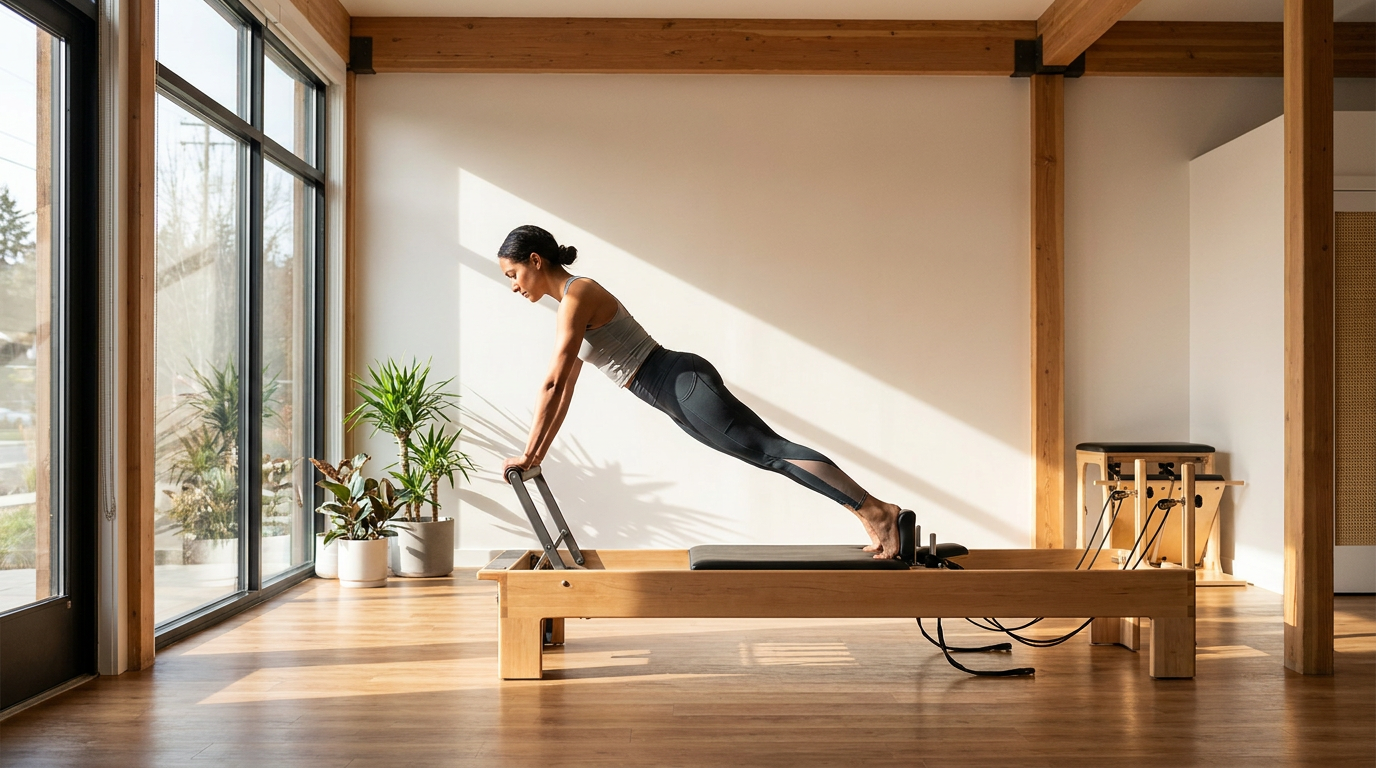
Reformer Pilates, conversely, utilizes a specialized apparatus featuring a sliding carriage, adjustable pulleys, and a system of heavy springs. This machine transforms the workout by introducing variable external resistance and a guided range of motion.
The science of the reformer lies in its springs. Unlike static dumbbells, which provide constant gravitational resistance, springs provide variable tension that peaks at the furthest point of the movement. This emphasizes eccentric muscle contractions—the lengthening of a muscle while it is under tension—which is a highly effective mechanism for building lean tissue and explosive power.[2][5]
Furthermore, the sliding carriage and supportive straps of the reformer absorb sheer force, making the workout exceptionally low-impact. This allows practitioners to build substantial lower-body and core strength without placing damaging stress on the knees, hips, or spinal discs.[2]
This combination of guided motion and joint protection makes the reformer an invaluable tool in clinical rehabilitation. Research indicates that reformer Pilates is safe and effective for populations managing complex neurological conditions, including multiple sclerosis and Parkinson's disease, by providing the proprioceptive feedback necessary to safely improve muscle strength and flexibility.[2][5]
Beyond rehabilitation, the medical community increasingly views Pilates as a critical intervention for longevity and healthy aging. Researchers note that the practice offers profound benefits for older adults, ranging from maintaining bone density to supporting immune function.[1]

One of the most vital benefits for aging populations is fall prevention. By simultaneously strengthening the lower limbs and enhancing core stability, Pilates significantly improves dynamic balance, directly mitigating the risk of catastrophic falls that often compromise independence in later life.[1]
The benefits extend beyond the muscular system into cognitive preservation. The intense concentration required to coordinate breath, posture, and precise physical execution creates a substantial cognitive load, which researchers suggest may help protect against age-related cognitive decline.[1]
For the broader population, Pilates serves as a powerful antidote to the biomechanical toll of modern lifestyles. By lengthening the spine, opening the chest, and strengthening underused postural muscles, it actively corrects the tech neck and rounded shoulders caused by prolonged sitting and screen time.
Ultimately, the science of Pilates reveals it to be much more than a fitness trend. Whether performed on a simple mat or a complex spring-loaded reformer, it is a comprehensive system of physical maintenance that builds a resilient, functional body capable of moving efficiently and pain-free through all stages of life.
Viewpoints in depth
Clinical Researchers
Focus on neuromuscular control, spinal stability, and injury rehabilitation.
For biomechanists and physical therapists, Pilates is primarily a tool for neuromuscular re-education. Researchers emphasize its ability to retrain the feedforward mechanism—the body's subconscious ability to brace the spine milliseconds before limb movement. By increasing the thickness and responsiveness of the transverse abdominis and multifidus, clinical Pilates protocols are frequently prescribed to permanently resolve chronic lower back pain rather than merely treating its symptoms.
Public Health Advocates
Focus on longevity, fall prevention, and accessibility for aging populations.
Public health experts view Pilates through the lens of healthy aging and longevity. Because the practice is low-impact and easily modified, it serves as a highly accessible form of resistance training for older adults. Advocates highlight its proven efficacy in improving dynamic balance, maintaining bone density, and reducing the risk of catastrophic falls, making it a critical component of preventative healthcare for senior populations.
Fitness Practitioners
Focus on functional strength, posture, and the complementary nature of the practice.
Within the fitness industry, instructors and trainers position Pilates as the ultimate foundational workout. Rather than prioritizing sheer muscle hypertrophy, this camp values functional strength, mobility, and postural alignment. Practitioners often utilize mat Pilates to build raw, unassisted core control, while leveraging the reformer to develop explosive power and eccentric strength that translates into better performance in other sports and daily activities.
What we don't know
- The exact threshold of weekly Pilates practice required to achieve optimal cognitive and neurological benefits remains under study.
- Long-term comparative data measuring injury rates between exclusive mat practitioners versus exclusive reformer practitioners is still limited.
Key terms
- Transverse Abdominis
- The deepest layer of abdominal muscle that wraps around the torso like a corset, providing essential stability to the spine and pelvis.
- Eccentric Contraction
- The lengthening of a muscle while it is under tension, which is highly effective for building strength and lean tissue.
- Proprioception
- The body's subconscious ability to sense its movement, action, and location in space.
- Feedforward Mechanism
- The central nervous system's anticipation of movement, activating stabilizing muscles milliseconds before the actual movement occurs to protect the joints.
- Multifidus
- A series of small, deep muscles attached directly to the spine that play a crucial role in extending and rotating the back.
Frequently asked
Is reformer Pilates better than mat Pilates?
Neither is objectively better; they serve different purposes. Mat Pilates builds foundational, unassisted core strength, while the reformer provides adjustable resistance and joint support that is excellent for rehabilitation and eccentric strengthening.
Can Pilates help with lower back pain?
Yes. By strengthening the deep stabilizing muscles of the core and retraining the body's alignment, Pilates is frequently recommended by physical therapists to alleviate and prevent chronic lower back pain.
Is Pilates considered strength training?
Yes. Both mat and reformer Pilates are forms of resistance training. While they may not induce massive muscle hypertrophy like heavy weightlifting, they effectively build muscular endurance, lean tissue, and functional strength.
Is Pilates safe for older adults?
Absolutely. Pilates is a low-impact exercise that can be easily modified for various mobility levels. It is highly effective for improving balance, maintaining bone density, and reducing fall risks in seniors.
Sources
Source coverage
6 outlets
3 viewpoints surfaced






[1]Harvard Health PublishingPublic Health Advocates
Pilates: A good option for older adults?
Read on Harvard Health Publishing →[2]Medical News TodayFitness Practitioners
Reformer vs mat pilates: Differences, risks, and more
Read on Medical News Today →[3]National Center for Biotechnology InformationClinical Researchers
Effects of Core Stability Training on Deep Stabilizing Muscle Function and Neuromuscular Control
Read on National Center for Biotechnology Information →[4]Frontiers in Sports and Active LivingClinical Researchers
Comparisons of functional movements and core muscle activity in women according to Pilates proficiency
Read on Frontiers in Sports and Active Living →[5]HealthlineFitness Practitioners
Reformer vs. Mat Pilates: Pros, Cons, and How to Choose the Best One
Read on Healthline →[6]Factlen Editorial TeamFitness Practitioners
Synthesis by Factlen editorial team
Read on Factlen Editorial Team →
Every angle. Every day.
Get fitness stories with full source coverage and perspective breakdowns delivered to your inbox.