
The Science of Pilates: How Controlled Movement Rewires the Core and Spine
Decades of clinical research reveal that Pilates goes far beyond aesthetic toning, offering proven mechanisms for resolving chronic back pain, improving proprioception, and building deep muscular endurance.
By Factlen Editorial Team
- Clinical Rehabilitation Specialists
- Focus on Pilates as a targeted neuromuscular therapy for injury recovery and back pain reduction.
- Strength & Conditioning Coaches
- Value Pilates for mobility and core stability, but emphasize the need for heavy lifting for bone density and hypertrophy.
- Mind-Body Practitioners
- Highlight the autonomic nervous system benefits, breathwork, and stress reduction inherent in the practice.
What's not represented
- · Classical Pilates purists who strictly adhere to Joseph Pilates' original 34 mat exercises without modern biomechanical modifications.
- · Older adults utilizing Pilates specifically for fall prevention and maintaining independence in daily living.
Why this matters
Understanding the precise biomechanics of Pilates allows individuals to use it effectively as a clinical tool for pain management and injury prevention, rather than just a cosmetic fitness trend.
Key points
- Pilates targets deep stabilizing muscles like the transverse abdominis and pelvic floor, rather than just superficial abdominal muscles.
- The practice relies on eccentric contraction, lengthening muscles under tension to build endurance without significant bulk.
- Multiple meta-analyses confirm Pilates is highly effective at reducing pain and disability in chronic low back pain patients.
- While excellent for stability and mobility, Pilates does not provide the heavy loading needed for maximal strength or bone density gains.
- Coordinated diaphragmatic breathing in Pilates engages the parasympathetic nervous system, reducing stress and improving sleep.
When Joseph Pilates developed his exercise system in the early 20th century, he called it 'Contrology'—a method designed to help injured soldiers and dancers regain strength and mobility through precise, mindful movement. Today, Pilates is often marketed through an aesthetic lens, promising toned abdominals and a leaner physique. However, a growing body of clinical research is shifting the focus back to its original intent, revealing that Pilates is a highly effective neuromuscular intervention that rewires how the body stabilizes itself.[6]
The scientific community has increasingly validated Pilates as a therapeutic tool, particularly for musculoskeletal rehabilitation. Unlike traditional strength training, which often isolates large, superficial muscle groups to generate maximum force, Pilates targets the deep stabilizing muscles that support the spine and pelvis. This shift in focus from raw power to movement quality offers profound benefits for posture, injury prevention, and chronic pain management.[6]
At the mechanical heart of Pilates is the concept of the 'powerhouse'—a complex system of core muscles that includes the transverse abdominis, the multifidus muscles of the back, the pelvic floor, and the diaphragm. Traditional abdominal exercises, like crunches, primarily work the rectus abdominis (the visible 'six-pack' muscles). In contrast, Pilates demands the simultaneous activation of the entire powerhouse, creating a corset-like effect that stabilizes the lumbar spine before any limb movement occurs.[4][6]

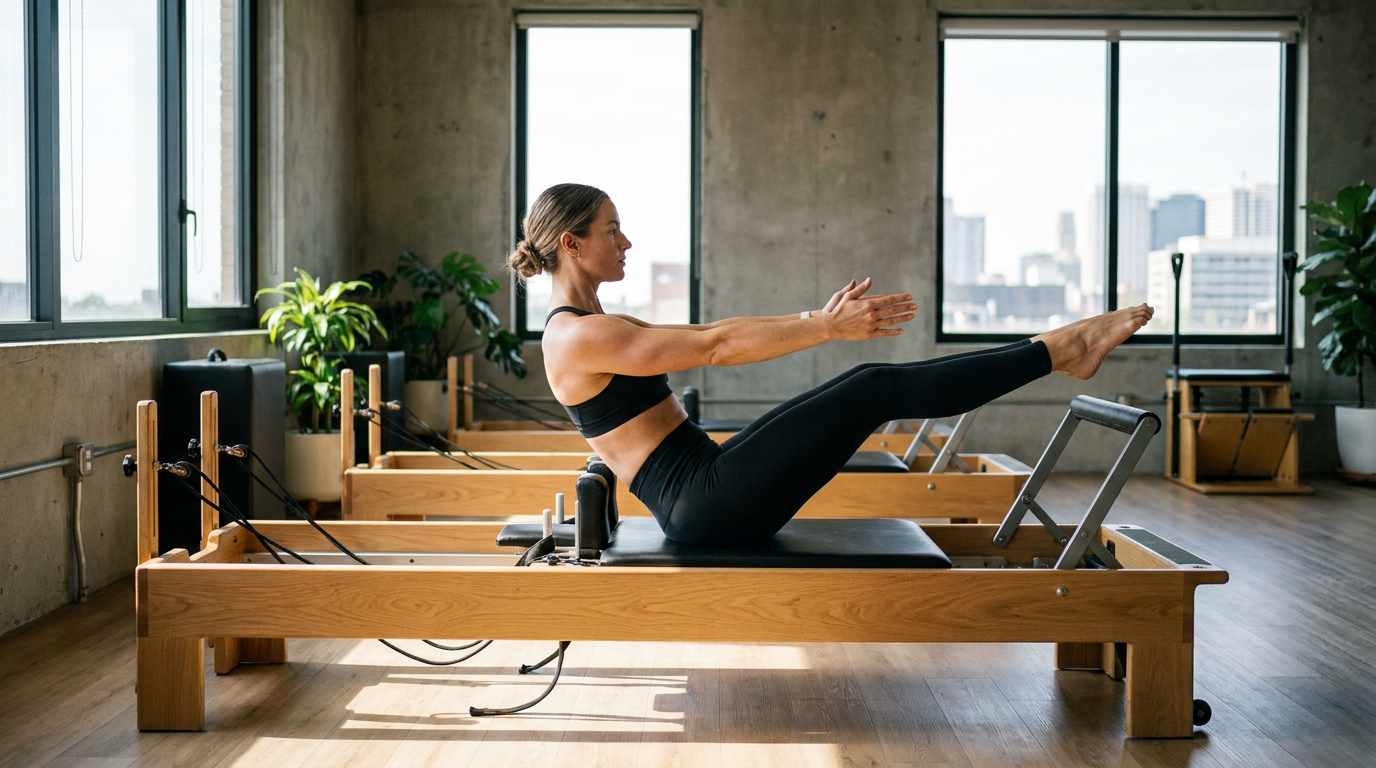
This deep core activation is achieved through a specific mechanism: eccentric contraction. In Pilates, muscles are frequently lengthened while under tension. This is especially prominent when using equipment like the Reformer, which utilizes spring-based resistance. As the practitioner controls the return of the carriage against the pull of the springs, the muscles must decelerate the movement. This eccentric control builds functional strength and muscular endurance without inducing the significant muscle hypertrophy associated with heavy weightlifting.[5][6]
The clinical efficacy of this approach is most evident in the treatment of chronic low back pain (CLBP), a condition that affects millions globally and is often exacerbated by weak spinal stabilizers. Multiple systematic reviews and meta-analyses have investigated the impact of Pilates on CLBP, consistently finding it superior to minimal intervention or no exercise.[1][2][3]
A comprehensive 2023 meta-analysis published in MDPI analyzed 19 randomized controlled trials involving over 1,100 patients. The researchers found that Pilates interventions led to statistically significant reductions in both pain intensity and functional disability. By retraining the multifidus and transverse abdominis to fire correctly, Pilates unloads the stressed passive structures of the spine, such as the intervertebral discs and ligaments.[2]

A comprehensive 2023 meta-analysis published in MDPI analyzed 19 randomized controlled trials involving over 1,100 patients.
Similarly, a 2024 review in the Journal of Physical Therapy confirmed these findings, noting that interventions lasting five to eight weeks produced the most prominent improvements in pain and disability. Interestingly, the research indicates that both mat-based Pilates—which relies on gravity and body weight—and equipment-based Pilates are effective, with no significant statistical difference in back pain outcomes between the two modalities.[4]
Beyond the core, Pilates significantly enhances peripheral flexibility and joint mobility. Because the exercises incorporate dynamic movements that stretch muscles while they are actively engaged, practitioners experience functional gains in their range of motion. Studies have shown that a 12-week Pilates program can increase hamstring flexibility by up to 28% and improve shoulder mobility, which directly translates to better gait mechanics and a reduced risk of falls in older populations.[6]
Proprioception—the body's ability to sense its position in space—is another critical adaptation. The precise, controlled nature of Pilates forces the nervous system to constantly monitor and adjust joint alignment. This heightened body awareness helps athletes correct compensation patterns that lead to overuse injuries, and it provides older adults with the balance necessary to navigate uneven terrain safely.[6]
However, exercise scientists are quick to point out what Pilates cannot do. While it is excellent for building muscular endurance and stability, it does not provide the progressive mechanical overload required for maximal strength gains or significant muscle hypertrophy. For experienced lifters, the muscle-building stimulus of Pilates is limited compared to traditional barbell training.[5]

Furthermore, Pilates has limitations regarding bone health. Weight-bearing exercises and heavy resistance training are the gold standards for increasing bone mineral density and preventing osteoporosis. Because Pilates is low-impact and does not subject the skeletal system to heavy axial loading, its impact on bone density is relatively minor. Consequently, fitness professionals often recommend combining Pilates with traditional strength training to achieve a comprehensive physical profile.[5][6]
The benefits of Pilates also extend into neurology and mental health. The practice requires intense concentration and coordinated diaphragmatic breathing, which actively engages the parasympathetic nervous system. This 'rest and digest' activation lowers cortisol levels and reduces the physiological markers of stress.[6]

Clinical studies have demonstrated that regular Pilates practice can lead to a 50% reduction in sleep latency (the time it takes to fall asleep) and an increase in REM sleep duration. By forcing the mind to focus entirely on the physical execution of movement, Pilates acts as a form of moving meditation, offering psychological relief that parallels its physical benefits.[6]
Ultimately, the science of Pilates reveals a highly sophisticated system of neuromuscular re-education. It is not merely a workout for the abdominal muscles, but a comprehensive method for restoring spinal health, enhancing movement efficiency, and bridging the gap between physical rehabilitation and lifelong fitness.[6]
How we got here
Early 1900s
Joseph Pilates develops 'Contrology,' a system of mindful movement and breath control.
World War I
Pilates attaches springs to hospital beds to help rehabilitate injured soldiers, laying the groundwork for the modern Reformer.
1920s
Pilates opens his first studio in New York City, gaining popularity among dancers for injury recovery and core strength.
Late 1990s
Pilates experiences a massive surge in mainstream fitness popularity, often marketed primarily for aesthetic toning.
2010s–Present
A growing body of peer-reviewed clinical research validates Pilates as an effective intervention for chronic back pain and neuromuscular rehabilitation.
Viewpoints in depth
Clinical Rehabilitation Specialists
Medical professionals who utilize Pilates as a targeted therapy for musculoskeletal injuries.
Physical therapists and rehabilitation specialists view Pilates primarily as a tool for neuromuscular re-education. They emphasize its ability to isolate and strengthen the deep stabilizers of the spine, such as the multifidus and transverse abdominis, which are often dormant or weak in patients with chronic back pain. For this camp, the value of Pilates lies in its low-impact nature and its focus on correcting postural asymmetries, allowing patients to rebuild functional movement patterns without overloading injured tissues.
Strength & Conditioning Coaches
Fitness professionals who integrate Pilates into broader athletic training programs.
Strength coaches value Pilates for its ability to improve mobility, core endurance, and proprioception, which can enhance an athlete's performance and reduce injury risk. However, they are careful to delineate its limitations. They argue that while Pilates is excellent for movement quality, it cannot replace heavy resistance training. Because Pilates lacks progressive axial loading, this camp insists that traditional weightlifting remains essential for driving muscle hypertrophy, increasing maximal force production, and building bone mineral density.
Mind-Body Practitioners
Advocates who focus on the psychological and autonomic nervous system benefits of the practice.
This perspective highlights the 'Contrology' aspect of Joseph Pilates' original vision, focusing on the integration of breath, focus, and movement. Mind-body practitioners point to research showing that the diaphragmatic breathing and intense concentration required in Pilates activate the parasympathetic nervous system. They view the practice not just as physical exercise, but as a moving meditation that lowers cortisol, reduces anxiety, and improves sleep architecture, making it a holistic tool for modern stress management.
What we don't know
- The exact long-term effects of Pilates on bone mineral density in postmenopausal women compared to other low-impact exercises.
- Whether specific equipment-based Pilates (like the Reformer) offers definitively superior clinical outcomes over mat Pilates for complex spinal pathologies.
- The precise neurobiological mechanisms by which Pilates breathing protocols alter sleep architecture and REM cycles.
Key terms
- Powerhouse
- The foundational concept in Pilates referring to the complex of muscles in the abdomen, lower back, hips, and pelvic floor that stabilize the body.
- Transverse Abdominis
- The deepest layer of abdominal muscle that wraps around the torso like a corset, crucial for spinal stability.
- Eccentric Contraction
- The lengthening of a muscle while it is under tension, commonly experienced when controlling the return of the springs on a Pilates Reformer.
- Proprioception
- The body's subconscious ability to sense its position, movement, and balance in space.
- Multifidus
- A series of small, deep muscles attached directly to the spine that play a vital role in stabilizing the vertebrae.
Frequently asked
Can Pilates help with chronic lower back pain?
Yes. Multiple clinical meta-analyses show that Pilates significantly reduces pain and functional disability in people with chronic low back pain by strengthening the deep muscles that support the spine.
Does Pilates build muscle mass?
Pilates builds muscular endurance and functional strength, but because it does not involve lifting progressively heavier weights, it is not highly effective for building large muscle mass (hypertrophy).
Is Pilates better than traditional strength training?
They serve different purposes. Pilates excels at core stability, mobility, and movement quality, while traditional strength training is necessary for maximal strength, muscle growth, and increasing bone density.
What is the difference between Mat and Reformer Pilates?
Mat Pilates uses gravity and body weight for resistance, requiring the practitioner to fully support their own body. Reformer Pilates uses a machine with springs that provide both resistance to build strength and assistance to guide alignment.
Sources
Source coverage
6 outlets
3 viewpoints surfaced






[1]National Institutes of HealthClinical Rehabilitation Specialists
Effectiveness of Pilates exercise on pain intensity and functional disability in low back pain
Read on National Institutes of Health →[2]MDPIClinical Rehabilitation Specialists
Efficacy of Pilates on Pain, Functional Disorders, and Quality of Life in Patients with Chronic Low Back Pain
Read on MDPI →[3]PLOS ONEClinical Rehabilitation Specialists
Effectiveness of Pilates Exercise in People with Chronic Low Back Pain: A Systematic Review
Read on PLOS ONE →[4]Journal of Physical TherapyClinical Rehabilitation Specialists
Effectiveness of Pilates on pain and disability in adults with chronic nonspecific low back pain
Read on Journal of Physical Therapy →[5]Rep FitnessStrength & Conditioning Coaches
Pilates vs Strength Training: How They Stack Up and Work Together
Read on Rep Fitness →[6]Factlen Editorial TeamMind-Body Practitioners
Synthesis by Factlen editorial team
Read on Factlen Editorial Team →
Every angle. Every day.
Get fitness stories with full source coverage and perspective breakdowns delivered to your inbox.