
The Science of Fat-Washing: How Culinary Chemistry Transformed the Cocktail
By leveraging the unique solvent properties of alcohol, bartenders and home enthusiasts are using a technique called fat-washing to infuse spirits with savory flavors and silky textures.

In short
- Fat-washing is a technique that infuses spirits with the savory flavors of liquid fats without leaving a greasy residue.
- The process relies on ethanol acting as a bridge solvent, extracting fat-soluble flavor compounds at room temperature.
- Freezing the mixture solidifies the fat for easy removal, leaving behind a clarified, flavor-packed spirit.
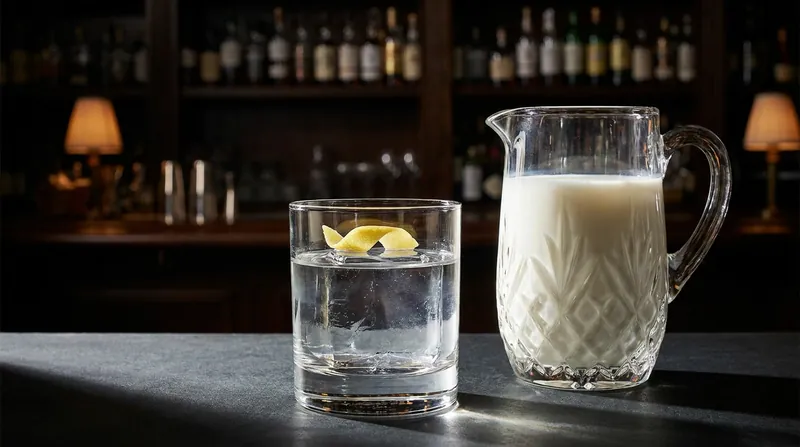
The first sip of a well-crafted Benton’s Old Fashioned presents a cognitive dissonance. The liquid in the glass is crystal clear, amber, and pristine, yet the aroma and flavor carry the unmistakable, rich smokiness of cured bacon. This is not the result of artificial flavorings or chemical syrups, but rather a culinary magic trick known as "fat-washing."
Over the past two decades, this technique has transformed modern mixology, allowing bartenders to infuse spirits with the savory depth of fats—from brown butter and duck fat to coconut and sesame oil—without leaving a greasy slick in the glass.[1][4]
At its core, fat-washing is a method of flavor extraction that bridges the gap between the kitchen and the bar. It solves a fundamental problem in drink-making: how to capture the complex, lip-smacking qualities of culinary fats in a medium that is traditionally served cold and liquid. If one were to simply pour melted butter into a cold cocktail, the result would be an unappetizing, curdled mess. Fat-washing circumvents this by using the alcohol itself as a chemical solvent, extracting the flavor molecules before the physical fat is entirely removed.[3]
The origins of this technique in the beverage world trace back to 2007 at Please Don't Tell (PDT), a pioneering speakeasy in New York City. Bartender Don Lee, inspired by conversations with experimental chefs, sought to capture the flavor of the heavily smoked Benton’s bacon served at a neighboring restaurant.
By combining rendered bacon fat with Four Roses bourbon, freezing the mixture, and skimming off the solidified fat, Lee created a cocktail that became an instant classic. The Benton’s Old Fashioned not only became PDT’s best-selling drink but also effectively introduced fat-washing to the global cocktail lexicon.[1]
While Lee popularized the method for drinks, the underlying concept is centuries old. Fat-washing is essentially a liquid adaptation of "enfleurage," a traditional perfume-making technique developed in 18th-century France. In enfleurage, odorless fats are used to capture the fragile, volatile aromatic compounds of flowers like jasmine and tuberose, which are then extracted using alcohol. Mixologists simply swapped the floral aromatics for savory culinary fats, leveraging the exact same chemical principles to build complex flavor profiles.[1][4]
The science of fat-washing relies entirely on the unique molecular structure of ethanol. Alcohol is a "bridge solvent," meaning it possesses both polar and non-polar properties. The hydroxyl group in an ethanol molecule interacts easily with water-soluble (polar) components, while its ethyl chain is highly effective at dissolving lipophilic, or "fat-loving," (non-polar) molecules. This dual nature allows high-proof spirits to act as a molecular sponge, pulling complex flavor compounds out of the fat and holding them in suspension.[2][3]
When a warm, liquid fat is introduced to a spirit—typically one sitting between 40% and 60% alcohol by volume—the extraction process begins immediately. The non-polar flavor volatiles, which include the compounds responsible for the taste of smoke, roasted nuts, or caramelized dairy, partition out of the lipid structure and dissolve directly into the ethanol. This transfer is highly efficient, ensuring that the spirit absorbs the aromatic blueprint of the fat while leaving the heavy triglycerides behind.[2][4]
The physical execution of the technique is surprisingly straightforward, requiring no specialized laboratory equipment. The process begins by gently heating the chosen fat until it is fully liquefied. This could involve rendering bacon in a pan, browning butter until it achieves a nutty aroma, or simply warming coconut oil.
The liquid fat is then poured into a wide-mouthed glass jar alongside the chosen spirit. The mixture is sealed, shaken vigorously to maximize the surface area contact between the oil and the alcohol, and left to rest at room temperature for several hours.[3]
This resting period is crucial. While some modern applications use heat or ultrasonic homogenizers to speed up the process, traditional room-temperature infusion is widely considered superior for preserving the delicate top notes of the spirit. Heat can destroy volatile aromatics, altering the foundational character of the whiskey, gin, or rum being used. By allowing the mixture to sit undisturbed, the ethanol has ample time to coax the flavor compounds across the phase boundary without thermal degradation.[2][4]
Once the infusion is complete, the mixture undergoes a phase transition via extreme chilling. The jar is placed in a freezer, typically overnight. Because ethanol has a freezing point of roughly -114°C (-173°F), the spirit remains entirely liquid in a standard kitchen freezer. The fat, however, undergoes crystallization. Saturated fatty acids, such as those found in butter or animal fats, form tightly packed crystalline lattices and solidify into a hard puck that floats at the top of the jar.[2]
The final step is separation. The solid cap of fat is pierced and removed, and the remaining liquid is poured through a fine-mesh strainer lined with a coffee filter or cheesecloth. This filtration catches any microscopic lipid crystals that may have remained suspended in the liquid. What drips through is a clarified, fat-washed spirit. It retains the exact visual clarity of the original alcohol, but its molecular makeup has been fundamentally altered, carrying the savory payload of the infused ingredient.[3]
Beyond flavor, fat-washing imparts a distinct textural change to the spirit. Even after the solid fats are removed, trace amounts of dissolved lipids and altered surface tension give the resulting liquid a heavier, more viscous mouthfeel. A butter-washed rum or an olive-oil-washed gin feels noticeably silkier on the palate than its unwashed counterpart. This textural enhancement allows bartenders to create cocktails that feel rich and indulgent without relying on heavy syrups or dairy creams.[3][4]
Success in fat-washing requires an understanding of ratios, as different fats yield vastly different intensities. Highly assertive fats, such as bacon grease or toasted sesame oil, require a light touch—often just one to two ounces of fat per 750-milliliter bottle of spirit. Using too much can result in an overpowering, unbalanced flavor that dominates the cocktail. Conversely, subtle fats like unsalted butter, coconut oil, or extra virgin olive oil require a higher ratio, sometimes up to four or five ounces per bottle, to make a noticeable impact.[4]
The choice of spirit is equally important, as the goal is flavor synergy rather than mere novelty. The smoky, corn-sweet backbone of bourbon pairs naturally with the savory saltiness of bacon or the rich caramel notes of brown butter. White rum provides a clean, grassy canvas that elevates the tropical nuances of coconut oil. Meanwhile, the botanical complexity of gin can be beautifully anchored by the grassy, peppery notes of a high-quality olive oil, creating a perfect base for a savory Martini.
From a food safety and stability standpoint, fat-washed spirits are remarkably resilient. Because the vast majority of the perishable fat is removed, and the remaining flavor compounds are suspended in high-proof alcohol, the resulting infusion is generally shelf-stable. However, to prevent any trace microscopic fats from oxidizing and developing rancid off-notes over time, most experts recommend storing fat-washed spirits in the refrigerator, especially if they are not going to be consumed within a few weeks.[3][4]
What began as a highly experimental technique in a single New York speakeasy has now been thoroughly democratized. Fat-washing is no longer the exclusive domain of professional mixologists with access to industrial centrifuges.
Because it relies on basic thermodynamic principles and requires only a jar, a freezer, and a coffee filter, it has become a beloved technique for home enthusiasts. It stands as a testament to how an understanding of basic food science can elevate everyday ingredients, turning a standard bottle of whiskey and a pat of butter into an extraordinary culinary experience.[1][4]
Jargon, explained
- Fat-Washing
- A culinary technique used to infuse alcohol with the flavor and texture of liquid fats before freezing and removing the solid fat.
- Ethanol
- The type of alcohol found in spirits, acting as a solvent with both polar and non-polar properties.
- Partition Coefficient
- A thermodynamic principle describing how aromatic compounds dissolve preferentially in substances with similar polarity.
- Enfleurage
- A historical perfume-making technique that uses odorless fats to capture the fragrant compounds exuded by plants.
- Lipophilic
- "Fat-loving" molecules that dissolve easily in lipids or fats, often responsible for complex savory flavors.
- Phase Transition
- The physical change of a substance from one state to another, such as liquid fat crystallizing into a solid when frozen.
Common questions
Does fat-washing make the cocktail greasy?
No. Because the mixture is frozen and the solid fat is strained out, the resulting spirit retains the flavor and a silky mouthfeel without any greasy residue.
Can I use plant-based fats?
Yes. Coconut oil, sesame oil, and olive oil are highly popular for fat-washing, especially with lighter spirits like gin or white rum.
How long does a fat-washed spirit last?
Once strained, it is generally shelf-stable due to the high alcohol content, but keeping it refrigerated extends its life and prevents any trace fats from oxidizing.
Do I need to heat the alcohol?
No. The infusion happens at room temperature. Heating the alcohol would evaporate the ethanol and destroy delicate flavor compounds.
Competing readings
The Culinary Mixologist's View
Focuses on flavor extraction and pushing the boundaries of what a cocktail can taste like.
For culinary-minded bartenders, cocktails should not be limited to the traditional spectrum of sweet, sour, and bitter. Historically, incorporating savory notes (umami) into a drink was difficult without making the beverage feel like cold soup. Fat-washing unlocked the savory quadrant of the flavor wheel, allowing mixologists to treat spirits with the same layering techniques a chef uses when building a sauce.
The Chemical Perspective
Focuses on the thermodynamics of solvents and phase transitions.
Food scientists view fat-washing not as magic, but as a practical application of the partition coefficient. Ethanol's amphiphilic nature—having both polar and non-polar ends—makes it the perfect vehicle for extracting lipophilic flavor compounds. By manipulating temperature to force a phase transition (freezing the fat while the alcohol remains liquid), the technique achieves a highly efficient separation that would otherwise require industrial centrifuges.
The Home Bartender's Approach
Appreciates the technique for its accessibility and low barrier to entry.
Unlike many modern mixology trends that require rotary evaporators, liquid nitrogen, or expensive clarification rigs, fat-washing requires zero specialized gear. Home enthusiasts champion the technique because it democratizes high-end cocktail creation. With nothing more than a mason jar, a standard kitchen freezer, and a coffee filter, amateur bartenders can replicate the complex flavor profiles found in the world's best bars.
- Culinary Mixologists
- View fat-washing as a bridge between the kitchen and the bar, prioritizing complex, savory flavor profiles.
- Food Scientists
- Focus on the thermodynamic principles, partition coefficients, and ethanol's role as a dual-polarity solvent.
- Home Enthusiasts
- Value the technique for its accessibility, requiring no specialized equipment to elevate home bartending.
Perspectives this story doesn't cover
- Vegan advocates concerned about the prevalence of animal fats in seemingly clear cocktails.
- Distillers who prefer their spirits to be consumed unadulterated.
Sources
Source coverage
4 outlets
3 viewpoints surfaced




- [1]Difford's GuideCulinary Mixologists
Benton's Old Fashioned - History and Recipe
Read on Difford's Guide → - [2]COMSOLFood Scientists
Fat-Washing Cocktails: Ethanol's Ability to Release Flavors
Read on COMSOL → - [3]Serious EatsFood Scientists
The Science of Fat-Washing Cocktails
Read on Serious Eats → - [4]Factlen Editorial TeamHome Enthusiasts
Synthesis by Factlen editorial team
Read on Factlen Editorial Team →
More in Food & Drink
See all →Spirits Consolidation
Sazerac's $15 Billion Bid for Brown-Forman Signals a New Era of Spirits Consolidation
3 sources
Cocktail Science
The Science of Fat-Washing: How Bartenders Extract Flavor from Bacon, Butter, and Oil
5 sources
Culinary Science
Fat-Washing Spirits: The Chemistry Behind Savory Cocktails
5 sources
Cocktail Science
The Science of Clarified Milk Punch: How Curdled Milk Makes Crystal-Clear Cocktails
4 sources
Comments
Every angle. Every day.
Get Food & Drink stories with full source coverage and perspective breakdowns, free every day.