
The Science of Deep Rest: How a 20-Minute Protocol Rewires the Nervous System
Neuroscientists and clinicians are increasingly pointing to Non-Sleep Deep Rest (NSDR), or Yoga Nidra, as a powerful, zero-cost tool to lower cortisol, increase dopamine, and restore cognitive function.
By Factlen Editorial Team
- Neuroscientists & Researchers
- Focus on measurable changes in brain chemistry, dopamine release, and brainwave shifts.
- Clinical Health Providers
- Emphasize practical applications for stress reduction, insomnia relief, and autonomic nervous system regulation.
- Editorial Synthesis
- Contextualizing the ancient roots of the practice with modern secular applications.
What's not represented
- · Traditional yoga scholars who view the secularization of Yoga Nidra as stripping away its spiritual and historical context.
Why this matters
Chronic stress and sleep deprivation are driving a global burnout epidemic. Understanding how to manually shift the nervous system into a state of deep rest offers a zero-cost, science-backed tool to restore focus, lower cortisol, and improve daily resilience.
Key points
- Yoga Nidra, or Non-Sleep Deep Rest (NSDR), is a guided relaxation practice performed while lying completely still.
- The practice actively shifts the autonomic nervous system from a 'fight-or-flight' stress response to a 'rest-and-digest' state.
- Brain imaging shows the practice slows brainwaves from alert beta frequencies into relaxed alpha and theta states.
- Research indicates NSDR can significantly increase dopamine levels in the brain's reward centers, restoring motivation and focus.
- Clinical providers increasingly recommend the practice to lower cortisol, reduce blood pressure, and manage chronic insomnia.
For decades, the solution to midday exhaustion was a simple binary: push through with caffeine, or surrender to a nap. But a growing body of neuroscientific research is validating a third option that exists in the liminal space between waking and sleeping.[6]
Known traditionally as Yoga Nidra, or "yogic sleep," the practice has recently been rebranded in clinical and performance circles as Non-Sleep Deep Rest (NSDR). Coined by Stanford neurobiologist Dr. Andrew Huberman, NSDR serves as a secular umbrella term for guided relaxation protocols that induce profound physiological rest while the practitioner remains entirely awake.[2][4]
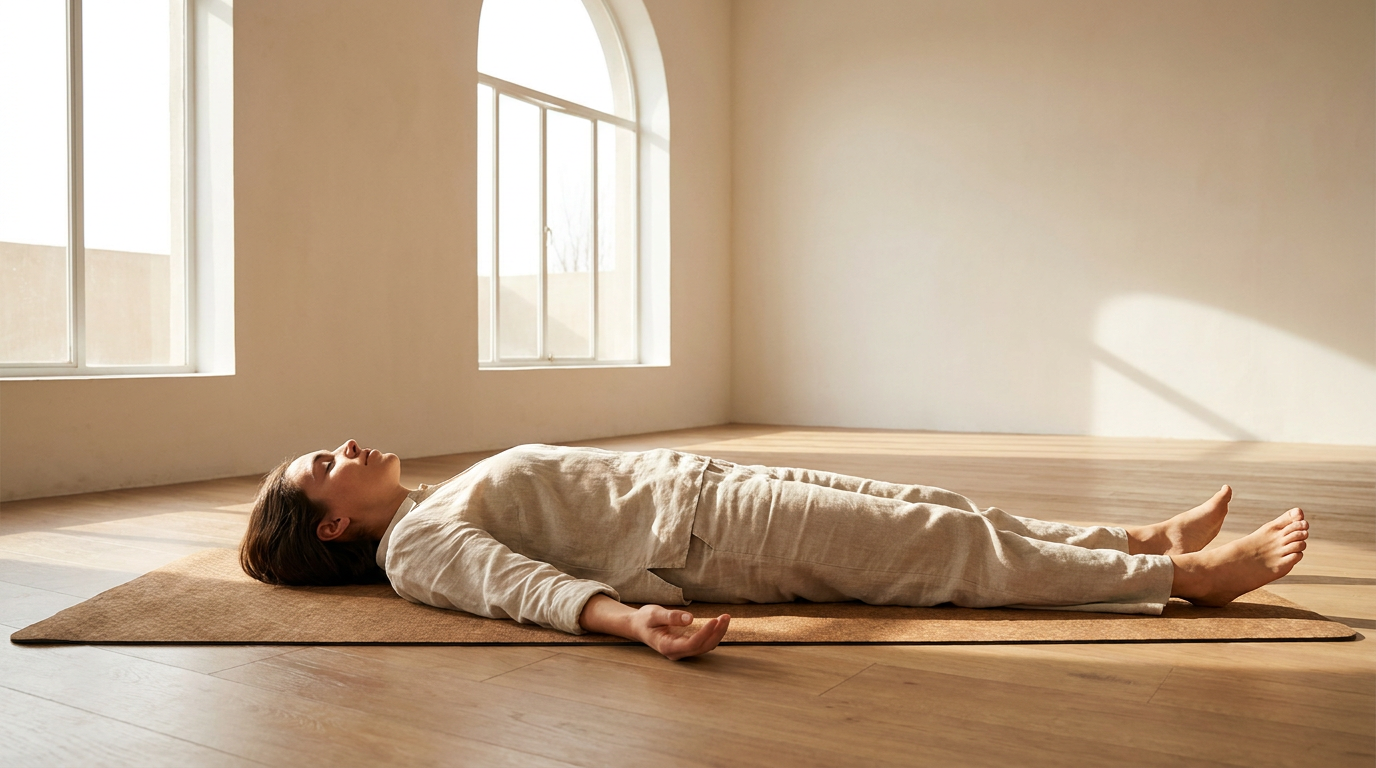
Unlike traditional seated meditation, which often requires active mental focus and upright posture, NSDR is performed lying flat on the back. Practitioners listen to an audio guide that walks them through a systematic body scan and breathing exercises. The goal is not to empty the mind, but to tether attention to physical sensations, allowing the brain to power down its executive functions.[1][2]
The core mechanism behind NSDR’s efficacy is its ability to hijack the autonomic nervous system. Throughout a typical workday, most people operate under the dominance of the sympathetic nervous system—the "fight-or-flight" network responsible for alertness, stress responses, and cortisol production.[1][5]

Guided deep rest acts as a physiological brake pedal. By deliberately slowing the breath and shifting focus away from external stressors, the practice deactivates the sympathetic response and engages the parasympathetic nervous system, commonly known as the "rest-and-digest" network.[2][5]
This autonomic shift triggers a cascade of measurable biological changes. Heart rate drops, blood pressure stabilizes, and cortisol levels plummet. For individuals suffering from chronic stress or burnout, this forced transition out of the fight-or-flight state provides a critical window of systemic recovery.[1][2]
The neurological changes are equally profound, visible in the shifting electrical frequencies of the brain. During normal waking hours, the brain operates primarily in beta waves, which are fast, alert, and sometimes anxious.[5]
The neurological changes are equally profound, visible in the shifting electrical frequencies of the brain.
As a practitioner settles into Yoga Nidra, brain activity slows into the alpha range (8 to 14 Hz), a frequency associated with calm, relaxed wakefulness. As the practice deepens, the brain often dips into theta waves—the slow, rhythmic patterns typically seen during daydreaming, deep meditation, or the very edge of sleep.[3][5]

In some advanced practitioners, the brain can even access delta waves. These are the slowest brainwaves, normally reserved for the deepest, most restorative phases of dreamless sleep. Accessing delta waves while maintaining conscious awareness is the hallmark of a successful Yoga Nidra session, allowing the body to undergo sleep-like healing without losing consciousness.[5]
Perhaps the most compelling claim surrounding NSDR is its impact on dopamine, the neurotransmitter responsible for motivation, focus, and reward. In a landmark 2002 study published in Cognitive Brain Research, researchers used PET scans to observe the brains of experienced yoga teachers during a Yoga Nidra session.[3]
The scans revealed a 65 percent increase in endogenous dopamine release in the ventral striatum, a key reward center in the brain. This massive dopamine spike helps explain why a 20-minute NSDR session can leave practitioners feeling highly motivated and mentally sharp, effectively clearing the "brain fog" that accumulates during long periods of cognitive effort.[3]

However, researchers caution against over-extrapolating this specific data point. The 65 percent figure was observed in highly experienced meditators, and it remains uncertain if a beginner listening to an app will experience the exact same neurochemical surge. Nonetheless, the general consensus holds that parasympathetic activation reliably supports healthy dopamine restoration.[3][6]
Beyond midday energy restoration, clinical providers are increasingly prescribing Yoga Nidra as a frontline intervention for insomnia. While the practice itself is not sleep, it trains the nervous system to down-regulate, making it easier to transition into actual sleep later at night.[1][4]
For those who wake up at 3:00 a.m. with racing thoughts, NSDR offers a structured way to quiet the mind. By focusing on the audio guide's instructions—such as feeling the weight of the left heel or the temperature of the right palm—the practitioner disrupts the cycle of sleep anxiety, often drifting back to sleep naturally.[4]
The accessibility of the practice is driving its rapid adoption in corporate wellness programs and high-performance athletics. Because it requires no specialized equipment, no physical flexibility, and no prior meditation experience, it bypasses the traditional barriers to entry associated with yoga.[2][4]

Despite its proven benefits, experts emphasize that NSDR is a supplement to, not a replacement for, actual sleep. The human body still requires the complex, multi-stage architecture of a full night's sleep to consolidate memories, clear cellular waste, and repair tissue.[3]
How we got here
Ancient India
The concept of 'yogic sleep' is developed as a spiritual practice to reach Samadhi.
1960s
Modern Yoga Nidra is systematized by Swami Satyananda Saraswati as a structured relaxation technique.
2002
A landmark PET scan study reveals a 65% increase in dopamine during Yoga Nidra practice.
2020s
Stanford's Andrew Huberman popularizes the secular term 'Non-Sleep Deep Rest' (NSDR), driving mainstream adoption.
Viewpoints in depth
Neuroscience Researchers
Focusing on the measurable neurochemical and electrical changes in the brain.
For neurobiologists, the value of NSDR lies in its quantifiable impact on brain chemistry. Researchers point to PET scans and EEG readings that show clear shifts from beta to theta brainwaves, alongside significant endogenous dopamine release. From this perspective, the practice is a mechanical lever to optimize cognitive performance, restore focus, and clear neurochemical fatigue without requiring pharmaceutical intervention.
Clinical Health Providers
Emphasizing practical applications for stress reduction and chronic disease management.
Medical professionals view Yoga Nidra primarily through the lens of autonomic nervous system regulation. By forcing the body into a parasympathetic state, the practice offers a non-invasive treatment for modern lifestyle ailments. Clinicians highlight its efficacy in lowering blood pressure, reducing circulating cortisol, and serving as a behavioral intervention for severe insomnia, focusing on systemic recovery rather than peak cognitive performance.
Traditional Practitioners
Viewing the practice as a spiritual discipline rather than just a biological hack.
In traditional yogic philosophy, the physical relaxation achieved during Yoga Nidra is merely a byproduct, not the ultimate goal. The practice is designed to peel away layers of physical and mental distraction to reach a state of pure awareness, often described as a stepping stone toward Samadhi (enlightenment). From this viewpoint, reducing the practice to a 'dopamine protocol' overlooks its profound capacity for deep self-inquiry and spiritual growth.
What we don't know
- Whether the massive 65% dopamine increase observed in experienced yoga teachers applies equally to beginners using audio apps.
- The exact long-term neuroplastic changes that occur from daily, sustained NSDR practice over multiple years.
Key terms
- Yoga Nidra
- An ancient practice translating to 'yogic sleep,' involving guided relaxation while lying completely still.
- Non-Sleep Deep Rest (NSDR)
- A secular umbrella term coined by neuroscientist Andrew Huberman for practices that induce deep relaxation without sleep.
- Sympathetic Nervous System
- The division of the nervous system responsible for the body's 'fight-or-flight' stress response.
- Parasympathetic Nervous System
- The division of the nervous system responsible for the 'rest-and-digest' relaxation response.
- Theta Brainwaves
- Slow electrical brain patterns typically associated with daydreaming, deep meditation, and the transition to sleep.
- Ventral Striatum
- A region of the brain associated with the reward system, motivation, and dopamine release.
Frequently asked
Do I need to fall asleep during Yoga Nidra?
No. The goal is to remain in a state of conscious awareness while the body rests, though falling asleep is a common and harmless side effect.
How is NSDR different from regular meditation?
While meditation often requires upright posture and active focus, NSDR is performed lying down and relies on passive listening to guide the brain into a sleep-like state.
Can NSDR replace a full night of sleep?
No. While it can restore energy and dopamine levels, it does not replace the comprehensive physiological repair that occurs during an eight-hour sleep cycle.
Sources
Source coverage
6 outlets
3 viewpoints surfaced






[1]Cleveland ClinicClinical Health Providers
What Is Yoga Nidra?
Read on Cleveland Clinic →[2]Sleep FoundationClinical Health Providers
What Is Non-Sleep Deep Rest (NSDR)?
Read on Sleep Foundation →[3]PubMed CentralNeuroscientists & Researchers
The Effects of an Online Yoga Nidra Meditation on Subjective Well-Being
Read on PubMed Central →[4]Huberman LabNeuroscientists & Researchers
Non-Sleep Deep Rest (NSDR)
Read on Huberman Lab →[5]WebMDClinical Health Providers
Yoga Nidra: What to Know to Reduce Stress, Anxiety, and Insomnia
Read on WebMD →[6]Factlen Editorial TeamEditorial Synthesis
Synthesis by Factlen editorial team
Read on Factlen Editorial Team →
Every angle. Every day.
Get fitness stories with full source coverage and perspective breakdowns delivered to your inbox.