
The Science of Aquafaba: How Chickpea Water Became a Culinary Miracle
Food scientists have decoded how the discarded liquid from canned chickpeas perfectly mimics the chemical properties of egg whites, revolutionizing plant-based cooking.

In short
- Aquafaba is the viscous liquid left over from cooking legumes, most commonly chickpeas, which can mimic the culinary properties of eggs.
- The liquid contains about 5% dry matter, consisting of proteins, carbohydrates, and saponins that work together to trap air and create stable foams.
- Adding an acid like cream of tartar lowers the pH of the liquid, reinforcing the denatured proteins and preventing the foam from collapsing.
The culinary world is full of complex techniques and expensive ingredients, but one of the most revolutionary discoveries of the last decade came from the drain of a kitchen sink. For generations, the murky, viscous liquid left over from canned chickpeas was considered useless waste and poured away without a second thought. Today, it is recognized as a polyfunctional culinary marvel capable of mimicking the exact chemical behaviors of egg whites, transforming the landscape of plant-based cooking and allergy-friendly baking.[4]
The discovery of this ingredient's immense potential is surprisingly recent. In 2014, a French musician and culinary experimenter named Joël Roessel discovered that the discarded liquid from canned beans could foam when whipped vigorously. He shared his initial findings on a blog, which quickly sparked a wave of experimentation across online plant-based cooking communities. The liquid was soon dubbed "aquafaba," a portmanteau of the Latin words for water and bean, and it rapidly transitioned from a niche internet hack to a staple ingredient in professional kitchens.[1][2]
As aquafaba gained mainstream traction, food scientists began investigating exactly why bean water behaves so remarkably like an animal product. To understand the mechanism, researchers had to analyze the chemical transfer that occurs during the cooking process. Legumes are primarily composed of carbohydrates, proteins, and water. When chickpeas are boiled or pressure-cooked, their internal starches undergo gelatinization, allowing soluble plant solids to leach out of the bean and dissolve into the surrounding cooking water, creating a nutrient-dense brine that captures the functional properties of the seed.[1][3]
Spectroscopic analysis reveals that the resulting liquid is still overwhelmingly water. Only about five percent of aquafaba's total makeup consists of dry matter transferred from the beans. However, that specific five percent contains a highly functional ratio of carbohydrates, proteins, and naturally occurring plant compounds. Notably, the liquid contains virtually no fat, which is a crucial factor for its ability to foam, as the presence of lipids actively inhibits the formation of stable air bubbles in culinary applications.[1][3]
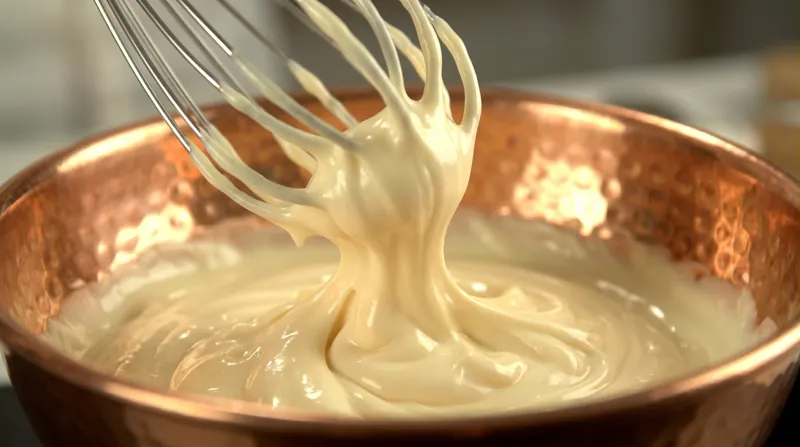
The most famous and visually striking application of aquafaba is its ability to whip into stiff, glossy peaks, a process that relies heavily on protein denaturation. When a whisk agitates the liquid, the intense mechanical force causes the coiled plant proteins to unfold from their natural, resting state. As these proteins denature, their molecular structure changes fundamentally. The water-loving ends remain submerged in the liquid, while the water-hating ends reach outward into the trapped air.[2][4]
This microscopic realignment creates a protective, flexible web that traps air bubbles, transforming the dense, yellowish liquid into a light, voluminous white foam. But proteins alone do not explain the rapid foaming action. Chickpeas also contain saponins, which are naturally occurring plant compounds that act as powerful surfactants. Saponins behave similarly to household soap, drastically lowering the surface tension of the liquid and allowing millions of tiny bubbles to form quickly when the mixture is agitated by a mixer.[2]
While proteins and saponins work together to create the bubbles, the leached carbohydrates provide the necessary architectural structure. The starches that migrated into the water during the cooking process increase the liquid's overall viscosity, thickening the walls of the bubbles and preventing the foam from immediately collapsing under its own weight. Although the liquid from any cooked legume can technically be used to achieve this effect, chickpea water has emerged as the undisputed gold standard in culinary science.[3]
Food lab experiments have consistently demonstrated that chickpeas offer the optimal proportion of starches to proteins required for generating highly stable foams. Furthermore, chickpeas possess the most neutral flavor profile of all common legumes, ensuring that delicate, sugar-forward desserts like meringues, macarons, and marshmallows do not carry an unappetizing, savory bean flavor. Despite its seemingly magical properties, however, aquafaba foam is inherently less stable than traditional foam made from whipped egg whites, requiring careful handling by chefs.[2][4]
Because it lacks the specific, highly structured albumins found in avian eggs, an aquafaba foam left sitting at room temperature will often lose its structural integrity and revert to a puddle of liquid within twenty to thirty minutes. To solve this instability, culinary science borrows a traditional baking technique: the introduction of an acid. Adding a small amount of cream of tartar or lemon juice lowers the pH of the aquafaba before whipping begins, fundamentally altering the chemical environment of the bowl.[2]
This newly acidic environment alters the electrical charge of the unfolded proteins, reinforcing the bubble walls and allowing the foam to hold its shape long enough to be baked into crisp meringues or folded gently into a rich chocolate mousse. But the utility of aquafaba extends far beyond simple aeration. It is classified by food scientists as a polyfunctional ingredient because it also excels at the complex processes of emulsification and coagulation, making it a versatile tool for savory cooking.
Emulsification is the culinary process of forcing two normally unmixable liquids, such as oil and water, to combine into a smooth, stable suspension. Just as egg yolks emulsify oil to create traditional mayonnaise, the proteins and complex carbohydrates in aquafaba can bind significant quantities of liquid fat. This allows home cooks and commercial food producers to create rich, stable, plant-based mayonnaise, aioli, and creamy salad dressings without relying on animal fats or highly processed synthetic emulsifiers.[4]
In its un-whipped, liquid state, aquafaba also serves as a highly effective binder for complex recipes. In vegan baking and gluten-free cooking, the viscous liquid provides the essential moisture and structural support typically supplied by whole eggs, helping disparate ingredients cling together in everything from dense chocolate brownies to savory plant-based burgers. For home cooks looking to utilize the ingredient, the substitution mathematics are remarkably precise and have been standardized across the culinary industry to ensure consistent, repeatable results.[1][4]
Generally, two tablespoons of aquafaba perfectly replaces one egg white, while three tablespoons replaces one whole egg in standard recipes. However, food scientists note a critical limitation regarding its nutritional profile that cooks must keep in mind. While aquafaba flawlessly mimics the physical and mechanical properties of eggs, it contains only about ten percent of the protein found in a standard egg white, altering the nutritional density of the final dish.[1]
This stark difference in protein density makes aquafaba unsuitable for structure-heavy baked goods that rely entirely on denatured egg protein for their primary architecture, such as angel food cake or traditional airy sponge cakes. Beyond its immediate utility for those managing egg allergies or adhering to plant-based diets, the rapid rise of aquafaba represents a significant, measurable triumph in the global effort toward food waste reduction and sustainable kitchen practices, proving that discarded materials hold untapped value.[1]
By identifying the immense chemical value in a byproduct that was historically discarded by the millions of gallons every single day, the culinary community effectively created a premium, highly sought-after ingredient out of thin air. What began as a curious internet experiment has rapidly evolved into a foundational concept taught in modern food science programs. It proves that molecular gastronomy is not exclusively the domain of high-end restaurant laboratories; sometimes, profound chemical transformations are waiting quietly in the pantry.[4]
Key terms
- Aquafaba
- The viscous liquid left over from cooking legumes, most commonly chickpeas, used as a plant-based egg substitute.
- Denaturation
- The process where proteins unfold from their natural coiled state, allowing them to form new structures that trap air.
- Emulsification
- The culinary process of forcing two normally unmixable liquids, such as oil and water, to combine into a smooth, stable suspension.
- Saponins
- Naturally occurring plant compounds that have soap-like, foaming properties when agitated, helping to lower surface tension.
- Gelatinization
- The process where starch granules absorb water and swell when heated, contributing to the liquid's overall viscosity.
Frequently asked
Can I use the liquid from any canned beans?
Yes, the liquid from most legumes will work, but chickpea water is preferred because it has the optimal starch-to-protein ratio and the most neutral flavor.
Does aquafaba make desserts taste like beans?
No. While the liquid smells like beans straight out of the can, the savory flavor dissipates entirely when whipped and mixed with sugar and vanilla.
Can I freeze leftover aquafaba?
Yes, aquafaba freezes exceptionally well. Many home cooks freeze it in ice cube trays, where one standard cube roughly equals one tablespoon.
Why did my aquafaba foam collapse?
Aquafaba foam is less stable than egg whites. It can collapse if left sitting too long, if exposed to fat, or if an acid like cream of tartar wasn't added to stabilize the proteins.
Viewpoints in depth
Culinary Scientists
Focuses on the molecular mechanisms that allow the liquid to mimic egg whites.
For food scientists, aquafaba is a fascinating study in plant chemistry. Researchers focus on how the specific 5% dry matter leached from chickpeas—comprising proteins, starches, and saponins—interacts under mechanical stress. They emphasize that while aquafaba mimics the macro-behavior of eggs, its micro-structure is entirely different, relying on carbohydrate viscosity rather than complex avian albumins to maintain foam stability.
Plant-Based Chefs
Values aquafaba as a revolutionary tool that unlocked previously impossible vegan recipes.
Professional vegan chefs view aquafaba as the ingredient that finally broke the plant-based pastry barrier. Before its discovery, creating stable vegan meringues, macarons, and airy mousses was considered nearly impossible, as traditional egg substitutes like flaxseed or bananas provided moisture but no aeration. Chefs celebrate aquafaba for allowing plant-based gastronomy to achieve the exact textures of classic French pastry.
Home Cooks
Prioritizes the accessibility, low cost, and precise substitution ratios of the ingredient.
For the everyday home cook, the appeal of aquafaba lies in its extreme accessibility and cost-effectiveness. Rather than purchasing expensive, highly processed commercial egg replacers, cooks can utilize a byproduct they already have in their pantry. The standardized substitution ratios—two tablespoons for an egg white, three for a whole egg—make it incredibly easy to adapt cherished family recipes without needing a degree in food science.
- Culinary Scientists
- Focuses on the molecular mechanisms that allow the liquid to mimic egg whites.
- Plant-Based Chefs
- Values aquafaba as a revolutionary tool that unlocked previously impossible vegan recipes.
- Home Cooks
- Prioritizes the accessibility, low cost, and precise substitution ratios of the ingredient.
Perspectives this story doesn't cover
- Commercial Egg Producers
- Industrial Food Manufacturers
Sources
Source coverage
4 outlets
3 viewpoints surfaced




- [1]WikipediaHome Cooks
Aquafaba - Composition and Uses
Read on Wikipedia → - [2]The Daily MealPlant-Based Chefs
The Science Of Aquafaba
Read on The Daily Meal → - [3]ResearchGateCulinary Scientists
Chemical composition of aquafaba
Read on ResearchGate → - [4]Factlen Editorial TeamHome Cooks
Synthesis by Factlen editorial team
Read on Factlen Editorial Team →
More in Food & Drink
See all →Culinary Science
The Science of Velveting: How Baking Soda Transforms Tough Meat for 30-Minute Dinners
3 sources
Culinary Science
180°F to 205°F: The Hydrolysis Window That Converts Bone Collagen Into Silky Stock
6 sources
Culinary Science
The Science of Brining: How Osmosis and Protein Denaturation Transform Meat
5 sources
Global Markets
Big Food's Growth Engine Shifts: Why Asia and Latin America Are Now Outpacing North American Sales
5 sources
Comments
Every angle. Every day.
Get Food & Drink stories with full source coverage and perspective breakdowns, free every day.