
The Science of a 'Good Room': How Neuroaesthetics is Rewiring Interior Design
Brain imaging reveals that interior design is not just a matter of taste—it directly alters our heart rates, stress hormones, and cognitive function.
By Factlen Editorial Team
- Neuroaesthetics Researchers
- Scientists focused on the measurable biological impact of spatial design.
- Architectural Designers
- Practitioners translating brain science into physical spaces.
- Trend Forecasters
- Analysts tracking the cultural shift toward sensory luxury.
What's not represented
- · Low-Income Housing Developers
- · Traditional Feng Shui Practitioners
Why this matters
For decades, interior design was treated as a matter of subjective taste or luxury. By proving that our environments actively alter our nervous systems, neuroaesthetics transforms home design into a vital, accessible component of preventative healthcare.
Key points
- Neuroaesthetics is the scientific study of how the brain responds to spatial design and architecture.
- fMRI studies show that curvilinear forms and natural light actively reduce cortisol and lower heart rates.
- The interior design industry is shifting away from sterile minimalism toward 'sensory luxury' and tactile warmth.
- Institutions like Johns Hopkins are pushing for neuroarchitecture to become standard in hospitals and schools.
Walking into a room and instantly feeling your shoulders drop, or conversely, feeling an inexplicable sense of tension, is a universal human experience. For decades, interior designers attributed this phenomenon to "good taste," spatial intuition, or simply the "vibes" of a home. If a room felt wrong, the solution was usually to rearrange the furniture or change the paint color until the aesthetic felt more balanced.[1]
But in 2026, the conversation has shifted from the subjective to the biological. The rapidly expanding field of neuroaesthetics is proving that our reaction to a room is not just a matter of preference—it is a measurable neurological event. Science is finally explaining what designers have long suspected: our built environments are constantly communicating with our nervous systems.[2]
Neuroaesthetics is the scientific study of how the brain perceives, processes, and responds to beauty, art, and spatial design. By utilizing functional magnetic resonance imaging (fMRI) and biometric sensors, researchers can now watch the human brain react to architecture in real-time, mapping exactly which spatial features trigger stress and which promote healing.[3][6]
The biological mechanism is surprisingly consistent across populations. When a person enters a thoughtfully designed space, the brain's orbitofrontal cortex and anterior cingulate cortex—regions intimately linked to emotional regulation and reward—light up. Simultaneously, the body experiences a cascade of physiological changes: heart rates slow, blood pressure drops, and the production of the stress hormone cortisol decreases.[1][7]

Conversely, poorly designed spaces trigger a low-grade fight-or-flight response. Unpredictable acoustics, harsh fluorescent lighting, and sharp, aggressive angles force the brain to expend excess energy scanning the environment for threats. This subconscious vigilance increases cognitive load, leading to fatigue and irritability even when a person is supposedly relaxing at home.[5]
This scientific validation is fundamentally changing the interior design industry. The era of "sterile minimalism"—characterized by stark white walls, empty surfaces, and rigid geometric furniture—is rapidly fading. While once viewed as the pinnacle of modern luxury, these spaces are now understood to be neurologically taxing.[5]
Trend forecasters note that overly sparse environments can actually trigger emotional detachment. When a space lacks visual warmth, texture, or acoustic dampening, the human brain struggles to form an attachment, reading the environment as cold, clinical, or even hostile. The brain craves sensory input to feel anchored.[1]
In its place, designers are embracing what is being termed "Imperfect Minimalism" or "Sensory Luxury." This shift is partly a reaction to the uncanny perfection of AI-generated imagery that flooded the internet in recent years; humans are increasingly craving tactile, organic environments that feel authentic, lived-in, and emotionally grounding.[1][5]
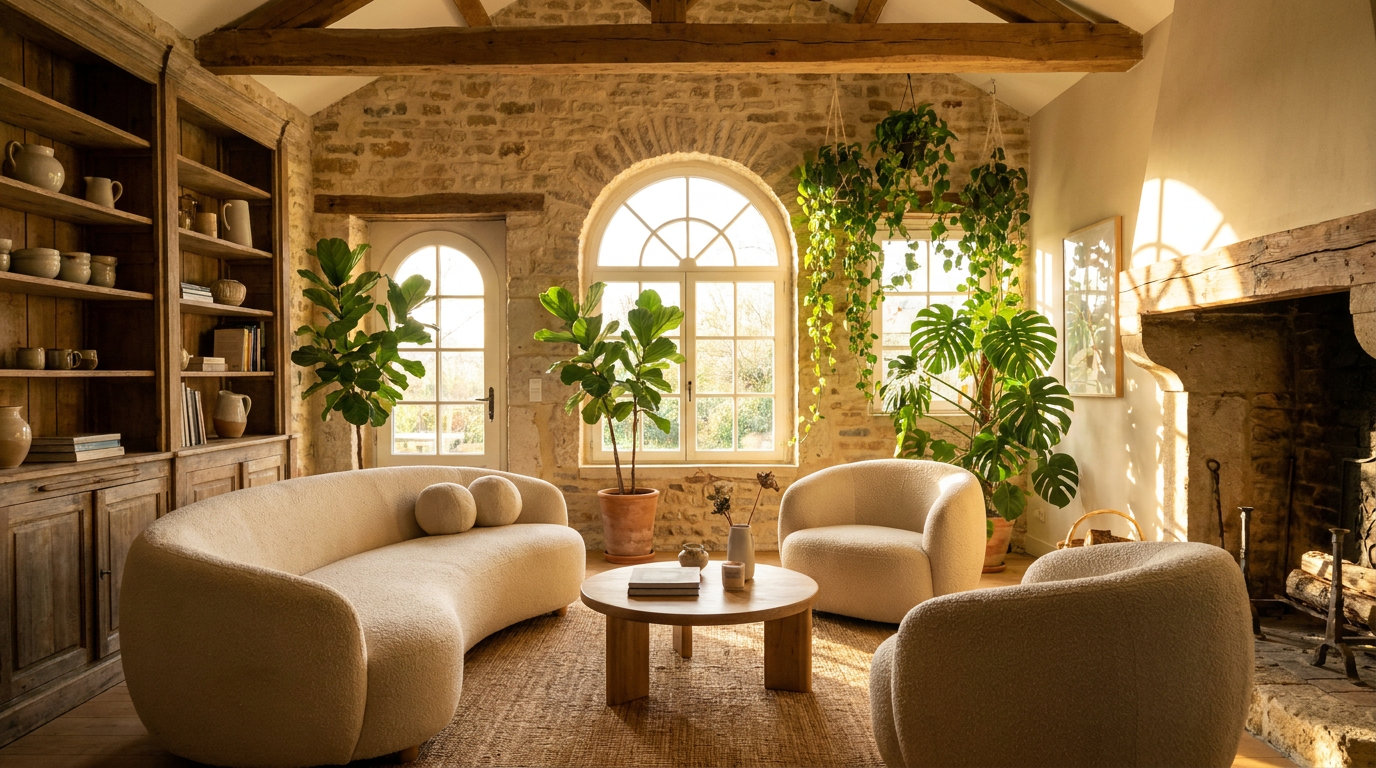
One of the most prominent neuroaesthetic principles driving this shift is the human preference for curvilinear forms over rectilinear ones. In the natural world, straight lines and sharp 90-degree angles are exceedingly rare, meaning our brains did not evolve to process them as comforting.[7]

One of the most prominent neuroaesthetic principles driving this shift is the human preference for curvilinear forms over rectilinear ones.
fMRI studies have demonstrated that participants consistently find curvilinear rooms more beautiful than rectilinear ones, and viewing them actively stimulates the brain's emotion centers. The brain processes curves and arches as safer and more approachable, a phenomenon researchers sometimes refer to as "biological resonance."[1][7]
This biological preference explains the sudden ubiquity of arched doorways, rounded kitchen islands, and "squishy," overstuffed furniture in contemporary home design. These softer forms provide a micro-dose of sensory satisfaction that sharp, clinical corners simply cannot match, signaling to the nervous system that it is safe to relax.[4]
Biophilic design is another cornerstone of the neuroaesthetic movement. While often reduced in pop culture to simply adding a few houseplants to a living room, true biophilia involves integrating the underlying patterns, rhythms, and materials of nature into the built environment.[2]
This includes maximizing access to dynamic natural light, which regulates the body's circadian rhythms and improves sleep quality, as well as utilizing natural materials like wood, stone, and linen. Studies show that touching or even just looking at natural wood grain can reduce physiological stress markers in a way that synthetic laminates do not.[4]
The impact of these principles extends far beyond residential living rooms. The Johns Hopkins International Arts + Mind Lab recently released the "Intentional Space Roadmap," a comprehensive report calling for the establishment of "Neuroarchitecture" as a standard practice in commercial, civic, and medical spaces.[3]

In healthcare settings, neuroaesthetic principles are already being used to optimize patient recovery. Empirical data shows that patients with access to daylight, natural views, and sound-dampening materials require less pain medication and heal faster than those recovering in standard, windowless clinical rooms.[2]
Similarly, in educational environments, classrooms designed with dynamic daylighting and warm wooden finishes have been linked to enhanced student concentration, higher test scores, and greater emotional stability. The design of the space actively participates in the learning process, rather than just housing it.[1]
Despite the enthusiasm, researchers acknowledge that neuroaesthetics is still a developing field. While there are universal biological baselines—such as the human need for natural light and the preference for curves—aesthetic preferences are also heavily influenced by cultural background, personal memory, and individual neurodivergence.[1][6]
Furthermore, there is a risk that "neuroaesthetics" could be co-opted as a marketing buzzword, used by brands to sell expensive, trendy furniture rather than to genuinely improve spatial well-being. Experts caution that buying a curved sofa will not magically cure chronic stress if the overall environment remains chaotic.[5]

True neuroaesthetic design does not require a luxury budget. The core tenets—decluttering to reduce visual noise, optimizing whatever natural light is available, incorporating varied tactile textures, and using color intentionally—can be applied to almost any space, from a studio apartment to a corporate office.[1]
Ultimately, the rise of neuroaesthetics represents a profound shift in how we value our environments. We are no longer just asking how a room looks for a photograph; we are asking how it makes us feel, and trusting the science that says those feelings matter to our long-term health.[3]
How we got here
1990
Neurobiologist Semir Zeki discovers that perceiving beauty activates a specific, consistent area of the brain.
2013
Researchers use fMRI scanners to prove that humans have a measurable neurological preference for curvilinear rooms over rectilinear ones.
2019
Google and Johns Hopkins debut 'A Space for Being' at Milan Design Week, using wearable tech to measure physiological responses to interior design.
2026
Neuroaesthetics moves from academic theory to mainstream interior design, driving a shift away from sterile minimalism.
Viewpoints in depth
Neuroaesthetics Researchers
Scientists focused on the measurable biological impact of spatial design.
For neuroscientists, interior design is a matter of public health. Researchers at institutions like Johns Hopkins and the University of Pennsylvania argue that our environments constantly send signals to our nervous systems. They focus on empirical data—fMRI scans, cortisol levels, and heart rates—to prove that humans are biologically wired to seek out spaces that offer safety, natural light, and organic forms, and that ignoring these needs leads to chronic low-grade stress.
Architectural Designers
Practitioners translating brain science into physical spaces.
Architects and interior designers view neuroaesthetics as a tool to validate their intuitive practices. Rather than relying solely on subjective taste, they use these scientific principles to justify design choices to clients. They emphasize practical applications, such as using acoustic dampening to reduce cognitive load, incorporating biophilic elements to speed up hospital recovery times, and softening harsh rectilinear floor plans with arches and curved furniture.
Trend Forecasters
Analysts tracking the cultural shift toward sensory luxury.
Trend analysts see the rise of neuroaesthetics as a cultural rebellion against the sterile, hyper-perfect aesthetics of the early 2020s and the recent flood of AI-generated imagery. They argue that consumers are craving 'Imperfect Minimalism' and 'Sensory Luxury'—spaces that feel lived-in, tactile, and emotionally grounding. For this camp, the science simply explains the market's sudden demand for textured fabrics, warm color palettes, and 'squishy' organic shapes.
What we don't know
- How strongly cultural background overrides universal biological preferences for certain shapes and colors.
- The exact long-term neurological benefits of living in a fully neuroaesthetic home versus a standard one.
- Whether the current preference for 'squishy' organic forms is a permanent evolutionary alignment or just a cyclical design trend.
Key terms
- Neuroaesthetics
- The scientific study of how the brain perceives, processes, and responds to beauty, art, and spatial design.
- Biophilic Design
- An architectural approach that connects building occupants more closely to nature through lighting, ventilation, and natural materials.
- Anterior Cingulate Cortex
- A region of the brain involved in processing emotion and reward, which activates when humans view aesthetically pleasing, curvilinear spaces.
- Biological Resonance
- The phenomenon where the human nervous system reacts positively to organic, tactile shapes that mimic nature.
Frequently asked
What is neuroaesthetics?
It is the scientific study of how aesthetic experiences, such as architecture and interior design, affect the human brain and nervous system.
Why are curves becoming more popular in home design?
fMRI studies show that the brain processes curvilinear forms as safer and more approachable, activating regions associated with emotional regulation and reward.
Does neuroaesthetic design cost more?
Not necessarily. While high-end materials can be expensive, the core principles—like maximizing natural light, reducing clutter, and using organic shapes—can be applied at any budget.
Sources
Source coverage
7 outlets
3 viewpoints surfaced







[1]Factlen Editorial TeamTrend Forecasters
Synthesis by Factlen editorial team
Read on Factlen Editorial Team →[2]Johns Hopkins Arts + Mind LabNeuroaesthetics Researchers
International Arts + Mind Lab Center for Applied Neuroaesthetics
Read on Johns Hopkins Arts + Mind Lab →[3]Design MilkArchitectural Designers
The Intentional Space Roadmap Re-assesses the Functional Value of Aesthetics
Read on Design Milk →[4]ArchDailyArchitectural Designers
Neuroaesthetics and Neuroarchitecture: Shaping Spaces for Mental Health
Read on ArchDaily →[5]LivingetcTrend Forecasters
Neuroaesthetics examines how the environments we live in affect us on a physical and emotional level
Read on Livingetc →[6]Penn Center for NeuroaestheticsNeuroaesthetics Researchers
The Penn Center for Neuroaesthetics: Research and Applications
Read on Penn Center for Neuroaesthetics →[7]Journal of Environmental PsychologyNeuroaesthetics Researchers
Impact of contour on aesthetic judgments and approach-avoidance decisions in architecture
Read on Journal of Environmental Psychology →
Every angle. Every day.
Get home stories with full source coverage and perspective breakdowns delivered to your inbox.