
The Rise of the 'Plyscraper': How Mass Timber is Rewriting the Rules of Architecture
Engineered wood is replacing steel and concrete in high-rise construction, promising a faster, greener, and surprisingly fire-resistant future for our cities.
By Factlen Editorial Team
- Sustainable Architects & Builders
- Advocates for mass timber as a crucial tool for decarbonizing the construction industry.
- Forestry & Climate Researchers
- Focuses on the economic and ecological benefits of timber demand for rural forests.
- Urban Development Analysts
- Monitors the practical scaling, regulatory hurdles, and economic viability of timber high-rises.
What's not represented
- · Traditional steel and concrete manufacturers
- · Local building code regulators
Why this matters
Concrete and steel account for roughly 15% of global carbon emissions. Shifting to mass timber turns buildings from carbon emitters into carbon sinks, while drastically reducing construction timelines and neighborhood disruption.
Key points
- Mass timber uses engineered wood products like CLT and Glulam to replace concrete and steel in high-rise buildings.
- Buildings constructed from mass timber act as carbon sinks, significantly reducing the construction industry's carbon footprint.
- Dense mass timber is highly fire-resistant, charring on the outside to protect its structural core.
- Prefabrication allows timber buildings to be assembled much faster and quieter than traditional construction.
- The demand for mass timber incentivizes the thinning of small-diameter trees, helping to prevent forest fires.
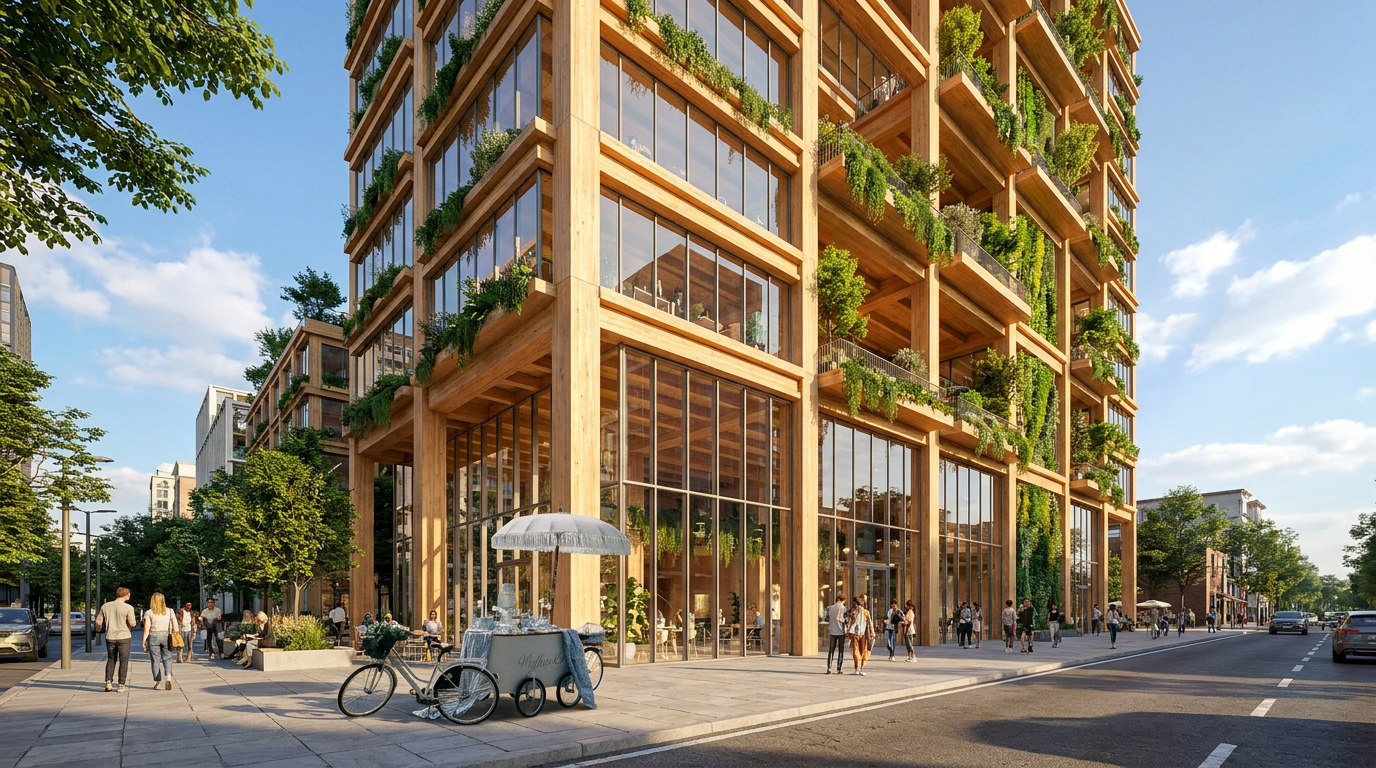
The skyline of Milwaukee is changing, and it smells like pine. The Ascent tower, standing 25 stories and 284 feet tall, currently holds the title of the world's tallest completed mass timber building.[2]
But its record won't last long. Just blocks away, developers are preparing to break ground on The Edison, a 31-story "plyscraper" that will utilize nearly 100,000 cubic feet of lumber. Meanwhile, in Sydney, the 42-story Atlassian headquarters is rising, showcasing how timber and steel can integrate on a massive scale.[1][2]
For over a century, the recipe for a skyscraper has been rigid: pour concrete and forge steel. But a quiet revolution is replacing those heavy, carbon-intensive materials with engineered wood, fundamentally rewriting the rules of modern architecture.[7][9]
The shift is driven by a pressing environmental reality. Concrete and steel production are responsible for roughly 15% of global carbon emissions. Mass timber offers a radically different math: because trees absorb carbon dioxide as they grow, buildings constructed from wood act as massive carbon sinks, locking away emissions for the lifespan of the structure.[3][4]

Studies indicate that swapping concrete and steel for mass timber can reduce a building's embodied carbon footprint by 35% to 50%. But to build a skyscraper out of wood, you cannot simply stack traditional two-by-fours. You need mass timber.[4]
"Mass timber" is an umbrella term for a family of engineered wood products designed to carry heavy structural loads. The most prominent of these materials is Cross-Laminated Timber (CLT).[5]
CLT is manufactured by taking solid wood boards and gluing them together in alternating, perpendicular layers—typically three, five, or seven plies thick. This crosswise arrangement gives the resulting panels exceptional two-way strength and rigidity, effectively creating a "super plywood" capable of serving as floors, walls, and elevator cores.[5][6]

For columns and beams, engineers rely on Glue-Laminated Timber (Glulam), where the wood grain of all layers runs parallel, maximizing strength in a single direction. Together, these components form a structural system that rivals traditional heavy materials.[5]
The most common question architects face when proposing a plyscraper is instinctual: won't it burn? The Great Chicago Fire casts a long psychological shadow over urban wood construction, making fire safety a paramount concern for regulators and the public alike.[1][9]
The most common question architects face when proposing a plyscraper is instinctual: won't it burn?
However, mass timber behaves very differently than the light-frame wood used in single-family homes. It has inherent fire resistance due to its sheer density and a chemical process called charring.[3]
When exposed to intense heat, the outer layer of a mass timber beam chars at a predictable rate of about 1.5 inches per hour. This charred layer acts as a thermal insulator, starving the fire of oxygen and protecting the structural integrity of the unburned wood inside.[3][8]

In rigorous testing conducted by the International Code Council, a seven-inch-thick CLT wall subjected to a continuous blaze lasted over three hours—exceeding current fire code requirements by a full hour.[8]
Beyond fire safety, mass timber fundamentally changes how a building is constructed. It shifts the process from on-site fabrication to off-site manufacturing, bringing factory precision to the construction site.[7]
Using detailed 3D models, structural elements are milled in factories by computer-controlled machines with millimeter precision. Openings for doors, windows, and plumbing are pre-cut before the wood ever leaves the facility.[5]
When the panels arrive on-site, they are hoisted by cranes and bolted together like a giant piece of flat-pack furniture. This prefabrication drastically reduces construction timelines, requires fewer site deliveries, and minimizes noise and neighborhood disruption.[3][6]

The timber boom also offers a surprising lifeline to rural forest economies. Sustainable mass timber is often sourced from smaller-diameter trees that are less commercially desirable for traditional lumber.[4]
Forestry experts note that selectively thinning these smaller trees is a standard practice for mitigating wildfire risks in overgrown forests. By creating a lucrative market for this thinned wood, mass timber incentivizes responsible forest management and helps fund conservation efforts.[4][7]
Despite the momentum, the plyscraper revolution faces headwinds. Wood is naturally susceptible to moisture, requiring meticulous weatherproofing during the construction phase to prevent warping or rot before the building is sealed.[6]
Furthermore, while building codes like the International Building Code have recently updated to allow timber structures up to 18 stories, local municipal codes often lag behind, requiring developers to undergo lengthy variance approval processes. Insurance underwriters, too, are still gathering actuarial data on long-term water damage, which can lead to higher premiums.[5][9]
Ultimately, the future of the skyline is likely hybrid. The tallest proposed timber towers utilize concrete foundations and steel exoskeletons paired with mass timber floors and walls. By placing the right material in the right role, architects are proving that the cities of tomorrow can be grown in the forests of today.[2][9]
How we got here
2015
Cross-Laminated Timber (CLT) is first recognized as a structural component in the International Building Code.
2022
The Ascent tower in Milwaukee is completed, becoming the world's tallest timber building at 25 stories.
2024
Portland International Airport opens its massive 9-acre mass timber roof, showcasing the material's aesthetic potential.
2025
Construction begins on The Edison in Milwaukee, set to surpass Ascent at 31 stories.
2026
Atlassian's 42-story hybrid timber headquarters continues rising in Sydney, pushing the limits of hybrid construction.
Viewpoints in depth
Sustainable Architects & Builders
Advocates for mass timber as a crucial tool for decarbonizing the construction industry.
This camp views the built environment as a primary driver of climate change, pointing to the massive emissions footprint of concrete and steel. By shifting to mass timber, they argue, cities can transform their skylines from carbon emitters into carbon sinks. They also emphasize the biophilic benefits of exposed wood, noting that natural materials in offices and homes improve occupant well-being and mental health. For these architects, timber is not just a structural alternative; it is a moral imperative for sustainable urban growth.
Forestry & Land Managers
Focuses on the economic and ecological benefits of timber demand for rural forests.
Forestry experts see the plyscraper boom as a solution to a different crisis: overgrown, fire-prone forests. Because mass timber can be manufactured from smaller, less commercially desirable trees, it creates a financial incentive for landowners to thin their forests responsibly. This thinning mitigates the risk of catastrophic wildfires. Furthermore, strong timber markets encourage private landowners to keep their land forested rather than selling it off for agricultural or suburban development, preserving long-term biodiversity.
Insurance & Risk Assessors
Maintains a cautious approach regarding long-term durability and water damage.
While acknowledging the impressive fire-testing results, the insurance and underwriting industry remains cautious about the long-term risks of mass timber. Their primary concern is not fire, but water. Wood is highly susceptible to moisture, and a plumbing leak or severe weather event during construction can cause warping, mold, or structural rot that is expensive to remediate. Until decades of actuarial data exist for modern high-rise timber structures, this camp often prices insurance premiums higher to account for the unknown variables of long-term maintenance.
What we don't know
- How mass timber skyscrapers will perform over a 100-year lifespan compared to traditional concrete structures.
- Whether the global supply chain for engineered wood can scale rapidly enough to meet surging urban demand without disrupting forest ecosystems.
- How quickly local municipalities will update their building codes to allow for timber structures above 18 stories without requiring special variances.
Key terms
- Mass Timber
- A category of engineered wood products designed to carry heavy structural loads in large buildings.
- Cross-Laminated Timber (CLT)
- Large wood panels made by gluing layers of lumber perpendicular to one another for two-way strength.
- Glulam (Glue-Laminated Timber)
- Structural beams and columns made by gluing layers of wood with the grain running in the same direction.
- Embodied Carbon
- The total greenhouse gas emissions generated by manufacturing, transporting, and assembling building materials.
- Charring
- The process where the outer layer of wood burns and turns to carbon, acting as an insulator that protects the inner core from fire.
Frequently asked
Is a mass timber building a fire hazard?
No. Unlike light-frame wood, dense mass timber chars on the outside when exposed to fire. This charred layer insulates the core, allowing the structure to maintain its strength and often exceed standard fire codes.
Is it environmentally friendly to cut down trees for buildings?
Yes, when sourced sustainably. Mass timber often uses smaller-diameter trees that are thinned to prevent wildfires, and the wood locks away carbon that would otherwise be released into the atmosphere.
Are mass timber buildings cheaper to build?
The materials themselves can sometimes cost more than concrete, but the overall project cost is often lower because prefabricated timber allows for much faster construction with less labor.
Sources
Source coverage
9 outlets
3 viewpoints surfaced









[1]Wood CentralUrban Development Analysts
North America's largest mass timber project will rise to 31 stories
Read on Wood Central →[2]Under the Hard HatSustainable Architects & Builders
Top Mass Timber Projects Reshaping Skylines
Read on Under the Hard Hat →[3]Government of CanadaForestry & Climate Researchers
Mass timber construction: sustainable and resilient
Read on Government of Canada →[4]Environmental and Energy Study InstituteForestry & Climate Researchers
Fact Sheet: Mass Timber
Read on Environmental and Energy Study Institute →[5]WoodWorksSustainable Architects & Builders
Mass Timber Products and Systems
Read on WoodWorks →[6]Stora EnsoSustainable Architects & Builders
Building the future with cross-laminated timber
Read on Stora Enso →[7]Texas A&M UniversityForestry & Climate Researchers
Mass timber takes root in Texas architecture
Read on Texas A&M University →[8]ArchDailySustainable Architects & Builders
Fire Safety in Mass Timber Buildings
Read on ArchDaily →[9]Factlen Editorial TeamUrban Development Analysts
Synthesis by Factlen editorial team
Read on Factlen Editorial Team →
Every angle. Every day.
Get home stories with full source coverage and perspective breakdowns delivered to your inbox.