
The Rise of the Green-Collar Workforce: How Clean Energy is Rewriting Vocational Education
As the global transition to renewable energy creates a massive shortage of skilled technicians, a new wave of intensive, debt-free apprenticeship programs is bypassing traditional four-year degrees.
By Kavya Nair

- Vocational Education Advocates
- Argue that skills-based, debt-free training is the most effective way to build the modern workforce and provide economic mobility.
- Clean Energy Employers
- Focus on the urgent need to close the skills gap to meet deployment targets, prioritizing hands-on competencies over traditional degrees.
- Labor Economists & Policymakers
- View green apprenticeships as a dual-purpose tool to achieve national climate goals while revitalizing the working class.
The global transition to clean energy has created a structural bottleneck that cannot be solved with capital alone: a severe shortage of human hands. As of early 2026, solar arrays are being manufactured faster than technicians can install them, and grid modernization projects face delays not from a lack of funding, but from a lack of qualified electrical workers. This friction has catalyzed a massive pivot in vocational education, giving rise to the "green-collar" workforce. Across the globe, industries are realizing that achieving ambitious climate targets requires an army of highly trained specialists who can physically build, maintain, and repair next-generation infrastructure.[3]
In 2024, global employment in the renewable energy sector reached a record 16.6 million people, with solar photovoltaics alone accounting for 7.3 million of those roles. Yet, industry analysts and the International Renewable Energy Agency warn that this growth is highly uneven and fundamentally insufficient to meet the deployment targets of the late 2020s. The traditional four-year university pipeline is proving to be misaligned with the immediate, hands-on technical requirements of these emerging industries. Companies are finding that theoretical engineering degrees, while valuable, do not produce the field-ready technicians needed to wire high-voltage charging stations or scale wind turbines.[3]
In response to this widening skills gap, a new educational architecture is scaling rapidly across community colleges, trade unions, and private training facilities. These institutions are bypassing traditional degree tracks in favor of hyper-focused, skills-based certifications and Registered Apprenticeship Programs (RAPs). This shift represents the convergence of the "new-collar" economy—roles requiring advanced technical skills but no bachelor's degree—with the urgent demands of climate infrastructure. By prioritizing practical competencies over academic credentials, this movement is democratizing access to the tech-adjacent jobs that will define the next half-century of industrial growth.[1]
The primary mechanism driving this workforce transformation is the "earn while you learn" apprenticeship model. Unlike traditional higher education, which often requires students to accumulate significant debt before ever entering the labor market, registered apprentices are paid employees from their very first day on the job. They receive rigorous on-the-job training under the direct supervision of experienced mentors, paired with specialized classroom instruction that contextualizes their field work. This dual approach ensures that the curriculum evolves in real-time alongside the rapidly changing technology they are being hired to install.
The financial outcomes for graduates of these programs are actively shifting the cultural stigma historically associated with vocational training. Workers completing federally recognized clean energy apprenticeships are entering the labor market with average starting salaries of $77,000, often carrying zero student debt. This compelling economic reality is drawing a highly diverse cohort of applicants. Career-switchers, recent high school graduates, and workers transitioning out of legacy fossil fuel industries are flocking to these programs, recognizing them as one of the most reliable pathways to the middle class in the modern economy.
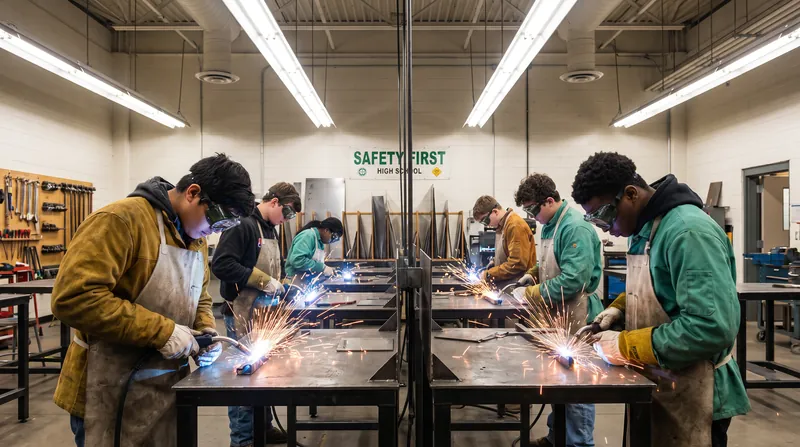
The curriculum for these modern roles looks vastly different from the traditional shop classes of the past. At institutions like Oakland Community College, an Electric Vehicle (EV) Technician certificate can now be completed in just 14 intensive weeks. The coursework bypasses internal combustion engines entirely, focusing instead on high-voltage battery diagnostics, industrial mathematics, and the Programmable Logic Controllers (PLCs) used heavily in automated manufacturing. Students graduate with a suite of industry-recognized credentials, ready to step immediately into roles maintaining the complex electronic brains of modern transportation.[4]
Similarly, Massasoit Community College recently launched a first-of-its-kind registered apprenticeship program specifically tailored for medium and heavy-duty electric vehicle technology. Backed by state workforce grants, the program trains technicians to repair and operate the next generation of electrified commercial fleets, from delivery vans to municipal buses. These hyper-specialized programs are designed in direct, ongoing collaboration with local employers, ensuring that the syllabus matches the exact hardware and software systems currently being deployed in the field, eliminating the gap between graduation and productivity.
Recognizing the critical nature of this workforce, federal and state governments are pouring unprecedented capital into vocational infrastructure. In February 2026, the U.S. Department of Labor introduced a $145 million Pay-for-Performance initiative aimed at rapidly expanding apprenticeship programs in vital sectors like nuclear energy and grid resilience. The explicit goal of this massive funding injection is to push the national baseline past one million active apprentices, providing the financial scaffolding necessary for training facilities to scale their operations and hire expert instructors.
Recognizing the critical nature of this workforce, federal and state governments are pouring unprecedented capital into vocational infrastructure.
State-level agencies are matching this federal urgency with their own targeted investments. In April 2026, the New York State Energy Research and Development Authority (NYSERDA) announced a $50 million expansion of its clean energy workforce commitment. The funding is specifically earmarked for career pathways, technical upskilling, and pre-apprenticeship programs that guarantee direct entry into union roles. By focusing on localized training hubs, states are ensuring that the economic benefits of the green transition remain within their own communities rather than being outsourced.[2]
A major catalyst for this domestic funding boom is the stringent regulatory framework attached to recent federal legislation. The Inflation Reduction Act, for instance, mandates that 15% of all labor hours on large-scale renewable energy projects must be completed by registered apprentices. This requirement has fundamentally altered the calculus for energy developers, forcing them to actively invest in local training pipelines rather than relying solely on transient, out-of-state contractors to build their solar arrays and wind farms.
To manage the heavy administrative burden of these federal requirements, industry intermediaries have stepped in to bridge the gap between employers and educators. The Apprenticeships in Clean Energy (ACE) Network, for example, expanded its footprint from just 15 participants to over 1,000 between 2023 and 2025. By centralizing the complex paperwork and standardizing the curriculum for roles like Energy Auditor and Construction Craft Laborer, the network allows smaller clean energy companies to hire apprentices without being overwhelmed by bureaucratic compliance.
As the industry matures, the definition of a "green-collar" job is also expanding to include vital indirect roles. While a wind turbine technician is clearly a direct green job, the heavy goods vehicle (HGV) driver transporting the massive turbine blades is increasingly recognized as an essential part of the green supply chain. Labor economists argue that recognizing and actively training for these indirect logistical roles is essential for preventing supply chain bottlenecks that could otherwise derail the pace of the global energy transition.
Despite the massive influx of funding and enthusiasm, scaling these vocational programs presents significant structural challenges. The most pressing issue facing community colleges is a severe shortage of qualified instructors. The professionals who possess the advanced technical knowledge required to teach high-voltage EV diagnostics or utility-scale solar integration can often earn significantly more working in the private sector than they can on a community college instructor's salary, creating a bottleneck in the number of students these programs can accept.[1]
Accessibility and retention remain additional hurdles for workforce developers. While the resulting jobs are highly lucrative, the intensive, full-time nature of the training can be difficult for individuals balancing existing low-wage jobs or childcare responsibilities. To address this, organizations like the Building Performance Association are piloting programs that include comprehensive wraparound services. By providing stipends, transportation assistance, and childcare support, these initiatives ensure that historically underrepresented populations can actually complete the training and enter the clean energy workforce.
The global picture closely mirrors these domestic workforce efforts. In the United Kingdom, entities like Energy & Utility Skills are partnering directly with national water and power companies to standardize "green skills" across the entire utility workforce. Similarly, in India, the National Skill Development Corporation is aggressively expanding programs that train thousands of rural youths specifically as solar photovoltaic technicians, recognizing that emerging economies have the opportunity to leapfrog traditional fossil-fuel infrastructure entirely by building a native green-collar workforce.[1]
Ultimately, the rapid rise of the green-collar workforce represents a fundamental realignment of how modern society values and delivers technical education. By directly linking specialized, debt-free training to high-paying, future-proof careers, the clean energy transition is inadvertently solving one of the most persistent structural issues in the modern labor market. It is proving that the most valuable education is not always the one that takes four years and costs a fortune, but the one that directly answers the needs of the physical world.[1]
As the physical infrastructure of the 21st century is painstakingly rebuilt, the technicians, electricians, and operators doing the actual work are stepping into roles that offer both profound economic mobility and a tangible stake in global sustainability. The bottleneck of human capital is slowly widening, paved by a new generation of vocational training that treats the trades not as a fallback option for the unacademic, but as the highly skilled, well-compensated vanguard of the new global economy.[1]
Key points
- Global renewable energy employment reached 16.6 million in 2024, but a severe skills gap threatens future deployment targets.
- Community colleges are launching intensive 14-week certificates for roles like EV technicians, bypassing traditional four-year degrees.
- Registered apprenticeships offer an "earn while you learn" model, with graduates securing average starting salaries of $77,000.
- Federal and state governments are injecting hundreds of millions of dollars into vocational infrastructure to meet climate mandates.
Why this matters
The surge in green-collar apprenticeships offers a lucrative, debt-free pathway to economic mobility for millions of workers, fundamentally shifting the landscape of higher education and ensuring the physical infrastructure of the climate transition actually gets built.
Key terms
- Green-Collar Job
- A role directly involved in environmental protection, renewable energy production, or sustainability infrastructure.
- Registered Apprenticeship (RAP)
- A federally or state-validated training program combining paid on-the-job learning with specialized classroom instruction.
- New-Collar Job
- A role that requires advanced technical skills and certifications, but not necessarily a traditional four-year college degree.
- Programmable Logic Controller (PLC)
- An industrial computer control system used heavily in automated manufacturing and electric vehicle infrastructure.
Frequently asked
Do I need a background in auto mechanics to become an EV technician?
No. Most modern EV technician certificate programs are designed for beginners and focus heavily on electrical systems and software rather than traditional combustion engines.
Are green-collar apprenticeships paid?
Yes. Registered Apprenticeship Programs operate on an "earn while you learn" model, meaning participants receive a wage that increases as they gain skills and experience.
How long does it take to get certified?
While full apprenticeships can take two to five years, many community colleges now offer intensive pre-apprenticeship or foundational certificates that take as little as 14 weeks to complete.
Sources
Source coverage
4 outlets
3 viewpoints surfaced




- [1]Factlen Editorial Team
Synthesis by Factlen editorial team
Read on Factlen Editorial Team → - [2]NYSERDALabor Economists & Policymakers
Clean Energy Workforce Commitment Expanded With $50 Million In New Funding
Read on NYSERDA → - [3]International Renewable Energy AgencyLabor Economists & Policymakers
Renewable Energy and Jobs: Annual Review 2026
Read on International Renewable Energy Agency → - [4]Oakland Community CollegeVocational Education Advocates
Electric Vehicle (EV) Technician Training Program
Read on Oakland Community College →
Comments

Every angle. Every day.
Get education stories with full source coverage and perspective breakdowns delivered to your inbox.