
The Rise of Hyper-Wellness Architecture in Ultra-Luxury Real Estate
High-end homebuyers in 2026 are trading flashy aesthetics for biological optimization, driving a boom in homes equipped with medical-grade air filtration, circadian lighting, and dedicated bio-hacking suites.
By Factlen Editorial Team
- Wellness Architects
- Designers focused on how the built environment directly impacts human physiology and psychology.
- Real Estate Developers
- Builders and investors tracking market demand and property valuations.
- Longevity Advocates
- Homeowners and health experts prioritizing biological optimization and recovery.
What's not represented
- · Middle-income homebuyers priced out of wellness tech
- · Environmental critics questioning the energy load of constant HVAC and climate-controlled plunges
Why this matters
The environments we live in dictate our long-term health, sleep quality, and daily energy levels. As medical-grade wellness technology becomes standard in luxury homes, these innovations are beginning to trickle down, setting new expectations for how all future housing can actively support human biology.
Key points
- Luxury homebuyers are prioritizing health and longevity over traditional flashy aesthetics.
- Medical-grade HVAC systems with UV-C filtration are becoming standard in high-end builds.
- Circadian lighting systems are being used to regulate melatonin and cortisol for better sleep.
- Biophilic design integrates natural materials and landscape sightlines to reduce stress.
- Traditional home gyms are being replaced by 'bio-hacking suites' featuring cold plunges and saunas.
The definition of residential luxury has undergone a quiet but radical transformation. Gone are the days when a sprawling footprint, gold fixtures, and a cavernous home theater were the ultimate status symbols. In 2026, the most coveted amenities in high-end real estate are entirely invisible, focusing instead on how a space makes its inhabitants feel.[4][7]
Ultra-high-net-worth buyers are increasingly viewing their homes not just as shelters or financial investments, but as active participants in their health and longevity. This shift has given rise to "wellness architecture," a design philosophy that places the human nervous and respiratory systems at the center of the floor plan, prioritizing biological optimization over pure aesthetics.[1][5]
The financial momentum behind this shift is staggering. According to the Global Wellness Institute, the wellness real estate sector is projected to exceed $1 trillion by 2029. Developers and architects are racing to meet the demand for spaces that actively support human biology, moving beyond the old paradigm of simply mitigating environmental harm.[1]
The most critical component of this new architectural standard is medical-grade air quality. The pandemic permanently altered how buyers perceive shared air and ventilation, transforming hospital-grade HVAC systems from a niche, eccentric request into a baseline requirement for luxury builds.[6][7]

In top-tier urban condominiums and sprawling estates alike, developers are installing systems that rival surgical suites. These setups bring in outside air, pass it through 12-inch deep HEPA filters capable of capturing 99.99% of pathogens, and treat it with ultraviolet-C (UV-C) light to neutralize biological contaminants before they ever reach the living space.[6]
The metric of choice for these advanced systems is Air Changes Per Hour (ACH). While standard luxury apartments might recycle air every four to five hours, the newest wellness-focused buildings boast a rate of one complete air change per hour, ensuring that residents never breathe stale, cross-contaminated, or VOC-heavy air.[6][7]
Beyond the air they breathe, buyers are meticulously optimizing the light they absorb. Natural light has always been a premium real estate asset, but wellness architecture treats it as a biological necessity rather than just a feature that makes a room look spacious.[2][3]
Enter circadian lighting systems. These dynamic lighting networks are programmed to mimic the shifting color temperature and intensity of the sun throughout the day. In the morning, the lights emit cooler, blue-toned spectrums designed to suppress melatonin and boost cortisol, naturally enhancing focus and energy.[3][4]
These dynamic lighting networks are programmed to mimic the shifting color temperature and intensity of the sun throughout the day.
As evening approaches, the system automatically transitions to warm, amber hues. This shift signals the brain to begin melatonin production, preparing the body for restorative sleep. Lighting designers note that these systems are no longer viewed as decorative; they are prescribed, structural interventions for sleep optimization.[2][3]

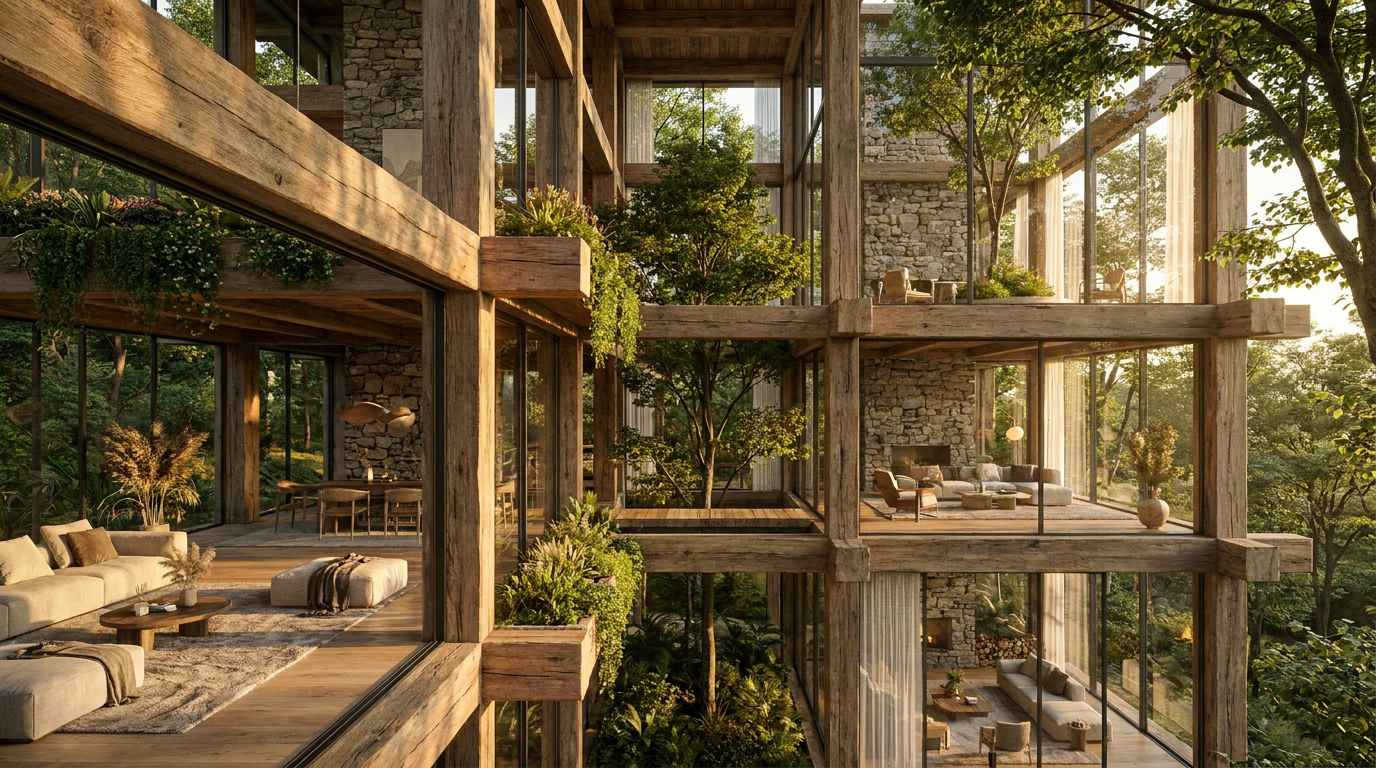
This biological approach extends to the physical materials and layout of the home, a concept known as biophilic design. True biophilia goes far beyond placing a few potted fiddle-leaf figs in a living room; it is the systematic integration of natural systems into the built environment.[2][5]
Architects practicing genuine biophilic design treat the surrounding landscape as the primary floor plan. Window placements are dictated by sightlines to mature trees, seasonal meadows, or water features, ensuring inhabitants are never more than a glance away from a living ecosystem.[2]
Material selection is equally rigorous. There is a marked shift toward "quiet luxury"—raw wood, unpolished stone, and natural fibers that develop a patina over time. Designers are actively avoiding synthetic materials that off-gas volatile organic compounds (VOCs) or shed microplastics, favoring surfaces that breathe and age gracefully alongside the homeowner.[1][4]

The traditional home gym has also been rendered largely obsolete, replaced by the "bio-hacking suite." Affluent buyers, particularly entrepreneurs, executives, and athletes, are demanding multi-functional recovery environments that look more like high-end longevity clinics than standard workout rooms.[3][4]
These suites routinely feature infrared saunas for cellular repair, commercial-grade cold plunge pools for inflammation reduction, and acoustic meditation rooms designed to block out all external noise. The focus has shifted entirely from mere physical exertion to comprehensive physiological recovery.[3][4]
Even the broader layout of the home is adapting to this wellness-first mindset. The vague "bonus rooms" of the past decade are being replaced by purpose-built flex spaces—yoga decks, soundproofed sleep sanctuaries, and dedicated climate-controlled environments for specific therapies.[4][5]

Despite the enthusiasm, the hyper-wellness trend faces practical hurdles. The maintenance required for medical-grade HVAC systems and complex circadian lighting networks is substantial. Filters must be meticulously changed, sensors calibrated, and software updates for integrated smart-home wellness tech managed to prevent glitches.[6][7]
Furthermore, there is an open question about the longevity of highly specific "bio-hacking" hardware. While natural light and clean air will always be intrinsically valuable, a built-in cryotherapy chamber or specialized IV-therapy station might feel as dated in a decade as a 1990s indoor racquetball court does today.[7]
Nevertheless, the core philosophy of wellness architecture appears permanent. By prioritizing physiological health, clean air, and natural rhythms, the luxury real estate market is redefining what it means to live well. In 2026, the ultimate luxury is no longer what a home shows the outside world, but how it heals the people inside it.[1][7]
How we got here
2020
The pandemic forces a global reevaluation of indoor air quality and residential ventilation.
2022
Basic biophilic design, such as living walls and indoor gardens, becomes a mainstream luxury request.
2024
Circadian lighting systems transition from commercial office spaces into high-end residential builds.
2026
The 'bio-hacking suite' replaces the traditional home gym as the standard for ultra-luxury wellness estates.
Viewpoints in depth
Wellness Architects
Designers focused on how the built environment directly impacts human physiology and psychology.
For this camp, a home is essentially a health intervention. They argue that traditional luxury—characterized by synthetic materials, static artificial lighting, and sealed environments—is actively detrimental to human health. Their design philosophy centers on the nervous system, advocating for spaces that lower cortisol, encourage deep sleep, and seamlessly integrate with the natural world through biophilic principles.
Real Estate Developers
Builders and investors tracking market demand and property valuations.
Developers view wellness architecture through the lens of return on investment. With the wellness real estate market projected to hit $1 trillion, they recognize that health-centric amenities are the new standard for commanding premium prices. For them, features like hospital-grade HVAC and bio-hacking suites are necessary differentiators in a highly competitive ultra-luxury market, ensuring properties don't become obsolete.
Longevity Advocates
Homeowners and health experts prioritizing biological optimization and recovery.
This demographic treats their residence as a tool for extending healthspan. They are less concerned with the aesthetic appeal of a marble foyer and more focused on the measurable data of their environment—air purity levels, water filtration metrics, and the availability of daily recovery tools like cold plunges and infrared saunas to manage physical stress and inflammation.
What we don't know
- Whether highly specific bio-hacking hardware will become obsolete as longevity science evolves.
- How quickly these medical-grade architectural standards will become affordable for the broader middle-class housing market.
- The long-term energy grid impact of running continuous medical-grade HVAC and climate-controlled recovery suites in residential zones.
Key terms
- Biophilic Design
- An architectural approach that connects building occupants more closely to nature through natural lighting, ventilation, landscape integration, and raw materials.
- Circadian Lighting
- Artificial lighting systems designed to mimic the natural progression of sunlight to support the human body's internal 24-hour sleep-wake cycle.
- Air Changes Per Hour (ACH)
- A metric measuring how many times the total volume of air in a room or building is completely replaced with filtered outside air in one hour.
- Volatile Organic Compounds (VOCs)
- Harmful chemicals emitted as gases from certain synthetic building materials, paints, and furnishings that can degrade indoor air quality.
Frequently asked
What makes a home's air filtration 'medical-grade'?
It typically involves multi-stage HEPA filtration capable of capturing 99.99% of pathogens, combined with UV-C light to neutralize biological contaminants, rather than just standard dust filters.
How does circadian lighting actually work?
Smart lighting systems automatically adjust their color temperature and brightness throughout the day, using cool blue light in the morning to boost alertness and warm amber light at night to promote sleep.
Is biophilic design just about adding house plants?
No. True biophilic design integrates natural light, raw materials like unpolished stone and wood, and architectural sightlines that connect interior spaces directly to the outdoor landscape.
Can these wellness features be retrofitted into older homes?
While some features like standalone medical air purifiers or smart bulbs can be added easily, true wellness architecture—like whole-home circadian networks and integrated cold plunges—often requires extensive renovation.
Sources
Source coverage
7 outlets
3 viewpoints surfaced







[1]ForbesReal Estate Developers
Wellness Architecture And Design Trends For 2026
Read on Forbes →[2]Social Life MagazineWellness Architects
Beyond Trend: Biophilic Design as the New Standard in Hamptons Luxury
Read on Social Life Magazine →[3]The Petrie TeamLongevity Advocates
The Rise of the 'Wellness Estate' in 2026
Read on The Petrie Team →[4]Nelson Brothers Real EstateReal Estate Developers
Wellness Architecture Will Dominate High-End Homes in 2026
Read on Nelson Brothers Real Estate →[5]Simran Boparai ArchitectsWellness Architects
Wellness-Oriented Architecture: Redefining Luxury
Read on Simran Boparai Architects →[6]Surgically Clean AirLongevity Advocates
Residential Air Purification: Healthcare Technology for Home
Read on Surgically Clean Air →[7]Factlen Editorial Team
Synthesis by Factlen editorial team
Read on Factlen Editorial Team →
Every angle. Every day.
Get real estate stories with full source coverage and perspective breakdowns delivered to your inbox.