
The Rise of Astrotourism: Why Travelers Are Chasing the Darkest Skies on Earth
As light pollution erases the Milky Way for 80 percent of North Americans, a booming 'astrotourism' industry is turning pristine, unpolluted night skies into the decade's most sought-after travel commodity.
By Factlen Editorial Team
- Conservationists & Astronomers
- Advocates for preserving the night sky to protect nocturnal ecosystems and scientific observation.
- Hospitality & Tourism Industry
- Views pristine darkness as a premium, highly marketable asset that drives luxury and rural travel.
- Public Health & Science
- Emphasizes the biological necessity of darkness for human circadian rhythms and mental well-being.
- Macro Trend Analysts
- Examines the intersection of the travel economy, environmental conservation, and human health.
What's not represented
- · Indigenous communities whose traditional sky-lore and cultural heritage are tied to the celestial landscapes being commercialized.
- · Local residents in rural dark-sky communities who may face increased traffic and housing costs due to the influx of astrotourists.
Why this matters
With artificial light disrupting both human sleep cycles and nocturnal ecosystems, the push to protect dark skies is about more than just stargazing—it is a growing economic engine that incentivizes rural communities to reverse decades of light pollution.
Key points
- Astrotourism has emerged as a major 2026 travel trend, driven by recent space missions and a desire to escape urban light pollution.
- Approximately 99% of people in the U.S. and Europe live under artificial skyglow, making the Milky Way invisible to most.
- The Bortle Scale is used to measure night sky brightness, with astrotourists seeking out pristine Class 1 environments.
- DarkSky International has certified over 200 Dark Sky Parks, Reserves, and Sanctuaries globally to protect nocturnal environments.
- The luxury hospitality industry is adapting by offering resident astronomers, private observatories, and dark-sky compliant lodging.
- Astrotourism provides vital economic incentives for rural communities to adopt responsible, downward-facing lighting ordinances.
When NASA's Artemis II crew splashed down in the Pacific Ocean, completing the first crewed journey to the vicinity of the moon in over fifty years, something shifted in the cultural conversation about space. Combined with a historically intense solar maximum that has pushed vibrant auroras to unusually low latitudes, the cosmos has suddenly felt closer and more relevant. For a rapidly growing demographic of travelers, watching a rocket launch on a screen is no longer enough. They want to experience the universe firsthand, fueling a massive surge in a travel sector known as astrotourism.[2][7]
Astrotourism—sometimes referred to as noctourism—is travel centered entirely around experiencing pristine dark skies, stargazing, and celestial phenomena. It has evolved from a niche hobby for amateur astronomers hauling heavy telescopes into a mainstream, highly sought-after luxury experience. Recent industry data reveals that 62 percent of travelers are now actively seeking out darker-sky destinations for their vacations. This shift represents a profound change in how people choose their getaways, prioritizing the quiet awe of the night over the bustling nightlife of illuminated cities.[1][2]
The driving force behind this trend is a quiet environmental crisis: the steady erasure of the night sky. Since the widespread adoption of artificial electric lighting, the natural darkness that defined human nights for millennia has been pushed to the absolute fringes of the map. Today, an estimated 99 percent of people living in the United States and Europe reside under skies polluted to some degree by artificial skyglow. The stars have not disappeared, but the atmospheric canvas between them has been painted over by the collective glare of modern civilization.[2][6]
The statistics are stark. For roughly 80 percent of North Americans, the Milky Way—the glowing, textured band of our home galaxy—is completely invisible from their doorsteps. A sight that was once a universal human inheritance, shared by every ancestor across every culture, has become a geographic rarity. Consequently, true darkness is now a commodity. To see the universe as it actually looks, modern citizens must pack their bags, secure a passport, and travel hundreds or thousands of miles away from the urban centers they call home.[2][5]

To understand what astrotourists are escaping, one must understand the mechanics of light pollution. It is generally categorized into three distinct forms. 'Skyglow' is the bright, diffuse halo that hovers over urban and suburban areas, caused by artificial light scattering off moisture and dust particles in the atmosphere. 'Glare' is the excessive, unshielded brightness that causes visual discomfort and reduces contrast. Finally, 'light trespass' occurs when poorly aimed lighting spills over into areas where it is neither intended nor needed, disrupting both human sleep and nocturnal ecosystems.[5]
To quantify this loss of darkness, astronomers and conservationists rely on the Bortle Scale. Established in 2001 by amateur astronomer John Bortle, the nine-level numeric scale measures the brightness of the night sky and the observability of celestial objects. A Class 9 sky represents an inner-city environment where the sky is brilliantly lit, the background is a bright yellow-white, and only the moon and a handful of the brightest planets are visible to the naked eye. Most suburban environments hover around a Class 5 or 6, where the Milky Way is entirely washed out.[4][5]
At the opposite end of the spectrum is a Class 1 sky, the holy grail of astrotourism. In a Class 1 environment, the sky is so profoundly dark that the Milky Way bursts with color, texture, and intricate dust lanes. The starlight is actually bright enough to cast obvious, distinct shadows on the ground. In these pristine locations, the sheer density of visible stars can be overwhelming, often making familiar constellations difficult to pick out against the crowded cosmic backdrop. Finding a Class 1 sky today requires deliberate, dedicated travel.[5]

The pursuit of these dark skies is not merely aesthetic; it is increasingly recognized as a biological necessity. Researchers studying the impacts of light pollution note that artificial light at night severely disrupts human circadian rhythms. The brain's production of melatonin—a crucial hormone that regulates sleep cycles and immune function—is triggered by natural darkness. Chronic exposure to artificial skyglow and blue light has been linked to increased rates of sleep disorders, metabolic issues, and heightened stress levels.[4]
The pursuit of these dark skies is not merely aesthetic; it is increasingly recognized as a biological necessity.
In this context, astrotourism functions as a form of 'darkness retreat.' By traveling to environments free from artificial light, visitors allow their biological clocks to reset. Industry experts note that many travelers initially turned to stargazing during the pandemic as a coping mechanism for stress, finding profound mental health benefits in the quiet stillness of the night. The vast, silent expanse of a truly dark sky offers a sense of perspective and mindfulness that is increasingly difficult to find in a hyper-connected, screen-dominated world.[4][6]
Recognizing the urgent need to protect these vanishing environments, the nonprofit organization DarkSky International established the International Dark Sky Places (IDSP) certification program. Modeled after UNESCO World Heritage Sites, the IDSP program rigorously evaluates and certifies locations around the globe that have taken concrete steps to preserve their nocturnal environments. To date, the organization has certified over 200 locations across 22 countries, providing a reliable roadmap for astrotourists seeking guaranteed darkness.[3]
The certification program is divided into several distinct categories, each serving a different conservation purpose. 'Dark Sky Parks' are typically publicly accessible lands, such as national or state parks, that possess exceptional starry nights and actively promote astronomy education. High-profile examples include Death Valley National Park and Arches National Park in the United States, where park rangers regularly host telescope viewing sessions and enforce strict lighting regulations within the park boundaries.[3]
'Dark Sky Reserves' operate on a much larger scale. These are massive, regional partnerships consisting of a dark 'core' zone surrounded by populated peripheral areas. The communities in the periphery agree to strict lighting ordinances to protect the core's darkness. New Zealand’s Aoraki Mackenzie International Dark Sky Reserve is a premier example. Spanning 4,300 square kilometers, it is the largest reserve in the Southern Hemisphere and strictly regulates local lighting to protect the world-class viewing conditions at the Mt John Observatory.[3][5]

The most exclusive and remote designation is the 'Dark Sky Sanctuary.' Unlike parks or reserves, sanctuaries are situated in geographically isolated locations with almost zero threat of encroaching light pollution. They are not typically designed for mass tourism; rather, they are protected primarily for their pristine scientific, natural, and cultural value. Visiting a sanctuary often requires significant logistical planning, making them the ultimate bucket-list destination for dedicated astrotourists.[3]
The luxury hospitality industry has aggressively pivoted to meet this surging demand. Recognizing that a clear night sky is a rapidly appreciating asset, high-end resorts and lodges are transforming darkness into their most coveted amenity. In 2023, DarkSky International even introduced a 'DarkSky Lodging' certification to recognize properties that adhere to strict, dark-sky-compliant lighting standards while offering exceptional stargazing experiences to their guests.[1][6]
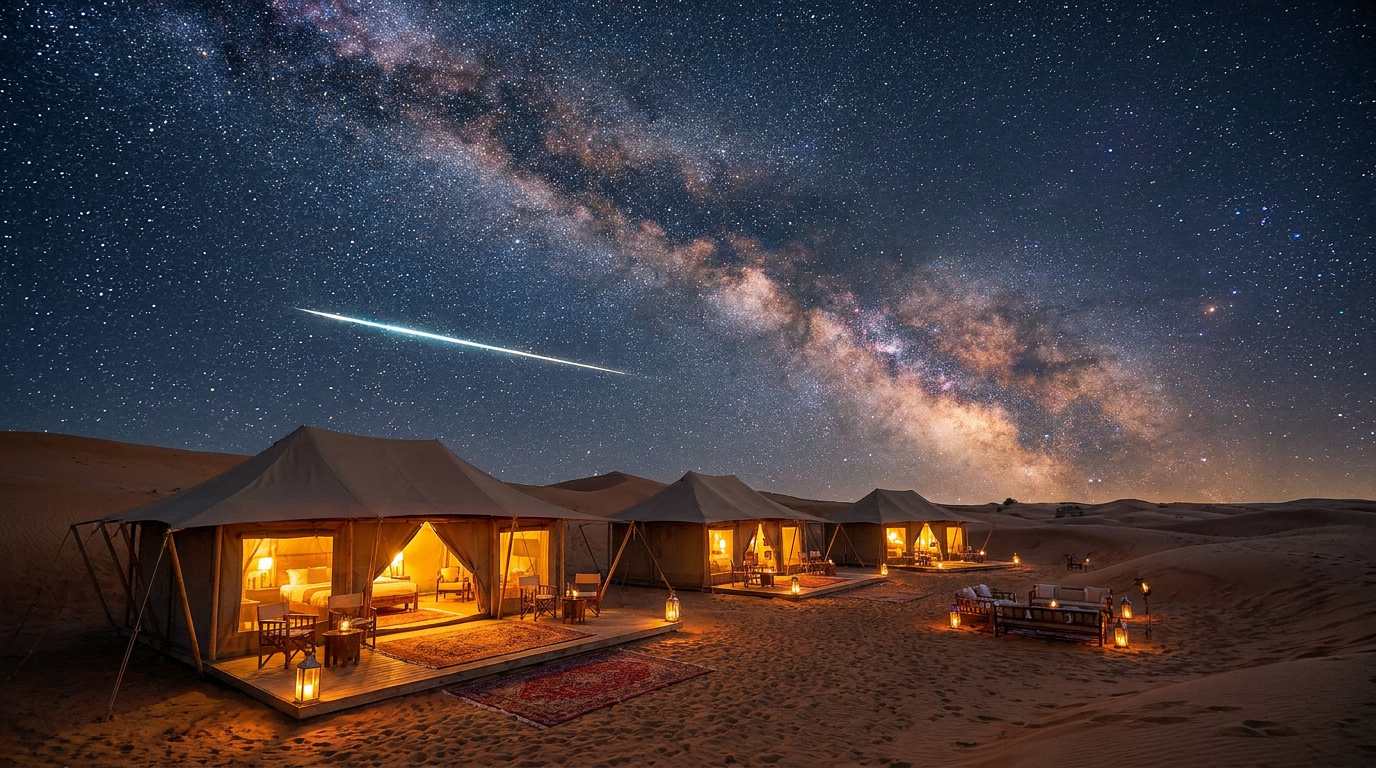
The amenities offered at these properties go far beyond a decorative telescope in the lobby. Luxury hotels in Chile's Atacama Desert, southern Iceland, and the American Southwest are now hiring full-time resident astronomers to guide guests through the cosmos. Properties are constructing private, state-of-the-art observatories on-site, offering open-air 'star beds' for sleeping outside, and designing suites with massive glass ceilings so guests can watch meteor showers from the comfort of a heated bed.[1]
This boom in astrotourism is providing a vital economic lifeline to rural and remote communities. Because dark skies inherently require a lack of urban density, the financial benefits of noctourism flow directly to out-of-the-way destinations that might otherwise be bypassed by traditional tourism circuits. Stargazers require lodging, meals, and local guides, injecting millions of dollars into local economies while incentivizing those communities to view their unpolluted skies as a lucrative natural resource.[4][6]

However, to capitalize on this economic opportunity, communities must commit to 'responsible lighting' practices. This involves retrofitting municipal streetlights and commercial signs to ensure they are fully shielded, pointing light only downward where it is needed. It also requires adopting warmer color temperatures—typically amber or soft white—that scatter less in the atmosphere and are less disruptive to nocturnal wildlife than harsh, blue-rich LED lights.[3][5]
When successfully implemented, these dark-sky initiatives create a rare, perfect alignment of economic and environmental interests. Local businesses thrive on the influx of astrotourists, travelers are rewarded with breathtaking, bucket-list views of the cosmos, and nocturnal ecosystems—from migrating birds to navigating sea turtles—are protected from the devastating disorientation caused by artificial light. The night sky becomes a protected heritage site, sustained by the very people who travel to see it.[4][5]
As the global stargazing tourism market marches toward a projected multi-billion-dollar valuation in the coming decade, the astrotourism movement offers a profound lesson in modern travel. In an era where destinations often compete by building bigger attractions and brighter spectacles, the most valuable and awe-inspiring experience a place can offer might simply be the pristine, unadulterated absence of artificial light.[2][7]
How we got here
2001
Amateur astronomer John Bortle introduces the Bortle Scale to quantify the brightness of the night sky.
2007
Natural Bridge National Monument in the U.S. becomes the first certified International Dark Sky Park.
2012
New Zealand establishes the Aoraki Mackenzie International Dark Sky Reserve, protecting 4,300 square kilometers of nocturnal environment.
2023
DarkSky International launches the 'DarkSky Lodging' certification to recognize hospitality venues that protect the night sky.
2024-2026
A historically intense solar maximum pushes vibrant auroras to lower latitudes, fueling a massive global surge in astrotourism.
Viewpoints in depth
Conservationists & Astronomers
Advocates for preserving the night sky to protect nocturnal ecosystems and scientific observation.
For the scientific and conservation communities, the rise of astrotourism is a crucial vehicle for environmental protection. Organizations like DarkSky International emphasize that light pollution is not just an aesthetic loss, but a severe ecological threat that disrupts the migratory patterns of birds, the navigation of sea turtles, and the hunting habits of nocturnal predators. By attaching a clear economic value to darkness, conservationists can successfully lobby local governments to implement strict lighting ordinances, effectively using tourism dollars to fund the preservation of the natural nighttime environment.
Hospitality & Tourism Industry
Views pristine darkness as a premium, highly marketable asset that drives luxury and rural travel.
The hospitality sector views the disappearance of the night sky as a unique market opportunity. With 62 percent of travelers expressing interest in darker-sky destinations, luxury brands are investing heavily in 'noctourism' infrastructure. This perspective focuses on the commercial viability of the trend, arguing that high-end amenities—like resident astronomers, private observatories, and glass-roofed suites—elevate stargazing from a rugged outdoor activity to a premium experiential luxury. For rural communities, this industry push provides a lucrative alternative to traditional, high-volume daytime tourism.
Public Health & Science
Emphasizes the biological necessity of darkness for human circadian rhythms and mental well-being.
Public health researchers approach the dark-sky movement through the lens of human biology. This camp points to mounting evidence that chronic exposure to artificial skyglow and blue light severely disrupts circadian rhythms, suppressing the brain's production of melatonin. From this viewpoint, astrotourism functions as a necessary 'darkness retreat'—a way for modern citizens to reset their biological clocks, improve sleep quality, and reduce the chronic stress associated with hyper-illuminated, screen-dominated urban environments.
What we don't know
- Whether the rapid commercialization of astrotourism will eventually introduce new forms of light pollution to currently pristine areas.
- How the deployment of massive low-Earth orbit satellite constellations will impact the long-term viability of ground-based stargazing tourism.
- The exact timeline for when the global astrotourism market will peak, given its heavy reliance on cyclical celestial events like the solar maximum.
Key terms
- Astrotourism
- A specialized form of travel centered around experiencing pristine dark skies, stargazing, and observing celestial phenomena.
- Bortle Scale
- A nine-level numeric scale used to measure the brightness of the night sky and the observability of celestial objects.
- Skyglow
- The bright, artificial halo that appears over urban areas at night, caused by light scattering off moisture and dust in the atmosphere.
- Light Trespass
- Artificial light that spills over into areas where it is neither intended nor needed, disrupting human sleep and nocturnal wildlife.
- Circadian Rhythm
- The natural, internal biological process that regulates the sleep-wake cycle and repeats roughly every 24 hours, heavily influenced by light and dark.
Frequently asked
What is the Bortle Scale?
The Bortle Scale is a nine-level numeric system used by astronomers to measure the brightness of the night sky. It ranges from Class 9, representing heavily light-polluted inner-city skies, to Class 1, which denotes an exceptionally dark, pristine sky where the Milky Way casts shadows.
Do I need a telescope for astrotourism?
No. In true dark sky destinations, the lack of light pollution allows visitors to see the Milky Way, meteor showers, and thousands of stars clearly with the naked eye. However, many dark sky parks and luxury lodges provide telescopes and guided viewing sessions.
What is the difference between a Dark Sky Park and a Sanctuary?
A Dark Sky Park is typically a publicly accessible area, like a national park, that promotes astronomy education. A Dark Sky Sanctuary is a much more remote, isolated location protected primarily for its fragile scientific and natural value, rather than mass public visitation.
Why is astrotourism surging in 2026?
The trend is being driven by a combination of factors, including the historic 2024-2026 solar maximum which has increased aurora visibility, renewed public interest in space following the Artemis missions, and a growing desire for wellness-focused 'darkness retreats'.
Sources
Source coverage
7 outlets
4 viewpoints surfaced







[1]ForbesHospitality & Tourism Industry
The Rise Of Astrotourism: 25 Hotels Leading The Stargazing Trend
Read on Forbes →[2]InteleTravelHospitality & Tourism Industry
What Is Astrotourism? The Stargazing Travel Trend You Need to Know
Read on InteleTravel →[3]DarkSky InternationalConservationists & Astronomers
International Dark Sky Places certification program
Read on DarkSky International →[4]Utah State UniversityPublic Health & Science
Utah Home to Greatest Concentration of Recognized Dark Sky Places
Read on Utah State University →[5]Sanctuary New ZealandConservationists & Astronomers
Dark Sky & Astrotourism - Aoraki Mackenzie
Read on Sanctuary New Zealand →[6]Illuminating Engineering SocietyPublic Health & Science
Dark Places: The Rise of Noctourism
Read on Illuminating Engineering Society →[7]Factlen Editorial TeamMacro Trend Analysts
Synthesis by Factlen editorial team
Read on Factlen Editorial Team →
Every angle. Every day.
Get travel stories with full source coverage and perspective breakdowns delivered to your inbox.