
The Rise of Astrotourism: Why Travelers Are Chasing the Darkest Skies on Earth
As light pollution obscures the stars for the vast majority of the developed world, a booming travel trend is sending millions to certified 'Dark Sky Parks' to reconnect with the cosmos.
By Factlen Editorial Team
- Conservationists & Ecologists
- View the preservation of dark skies as a critical ecological imperative to protect nocturnal wildlife from the devastating impacts of artificial light.
- Astrotourism Operators
- See dark skies as a sustainable, high-value economic engine that brings vital tourism revenue to remote and rural communities.
- Amateur Astronomers
- Focus on the technical preservation of Bortle 1 and 2 skies, advocating for strict lighting ordinances to maintain visibility of deep-space objects.
What's not represented
- · Lighting Manufacturers
- · Urban Planners
Why this matters
With artificial light erasing the night sky for 99% of Americans and Europeans, true darkness has become a rare natural resource. The astrotourism boom is not only reconnecting humans with the universe, but creating powerful economic incentives to reverse light pollution and protect nocturnal ecosystems.
Key points
- Astrotourism is surging as travelers seek out pristine night skies free from artificial light pollution.
- 99% of people in the US and Europe live under light-polluted skies, making true darkness a rare commodity.
- The Bortle Scale measures sky darkness from 1 (pristine) to 9 (inner-city), with tourists hunting for Class 1 and 2 skies.
- DarkSky International has certified over 200 Dark Sky Places globally that actively protect their nocturnal environments.
- Beyond stargazing, preserving dark skies is critical for the survival and navigation of nocturnal wildlife.
- Astrotourism provides a powerful economic incentive for remote communities to implement dark-sky-friendly lighting policies.
For most of human history, the night sky was a universal inheritance—a glittering canopy that guided navigation, inspired mythology, and dictated the rhythms of agriculture. Today, it is an endangered environment. According to research by DarkSky International, an astonishing 99 percent of people living in the United States and Europe now reside under skies polluted by artificial light. For roughly 80 percent of North Americans, the Milky Way is entirely invisible from their front doors, washed out by the relentless amber and white glow of urban sprawl.[2][3]
This profound loss of darkness has birthed one of the defining travel trends of 2026: astrotourism. Rather than booking trips based on daytime landscapes, a rapidly growing demographic of travelers is planning vacations entirely around the absence of light. They are venturing to remote deserts, high-altitude plateaus, and protected wilderness areas simply to look up and experience the cosmos as our ancestors did.[1][6]
The travel industry has taken notice. What was once a niche pursuit for amateur astronomers hauling heavy telescopes has evolved into a mainstream, multi-billion-dollar global market. Travel agencies report surging demand for eclipse-chasing tours, aurora borealis expeditions, and stays at remote lodges that promise pristine nocturnal views. The appeal, industry experts note, lies in the profound sense of perspective it offers—a grounding reminder of humanity's smallness in an increasingly hyper-connected, digital world.[1][2]
But what exactly makes a sky "dark" enough to warrant a trip? In the astronomy community, the gold standard for measuring night sky brightness is the Bortle Scale. Created in 2001 by amateur astronomer John E. Bortle, the nine-level numeric system provides a standardized way to evaluate how much light pollution is interfering with celestial observation.[5][6]
At the bottom of the scale sits Bortle Class 9, representing an inner-city sky. Here, the sky glows brightly, clouds are illuminated from below, and only the moon, a few planets, and the brightest handful of stars are visible to the naked eye. Moving down the scale to Bortle 5 (a typical suburban sky), the Milky Way remains washed out, though constellations become recognizable.[5]

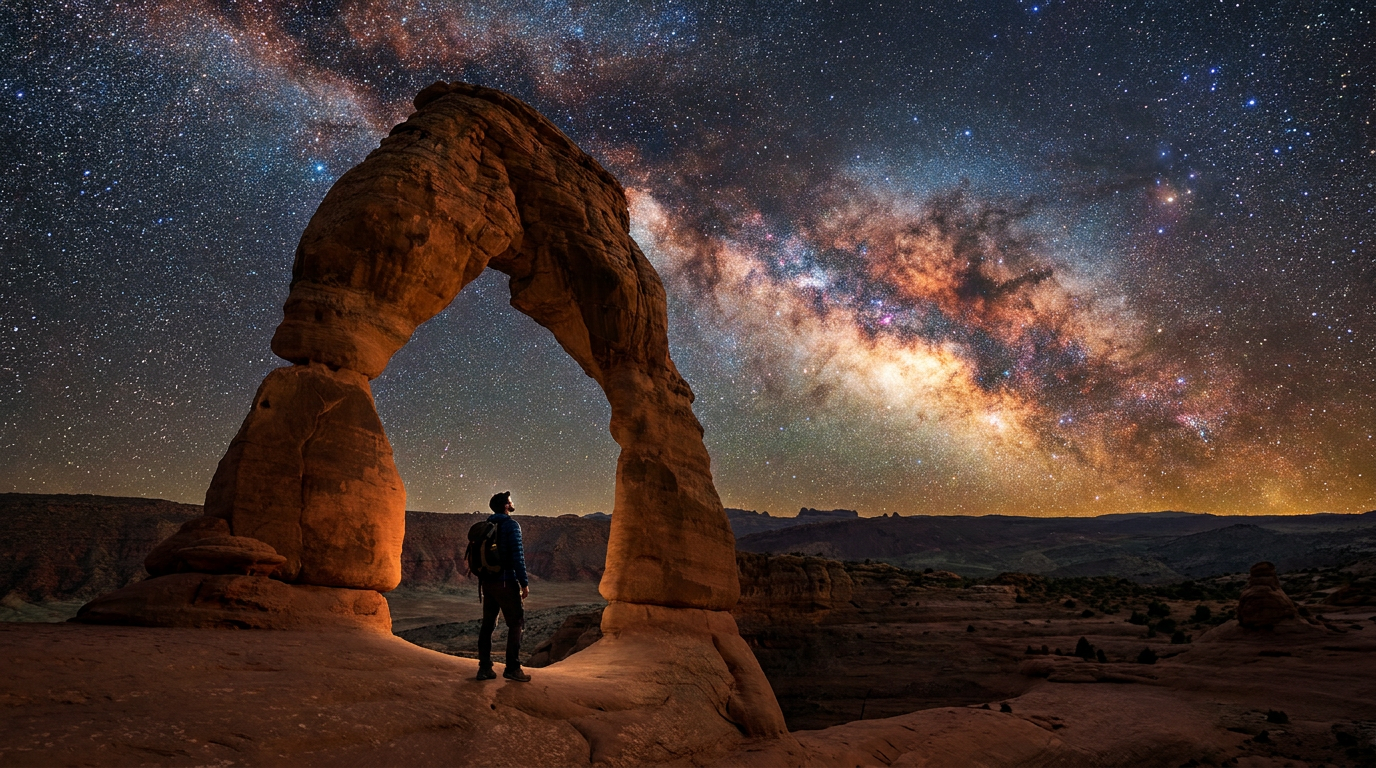
Astrotourists, however, are hunting for Bortle Class 1 and 2 skies. Under a Class 1 sky—the darkest available on Earth—the visual experience is staggering. The Milky Way is so bright and detailed that it casts faint, diffuse shadows on the ground. Faint phenomena like the zodiacal light (sunlight scattering off cosmic dust) are clearly visible, and the sky is so saturated with stars that familiar constellations can actually be difficult to pick out against the crowded background.[5][6]
Finding these pristine Bortle 1 and 2 environments is becoming harder, which is where DarkSky International steps in. The nonprofit organization manages the International Dark Sky Places program, a rigorous certification system that identifies and protects the world's best stargazing locations. Since designating Flagstaff, Arizona, as the first Dark Sky City in 2001, the program has exploded in popularity.[3][6]
Finding these pristine Bortle 1 and 2 environments is becoming harder, which is where DarkSky International steps in.
Today, there are more than 200 certified Dark Sky Places spanning 22 countries on six continents. Together, they protect over 160,000 square kilometers of land and night sky. These designations are broken down into several categories, including Dark Sky Parks (public conservation areas), Dark Sky Reserves (dark core zones surrounded by populated peripheries), and Dark Sky Sanctuaries (the most remote and fragile dark places on Earth).[3]

Earning a Dark Sky Park certification is not merely a matter of geographic isolation. The National Park Service notes that the certification carries no legal authority, but requires a massive, proactive commitment from the park and surrounding communities. To qualify, parks must retrofit their infrastructure with energy-efficient, fully shielded lighting that points downward. They must also implement ongoing public education programs, hosting "dark sky ranger" events and stargazing nights to teach visitors about light pollution.[3][4]
The United States has emerged as a global hub for this movement, particularly the American Southwest. The state of Utah currently boasts the highest concentration of certified Dark Sky Parks in the world, with 26 locations. Natural Bridges National Monument in Utah made history in 2007 when it became the world's very first certified International Dark Sky Park, drawing visitors specifically for its glittering, Bortle 1 canopy.[1][4]
Internationally, the map of protected skies is expanding rapidly. Chile's Atacama Desert and New Zealand's Aoraki Mackenzie Reserve have long been astrotourism meccas. In 2020, the tiny South Pacific island nation of Niue became the first entire country to be designated a Dark Sky Sanctuary. These locations offer travelers a chance to see the Magellanic Clouds and the Southern Cross, celestial wonders invisible from the Northern Hemisphere.[1][3]

The benefits of astrotourism extend far beyond human recreation; it is fundamentally a form of ecotourism. Artificial skyglow wreaks havoc on nocturnal ecosystems. Millions of birds die annually after being disoriented by city lights during migration. Sea turtle hatchlings are drawn away from the ocean by coastal lighting, and the feeding and mating patterns of countless nocturnal mammals and insects are severely disrupted by the loss of true darkness.[2][3]
By tying economic value to darkness, astrotourism creates a powerful financial incentive for conservation. Rural and remote communities that might otherwise struggle to attract traditional tourism are finding that their lack of development is actually a highly marketable asset. When travelers book local hotels, eat at local restaurants, and hire local astronomy guides, they prove to municipal governments that keeping the lights off pays dividends.[1][2]

Unlike many environmental crises, light pollution is uniquely solvable. It does not require centuries to clear from the atmosphere or oceans. The moment a poorly designed streetlamp is shielded, replaced with a warm-hued LED, or simply turned off, the light pollution vanishes at the speed of light. The stars return instantly.[3][6]
As urbanization continues and the global transition to bright LED lighting threatens to further erase the night, the role of Dark Sky Parks will only grow in importance. For the millions of travelers packing red-light flashlights and star maps this year, these protected oases offer more than just a beautiful view. They offer a rare, uplifting environmental victory—a place where, simply by choosing to look up, we can ensure the universe remains visible for the next generation.[2][6]
How we got here
2001
Amateur astronomer John E. Bortle publishes the Bortle Dark-Sky Scale to standardize the measurement of night sky brightness.
2001
Flagstaff, Arizona, is designated as the world's first International Dark Sky City.
2007
Natural Bridges National Monument in Utah becomes the first certified International Dark Sky Park.
2020
The South Pacific island of Niue becomes the first entire country to be designated a Dark Sky Sanctuary.
2026
Astrotourism is recognized as a major global travel trend, with over 200 certified Dark Sky Places operating worldwide.
Viewpoints in depth
Conservationists & Ecologists
Advocates who view the preservation of dark skies as a critical ecological imperative.
For ecologists, the astrotourism boom is a welcome vehicle for a much larger mission: saving nocturnal habitats. Life on Earth evolved over billions of years with a reliable cycle of light and dark. Artificial skyglow fundamentally disrupts this cycle, acting as a profound ecological pollutant. Conservationists point out that millions of birds die annually after being disoriented by city lights during migration, while the feeding, mating, and pollination patterns of countless mammals and insects are severely altered by the loss of true darkness. To this camp, Dark Sky Parks are not just tourist attractions; they are vital sanctuaries for wildlife that require darkness to survive.
Astrotourism Operators
Local businesses and tourism boards that see dark skies as a sustainable economic engine.
For rural and remote communities, astrotourism represents a highly lucrative, low-impact economic opportunity. Traditional tourism often requires massive infrastructure—paved roads, large resorts, and daytime attractions that can alter the landscape. Astrotourism, by contrast, monetizes what these communities already have: isolation and darkness. Operators note that stargazing tourists tend to stay overnight, injecting money into local lodging and dining sectors that might otherwise be bypassed. This creates a powerful, self-sustaining financial incentive for municipal governments to pass strict lighting ordinances, proving that keeping the lights off is actually good for business.
Amateur Astronomers
Enthusiasts focused on the technical preservation of Bortle 1 and 2 skies for deep-space observation.
The amateur astronomy community is the foundational driving force behind the dark sky movement. For decades, they have watched as urban sprawl and the transition to bright, blue-rich LED lighting have steadily erased their view of the cosmos. This camp is highly technical, relying on metrics like the Bortle Scale and Sky Quality Meters to track the degradation of the night sky. They advocate for highly specific interventions—such as fully shielded fixtures, motion sensors, and warm-color-temperature bulbs—to ensure that the faint light of distant galaxies and nebulae remains visible through their telescopes. For them, astrotourism is a way to recruit the general public into the fight to save the stars.
What we don't know
- Whether the economic incentives of astrotourism will be enough to convince major urban centers to retrofit their lighting grids.
- The long-term impact of massive low-earth-orbit satellite constellations (like Starlink) on the pristine viewing conditions of Dark Sky Parks.
Key terms
- Astrotourism
- A form of travel centered on experiencing dark skies, stargazing, and celestial events in areas with minimal artificial light.
- Bortle Scale
- A nine-level numeric scale used to measure the brightness of the night sky and the observability of celestial objects.
- Light Pollution
- The inappropriate or excessive use of artificial light, which obscures the stars and disrupts human and ecological health.
- Skyglow
- The diffuse brightening of the night sky over inhabited areas, caused by artificial light scattering in the atmosphere.
- Zodiacal Light
- A faint, roughly triangular glow visible in the night sky under extremely dark conditions, caused by sunlight scattering off cosmic dust.
Frequently asked
Do I need a telescope for astrotourism?
No. While telescopes enhance the experience, the primary draw of Dark Sky Parks is the ability to see the Milky Way, meteor showers, and thousands of stars clearly with the naked eye.
What is the Bortle Scale?
It is a nine-level numeric scale used by astronomers to measure the brightness of the night sky. Class 1 represents pristine darkness, while Class 9 represents heavily light-polluted inner-city skies.
How does a park become a certified Dark Sky Place?
Parks must apply through DarkSky International, demonstrating exceptional sky quality, implementing strict outdoor lighting policies (like shielding fixtures), and offering public education programs about light pollution.
Why is light pollution harmful to animals?
Artificial light disrupts the natural circadian rhythms of nocturnal wildlife, interfering with their feeding, mating, and migration patterns. Millions of migrating birds, for example, are thrown off course by city skyglow.
Sources
Source coverage
6 outlets
3 viewpoints surfaced






[1]South China Morning PostAstrotourism Operators
What does 2026 have in store for travel? Experts talk about dark sky gazing
Read on South China Morning Post →[2]Field MagConservationists & Ecologists
What Is Astrotourism? Stargazing As Responsible Outdoor Travel
Read on Field Mag →[3]DarkSky InternationalConservationists & Ecologists
Conserving Dark Sky Places around the world
Read on DarkSky International →[4]National Park Service
International Dark Sky Park Certification
Read on National Park Service →[5]Sky & TelescopeAmateur Astronomers
The Bortle Dark-Sky Scale
Read on Sky & Telescope →[6]Factlen Editorial Team
Synthesis by Factlen editorial team
Read on Factlen Editorial Team →
Every angle. Every day.
Get travel stories with full source coverage and perspective breakdowns delivered to your inbox.