
The Physics of the Badminton Smash: How the Fastest Projectile in Sports Defies Gravity
A badminton shuttlecock can reach speeds exceeding 560 km/h—faster than a Formula 1 car—before aerodynamic drag forces it into a near-vertical drop.
By Factlen Editorial Team
- Equipment Manufacturers
- Focus on pushing the boundaries of carbon fiber technology and developing synthetic materials to replace natural feathers.
- Aerodynamic Researchers
- Focus on the unique physics and drag coefficients of the shuttlecock's flight, studying how it defies standard parabolic motion.
- Professional Players
- Focus on the explosive power, racket feel, and the precise control required to execute shots at elite speeds.
- Traditionalists
- Value the irreplaceable flight characteristics and touch of natural goose feathers over synthetic alternatives.
What's not represented
- · Grassroots club players affected by rising equipment costs
- · Agricultural suppliers of goose and duck feathers
Why this matters
Understanding the extreme aerodynamics of badminton reveals how material science and physics intersect to push the boundaries of human athletic performance. It also highlights the engineering challenges required to make sports equipment more sustainable.
Key points
- The badminton smash is the fastest projectile in sports, with the world record standing at 565 km/h.
- A shuttlecock's unique feather skirt creates immense aerodynamic drag, forcing it into a steep 'parachute trajectory'.
- Modern rackets use ultra-high-modulus carbon fiber to store and release massive amounts of kinetic energy.
- A global shortage of goose feathers is driving the Badminton World Federation to test synthetic shuttlecocks in official tournaments.
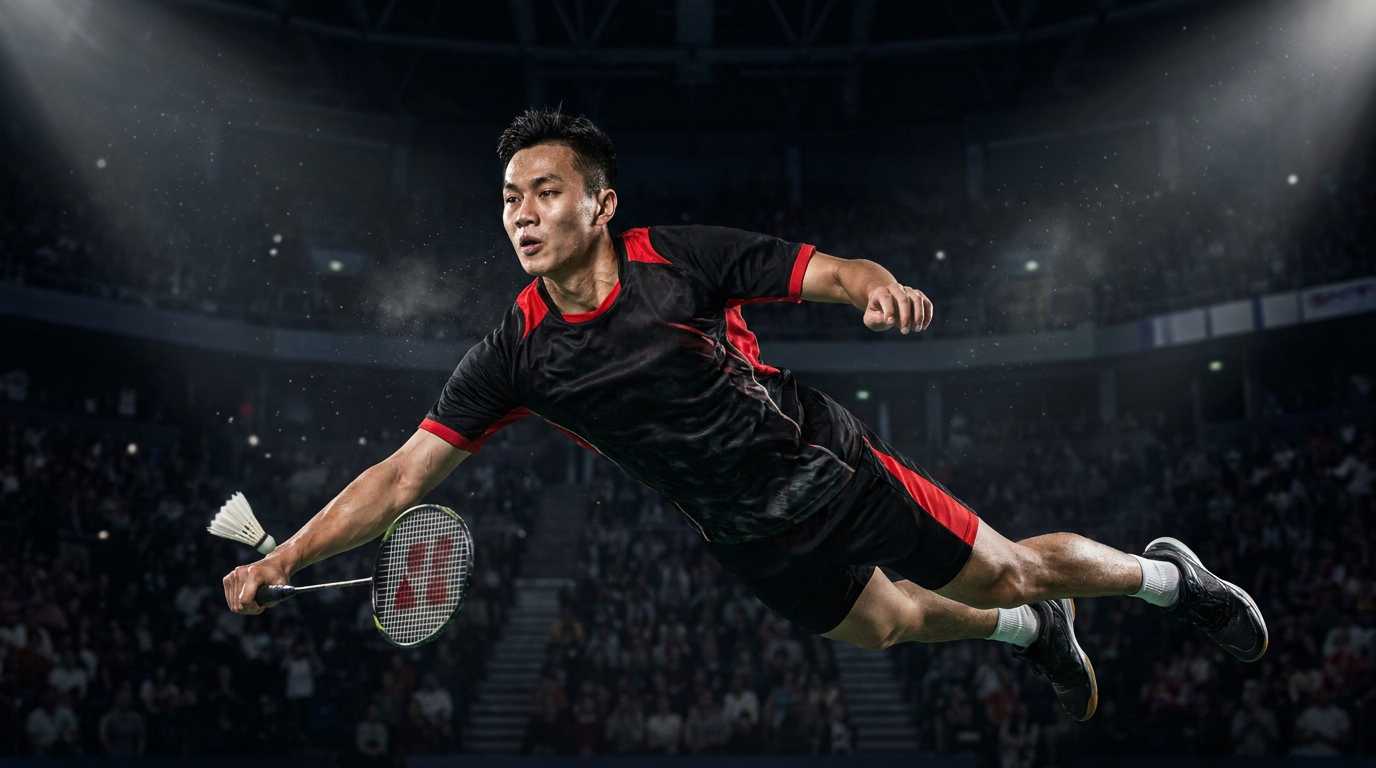
The fastest projectile in the sporting world is not a golf ball driven off a titanium clubface, nor a hockey puck slapped across the ice. It is a badminton shuttlecock. When Indian doubles specialist Satwiksairaj Rankireddy executed a jump smash in a controlled Yonex testing facility, the shuttlecock left his racket at an astonishing 565 kilometers per hour (351.1 mph).[2]
To put that velocity into perspective, the fastest speed ever recorded by a Formula 1 race car maxes out at roughly 397 km/h, while the fastest tennis serve in history sits at 263 km/h. In the women's game, Malaysian star Pearly Tan holds the record with a blistering 438 km/h strike, proving that elite badminton operates at a speed scale entirely its own.[1][2]

This extreme speed presents a fascinating physics paradox. How does an object traveling over 350 mph stay within the confines of a court that measures just 13.4 meters (44 feet) in length? The answer lies in a brilliant collision of aerodynamic drag and cutting-edge material science.[3][7]
Unlike a tennis ball or a baseball, which follow a relatively symmetrical parabolic arc through the air, a shuttlecock follows what physicists describe as a "parachute trajectory." The projectile is constructed from a weighted hemispherical cork base attached to a conical skirt, traditionally made of 16 overlapping goose or duck feathers.[3][4]
This unique geometry gives the shuttlecock an exceptionally high drag coefficient—typically measuring between 0.6 and 0.7, which is roughly ten times higher than that of a standard tennis ball. When struck, the shuttlecock slices through the air base-first, but the massive frontal area of the feather skirt creates immense and immediate air resistance.[4]
As a result, the shuttlecock decelerates violently. It can lose up to 90 percent of its horizontal velocity within a fraction of a second. After traveling just a few meters at breakneck speed, the aerodynamic drag overcomes the initial kinetic energy, causing the shuttlecock to drop almost vertically toward the floor, keeping it safely within the boundaries of the court.[3][4]

Generating that initial 500+ km/h velocity requires more than just human muscle; it relies heavily on highly engineered racket technology. Modern badminton rackets have evolved far beyond the wooden and aluminum frames of the past, relying entirely on advanced carbon fiber composites to handle the immense forces generated by elite players.[6]
Generating that initial 500+ km/h velocity requires more than just human muscle; it relies heavily on highly engineered racket technology.
Today's elite frames utilize ultra-high-modulus graphite and metallic carbon fibers, sometimes infused with materials like Nano Aerogel—the world's lightest solid. These materials offer an extreme strength-to-weight ratio, allowing players to swing the racket with blinding speed while maintaining the structural rigidity required for precise shot placement.[6]
When a player executes a smash, the carbon fiber shaft bends backward, storing immense potential energy. At the exact moment of impact, the shaft snaps forward, transferring that stored energy directly into the shuttlecock. Combined with string tensions that can exceed 30 pounds, the racket acts as a high-tech, high-tension trampoline.[6][7]

However, the sport's reliance on extreme physics is currently colliding with global supply chain realities. The production of traditional shuttlecocks requires highly specific goose and duck feathers, which are primarily sourced from agricultural hubs in China.[5]
In recent years, shifting dietary preferences in China—with consumers increasingly favoring pork over poultry—have led to a sharp decline in duck and goose output. This shortage has caused the price of premium feather shuttlecocks to skyrocket, threatening the accessibility of the sport at the grassroots and club levels.[5]
In response, the Badminton World Federation (BWF) has accelerated the testing of synthetic shuttlecocks. In 2025 and 2026, the governing body officially approved the use of advanced plastic and carbon-composite shuttlecocks from manufacturers like Yonex and Victor in Grade 3 international tournaments and junior competitions.[5]

Replicating the exact aerodynamic profile of a natural feather remains a monumental engineering challenge. Wind tunnel tests show that plastic skirts tend to deform under the extreme forces of a 400 km/h smash, altering the drag coefficient and reducing the spin rate compared to the rigid structure of natural feathers.[3]
While synthetic models currently reach the ground a fraction of a second faster during certain shots, manufacturers are rapidly iterating on their designs. The goal is to perfectly match the precise parachute trajectory that defines the elite game, ensuring that the transition away from animal products does not fundamentally alter how the sport is played.[3][5]
As material science continues to advance, badminton stands at a unique intersection of tradition and innovation. Whether struck with natural feathers or next-generation synthetics, the badminton smash remains a testament to the extreme limits of human athletic power and aerodynamic engineering.[7]
How we got here
May 2013
Malaysia's Tan Boon Heong sets the badminton smash world record at 493 km/h.
April 2023
Satwiksairaj Rankireddy shatters the record with a 565 km/h smash, while Pearly Tan sets the female record at 438 km/h.
2024–2025
A global shortage of goose and duck feathers causes the price of premium shuttlecocks to surge.
April 2026
The BWF officially approves synthetic shuttlecocks for use in Grade 3 international tournaments to test their viability for elite play.
Viewpoints in depth
Sports Physicists
Focus on the extreme deceleration and the unique aerodynamics of the shuttlecock.
Aerodynamic researchers view the shuttlecock as a fascinating anomaly in sports physics. Unlike a tennis ball, which acts as a relatively smooth sphere, the shuttlecock functions as a 'bluff body.' The conical skirt creates a massive low-pressure wake behind the projectile, resulting in a drag coefficient that is nearly ten times higher than other sports balls. This unique property is what allows players to strike the shuttlecock with explosive, F1-level speeds while ensuring it still drops within the tight confines of a 13.4-meter court.
Equipment Engineers
Focus on the material science arms race to create stiffer, lighter, and more powerful rackets.
For racket manufacturers, the goal is maximizing energy transfer. Engineers are constantly experimenting with ultra-high-modulus carbon fiber, metallic weaves, and nano-materials to create frames that can withstand string tensions of over 30 pounds without warping. The science lies in the 'snap back' effect: designing a shaft that flexes just enough to store the kinetic energy of the player's swing, and then recovers its shape instantly upon impact to launch the shuttlecock at maximum velocity.
Sustainability Advocates
Focus on the urgent need to transition away from animal-derived feathers due to supply chain shortages.
With shifting agricultural trends in China leading to a severe shortage of the specific goose and duck feathers required for premium shuttlecocks, sustainability advocates and the BWF are pushing for synthetic alternatives. The challenge is engineering a plastic or carbon-composite skirt that mimics the exact deformation and spin rate of natural feathers. While early synthetic models struggled with precise flight paths, rapid prototyping is closing the gap, promising a more durable and cost-effective future for the sport.
What we don't know
- Whether synthetic shuttlecocks will ever perfectly replicate the exact spin and aerodynamic drag of natural goose feathers at elite speeds.
- If the 565 km/h smash record represents the absolute physical limit of human power combined with current carbon fiber technology.
Key terms
- Drag Coefficient
- A dimensionless number used by aerodynamicists to quantify the resistance of an object in a fluid environment, such as air.
- Parachute Trajectory
- A flight path where an object decelerates rapidly due to high air resistance, resulting in a steep, near-vertical drop rather than a symmetrical arc.
- High-Modulus Graphite
- An advanced, lightweight carbon fiber material used in racket frames to provide extreme stiffness and efficient energy transfer.
- Synthetic Shuttlecock
- A shuttlecock manufactured using nylon, plastics, or carbon composites instead of traditional animal feathers.
Frequently asked
What is the fastest badminton smash ever recorded?
India's Satwiksairaj Rankireddy holds the men's record at 565 km/h (351 mph), while Malaysia's Pearly Tan holds the women's record at 438 km/h.
Why does a shuttlecock slow down so quickly?
The shuttlecock's conical feather skirt creates a massive amount of aerodynamic drag, causing it to lose up to 90% of its horizontal speed in a fraction of a second.
Why is the BWF testing synthetic shuttlecocks?
A global shortage of duck and goose feathers has driven up costs, prompting the governing body to test durable synthetic alternatives to ensure the sport remains accessible.
What makes modern badminton rackets so powerful?
They are constructed from ultra-high-modulus carbon fiber composites that bend to store energy and snap back instantly upon impact, acting like a high-tension trampoline.
Sources
Source coverage
7 outlets
4 viewpoints surfaced







[1]The VibesProfessional Players
Pearly sets Guinness World Record for fastest badminton smash
Read on The Vibes →[2]Olympics.comProfessional Players
Fastest badminton smash: India's Satwiksairaj Rankireddy sets Guinness world record
Read on Olympics.com →[3]University of Southern CaliforniaAerodynamic Researchers
The Physics Behind the Badminton Shuttlecock
Read on University of Southern California →[4]FizziQAerodynamic Researchers
Studying aerodynamic forces on a badminton shuttlecock
Read on FizziQ →[5]Inside The GamesEquipment Manufacturers
BWF to test synthetic feather shuttlecocks
Read on Inside The Games →[6]MDPIEquipment Manufacturers
Badminton Racket Coatings and Athletic Performance: Review Based on Functional Coatings
Read on MDPI →[7]Factlen Editorial TeamTraditionalists
Synthesis by Factlen editorial team
Read on Factlen Editorial Team →

More in sports
See all 13 stories →Olympic Sustainability
How the LA 2028 Olympics Will Run Entirely on Existing Stadiums
0 sources

NBA Finals
New York Knicks Win 2026 NBA Finals, Ending 53-Year Championship Drought
0 sources

NBA Finals
New York Knicks Capture First NBA Championship Since 1973
0 sources

Hockey Strategy
How the PWHL's 'Jailbreak' and 'No Escape' Rules Are Rewriting Hockey Strategy
0 sources
Every angle. Every day.
Get sports stories with full source coverage and perspective breakdowns delivered to your inbox.