
The Physics and Strategy of Short Track Speed Skating
A deep dive into the engineering, biomechanics, and high-speed tactics that make short track speed skating one of the most intense sports on ice.
By Factlen Editorial Team
- Equipment Innovators
- Focuses on the engineering arms race, from offset blades to custom carbon-fiber boots, seeking marginal gains in speed and safety.
- Tactical Analysts
- Focuses on race strategy, emphasizing the critical importance of the start in sprints and the complex aerodynamics of drafting.
- Sports Biomechanists
- Focuses on the physiological toll of the sport, particularly the asymmetrical muscle fatigue and oxygen depletion in the right leg.
What's not represented
- · Ice Technicians
- · Referees and Officials
Why this matters
Understanding the hidden mechanics of short track speed skating transforms the viewing experience from a chaotic scramble into a masterclass of applied physics, engineering, and tactical brilliance.
Key points
- Short track speed skating takes place on a tight 111.12-meter oval, creating immense centrifugal forces.
- Athletes use offset blades mounted to the left of the boot to achieve extreme lean angles without crashing.
- The sport causes profound asymmetrical fatigue due to blood flow occlusion in the right leg during tight corners.
- In sprint events, the rank position entering the first corner is the strongest statistical predictor of winning.
- Skaters wear Kevlar-reinforced suits and plastic-tipped gloves to protect against razor-sharp blades and ice friction.
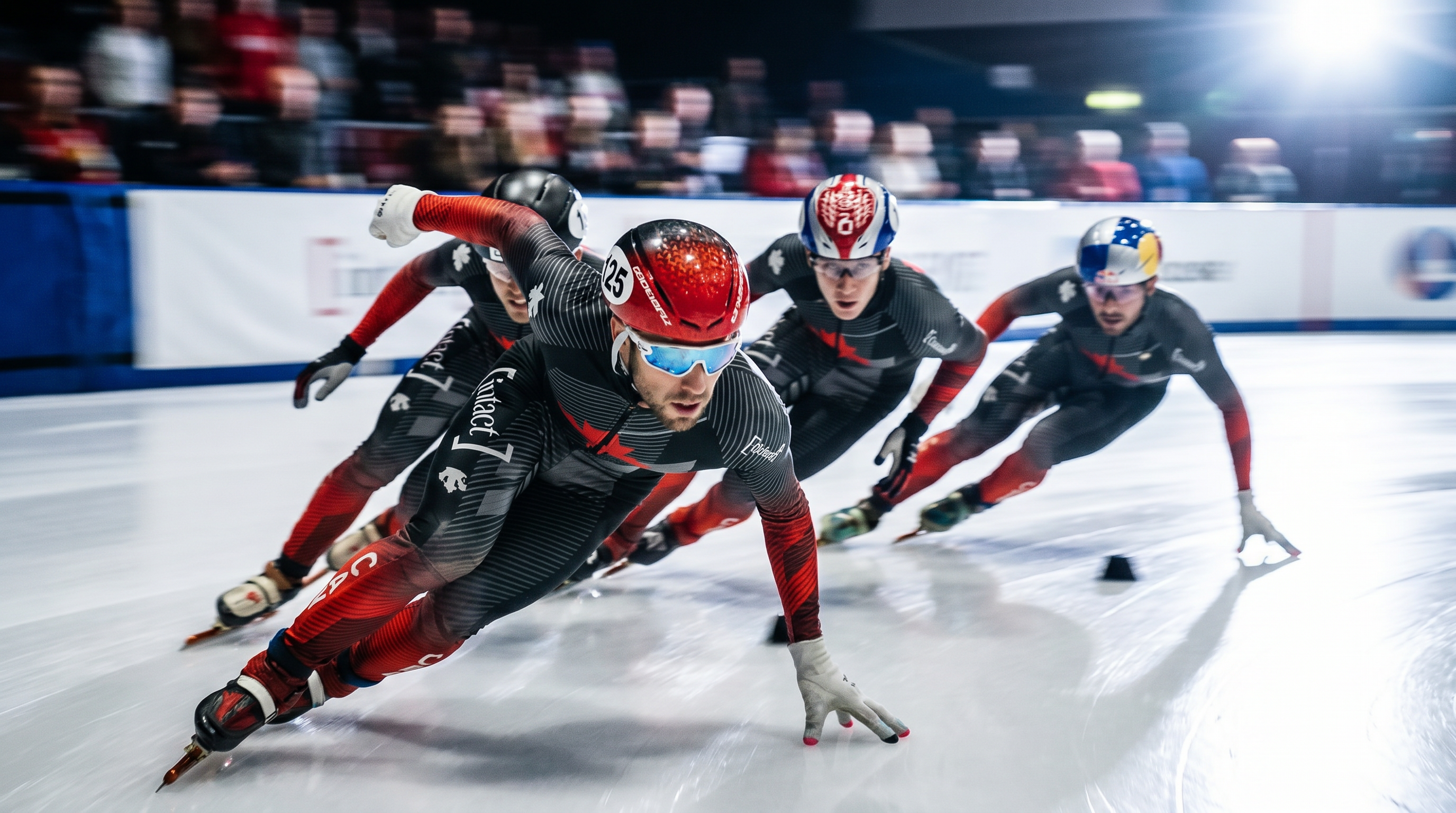
Short track speed skating is often described as NASCAR on ice. It is a sport of high-speed pack racing, where athletes reach speeds of up to 50 kilometers per hour on a tight, unforgiving circuit.[6]
Unlike traditional long-track speed skating, which is a time trial run in isolated lanes on a 400-meter oval, short track is a chaotic, head-to-head battle. Skaters race in packs on a 111.12-meter track that fits inside a standard ice hockey rink.[3]
The compact size of the track fundamentally changes the physics of the race. Because the straightaways are incredibly short, athletes spend the vast majority of their time navigating tight corners, battling immense centrifugal forces that threaten to throw them into the padded barriers.[6]
To survive these corners at high speeds, skaters must lean their bodies at extreme angles, often hovering just inches above the ice. This physical necessity drove one of the most significant equipment revolutions in winter sports history.[1]

In the early 1980s, a Canadian innovator named Raymond Laberge realized that traditional skates were limiting athletes. When skaters leaned too far into a turn, the side of their leather boot would touch the ice—a phenomenon known as scrubbing—which caused them to lose their edge and crash.[1][5]
Laberge's solution was to invent a molded boot with the blade offset to the left. By shifting the blade off-center, athletes could suddenly achieve much steeper lean angles without the boot ever making contact with the ice surface.[1]
This innovation completely revolutionized the sport. Today, short track boots are custom-molded to the skater's foot using stiff fiberglass, graphite, and Kevlar, locking the ankle in place to ensure that every ounce of power is transferred directly into the ice.[1][5]
The blades themselves are highly specialized. They are shorter than long-track blades—typically 30 to 45 centimeters long—and about 1.1 millimeters thick.[1]
Crucially, short track skaters do not use the clap skates that dominate long-track racing. Because short track requires constant agility, rapid crossovers, and aggressive cornering, the blade remains firmly fixed to the boot at both the heel and the toe.[1]

Crucially, short track skaters do not use the clap skates that dominate long-track racing.
The biomechanics of navigating a short track corner are uniquely punishing. Sports scientists divide the cornering process into three distinct phases: the entry, the hang, and the exit.[2]
During the entry, the skater performs a rapid series of leg crossovers to build momentum. This transitions into the hang phase, where the athlete travels around the apex of the corner supported almost entirely by the right blade, before executing another series of crossovers on the exit.[2]
This prolonged hang phase places an extraordinary physiological burden on the right leg. Researchers have found that the tight corners require relatively long periods of static muscle contraction, leading to significant blood flow occlusion and deoxygenation in the right leg compared to the left.[2]
As a result, short track skaters experience profound asymmetrical fatigue. The right leg is forced to absorb the brunt of the centrifugal force while starved of oxygen, making the sport a grueling test of localized muscular endurance.[2]
Beyond the physical toll, short track is a game of high-stakes chess. In sprint events like the 500-meter race, tactical positioning is often decided in the opening seconds.[4]
Sports performance analysts have quantified the immense value of the start. Research indicates that a skater's Rank Position Entering the First Corner (RPEFC) has a substantial statistical correlation with their final race outcome, making the initial 14-meter sprint one of the most critical phases of the competition.[4]

In longer distances, such as the 1000-meter and 1500-meter events, the strategy shifts to drafting and energy conservation. Skaters tuck in closely behind the leader to reduce aerodynamic drag, waiting for the perfect moment to launch an overtaking maneuver.[6]
Overtaking is notoriously difficult and dangerous. The rules dictate that the skater changing lanes must not impede another athlete, and the tight confines of the 111.12-meter track mean that passes must be executed with millimeter precision.[3][4]
Because crashes are a statistical inevitability, the athletes wear specialized suits of armor. Modern racing suits incorporate Kevlar panels over major arteries to protect against the razor-sharp blades of competitors.[1]

Even the gloves are engineered for the track's unique demands. The left glove features hard plastic tips on the fingers, allowing the skater to drag their hand on the ice for balance during extreme cornering without generating excessive friction.[1]
Ultimately, short track speed skating is a masterclass in applied physics and human resilience. It requires the explosive power of a sprinter, the tactical mind of a chess grandmaster, and the sheer nerve to lean into the razor's edge.[6]
How we got here
1892
The International Skating Union (ISU) is founded, becoming the first international federation for any winter sport.
1970s
Short track speed skating begins to organize globally, evolving from a recreational activity into a highly competitive racing discipline.
Early 1980s
Raymond Laberge invents the offset blade and molded boot, revolutionizing the sport by allowing extreme lean angles in corners.
1992
Short track speed skating officially enters the Winter Olympic Games program in Albertville, France.
Viewpoints in depth
Sports Biomechanists
Focuses on the physiological toll of the sport, particularly the asymmetrical muscle fatigue and oxygen depletion in the right leg.
Biomechanists study the unique physical demands of the 111.12-meter track, noting that the tight corners force skaters into prolonged periods of static contraction. During the hang phase of a turn, the right leg supports the entire body weight against immense centrifugal force. This leads to severe blood flow occlusion and deoxygenation in the right leg, creating a profound asymmetrical fatigue that athletes must train specifically to overcome.
Equipment Innovators
Focuses on the engineering arms race, from offset blades to custom carbon-fiber boots, seeking marginal gains in speed and safety.
For equipment manufacturers, short track is an engineering puzzle. The primary goal is to allow skaters to achieve maximum lean angles without the boot scrubbing the ice. This led to the invention of the offset blade, which is mounted to the left of the boot's center. Innovators also focus on safety, developing advanced Kevlar racing suits and specialized gloves with plastic resin tips to protect athletes from the razor-sharp, 1.1-millimeter-thick steel blades.
Tactical Analysts
Focuses on race strategy, emphasizing the critical importance of the start in sprints and the complex aerodynamics of drafting.
Analysts view short track not just as a physical contest, but as a high-speed chess match. In 500-meter sprints, data shows that the Rank Position Entering the First Corner (RPEFC) is the strongest predictor of the final race outcome, making the initial 14-meter explosion critical. In longer races, the focus shifts to aerodynamic drafting and energy conservation, where skaters must calculate the exact moment to break out of the slipstream and execute a flawless overtaking maneuver.
What we don't know
- How future advancements in carbon-fiber boot stiffness will affect the natural biomechanics of the ankle.
- Whether new aerodynamic suit materials can further reduce drag without compromising the required Kevlar cut protection.
Key terms
- Scrubbing
- When the side of a skater's boot touches the ice during a sharp turn, causing friction and often leading to a crash.
- Offset Blade
- A skate blade mounted off-center to the left, allowing for steeper lean angles in corners.
- Hang Phase
- The middle section of a corner where the skater glides around the apex supported almost entirely by their right blade.
- RPEFC
- Rank Position Entering First Corner; a critical metric in sprint races that heavily correlates with the final outcome.
- Crossovers
- A skating technique used to accelerate through corners by stepping the right foot over the left.
Frequently asked
Why don't short track skaters use clap skates?
Short track requires constant agility and aggressive cornering. A fixed blade provides necessary stability, whereas a hinged clap skate would be too unstable in tight turns.
Why do skaters touch the ice with their hand?
Skaters drag their left hand to maintain balance while leaning at extreme angles. Their left glove has hard plastic tips to reduce friction.
What is an offset blade?
An offset blade is mounted slightly to the left of the boot's center line, allowing the skater to lean further into left-hand turns without the boot touching the ice.
Sources
Source coverage
6 outlets
3 viewpoints surfaced






[1]International Skating UnionEquipment Innovators
Developments in Short Track Equipment
Read on International Skating Union →[2]National Institutes of HealthSports Biomechanists
Biomechanics and Physiology of Short-Track Speed Skating
Read on National Institutes of Health →[3]WikipediaTactical Analysts
Speed skating
Read on Wikipedia →[4]ResearchGateTactical Analysts
Initial short-track speed-skating 14-m start performance has substantial influence on 500-m race outcome
Read on ResearchGate →[5]Bont SkatesEquipment Innovators
Short Track Speed Skating Equipment
Read on Bont Skates →[6]Factlen Editorial TeamTactical Analysts
Synthesis by Factlen editorial team
Read on Factlen Editorial Team →

More in sports
See all 13 stories →Olympic Sustainability
How the LA 2028 Olympics Will Run Entirely on Existing Stadiums
0 sources

NBA Finals
New York Knicks Win 2026 NBA Finals, Ending 53-Year Championship Drought
0 sources

NBA Finals
New York Knicks Capture First NBA Championship Since 1973
0 sources

Hockey Strategy
How the PWHL's 'Jailbreak' and 'No Escape' Rules Are Rewriting Hockey Strategy
0 sources
Every angle. Every day.
Get sports stories with full source coverage and perspective breakdowns delivered to your inbox.