
The New Architecture of Social Media: Understanding AT Protocol and ActivityPub
As users tire of algorithmic lock-in, decentralized social networks are gaining ground. Here is how the open protocols behind Bluesky, Mastodon, and Threads are fundamentally rewiring how we connect online.
By Factlen Editorial Team
- Pragmatic Decentralizers
- Prioritize seamless user experience, account portability, and algorithmic choice through newer protocols.
- Open-Web Purists
- Advocate for fully federated, non-corporate social networks built on established W3C standards.
- Corporate Adopters
- Seek to integrate open protocols into massive existing platforms to appease regulators and power users.
What's not represented
- · Everyday non-technical users
- · Trust and Safety professionals
Why this matters
If you have ever lost your followers when an app shut down or changed its algorithm, these new protocols offer a permanent fix. By separating your digital identity from corporate servers, they ensure you own your social graph and can take it anywhere.
Key points
- Centralized social media platforms lock users into walled gardens, controlling their data, followers, and algorithms.
- ActivityPub is a W3C standard powering the Fediverse, allowing independent servers to communicate.
- The AT Protocol uses cryptographic identifiers to give users permanent ownership of their accounts, enabling seamless server migration.
- Third-party bridges are actively being developed to allow users on different protocols to interact with each other.
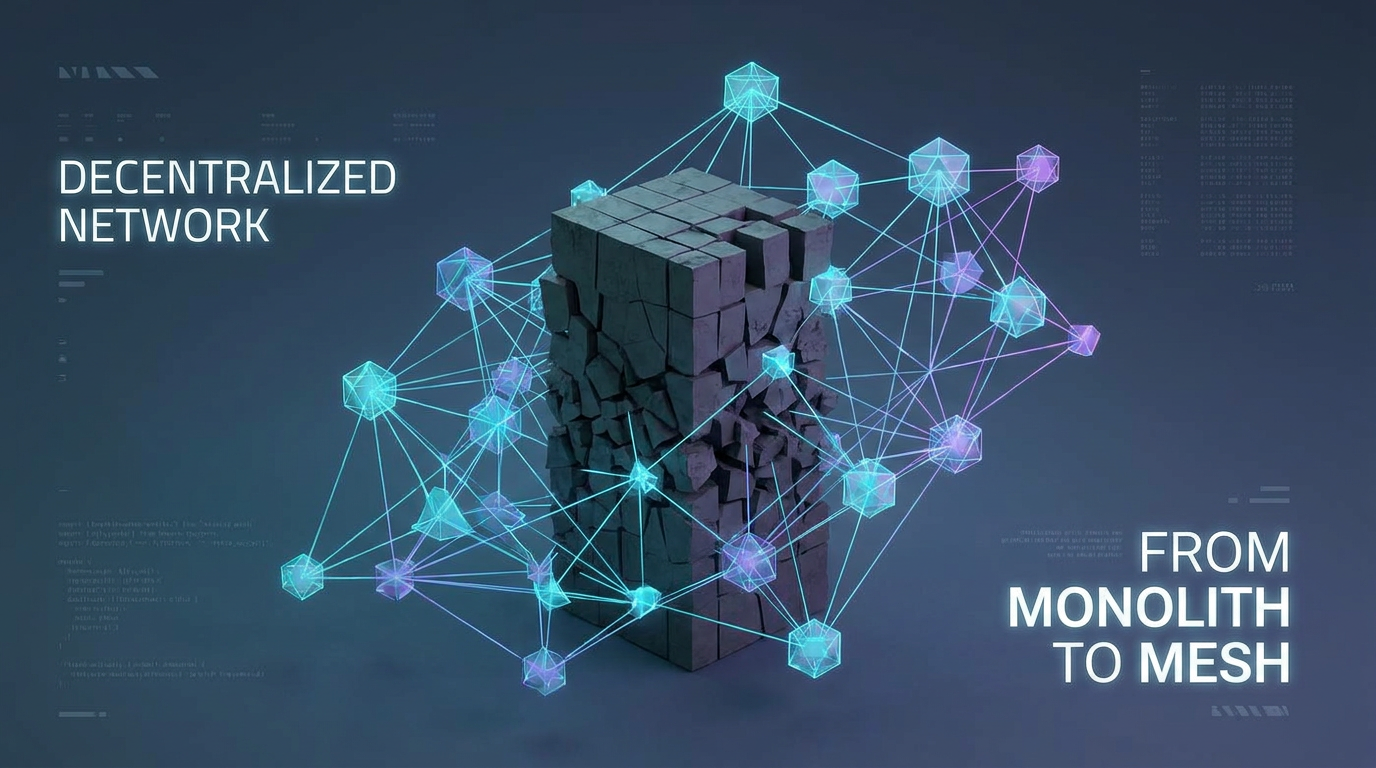
For the past two decades, the social internet has operated as a series of walled gardens. Users invest years building audiences, curating feeds, and establishing digital identities, but the platforms hold the keys. In this centralized model, the data, the social graph, and the distribution algorithms are entirely controlled by single corporate entities. If a user decides to leave—or if the platform changes its rules—they cannot take their community with them. It is akin to moving to a new city and being forced to leave all your friends, memories, and belongings behind.[1]
This fragility became glaringly apparent in recent years as major platforms underwent chaotic ownership changes, aggressive algorithmic shifts, and sudden shutdowns. Creators and everyday users alike realized that their online presence was essentially rented space. When a platform's algorithm decides a user is no longer relevant, their reach vanishes overnight. This widespread frustration has accelerated a fundamental architectural shift in how social media is built, moving away from closed corporate silos and toward open, decentralized protocols that give users permanent ownership of their digital lives.[1][3]
The concept of decentralized communication is not new; it is how the foundational layers of the internet already work. Email and phone networks are built on open protocols. A person using a Gmail account can seamlessly email someone using Outlook, and an iPhone user can call an Android device without a second thought. The underlying infrastructure is shared, meaning no single company can dictate who is allowed to communicate. Decentralized social media attempts to apply this exact same logic to our feeds, followers, and posts.[1]

Currently, a quiet but high-stakes battle is unfolding over which technical standard will power this new era of the internet. Two major open protocols have emerged as the leading candidates to rewire social media: ActivityPub and the Authenticated Transfer (AT) Protocol. While both share the ultimate goal of breaking down walled gardens and enabling interoperability, they take fundamentally different approaches to identity, server architecture, and user experience.[2][3]
ActivityPub is the older and more established of the two. Developed and published as a recommended standard by the World Wide Web Consortium (W3C) in 2018, it serves as the technical backbone for the "Fediverse"—a sprawling network of independent, interconnected servers. The most famous implementation of ActivityPub is Mastodon, a microblogging platform that gained massive traction as users sought alternatives to legacy networks.[3]
On a technical level, ActivityPub operates as a set of standardized rules that allow decentralized servers to share posts and updates. Instead of everyone logging into one massive central server, users join specific, independently operated communities (or "instances"). Because these instances all speak the ActivityPub language, a user on a small, niche server can seamlessly follow and interact with a user on a massive, general-purpose server.[3]
ActivityPub received a monumental endorsement when Meta launched Threads and promised to integrate the protocol. By pledging to make Threads interoperable with the broader Fediverse, Meta signaled that open protocols were no longer just a niche experiment, but a viable future for mainstream social networking. This integration theoretically allows a user on Mastodon to follow and interact with a Threads user without ever needing an Instagram account.[3][4]

However, the rollout of ActivityPub on Threads has been cautious and gradual. Meta has slowly enabled opt-in federation for select accounts, allowing their posts to be visible on Mastodon, but full, bidirectional interoperability remains a work in progress. Critics argue that Meta's slow pace reflects a reluctance to fully surrender control over its massive user base, while defenders point out the immense technical complexity of bolting a decentralized protocol onto architecture originally built for a closed ecosystem.[4][6]
However, the rollout of ActivityPub on Threads has been cautious and gradual.
Beyond corporate adoption, ActivityPub faces structural criticisms regarding account portability. In the ActivityPub model, a user's identity is tied to the specific server they join. If that independent server shuts down, runs out of funding, or is taken over by a malicious administrator, migrating that identity and its associated followers to a new server can be a clunky, friction-heavy process.[6]
This specific vulnerability birthed the AT Protocol. Originally incubated as an internal research project at Twitter before spinning out into an independent public benefit corporation, the AT Protocol is the engine powering the Bluesky social network. Its developers set out to solve the perceived flaws of ActivityPub—specifically focusing on seamless account portability, global discoverability, and algorithmic choice.[2][5]
The defining feature of the AT Protocol is its use of Decentralized Identifiers (DIDs). In this system, a user's identity is not tied to a specific server or domain name, but rather to a cryptographic key. This means the user maintains absolute, cryptographic ownership of their account. The server merely hosts the data; it does not own the identity.[5]
Because of this identity-first architecture, account portability on the AT Protocol is virtually seamless. If a user's hosting provider fails or degrades in quality, the user can migrate their entire data repository—including every post, like, and follower—to a new server without the original server's permission or involvement. To the user's followers, the transition is entirely invisible.[5]

The AT Protocol also introduces a novel separation between "speech" and "reach." In traditional social media, the company that hosts your posts also controls the algorithm that distributes them. The AT Protocol decouples these functions. The base layer of the network acts as a personal data repository where users publish their content (speech), while separate, independent indexing services aggregate that data to build feeds (reach).[5]
This separation fundamentally changes how users experience content. Instead of being subjected to a single, opaque corporate algorithm designed to maximize engagement, users on the AT Protocol can subscribe to custom feeds built by anyone. A user can toggle between a chronological feed of their friends, a feed strictly dedicated to scientific research, or a feed curated by a specific community, putting the power of algorithmic choice entirely in the hands of the consumer.[1][5]
While ActivityPub and the AT Protocol represent two distinct visions for the decentralized web, they are not necessarily doomed to remain isolated from one another. The open-source community is actively building bridges to connect the two ecosystems, ensuring that the decentralized web does not simply fracture into new, slightly smaller walled gardens.[2]
Software projects like Bridgy Fed act as universal translators between the networks. By running in the background, these bridges can automatically crosspost content and translate the AT Protocol's data schemas into ActivityPub's format, and vice versa. This allows a user on Mastodon to seamlessly follow and reply to a user on Bluesky, effectively merging the social graphs of the two competing standards.[2]

The transition to decentralized social media is not without its hurdles. Open protocols often struggle to match the frictionless onboarding, polished user interfaces, and algorithmic stickiness that centralized giants have perfected over decades. Furthermore, content moderation in a federated environment is infinitely more complex, requiring communities to build shared blocklists and decentralized moderation tools rather than relying on a single corporate trust and safety team.[4]
Despite these challenges, the momentum behind open social protocols is undeniable. As users increasingly demand ownership of their digital identities and protection against algorithmic whims, the foundational architecture of the internet is shifting. Whether ActivityPub or the AT Protocol ultimately dominates, the era of the closed corporate walled garden is slowly giving way to a more open, user-controlled web.[1][7]
How we got here
2018
The W3C publishes ActivityPub as a recommended standard for decentralized social networking.
Oct 2022
The Authenticated Transfer (AT) Protocol is officially introduced as the foundation for Bluesky.
Jul 2023
Meta launches Threads and announces plans to integrate the ActivityPub protocol.
Feb 2024
Bluesky officially opens federation, allowing independent servers to join its network.
Viewpoints in depth
Open-Web Purists
Advocates who believe social media should be fully federated and free from corporate control.
This camp, heavily populated by early Mastodon adopters and W3C contributors, views ActivityPub as the gold standard for a free internet. They argue that true decentralization requires independent, community-funded servers rather than venture-backed protocols. For these purists, Meta's adoption of ActivityPub is often viewed with deep suspicion—seen less as a victory for the open web and more as an attempt by a corporate giant to co-opt and eventually dominate a free standard.
Pragmatic Decentralizers
Developers and users focused on seamless account portability and user experience.
Supporters of the AT Protocol argue that ideological purity shouldn't come at the expense of usability. They point out that ActivityPub's server-bound identities create unnecessary friction for average users who just want their apps to work. By prioritizing cryptographic identity ownership (DIDs) and custom algorithms, this camp believes they can build decentralized networks that actually compete with legacy giants on features and performance, rather than just on principles.
Corporate Adopters
Massive tech platforms integrating open protocols to retain users and satisfy regulators.
For legacy giants like Meta, integrating open protocols is a strategic hedge. By slowly adopting ActivityPub for Threads, they can appeal to power users, generate positive PR, and preemptively satisfy antitrust regulators demanding more interoperability. This camp argues that without the massive scale and polished infrastructure of corporate platforms, decentralized protocols will remain niche experiments rather than global communication standards.
What we don't know
- Whether Meta will ever enable full, bidirectional ActivityPub federation for all Threads users, or keep it restricted and opt-in.
- How decentralized networks will sustainably fund the massive server and storage costs required to host millions of users without traditional ad models.
- If the average consumer actually cares enough about protocol-level decentralization to leave the polished convenience of legacy platforms.
Key terms
- ActivityPub
- An open, decentralized social networking protocol developed by the W3C, currently used by Mastodon and Threads.
- AT Protocol
- The Authenticated Transfer Protocol, a decentralized framework built by Bluesky that emphasizes account portability and custom algorithms.
- Fediverse
- A portmanteau of 'federation' and 'universe,' referring to the interconnected network of independent social media servers.
- Decentralized Identifier (DID)
- A unique, cryptographic digital identity that belongs to the user rather than a specific platform or server.
- Interoperability
- The ability of different software systems or platforms to connect, communicate, and exchange data seamlessly.
Frequently asked
What is the Fediverse?
The Fediverse is a collection of decentralized, independent social networks that can communicate with each other, primarily powered by the ActivityPub protocol.
Can Mastodon users talk to Bluesky users?
Not natively, as they use different protocols. However, third-party bridges like Bridgy Fed are actively being developed to translate between the two networks and allow cross-platform communication.
Why is Threads adopting ActivityPub?
Meta aims to make Threads interoperable with the broader open web, which appeals to power users and preemptively addresses regulatory concerns about platform lock-in.
What happens if my Bluesky server shuts down?
Because the AT Protocol uses cryptographic Decentralized Identifiers (DIDs), you can seamlessly migrate your account, posts, and followers to a new server without losing any data.
Sources
Source coverage
7 outlets
3 viewpoints surfaced







[1]Digital GEMsPragmatic Decentralizers
Beyond Bluesky: How the AT Protocol is Changing Social Media
Read on Digital GEMs →[2]WikipediaPragmatic Decentralizers
AT Protocol
Read on Wikipedia →[3]The VergeOpen-Web Purists
How ActivityPub is setting the stage to weave all your social media feeds together
Read on The Verge →[4]ZapierCorporate Adopters
Bluesky vs. Threads: What's the difference?
Read on Zapier →[5]BlueskyPragmatic Decentralizers
Protocol Overview
Read on Bluesky →[6]Hacker NewsOpen-Web Purists
Threads has been promising to integrate with ActivityPub since it launched
Read on Hacker News →[7]Factlen Editorial TeamPragmatic Decentralizers
Synthesis by Factlen editorial team
Read on Factlen Editorial Team →

Every angle. Every day.
Get technology stories with full source coverage and perspective breakdowns delivered to your inbox.