
The 'Moana' Misfire: What Disney's $250 Million Box Office Flop Reveals About the Remake Economy
The live-action adaptation of 'Moana' opened to a disappointing $95 million globally, sparking an industry-wide debate over the trade-offs between rebooting recent hits and investing in original animation.
By Austin Blake

Share this story
The July 2026 box office has delivered a stark and expensive verdict on one of Hollywood's most historically reliable business models. Disney’s live-action adaptation of Moana, starring Dwayne Johnson reprising his role as Maui alongside newcomer Catherine Laga'aia, opened to a muted $43 million domestically and $95 million worldwide.
Measured against a staggering production budget of $250 million and an estimated $120 million global marketing spend, the film is currently projected by industry analysts to lose upwards of $100 million. This severe financial underperformance stands in sharp contrast to the franchise's recent animated triumphs, forcing entertainment executives across the industry to fundamentally reevaluate the mechanics of franchise management and the limits of audience nostalgia.[4]
The contrast in audience reception is particularly striking given the property's recent and highly lucrative history. Just twenty months prior, the animated sequel Moana 2 shattered Thanksgiving box office records, ultimately grossing over $1 billion globally and proving the brand's immense popularity.
Furthermore, the original 2016 animated feature remains a perennial juggernaut, consistently ranking as the most-streamed movie on the Disney+ platform year after year. This stark divergence in consumer behavior—flocking to the animated continuation while actively rejecting the live-action repetition—provides a perfect, real-time case study for a side-by-side trade-off analysis of modern studio development strategies.[5]
When evaluating the live-action remake strategy, the primary argument for the approach is rooted in multi-generational nostalgia and established, risk-free brand awareness. Historically, translating a beloved animated property into a live-action blockbuster has functioned as a billion-dollar printing press for the studio.
Films like 2019’s The Lion King ($1.66 billion), Beauty and the Beast ($1.26 billion), and 2025’s Lilo & Stitch ($1.03 billion) demonstrate that global audiences are often willing to pay premium theatrical ticket prices to see familiar, comforting stories rendered with cutting-edge photorealistic spectacle. The strategy theoretically minimizes the massive marketing risk associated with launching entirely new intellectual property.[3][5]
However, the argument against the live-action engine centers on astronomical production costs and the diminishing returns of creative redundancy. Recreating highly stylized animated environments in a live-action context requires massive, labor-intensive visual effects budgets that push the threshold for success to extreme heights.
Moana cost $250 million to produce, meaning it requires nearly $800 million globally just to break even at the box office. When a film operates at this massive financial scale, any slight deviation from blockbuster status results in catastrophic corporate losses, a vulnerability previously exposed by 2025's Snow White, which stalled at a disappointing $205 million worldwide.[4]
The financial evidence regarding live-action remakes points heavily toward the critical importance of the nostalgia gap. The most successful adaptations have typically enjoyed a breathing room of twenty to thirty years between the original release and the modern reboot. Moana arrived in theaters a mere ten years after its animated predecessor.
Critics immediately noted this proximity, awarding the film a dismal 34% on Rotten Tomatoes and describing it as a shot-for-shot carbon copy that offered nothing new. When the original film is still incredibly fresh in the cultural memory, the remake struggles to justify its existence to paying consumers.[1][5]
Conversely, the argument for prioritizing original and continued animation rests on creative boundlessness and vastly superior long-term profit margins. Animation allows filmmakers to execute physics-defying action sequences, vibrant musical numbers, and highly expressive character designs without triggering the uncanny valley effect that often plagues photorealistic CGI. Furthermore, while top-tier computer animation is undeniably expensive, it generally costs significantly less than a VFX-heavy live-action blockbuster. This lowers the threshold for theatrical profitability and feeds directly into the company's highly lucrative consumer products division and theme park integrations.
The primary argument against relying solely on animation is the inherent difficulty of capturing older demographics and the steep marketing hurdle of introducing unfamiliar worlds. While established animated sequels like Inside Out 2 and Moana 2 enjoy massive built-in audiences, launching a brand-new animated property requires convincing audiences to invest emotional energy in entirely unknown characters. Studios often lean on live-action remakes because they offer a reliable four-quadrant appeal, theoretically drawing in nostalgic adults who grew up with the property alongside their young children.[6]
Despite these marketing hurdles, the current financial evidence comparing the two mediums heavily favors the animated expansion model. The $1 billion success of Moana 2 proved definitively that audiences are eager to see these specific characters embark on new, unpredictable adventures.
Meanwhile, the live-action Moana lost its opening weekend to Christopher Nolan’s original historical epic The Odyssey and faced stiff, unyielding competition from the animated sequel Minions & Monsters, which held strong with a $108 million domestic running total. The current theatrical market is actively rewarding novelty and narrative progression over literal, beat-for-beat translation.[1][3]
A critical factor in this trade-off analysis is the immense challenge of visual translation. The 2016 Moana utilized highly stylized, vibrant animation to turn the ocean itself into a sentient, expressive character and to render the giant crab Tamatoa as a bioluminescent, musical spectacle. Translating these inherently cartoonish elements into a grounded, live-action environment often dilutes their original charm. Reviewers consistently noted that the photorealistic approach stripped the vibrant Polynesian mythology of its visual poetry, replacing boundless artistic expression with literal, uninspiring physical constraints.[3][5]
Ultimately, the live-action remake strategy fits well when adapting 20th-century classics where modern visual effects can offer a genuinely new, immersive theatrical experience. Properties like The Jungle Book or Cinderella benefited immensely from decades of technological advancement, allowing contemporary filmmakers to present the classic stories in a breathtaking way that was physically impossible during their original release. In these specific instances, the remake serves as a necessary technological upgrade that successfully bridges a generational divide and introduces the IP to a new era.[3]
Conversely, the strategy does not fit well when the animated original is a modern digital creation that is still actively consumed by the target demographic. If the source material already utilizes state-of-the-art computer animation and consistently dominates current streaming charts, a live-action remake risks feeling like a redundant, cynical commercial exercise rather than a genuine creative necessity. The rapid, ten-year turnaround of the Moana remake fundamentally violated the core tenet of theatrical nostalgia: absence makes the heart grow fonder.
Moving forward, the optimal path for family entertainment conglomerates involves a highly disciplined hybrid approach that respects these specific market conditions. Studios must carefully weigh the immediate brand recognition of a live-action remake against the long-term creative health of the franchise. As the sobering box office reception of Moana clearly demonstrates, modern audiences are becoming increasingly discerning with their entertainment budgets, demanding that returning to a beloved cinematic world offers a genuinely new horizon rather than just a familiar, repetitive shore.
Key points
- The live-action Moana opened to just $95 million globally against a $250 million production budget.
- The film's struggles highlight the importance of the 'nostalgia gap,' arriving only 10 years after the original.
- Disney's animated Moana 2 grossed over $1 billion just 20 months prior, showing audiences prefer narrative expansion over repetition.
- Industry analysts suggest a pivot toward original animation and sequels rather than rapid-fire live-action remakes.
What we don’t know
- Whether Disney will cancel or delay other recently announced live-action adaptations in response to this box office result.
- How the film's theatrical losses will ultimately be offset by its eventual performance on the Disney+ streaming platform.
How we got here
Nov 2016
The original animated 'Moana' is released, becoming a critical and commercial smash.
Nov 2024
The animated sequel 'Moana 2' hits theaters, grossing over $1 billion globally.
Jul 10, 2026
The live-action 'Moana' remake debuts in theaters to a disappointing $43 million domestic opening.
Jul 19, 2026
The film suffers a steep second-weekend drop, losing premium screens to new blockbuster releases.
- Box Office Analysts
- Focuses on the raw financial metrics, production budgets, and the concept of the nostalgia gap.
- Animation Advocates
- Champions the unique artistic capabilities of animation and criticizes shot-for-shot remakes.
- Franchise Strategists
- Evaluates the long-term health of the intellectual property across streaming, merchandise, and theme parks.
Perspectives this story doesn't cover
- Theater Owners
- Merchandise Licensees
Sources
Source coverage
6 outlets
3 viewpoints surfaced






- [1]ColliderBox Office Analysts
Disney's 'Moana' Remake Drowned Out by 'The Odyssey' at the Box Office
- [2]WikipediaFranchise Strategists
Moana (2026 film)
- [3]Animation MagazineAnimation Advocates
Live-Action 'Moana' Underperforms with a $43 Mil Opening
Read on Animation Magazine → - [4]ForbesBox Office Analysts
Live Action 'Moana' Disappoints With $43 Million Opening Weekend
- [5]The GuardianAnimation Advocates
Disney's live-action Moana fails to make a splash at box office with underwhelming opening
- [6]Screen RantFranchise Strategists
Dwayne Johnson's $250 Million Moana Remake With Flop Debut
Read on Screen Rant →

More in Entertainment
See all →Pixar Strategy
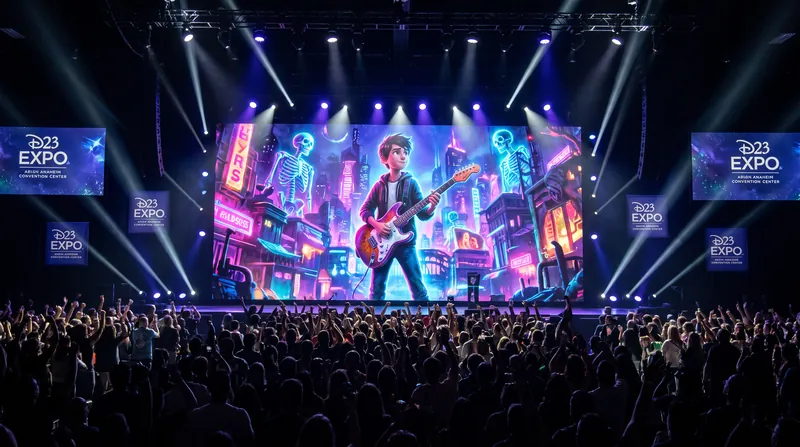
Pixar Confirms 'Coco 2' for 2029 Release at D23, Signaling Return to Core IP Strategy
3 sources
Gaming Industry
Saudi PIF's $55 Billion Buyout of EA Nears EU Approval, Reshaping the Gaming Industry
3 sources

Film Incentives
California's $750 Million Film Tax Credit Expansion Projects $6.6 Billion Economic Impact
3 sources
Box Office Metrics
The A+ Grade and the 4.8x Multiplier: How CinemaScore Predicts a Film's Box Office Run
6 sources

Comments
Every angle. Every day.
Get Entertainment stories with full source coverage and perspective breakdowns, free every day.