
The Asymmetric Cost of Air Defense: Comparing Interceptor Prices to Loitering Munition Threats
As mass-produced loitering munitions proliferate, the mathematical disparity between cheap offensive drones and multi-million-dollar defensive interceptors is forcing a fundamental shift in military procurement.

Share this story
In short
- The proliferation of cheap loitering munitions has inverted the economic logic of modern air defense.
- Intercepting a $50,000 drone with a $4 million PAC-3 MSE missile yields an 80:1 cost-exchange ratio against the defender.
- The U.S. Navy is deploying new 30mm and .50 caliber gun systems to warships to preserve expensive missiles.
The mathematical reality of modern air defense is forcing a fundamental architectural shift across Western militaries. The paradigm of protecting high-value assets has long relied on sophisticated, multi-million-dollar kinetic interceptors designed to defeat fast, complex threats like supersonic aircraft and ballistic missiles. But the proliferation of cheap, mass-produced loitering munitions has inverted the economic logic of the battlefield.
When a defender must expend a highly advanced interceptor to destroy a drone built from commercial-off-the-shelf components, the attacker wins the economic exchange even if the drone is destroyed. This asymmetric cost curve is now dictating procurement decisions from the Pentagon to allied ministries, driving a rapid pivot toward gun-based point defense and directed energy weapons.[1][2][3][4]
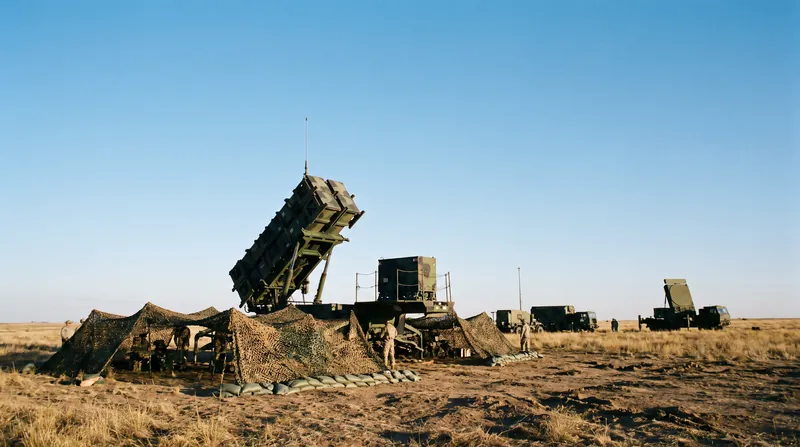
The raw numbers illustrate the severity of the disparity. A single Patriot PAC-3 MSE missile—the premier terminal-phase interceptor in the U.S. arsenal—carries a unit cost of approximately $4 million. In contrast, the Iranian-designed HESA Shahed-136 loitering munition, which has seen extensive use in recent conflicts, can be manufactured domestically for an estimated $10,000 to $50,000.
Engaging a swarm of these low-and-slow drones with top-tier interceptors yields a cost-exchange ratio of roughly 80 to 1 against the defender. At that rate, an attacker can exhaust a multi-billion-dollar air defense battery's magazine using a fraction of the financial resources, leaving the defended area vulnerable to follow-on ballistic missile strikes.[1][2][7]
Recognizing that kinetic interceptors are mathematically unsustainable for counter-drone operations, the U.S. military is accelerating the deployment of alternative kill chains. The U.S. Navy has begun outfitting its destroyers with new "piggy-backed" point defense systems that combine 30mm cannons and .50 caliber machine guns.
These systems, such as the Mk 38 Mod 4, offer a major capability boost against drone swarms by substituting expensive missiles with high-explosive rounds that cost mere hundreds of dollars per engagement. By shifting the counter-unmanned aerial system mission to gun systems, warships can preserve their limited vertical launch system cells for high-end threats.[3]
The U.S. Army is executing a similar transition for its ground forces. The service recently selected a team led by Lockheed Martin, Boeing, and Anduril to advance to the next phase of the Indirect Fire Protection Capability Increment 2 competition.
This program aims to field a mobile, ground-based system capable of defeating cruise missiles and drones without relying exclusively on legacy interceptors. By integrating advanced software, modular launchers, and potentially directed energy, the Army intends to build a layered architecture where the cost of the defense scales proportionally with the cost of the threat.[4][7]
This strategic pivot extends beyond the United States. As European militaries evaluate new cruise missile vendors and rebuild their own stockpiles, the focus has shifted from simply acquiring interceptors to building sustainable, high-capacity magazines.
The diplomatic and military posturing expected at the upcoming U.N. General Assembly will likely reflect this new reality, as allied nations seek collaborative frameworks to share the burden of developing cheaper, more abundant air defense technologies. The era of relying solely on exquisite, low-density missiles is ending, replaced by a doctrine that prioritizes cost-per-kill as highly as probability-of-kill.[5][6][7]
The physics of the interception further complicate the defender's challenge. Traditional radar-guided missiles are optimized for high-altitude, high-speed targets with significant radar cross-sections and thermal signatures. Loitering munitions, however, are often constructed from radar-absorbent composites or fiberglass, powered by small piston engines that emit very little heat.
This makes them difficult to track at range, compressing the engagement window and forcing air defense crews to make split-second decisions. When a drone swarm appears on scope just miles from the target, the automated systems often default to launching the fastest available interceptor, regardless of the economic mismatch.[1][2][7]
Directed energy weapons represent the ultimate solution to the cost-exchange problem, though they remain constrained by atmospheric conditions and power generation requirements. High-energy lasers offer a "cost per shot" measured in the single dollars—the price of the diesel fuel required to run the generator.
While the U.S. Army and Navy have successfully tested 50-kilowatt and 100-kilowatt class lasers against Group 1 and Group 2 drones, scaling these systems to reliably defeat larger, faster munitions like the Shahed-136 in adverse weather remains an ongoing engineering effort. Until directed energy matures into a ubiquitous battlefield asset, programmable gun ammunition remains the most viable bridge capability.[2][3][4][7]
The strategic implications of this shift are profound. Adversaries have realized that they do not need to match Western militaries in technological sophistication to achieve operational parity; they only need to manufacture enough cheap munitions to exhaust the defender's magazine.
By embracing layered architectures that pair $4 million interceptors with 30mm cannons and emerging laser systems, the U.S. and its allies are attempting to close the economic vulnerability that loitering munitions have exposed. The future of air defense will be defined not just by the ability to hit a target, but by the ability to afford the engagement.[3][4][7]
Jargon, explained
- Cost-Exchange Ratio
- The financial comparison between the cost of an offensive weapon and the cost of the defensive measure used to defeat it.
- Loitering Munition
- An autonomous or semi-autonomous weapon system that can loiter in an area before striking a target.
- Point Defense
- Short-range defensive systems designed to protect a specific, high-value asset from incoming threats in the final seconds of their flight.
- Vertical Launch System (VLS)
- A standardized silo system on naval vessels used for holding and firing a variety of missiles.
Common questions
Why can't militaries just build cheaper interceptor missiles?
Developing a missile with the speed, maneuverability, and guidance necessary to hit a moving target requires expensive sensors and rocket motors, creating a price floor that is difficult to lower.
What exactly is a loitering munition?
A loitering munition is a single-use unmanned aerial vehicle equipped with a warhead that can fly to a target area, search for a specific target, and crash into it.
How do 30mm cannons defeat drone swarms?
Modern 30mm cannons use programmable airburst ammunition that detonates at a specific distance, creating a cloud of shrapnel that destroys the drone's fragile components without requiring a direct hit.
Competing readings
Air Defense Strategists
Advocate for a rapid transition to layered, multi-tier architectures.
Military planners argue that relying exclusively on high-end kinetic interceptors creates an unsustainable economic vulnerability. They advocate for a layered approach where $4 million missiles are reserved strictly for high-value ballistic threats, while cheaper gun systems and directed energy weapons handle the bulk of low-cost loitering munitions. This perspective emphasizes that magazine depth—having enough cheap shots to outlast a swarm—is now as critical as the technical capability of the interceptor itself.
Offensive Swarm Proponents
View cheap drones as a strategic equalizer against technologically superior adversaries.
From the perspective of nations utilizing mass-produced loitering munitions, the 80:1 cost-exchange ratio is a deliberate strategic feature, not a byproduct. By forcing a technologically superior adversary to expend finite, multi-million-dollar interceptors on $50,000 drones, the attacker achieves a strategic victory even if every drone is shot down. This doctrine relies on the premise that Western defense industrial bases cannot produce high-end missiles fast enough—or cheaply enough—to sustain a prolonged war of attrition.
- Air Defense Strategists
- Advocate for a rapid transition to layered, multi-tier architectures.
- Offensive Swarm Proponents
- View cheap drones as a strategic equalizer against technologically superior adversaries.
- Defense Industrial Base
- Focus on scaling the production of both high-end interceptors and new, cheaper counter-UAS technologies.
Perspectives this story doesn't cover
- Drone Manufacturers
- Frontline Air Defense Operators
Sources
Source coverage
7 outlets
3 viewpoints surfaced






- [1]WikipediaOffensive Swarm Proponents
MIM-104 Patriot
Read on Wikipedia → - [2]WikipediaOffensive Swarm Proponents
HESA Shahed 136
Read on Wikipedia → - [3]The War Zone (TWZ)Air Defense Strategists
Navy Destroyer Packs New ‘Piggy-Backed’ Point Defense System That Combines 30mm And .50 Cal Guns
Read on The War Zone (TWZ) → - [4]Breaking DefenseAir Defense Strategists
Army selects Lockheed, Boeing-Anduril team for next phase in IFPC Inc 2 competition
Read on Breaking Defense → - [5]Defense NewsDefense Industrial Base
German military eyes cruise missiles from Covenant, a surprise vendor setting up shop
Read on Defense News → - [6]War on the RocksDefense Industrial Base
What America’s Adversaries and Allies Hope to Gain at the U.N. General Assembly
Read on War on the Rocks → - [7]Factlen Editorial TeamAir Defense Strategists
Synthesis by Factlen editorial team
Read on Factlen Editorial Team →
More in Defense & Security
See all →Undersea Warfare
China Building World's First Mothership for Giant Submarine Drones
4 sources

Military Strategy
The Anti-Access/Area Denial Strategy: How Layered Defenses Restrict Military Operations
6 sources
Precision Fires
Army Awards Lockheed Martin $1.21 Billion Contract for PrSM Increment 2 Maritime-Strike Missile
5 sources
Fighter Procurement
Air Force Tells Congress It Needs 1,509 Combat-Coded Fighters by 2035
7 sources
Comments
Every angle. Every day.
Get Defense & Security stories with full source coverage and perspective breakdowns, free every day.